Guide · glossary
Digicam terms explained: 16 words you will meet when you shop
Shopping for a digicam means learning a lot of jargon fast. Here are 16 terms in plain English, each with a short answer first, the thing to check before you buy, and a real camera as an example.
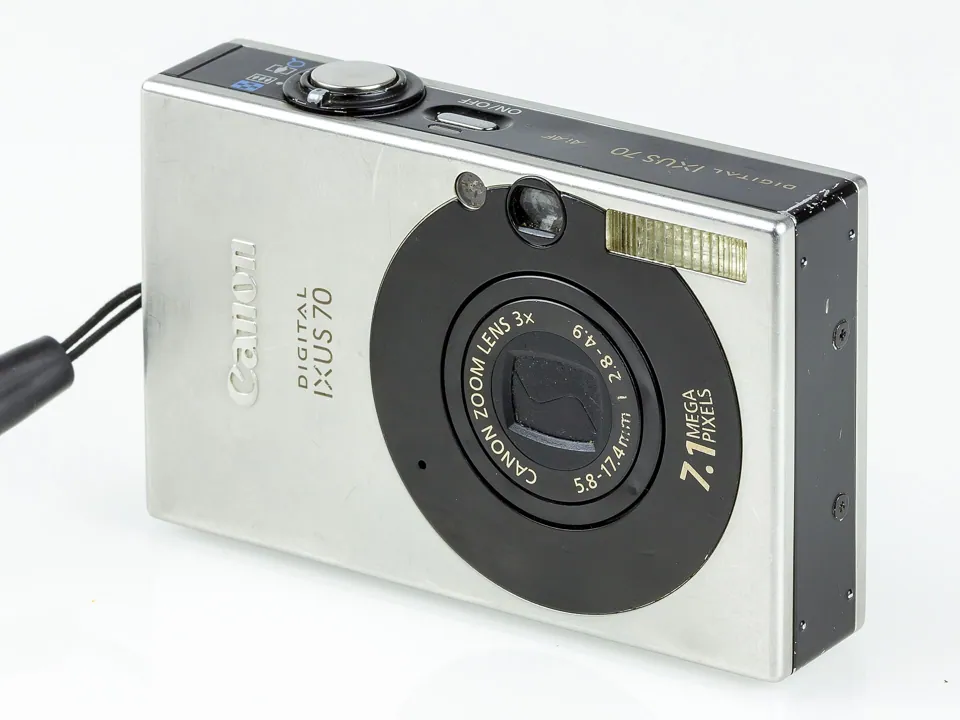
The short answers
- Digicam
- A digital compact camera: a small point-and-shoot with a built-in lens.
- CCD sensor
- The older kind of image chip. 22 of the 25 cameras we have reviewed use one.
- CMOS and BSI sensors
- The newer kind of chip, built for low light and fast video. Look for "HS" on Canon cameras.
- Megapixels
- A million pixels. More is not automatically better, so check the sensor and the low-light reviews too.
- Optical zoom vs digital zoom
- Optical zoom uses the lens and keeps quality. Digital zoom just crops and enlarges.
- 35 mm equivalent (28 mm)
- A way to compare lenses across different sensors. Lower numbers show a wider view.
- Aperture (f/2.0)
- How wide the lens opens. A smaller f-number lets in more light.
- ISO and noise
- The sensor's sensitivity setting. Higher ISO lets you shoot in the dark but makes pictures grainier.
- Image stabilisation (IS)
- Hardware or software that reduces blur from shaky hands.
- Shutter lag
- The delay between pressing the button and the picture being taken.
- Red-eye
- The flash sits next to the lens, so light bounces straight back from the eye.
- Memory cards
- SD for most; older Fujifilm and Olympus use xD, Sony uses Memory Stick Duo, and some early models use CompactFlash.
- Batteries and CIPA
- Look up the camera's battery code (like NB-5L) and check the CIPA shots-per-charge rating.
- Regional names (IXUS, ELPH, IXY)
- Canon sold one camera under three names: PowerShot ELPH in the US, IXUS in Europe, IXY in Japan.
- Face detection and smile shutter
- A mode that finds faces in the frame and focuses on them. Smile shutter waits for a smile.
- 720p and 1080p video
- Video resolution: 720p is HD (1,280 by 720) and 1080p is Full HD (1,920 by 1,080).
What is a digicam?
A digicam is another name for a digital camera,1 and on this site it means a small point-and-shoot with a lens built in and a flash, designed for simple operation.2 Wikipedia notes these cameras were popular for snapshots of holidays, parties and reunions, made by people who did not think of themselves as photographers.2
What to check: on this site the word covers cameras from about 2000 to 2016. A 2-megapixel model from 2002 and a 20x zoom from 2012 are both digicams, and they behave nothing like each other. Browse them all on our camera index.
What is a CCD sensor?
A CCD (charge-coupled device) is an image sensor made of an array of linked capacitors that pass their charge along to be read out, and it is a major technology in digital imaging.3 It is the older of the two common sensor types in digicams.
What to check: the sensor type is listed on every page we write. 22 of the 25 cameras we have reviewed have a CCD, including the Fujifilm FinePix F30, the Canon PowerShot SD1000 and the Sony Cyber-shot DSC-T9.
What is a CMOS or back-illuminated (BSI) sensor?
A CMOS sensor is the now much more common kind of active-pixel sensor, the family used in most modern pocket cameras; CMOS emerged as an alternative to CCD and eventually outsold it by the mid-2000s.4 A back-illuminated (BSI) sensor is arranged to capture more light, which improves low-light performance.5
Canon labelled this "HS" on cameras like the Canon PowerShot ELPH 300 HS and the Canon PowerShot S100: Imaging Resource explained that the HS designation meant a back-illuminated CMOS sensor, the DIGIC 4 processor and a brighter lens.28 Canon said the S100's new sensor and processor cut noise to a quarter of its predecessor's at ISO 1600.20 Sony's Sony Cyber-shot DSC-HX20V used an Exmor R CMOS sensor.38
What to check: the three CMOS cameras among our reviews are the 2011 and 2012 models, and all three record 1080 video.192037
How many megapixels do you actually need?
A megapixel is a million pixels, and a pixel is the smallest element of a digital image.6 More pixels give bigger prints and more room to crop, but not automatically better pictures.
Imaging Resource said the 7.1-megapixel Canon SD500 made sharp prints up to 11 by 17 inches,24 and DPReview found it captured considerably more detail than the 4 and 5 megapixel cameras of the time.32 At the other end, DPReview listed the Nikon Coolpix 2500's 2 megapixels (1600 by 1200) in 2002;33 Expert Reviews found the 18-megapixel Sony HX20V smoothed away fine texture such as grass and hair with noise reduction.37
What to check: compare the sensor size and low-light reviews, not just the megapixel number. See the Canon PowerShot SD500 and the Sony Cyber-shot DSC-HX20V for two ends of the range.
What is the difference between optical zoom and digital zoom?
Optical zoom changes the lens to magnify the scene. Digital zoom crops the picture and scales it up, so no optical resolution is gained.7
Imaging Resource put it plainly in its SD500 review: digital zoom decreases image quality because it crops out and enlarges the centre pixels.24 Canon's own spec for the Canon PowerShot SD1300 IS lists a 4x optical zoom, "up to approx. 16x in combination with the digital zoom".21
What to check: read the optical figure only. A camera advertised as "16x" with a 4x lens is a 4x camera.
What does "28 mm equivalent" mean?
The 35 mm equivalent focal length expresses the angle of view of any lens and sensor combination in terms of the old 35 mm film format.8 On a digicam, 28 mm is a wide angle and 100 mm or more is telephoto.
It matters because, as DPReview put it, most compacts started at 35 or 38 mm. The same review said a 28 mm start offers practical and creative advantages, "from landscapes to interiors to group shots".30 Canon called the Canon PowerShot SD800 IS the first IXY model with a wide-angle optical zoom, covering 28 to 105 mm.23 The Canon PowerShot SD870 IS kept the same range.26
What to check: if you like group shots, rooms and street scenes, look for a lens that starts at 28 mm or wider.
What does f/2.0 mean on a camera lens?
The f-number is the ratio of the lens focal length to the diameter of its opening; it measures light-gathering ability, and a lower number means more light.9
Zooms usually get dimmer as they extend. PhotographyBLOG noted that the Canon PowerShot S100's f/2.0 applied only at the wide end, with the aperture slowing to f/5.9 at 120 mm.36 Expert Reviews calculated that f/2 captures over three times more light than the f/3.5 of a typical mirrorless kit zoom.35
What to check: a bright lens helps indoors and at night without raising ISO. Compare the wide-end and telephoto numbers, not only the best one.
What is ISO and why does it add noise?
In digital cameras, ISO describes the relationship between exposure and the lightness of the output image, a rating carried over from film speed.10 Raising it brightens dark scenes but amplifies noise.
Reviewers of these cameras were blunt about where it falls apart: DPReview said the SD870 IS suffered above ISO 400 from noise and noise reduction,31 Photo Review found the Sony T90's resolution declined at ISO 800 and was very low at ISO 3200,40 and Expert Reviews called the Canon PowerShot S100's ISO 6400 grainy but usable for small web images.35
What to check: the usable ISO range matters more than the maximum on the box. Our review pages include real photos taken at high ISO, with the sensitivity read from each file.
What is image stabilisation (IS)?
Image stabilisation is a family of techniques that reduce blur from camera motion during an exposure.11 On Canon cameras it appears as "IS" in the name; Sony called its version Super SteadyShot.40
Imaging Resource said Canon's stabilisation typically lets you take crisp shots in light four times darker than you could without it.25 Beware the digital version: the Sony T90 also offered a Digital Image Stabilization mode that raises sensitivity to get a faster shutter speed, which also raises noise.29
What to check: prefer optical (lens-shift) stabilisation. Examples: the Canon PowerShot SD800 IS and the Canon PowerShot SD1100 IS.
What is shutter lag?
Shutter lag is the delay between pressing the shutter and the photo being recorded, including time to meter and focus; pre-focusing reduces it.12
Imaging Resource measured the Canon PowerShot SD1300 IS's lag at 0.53 seconds at wide angle with full autofocus, but just 0.073 seconds when the camera was prefocused.27 Macworld, in contrast, found the 2005 SD500's lag virtually nonexistent.42
What to check: half-press the shutter first, wait for the beep, then press fully. It makes any digicam feel faster.
Why do digicam flash photos have red eyes?
The red-eye effect happens when a flash at low light reflects off the back of the eye; it is stronger when the flash is close to the lens.13 Most compact cameras put the flash right next to the lens.
CreativePro said of the Nikon Coolpix 2500 that the small flash beside the lens gives unflattering front lighting and "vampirish redeye", and that the red-eye reduction mode swaps it for startled expressions.34 DPReview agreed the flash produced red-eye.33 It is also, for many people, the look: see our story Somebody always had the camera.
What to check: red-eye reduction fires a pre-flash. It helps, and it is why people blink in old party photos.
Which memory cards do old digicams use?
Most digicams use SD cards, but several makers used their own formats: xD-Picture Card from Olympus and Fujifilm,15 Memory Stick from Sony,16 and CompactFlash in some early models.17
| Card type | Cameras we have reviewed that use it |
|---|---|
| SD | PowerShot SD500, PowerShot SD600, PowerShot SD800 IS, EX-Z75, TZ3, PowerShot SD870 IS, LX3, S3000, DSC-HX20V |
| SD / SDHC | PowerShot SD750, PowerShot SD1000, PowerShot A590 IS, PowerShot SD1100 IS, PowerShot S90 |
| SD / SDHC / SDXC | PowerShot SD1300 IS, PowerShot SD1400 IS, PowerShot S95, PowerShot ELPH 300 HS, PowerShot S100 |
| xD-Picture Card | F30, F31fd, Stylus 1030 SW |
| Memory Stick Duo | DSC-T9, DSC-W55 |
| CompactFlash Type I | Coolpix 2500 |
Even SD is not one thing. SD cards come in three capacity standards: SD up to 2 GB, SDHC up to 32 GB and SDXC up to 2 TB. SDXC cards use the exFAT file system, and older devices may not recognise SDHC cards without a firmware update.14 Canon's museum lists the 2005 Canon PowerShot SD500 as taking an "SD memory card",22 while its 2010 Canon PowerShot SD1300 IS accepts SDXC.21 xD cards were phased out in 2009 and are hard to find new.15
What to check: read the card type on the camera's page before buying a card. A small, old-style SD card (a gigabyte or two) is the safest match for a pre-2006 camera.
How do I find the right battery, and what does "CIPA" mean?
Every digicam uses a model-specific rechargeable battery with a code, such as NB-5L for the Canon S100 or NP-BG1 for the Sony HX20V. CIPA is the Camera & Imaging Products Association, a Japanese industry body for camera makers,18 and "CIPA" on a spec sheet means the shots-per-charge figure came from its standard test.25
Imaging Resource rated the Canon PowerShot SD870 IS at 270 shots per charge by the CIPA method and recommended a spare battery.26 Sony's Sony Cyber-shot DSC-HX20V could charge in the camera from a USB lead, T3 noted, which means a spare is less useful there.39
What to check: the battery code is on each of our review pages, with a link to buy a replacement.
Why does the same camera have different names (IXUS, ELPH, IXY)?
Canon gave the same compact camera different names by region. The Canon Camera Museum lists, for example, the PowerShot SD500 Digital ELPH in the Americas, the Digital IXUS 700 in Europe and the IXY Digital 600 in Japan.22
The same pattern holds for the SD1300 IS (IXUS 105, IXY 200F)21 and the ELPH 300 HS (IXUS 220 HS, IXY 410F).19
What to check: when you search eBay, try all three names. Our pages list every name and redirect the alternatives to one page. Start from the Canon list.
What is face detection (and smile shutter)?
Face detection lets the camera find faces in the scene and set focus and exposure for them. Some Sony models added a Smile Shutter that fires when it detects a smile.29
Imaging Resource found the face detection on the Canon PowerShot SD800 IS really works,25 while DPReview called it a little haphazard on the Canon PowerShot SD870 IS.31 Imaging Resource added that the Sony T90 could distinguish children from adults and detect a blink.29
What to check: face detection is a bonus. For night shots and objects, turn it off and use centre focus.
What do 720p and 1080p mean on an old digicam?
720p means video 1,280 pixels wide by 720 tall (HD); 1080p means 1,920 by 1,080 (Full HD). Earlier cameras shot smaller clips: DPReview listed the 2002 Coolpix 2500 at 320 by 240 and 15 frames per second with no sound,33 and the 2005 SD500 at 640 by 480.32
Sony announced the T90 in 2009 with 1280 by 720 video at about 30 frames per second,41 and Photo Review's "don't buy" list says to look elsewhere if you need Full HD.40 Canon's Canon PowerShot ELPH 300 HS recorded 1080 video at 24 frames per second.19
What to check: older cameras limit clip length and often need a faster card for HD video. Check the specs on the review page.
Ready to look at cameras?
Every camera we review has its specs, sensor type, battery, card, real sample photos and what to check before buying on one page. Start with the full camera index, or read why people are hunting for these cameras again in Pictures that never left the card.
Sources
- Wikipedia, Digital camera
- Wikipedia, Point-and-shoot camera
- Wikipedia, Charge-coupled device
- Wikipedia, Active-pixel sensor
- Wikipedia, Back-illuminated sensor
- Wikipedia, Pixel
- Wikipedia, Digital zoom
- Wikipedia, 35 mm equivalent focal length
- Wikipedia, F-number
- Wikipedia, Film speed (digital ISO)
- Wikipedia, Image stabilization
- Wikipedia, Shutter lag
- Wikipedia, Red-eye effect
- Wikipedia, SD card (capacity standards)
- Wikipedia, xD-Picture Card
- Wikipedia, Memory Stick
- Wikipedia, CompactFlash
- Wikipedia, Camera & Imaging Products Association
- Canon Camera Museum, PowerShot ELPH 300 HS / IXUS 220 HS
- Canon Camera Museum, PowerShot S100
- Canon Camera Museum, PowerShot SD1300 IS / IXUS 105
- Canon Camera Museum, PowerShot SD500 / IXUS 700
- Canon Camera Museum, PowerShot SD800 IS / IXUS 850 IS
- Imaging Resource, Canon PowerShot SD500 review (2005)
- Imaging Resource, Canon PowerShot SD800 IS review (2007)
- Imaging Resource, Canon PowerShot SD870 IS review (2007)
- Imaging Resource, Canon SD1300 IS review (2010)
- Imaging Resource, Canon ELPH 300 HS review (2011)
- Imaging Resource, Sony DSC-T90 overview
- DPReview, Canon SD800 IS concise review (2007)
- DPReview, Canon SD870 IS concise review (2007)
- DPReview, Canon PowerShot SD500 review (2005)
- DPReview, Nikon Coolpix 2500 review (2002)
- CreativePro, Nikon Coolpix 2500 review (23 Apr 2002)
- Expert Reviews, Canon PowerShot S100 review (16 Dec 2011)
- PhotographyBLOG, Canon PowerShot S100 review (24 Nov 2011)
- Expert Reviews, Sony Cyber-Shot DSC-HX20V review (30 May 2012)
- TechRadar, Sony HX20V review (12 Jun 2012)
- T3, Sony HX20V review (10 Sep 2012)
- Photo Review (Australia), Sony Cyber-shot DSC-T90 review (2009)
- Sony Japan press release, Cyber-shot DSC-T90 / T900 (19 Feb 2009; in Japanese)
- Macworld, Canon PowerShot SD500 review (25 May 2005)
Definitions come from Wikipedia and the reviews and manufacturer pages linked above; examples link to our own sourced reviews. Photo credit under the picture.