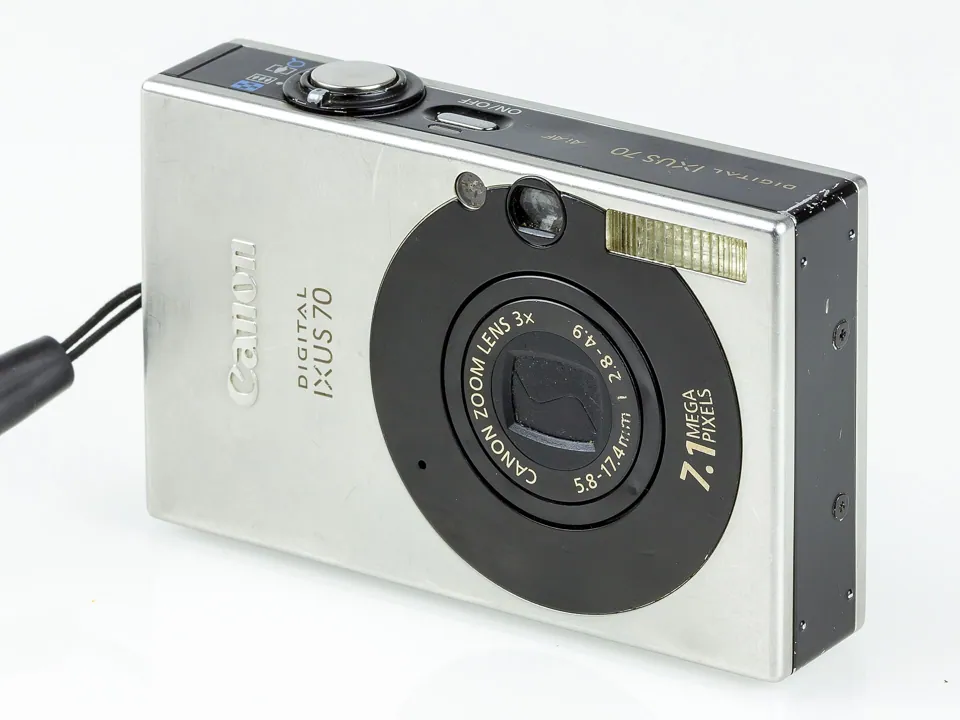

It is after midnight and the room is lit by one lamp. You lift a camera with the footprint of a credit card, and for a second nothing happens. Then the flash fires, white and total, and the room comes back in two tones: the faces bright, everything behind them gone black. You wait while it recharges. Someone asks to see. You tilt a screen not much bigger than a matchbook so that only the two of you can look.
That picture will not be online tomorrow. It exists on a card in your pocket, one of about twenty, and nowhere else.An imagined scene, built from this camera's real specifications
It is hard to say how strange that is now. The camera in your pocket today is built to connect: it backs up, it buzzes, it asks if you want to share. The cameras people are hunting for on second-hand sites were built before any of that. Take the Canon SD1000, a 2007 compact. It measures 86 by 54 millimetres, almost exactly the footprint of a credit card, and 19 millimetres thick.1 Its specification lists a USB cable socket and an SD card slot, and nothing wireless.1 For a photograph to leave that camera, somebody had to take out the card or plug in a cable.
Private by default
About twenty.That is how many full-size pictures fit on the 32 MB card that came in the box of the UK camera.9 A weekend, a trip, a long night out: a few dozen frames in a pocket, and nothing in a cloud.
People who are buying these cameras now describe exactly this. The company behind a screen-free summer-camp camera, which has become a favourite of adults at music festivals, built it so that nobody sees a picture until it is plugged into a computer later.2 A 21-year-old with an old Canon told PetaPixel they love that they cannot post a picture straight away, and find the waiting refreshing.4 A wedding photographer says you put the camera in your bag and stop thinking about it, and at the end of the night go through the pictures and relive it, instead of pulling out a phone, seeing a notification and checking email.2
There is a quiet thrill in that. A picture nobody else has seen. A picture you can decide about tomorrow, or next week, or never. The kind of picture you would only ever take for one person.
A screen for two
The SD1000's screen is 2.5 inches across with 230,000 pixels,1 bright enough to read in sun and usable in the dark, according to Imaging Resource.7 That is small on purpose. You cannot show it to a room. You hold it between you and lean in.
 3 14 ’07
 3 14 ’07
 3 14 ’07
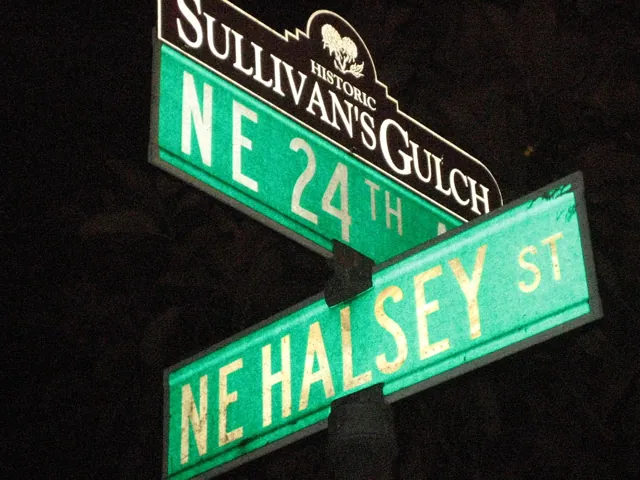
Real photographs taken with this camera, shown the way they would have appeared on its back screen. The orange date stamps are decoration we added.
The light you can't flatter
Then there is the flash. It is the signature of these cameras, and it explains a lot. Canon's face detection exposed for the faces it found and set the flash to match,7 so in a dark room you got bright faces and a background that dropped away. A second-hand camera seller told ABC News that a digicam's flash looks stronger than a phone's and gives “a different kind of vibe.”3 One marketplace blog calls harsh direct flash honest and unflattering next to the soft light of a social feed.6 NPR's reporter describes the pictures as warm and grainy, somehow both dim and overexposed.2


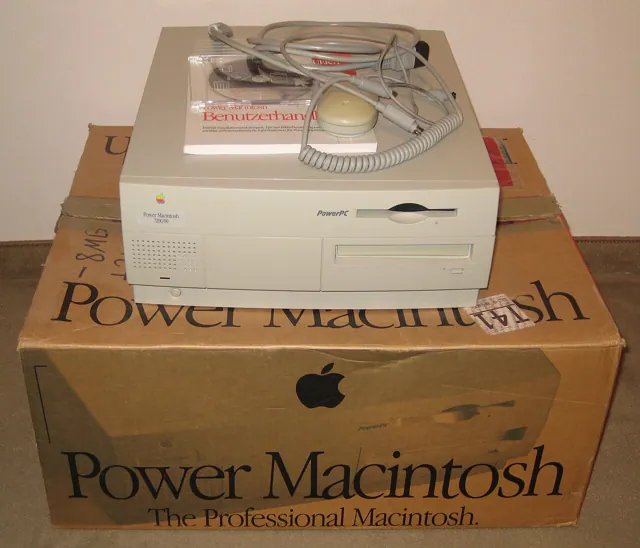





Flash photographs taken with the same camera model, from Wikimedia Commons.
The cameras suit it. Reviewers in 2007 noted the colour ran warm indoors7 and that noise showed up from ISO 400,8 and the pictures that came out of a dark room were, by the standards of the day, a little rough. Today those are the qualities people name when they say why they bought one. A sixteen-year-old who borrowed a digicam described their pictures as “genuine” and “warm.”2 Two sisters like the blur for being flattering next to hypersharp phone photos, and one says iPhone pictures can look a little too real.2
Where it comes from
Photographers writing about the revival put the idea more technically. A modern phone stacks exposures, reduces noise, smooths skin and invents detail in the dark, so that every phone ends up with the same house style, while an old camera's flaws come from a small CCD sensor and a plastic lens and are easy to understand.5 Taking a picture becomes a deliberate act, with a device that is not also delivering your work email.5
And there is memory. A media researcher at the University of Tasmania told ABC News that trends tend to come around on roughly twenty-year cycles, and that young people know the early 2000s from screens as “cultural memories that belong to something bigger than you.”3 A camera shop worker said customers want the look of their own childhood photos.3 The older look, the researcher added, makes an image feel more like a memory.3
It got out anyway
The irony is that a trend about keeping pictures private spread by being posted. By late 2022 Bella Hadid, Emily Ratajkowski and Nicola Peltz Beckham were posting digicam pictures, and TikTok videos were telling people to buy an old digital camera and naming second-hand models, among them the Canon PowerShot SD1300.4 A tutorial for faking the look on an iPhone with plastic wrap, lip balm and flash passed 4.5 million views.4 Canon told NPR in July 2026 that sales of its PowerShot line rose nearly sevenfold between 2022 and 2025,2 though the Fstoppers analysis cautions that this is a niche revival, not a return to the 120 million compacts shipped in 2010.5
One young woman told NPR that for most people on social media it is just an aesthetic.2 Perhaps so. But the pictures on the card in your pocket are still yours until you decide otherwise, and that part is not an aesthetic.
What reviewers marked down in 2007
Read the reviews of one typical camera, the Canon SD1000, when it was new, and almost everything critics held against it is something buyers now look for.
| Marked down in 2007 | Said by | Said now |
|---|---|---|
| Noise and softness from ISO 400 up | PhotographyBLOG called it the main weakness.8 | Grain is the look.24 |
| Colour that runs warm, especially indoors | Imaging Resource cautioned about white balance.7 | “Warm” is the word people reach for.2 |
| Flash with limited range and darker corners | Imaging Resource listed it as a flaw.7 | A stronger flash is the draw.3 |
| No stabiliser, no manual exposure control | Both reviews counted it against the camera.87 | Fewer decisions, and a camera you can forget in your bag.2 |
| Modest resolution, soft edges | What Digital Camera noted the softness.10 | Phone pictures can look “too real.”2 |
Nobody at Canon planned any of it. The camera was made to produce a good snapshot as easily as possible in 2007, and it did. What changed was the world around it. When everything else became sharp, balanced, connected and quietly improved, a camera that kept its pictures to itself started to look like a luxury.
If you want to see what one of these cameras actually was, our retrospective on the Canon SD1000 follows it through the spring of 2007.
Sources
- Canon Camera Museum: IXY Digital 10 / PowerShot SD1000 / Digital IXUS 70 (specifications)
- NPR Weekend Edition, “Old-school digicams are everywhere” by Alina Selyukh (19 Jul 2026)
- ABC News (Australia), “'It's a gen Z thing': why young people are obsessed with digital cameras” (18 Jun 2025)
- PetaPixel, “Gen Z is bringing back digital cameras of the early 2000s” (26 Oct 2022)
- Fstoppers, “The compact camera comeback is real”
- GearFocus, “Why are digicams popular again?” (25 Feb 2026; the blog of a used-camera marketplace)
- Imaging Resource, Canon SD1000 review (8 May 2007)
- PhotographyBLOG, Canon Digital IXUS 70 review (9 Apr 2007)
- Tech Digest, “Review: Canon Digital Ixus 70” (8 May 2007)
- What Digital Camera, Canon IXUS 70 review
Quoted statements are from the cited articles and attributed there. Some sources are marketplace blogs and are marked as such. Camera photo: Raimond Spekking (CC BY-SA 4.0); other photographs are credited under each one.