Fujifilm FinePix F series · on sale May 2006 · a retrospective
The Fujifilm FinePix F30: ISO 3200 in your pocket
In 2006 a $399 pocket camera could shoot handheld in a dim room, no flash, and keep the room looking like the room. Here is what reviewers found, and what to check before you buy one.
Meet the camera
Picture a 2006 dinner party. The lights are low, someone pulls out a compact camera, and the flash goes off: white faces, black background, everyone squinting. DPReview's reviewer thought that was exactly where an ordinary snapshooter used a camera most, at dimly lit social occasions, and that a camera which avoided the flash was a real advantage.3 The F30 was built for that moment.
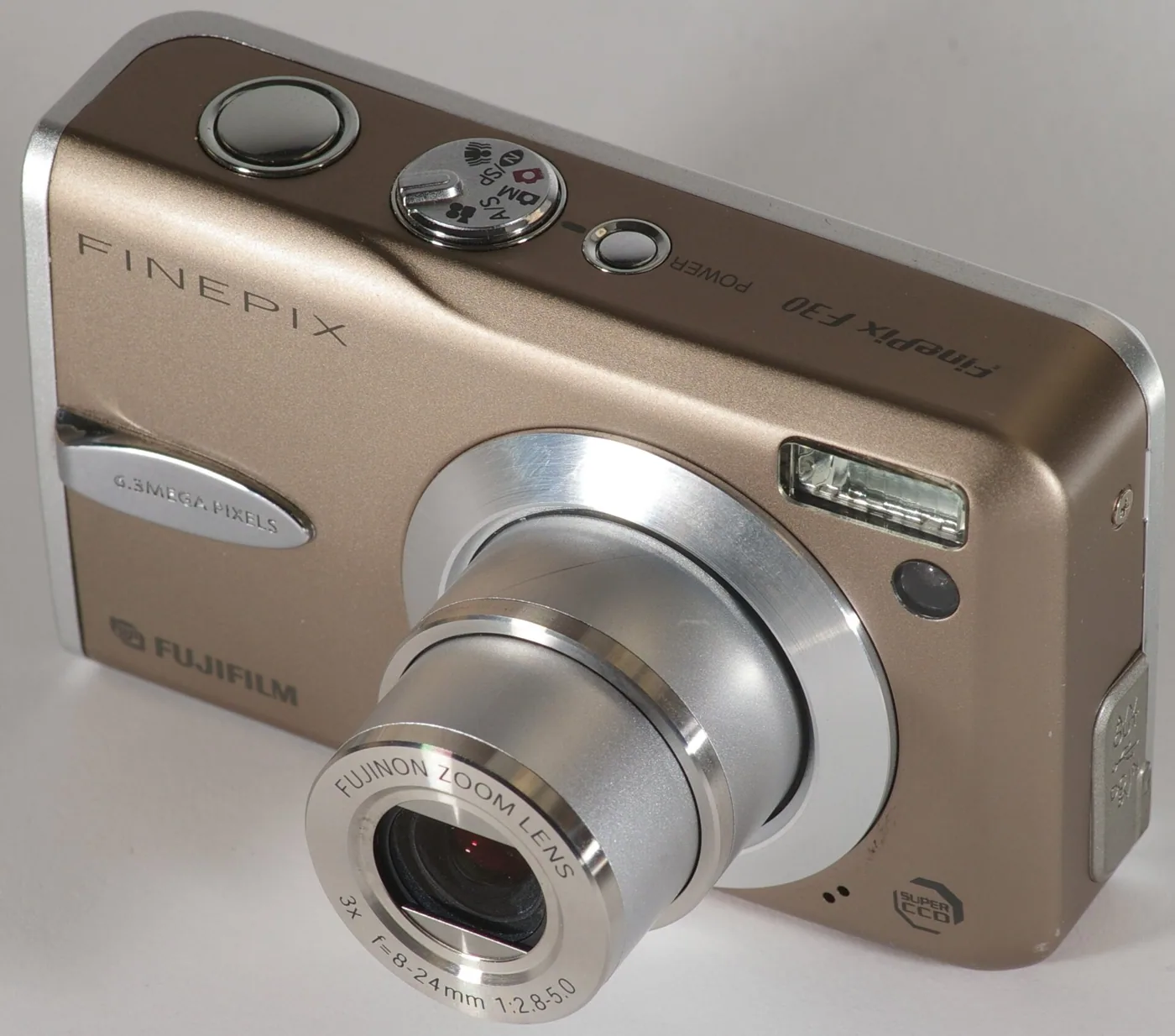
The photograph above is nearly a diagram. A champagne-coloured body, FINEPIX F30 engraved across the top, a silver badge reading 6.3 mega pixels, and a lens barrel that carries its own specification around the rim: Fujinon zoom lens, 3x, f=8 to 24 mm, 1:2.8 to 5.0. It is 92.7 millimetres wide and 27.8 thick and weighs 155 grams without its battery, or about 195 with it.13 Imaging Resource described a metal front plate locking into a lighter silver back,6 and noted there was no optical viewfinder at all: the 2.5-inch screen takes up most of the back.6
Fujifilm announced it on February 14, 2006, and said it would go on sale in May.2 It had the same 6.3-megapixel count as the F10 before it,7 and PhotographyBLOG treated it as the next step after the F11.5 Gizmodo reported a price of $399;2 Imaging Resource put it at just under $400 list,6 and Reviewed.com quoted $349 by the time it published.7
The spring it came out
In 2006 about 106 million digital cameras shipped worldwide, up 14.5 percent. Canon led with 19.7 million, Sony followed with 16.7 million, and Kodak, third at 10.6 million, shrank by almost a quarter.9 It was a market of pocket cameras fighting over megapixels and, more quietly, over sensitivity. Canon's SD600 reached shops in March with ISO 800 as its headline.10 We cover it in our SD600 retrospective. The F30 arrived two months later offering four times that.
It could do that because it was built differently. The SD600's sensor measured 1/2.5 inch;10 the F30's was a 1/1.7-inch Super CCD HR, a larger sensor that Fujifilm called its sixth generation, paired with its Real Photo Processor II.1
Why this one was interesting
Fujifilm's claim was that the F30 was the world's first digital compact to deliver ISO 3200 at full resolution, and that this was eight times as effective in low light as a conventional compact at ISO 400.1
The reviewers tested it, and the test results are the story. DPReview's Simon Joinson found at least a two-stop advantage over the best conventional CCD compacts, in many cases three, with ISO 800 output that could rival some cameras at ISO 200. The review called the F30 "a tantalizing glimpse" of what compacts could be if makers spent as much on sensors as on looks.3 Against its predecessor, the F10, it was about two stops better between ISO 200 and 800,3 and the Canon SD700 IS, one of the cleanest compacts of its day, had chroma noise at ISO 80 about equal to the F30's at ISO 400.3 Next to a Nikon D50 entry-level SLR at ISO 800, the Nikon had better colour and less noise reduction, but the review found the F30 closer to "SLR-like" output than a compact had come before.3
Was it a new chip?
Yes, and it was the point. Fujifilm announced a sixth-generation Super CCD HR and a Real Photo Processor II to go with it.1 In its initial press release the company claimed 25 percent less noise than the F10's sensor, which Reviewed.com thought a bold claim, since the F10 was already clean. Reviewed.com tested it and scored the F30 11.71 for noise across the manual ISO range, against the F10's 11.42, and 11.44 on automatic ISO against the F10's 3.22.7
A new lens?
No. The Fujinon lens was a 3x zoom equivalent to 36 to 108 mm at f/2.8 to f/5.0, a standard range.6 The barrel extended from the body in two segments when the camera was switched on and retracted fully, behind a built-in lens cap, when it was off.73 The attention was all on what sat behind it.
The dark, rung by rung
Every reviewer climbed the ISO ladder and reported where the pictures gave out. DPReview found ISO 100 to 400 clean and detailed, ISO 800 only somewhat noisier and still fine for normal prints, ISO 1600 acceptable for small prints or casual low-light snapshots, and ISO 3200 heavily noise-reduced and best avoided unless there was no alternative.3 Imaging Resource called ISO 800 the best value and ISO 1600 "not bad," and found ISO 3200 well controlled but advised against it, with decent 4 by 6 prints and not much beyond 5 by 7.6 PhotographyBLOG judged the results clean from ISO 400 up, usable at 800 and 1600, and acceptable at 3200 for smaller prints.5 What Digital Camera called ISO 3200 weak but no worse than ISO 3200 film.8
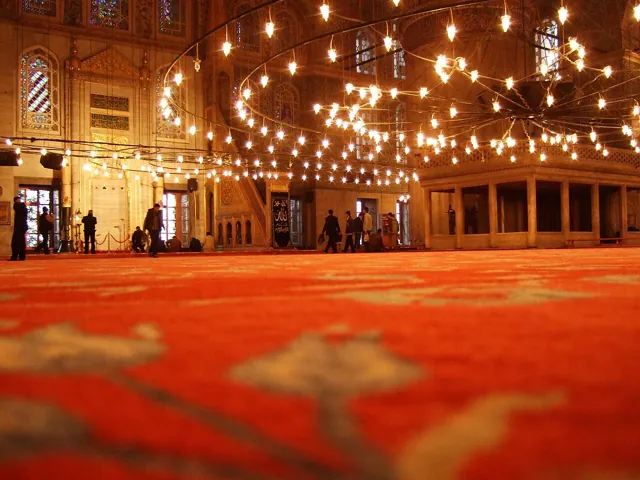
Put that in 2006 terms. A pocket camera that could take a usable, handheld, flash-free picture in a dim restaurant or a candlelit room was new, and PhotographyBLOG's conclusion was that no other compact digicam came close at ISO 400 and above.5 The photographs below show what that looked like: grainy, warm and unmistakably real.




.jpg)


Real photographs taken with this camera. The sensitivity shown is recorded in each file's own data.
Like that look? See what F30s have recently sold for on eBay ↗

Not everyone was dazzled. Reviewed.com's lab found noise well controlled across the manual ISO range and called ISO 3200 the highest setting offered on a consumer compact, but it also found low-light pictures underexposed and colours fading as the light dropped, and shutter-priority exposures capped at 3 seconds.7
On eBay right now
Live listings for this camera, supplied by eBay and updated automatically. We earn a commission if you buy through them.
The little wins
Around the headline ISO figure, the F30 was full of small things that reviewers noticed.
A battery rated for 580 shots
Imaging Resource called the battery life excellent, and PhotographyBLOG called the rating of 580 shots impressive.65
Shutter lag you could ignore
Imaging Resource measured 0.018 seconds from press to capture when the camera was pre-focused. Without pre-focusing, it measured 0.56 seconds at wide angle,6 and Reviewed.com measured an average of 0.36 seconds to focus and shoot.7
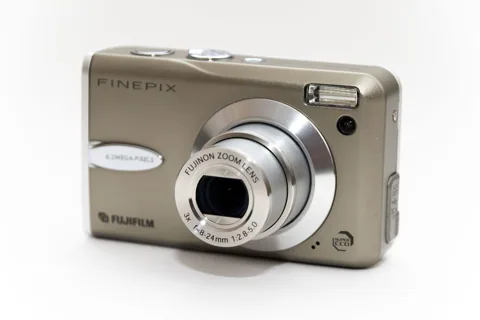 The F30 from the front, lens extended. · Digitalsignal · CC BY-SA 3.0 · Commons
A lens that announced itself
The barrel carries its own specification engraved around the rim, and it extended from the body in two segments when the camera was switched on, with a cover that snapped open.7 Reviewed.com also noted that the motor was less noisy than the F10's, but still frightening.7
Ten megabytes and a bigger card
The F30 had 10 MB of built-in memory and took xD-Picture Cards. No card came in the box, and Imaging Resource recommended at least 128 MB.6
A flash that borrowed the light
Intelligent Flash used the camera's high sensitivity to blend the natural light of a scene with a balanced flash exposure, avoiding both the blur of slow-sync flash and the harshness of a plain flash.1 Reviewed.com found it effective, and Imaging Resource found its results mixed.76
A screen with a coating
The 2.5-inch screen had 230,000 pixels, twice the F10's, and a Fujifilm film meant to reduce glare and smudges. Imaging Resource found it easy to use even in bright midday light,6 but DPReview found it not bright or contrasty enough for direct sun, with no viewfinder to fall back on,3 and Reviewed.com thought the viewing angle finicky.7
Priority modes, and a misleading M
The F30 offered aperture and shutter priority, which PhotographyBLOG called almost full creative control.5 But Reviewed.com and What Digital Camera both pointed out that the dial position marked M was not true manual control.78
How it drew the picture
In daylight the F30 was a sharp camera with strong colour. Imaging Resource found it rich and vibrant, with very good sharpness for its class, though skin tones ran slightly oversaturated and could turn pink in the Chrome setting.6 DPReview noted a high-contrast tone curve that clipped highlights and shadows, overexposure in bright scenes and purple fringing,3 and Reviewed.com thought the colour accuracy weak, tilting green and yellow.7 PhotographyBLOG's reviewer also found fringing in high-contrast scenes.5








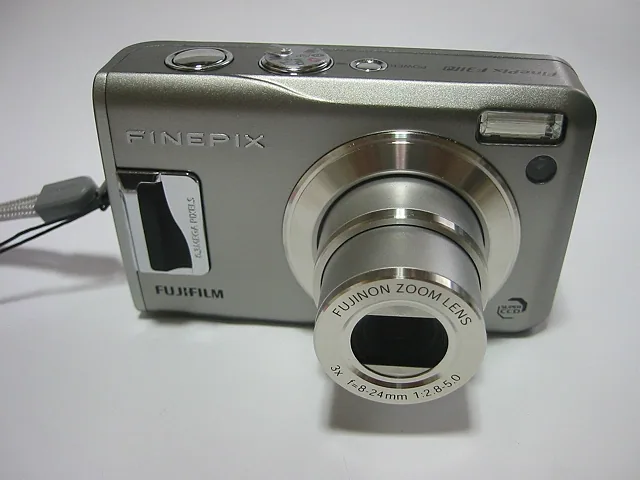
Photos taken with this camera, from Wikimedia Commons, credited under each picture.
What the reviewers said in 2006
| Outlet | Date | Verdict |
|---|---|---|
| DPReview | 25 Jul 2006 | A clear step up from the F10, especially in low light. Class-leading high ISO, very low shutter lag, long battery life and a solid build. Faults: a contrasty tone curve, purple fringing, a three-shot burst limit and a screen hard to see in direct sun.3 |
| PhotographyBLOG | 7 Aug 2006 | Design 4.5, features 4, ease of use 4.5, image quality 4.5, value 4 (out of 5). The best carry-everywhere compact of its time for serious photographers, and the top low-light compact available. Missing: a histogram, manual focus and RAW.5 |
| Imaging Resource | Aug 2006 | Dave's Pick. Worth the price on the strength of its high-ISO shooting, despite inconsistencies. Disliked: a cramped mode dial, oversaturated skin tones and no dedicated ISO button.6 |
| Reviewed.com | Undated | Mixed. Strong sharpness, low noise and long battery life, but weak colour accuracy, underexposed low-light pictures and a loud autofocus and zoom motor. It noted that the older F10 could by then be found for under $300.7 |
| What Digital Camera | Page dated 2014 | Called it a very good camera with few bad habits, for keen photographers who value high-ISO performance.8 |
The timeline
- 14 February 2006Fujifilm announces the F30 with ISO 3200 at full resolution.12
- March 2006Canon's SD600 reaches shops with ISO 800.10
- May 2006The F30 goes on sale, at around $399.2
- 25 July 2006DPReview publishes its review.3
- 7 August 2006PhotographyBLOG publishes its review.4
- August 2006Imaging Resource's review is updated and names it a Dave's Pick.6
- September 2006The F31fd succeeds it.11
Should you buy one now?
Buy one if you want grainy, flash-free pictures of dim rooms from a camera that fits in a pocket, and you are happy with a screen-only camera. It launched at about $399;2 what it sells for now is a question for the sold listings, not for us. Before you bid, check these:
- Is there a card? No card came in the box, and the camera takes xD-Picture Cards, not SD.6 It has only 10 MB of built-in memory.6
- The battery. The NP-95 is the part most likely to be tired after all these years;6 a fresh one is cheap on Amazon ↗.
- The lens. Ask for a photo with the lens extended. The barrel comes out in two segments and a cover snaps open when it powers up.7
- The screen. It has no viewfinder, and DPReview found the screen hard to read in direct sun.3
- Your settings. Expect heavy noise reduction at ISO 3200,3 and be careful with the Picture Stabilization mode, which tends to pick ISO 3200.6
If an F30 is out of reach, its successor, the F31fd, followed in September 2006.11
If you are wondering why cameras like this are being hunted down again, we tell that story once, in Pictures that never left the card.
See recent sold prices on eBay ↗Shop on eBay ↗NP-95 battery ↗
New to the jargon (CCD, ISO, xD cards, IXUS vs ELPH)? Read our plain-English digicam glossary.
Sources
- DPReview, “Fujifilm FinePix F30 sports ISO 3200” (14 Feb 2006)
- Gizmodo, “Fujifilm adds three cameras to FinePix line” (Feb 2006)
- DPReview, Fujifilm FinePix F30 review by Simon Joinson (25 Jul 2006)
- PhotographyBLOG, Fujifilm FinePix F30 review, introduction and features (7 Aug 2006)
- PhotographyBLOG, Fujifilm FinePix F30 review, conclusion
- Imaging Resource, Fujifilm F30 review by Dan Havlik (updated 19 Aug 2006)
- Reviewed.com, Fujifilm FinePix F30 review (undated)
- What Digital Camera, Fujifilm FinePix F30 review (page dated 2014; camera from 2006)
- Imaging Resource, “2006 worldwide digital camera market share” (IDC figures, 4 Apr 2007)
- Canon Camera Museum: PowerShot SD600 (sensor size, ISO range, launch date)
- Wikipedia, Fujifilm FinePix F series (the F31fd as the F30's successor)
Camera photos by Hustvedt, Digitalsignal (both CC BY-SA 3.0) and Jnn (CC BY 2.1 jp); other photographs are credited under each one, all via Wikimedia Commons. Links to eBay and Amazon are affiliate links.