Sony Cyber-shot T series · on sale January 2006 · a retrospective
The Sony Cyber-shot DSC-T9: the one that looked like a cigarette case
In 2006 Sony's thinnest Cyber-shot added a six-megapixel sensor, a stabilised Zeiss lens and a sliding door that switched it on. Reviewers fell for the design before they noticed the price.
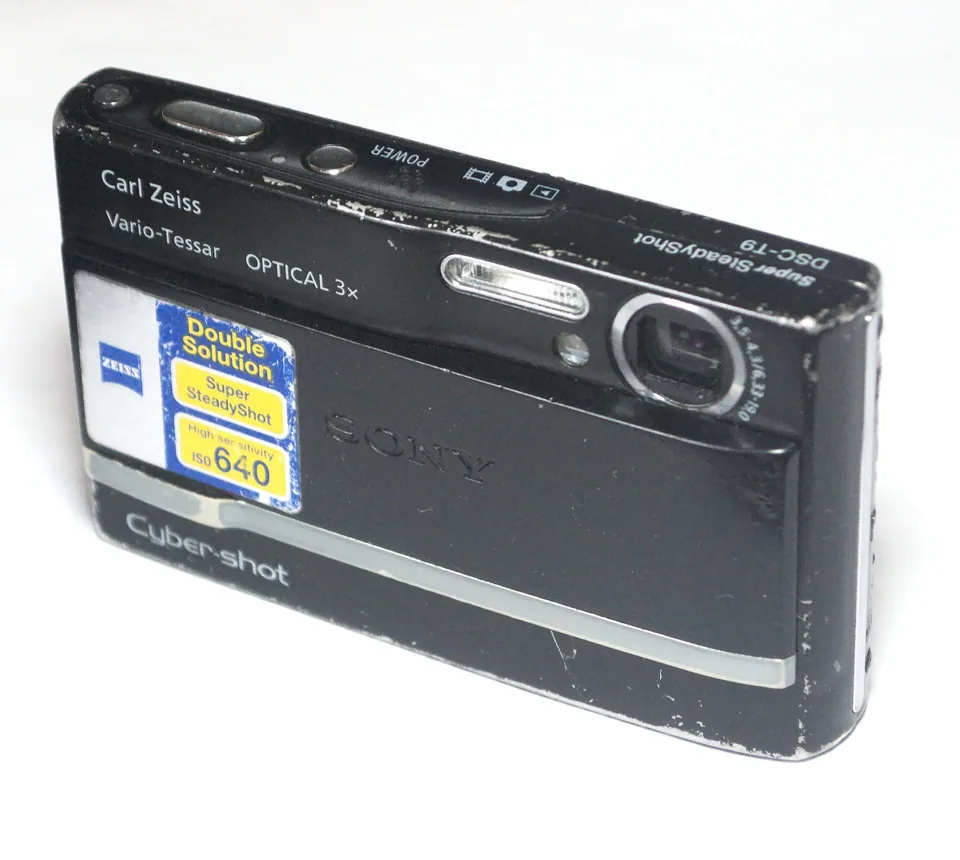
Meet the camera
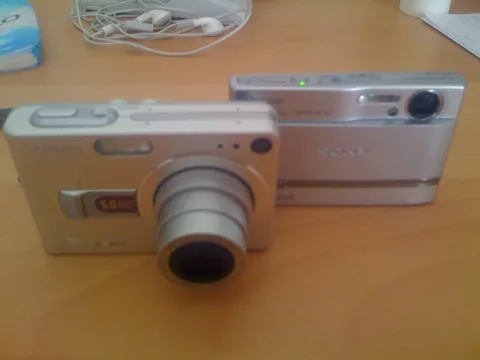
It is a thin metal slab with a sliding door on the front. Slide the door down and the camera switches on; slide it up and it goes to sleep. Digital Trends found the style very minimalist, with very few buttons or decals, and thought a T9 on a table looked like a sophisticated cigarette case from a 1940s Bette Davis film.3 Imaging Resource called the body ultra thin, like a small makeup case, and said the sliding lens cover doubled as a finger rest when open.2 It measures about 90 by 55 millimetres and 20 thick,1 and Digital Trends noted that the thinnest part was only 0.625 inches.3
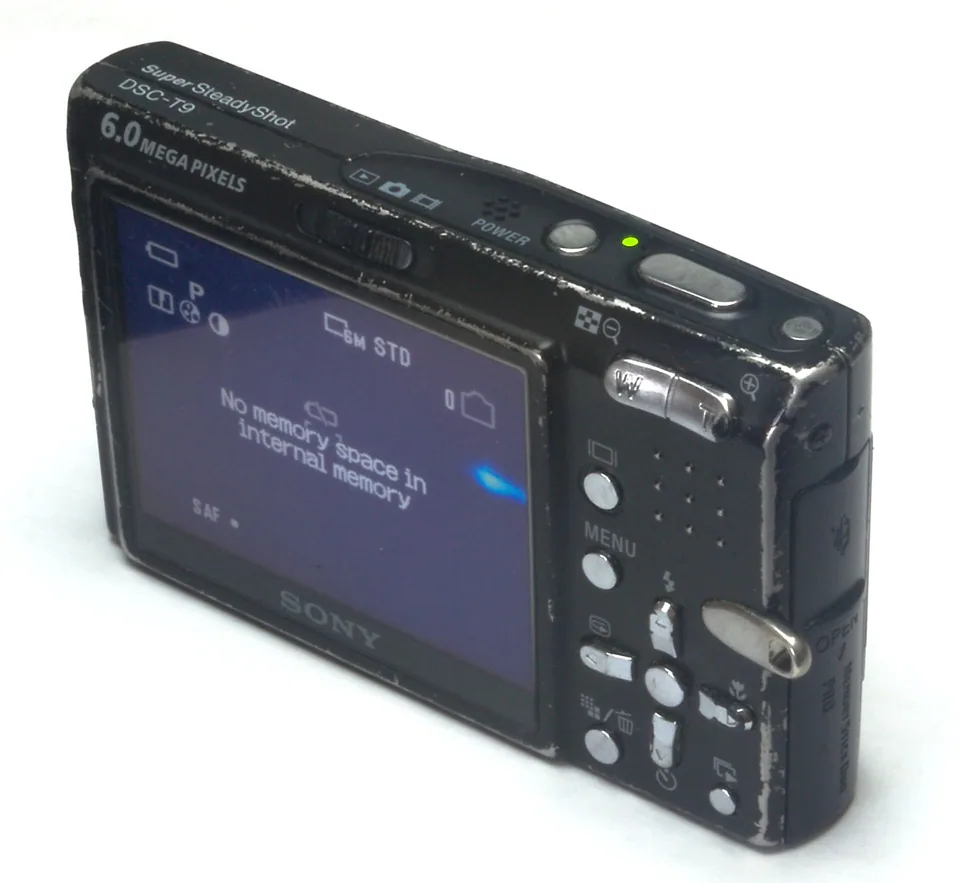
Sony announced it on November 1, 2005 as the first camera to combine an optically stabilised, prism-folded lens with high ISO sensitivity, shipping in January at $450.1 Digital Trends pointed out that the original T1 two years earlier had been the first 5-megapixel model with a huge 2.5-inch screen and a lens that did not extend, and that it had sold for $550. The T9 was about a hundred dollars cheaper.3
Why this one was interesting
A stabiliser in a camera held by your fingertips
Digital Trends called optical stabilisation very important for a camera that is held by your fingertips.3 DCResource, as PhotographyBLOG summarised it, found the stabiliser the camera's most notable feature, helping in dim light by allowing slower shutter speeds, working in movie mode too, but not stopping the blur of a moving subject.4
Was it a new chip?
A 6-megapixel CCD with an ISO range of 64 to 640, Sony said.1 Imaging Resource rated picture quality very good for a 6-megapixel camera of its size.2
A new lens?
Yes, in name: a Carl Zeiss Vario-Tessar, which Imaging Resource's news item noted was the first time it knew of a stabilised lens in a Sony camera carrying that name.1 It folded light sideways through a prism so that nothing stuck out of the front, with a 38 to 114 mm range, which Imaging Resource called fairly standard.2
The budget Sony of the following year is in our W55 retrospective, and a rival that chased low light instead of thinness is the Fujifilm F30.
The dark: limited
This was a camera for daylight and bright rooms. Imaging Resource found limited low-light performance, barely capable of capturing bright pictures under average city street lighting, a flash with marginal power and ISO 640 shots usable only for 4 by 6 inch prints.2 The pictures below carry the camera's recorded sensitivity, up to its ISO 640 ceiling.

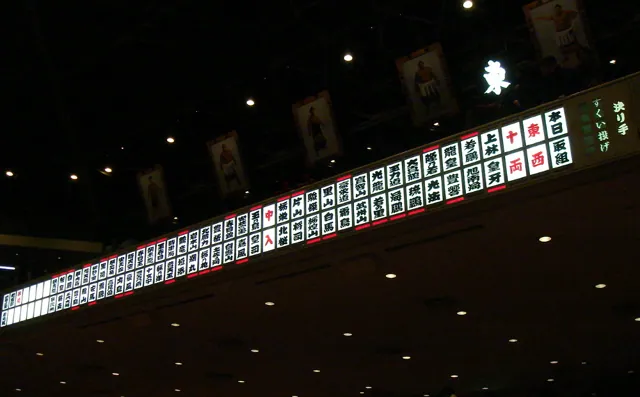


Real photographs taken with this camera. The sensitivity shown is recorded in each file's own EXIF data.

Like that look? See what T9s have recently sold for on eBay ↗
On eBay right now
Live listings for this camera, supplied by eBay and updated automatically. We earn a commission if you buy through them.
The little wins
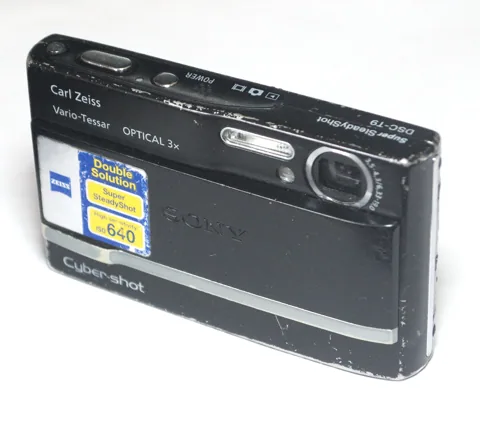 The T9's lens door and badge. · P2u111 · CC BY 4.0 · Commons
A door that was the power switch
Move the sliding front door down and the camera powers up. Some people disliked that it could open in a pocket and drain the battery, Digital Trends noted, but its reviewer thought the coolness factor trumped that.3
Quick to shoot
Imaging Resource measured shutter lag of 0.38 seconds at wide angle and 0.46 at telephoto, but only 0.013 seconds when pre-focused, among the fastest on the market, with about 1.44 seconds between shots.2
Battery life
Imaging Resource called battery life excellent for a subcompact: 121 minutes of shooting with the screen on.2


.jpg)

How it drew the picture
Imaging Resource found good colour and high resolution, but slightly soft images with detail blurred by noise suppression, very high contrast and limited shadow detail in strong sun.2 Digital Trends summed up the pictures as solid but not at SLR level.3







.jpg)
Photos taken with this camera, from Wikimedia Commons, credited under each picture.
Where it let you down
Digital Trends listed a high price and crummy bundled editing software.3 Imaging Resource listed limited low-light ability, a weak flash and a slow continuous mode of a bit over one frame a second.2
What the reviewers said
| Outlet | Date | Verdict |
|---|---|---|
| Imaging Resource | 2 Feb 2006 | An easy Dave's Pick and arguably the best T-series model yet: a very good feature set in a rugged all-metal body, with limited low light and a marginal flash.2 |
| Digital Trends | Early 2006 | Loved the looks; solid photos, not SLR level; expensive, with poor bundled software.3 |
| DCResource | 12 Dec 2005 (summarised) | Called the optical stabiliser the most notable feature.4 |
The timeline
- 1 November 2005Sony announces the T9 at $450.1
- January 2006It goes on sale.1
- 2 February 2006Imaging Resource publishes its review.2
Should you buy one now?
Buy one if you want a very thin, stylish 2006 compact with a stabilised Zeiss lens and a screen that fills the back, and you will shoot in daylight. It launched at $450;1 what it sells for now is a question for the sold listings, not for us. Before you bid, check these:
- The sliding door. It is the power switch, so check it opens and closes smoothly and turns the camera on and off.3
- The battery. It takes the NP-FT1,2 and an old one will not last; a replacement is on Amazon ↗.
- The card. It takes Memory Stick Duo or Pro Duo cards, not SD, and has 58 MB built in.1
- The screen. It is the whole viewfinder; check for scratches.2
- The lens. Check that the lens behind the door is clean and the stabiliser works.1
If you are wondering why cameras like this are being hunted down again, we tell that story once, in Pictures that never left the card.
See recent sold prices on eBay ↗Shop on eBay ↗NP-FT1 battery ↗
New to the jargon (CCD, ISO, xD cards, IXUS vs ELPH)? Read our plain-English digicam glossary.
Sources
- Imaging Resource, “Sony announces DSC-T9” by Mike Tomkins (1 Nov 2005)
- Imaging Resource, Sony Cyber-shot DSC-T9 quick review (2 Feb 2006)
- Digital Trends, Sony Cyber-shot DSC-T9 review (early 2006)
- PhotographyBLOG news summary of DCResource's T9 review (12 Dec 2005; secondary source)
Camera photos by P2u111 (CC BY 4.0) and GillyBerlin (CC BY 2.0); other photographs are credited under each one, all via Wikimedia Commons. Links to eBay and Amazon are affiliate links.