Canon PowerShot ELPH · on sale spring 2011 · a retrospective
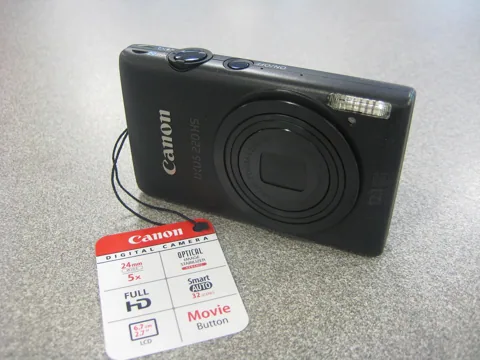
The Canon PowerShot ELPH 300 HS (IXUS 220 HS): 24 mm and a night mode in 20 mm of camera
In 2011 Canon fitted a backside-illuminated CMOS sensor and Full HD video into its slimmest wide-angle ELPH. It became the best seller of Canon's 2011 range, and reviewers agreed it was the sensible one.
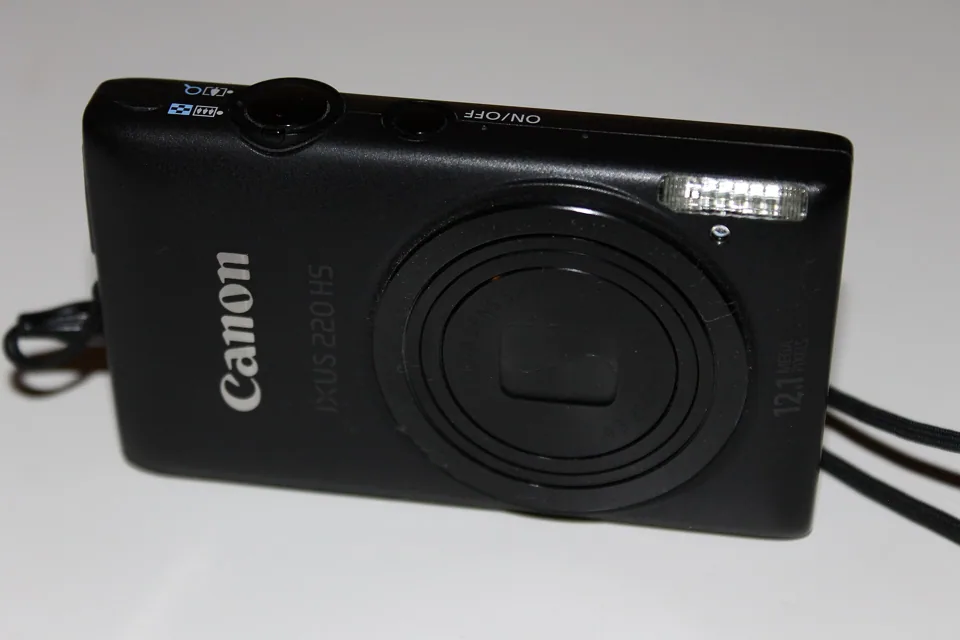
Meet the camera
Canon's launch text claimed the world's slimmest body among digital cameras with a 24 mm wide-angle 5x zoom, about 19.5 mm thick.1 Imaging Resource measured it at 92 by 56 by 20 millimetres and 141 grams with battery.2 Cameralabs added that it capitalises on the ELPH reputation for good looks with an all-over textured surface, and that in the hand it feels much more compact than its bigger-screened sibling.4
It had three names. Canon sold it as the PowerShot ELPH 300 HS in the Americas, the Digital IXUS 220 HS elsewhere and the IXY 410F in Japan.1 Canon's museum lists it as marketed in February 2011;1 Imaging Resource said it shipped in March 2011 in the US at $250, the same price as the SD1400 IS it replaced,2 and PhotographyBLOG listed £199, €239 and $249.99, in silver, red and black.3
Why this one was interesting
A very wide lens in a very thin body
The 24 mm starting point was the selling point. Cameralabs noted that the 5x lens starts wider than many of the more expensive models in the Canon lineup of the time,4 and Imaging Resource called it a very capable camera that captures 24 mm wide-angle images yet slips into a pocket with ease.2 The trade-off was reach: Cameralabs contrasted it with the 8x ELPH 310 HS / IXUS 230 HS, which went further but started at a narrower angle and came with a larger screen.4
A new kind of sensor
The HS in the name meant a back-illuminated CMOS sensor with the DIGIC 4 processor, and Canon said it delivered reduced noise even in low light.1 Imaging Resource explained the designation the same way, adding that the camera also had a brighter lens, and that Canon had therefore added Handheld Night Scene and Low Light options.2 The camera was the next step after its CCD-based predecessor, the SD1400 IS, and Imaging Resource noted that its 12 megapixels did not quite match last year's CCDs in print size.2
Full HD in a pocket
It recorded 1,920 by 1,080 video at 24 frames per second with stereo sound, with the optical zoom usable while filming.1 Imaging Resource listed a dedicated movie button and HDMI output among its pros, but noted 24 fps looked a bit jerky and the microphones exaggerated wind noise.2
The dark: what the sensor was for
Imaging Resource called it an excellent low-light shooter and said casual shooters would love the performance at high ISOs, especially in Handheld Night Scene, which merges three images into one without the noise of ISO 3200 or the lower resolution of the 3-megapixel Low Light mode.2 It added the caution that you cannot fight physics or slow shutter speeds for a moving subject in the dark.2 PhotographyBLOG found largely noise-free results even at the higher ISO settings.3




Real photographs taken with this camera, from Wikimedia Commons, all by one photographer. The sensitivity shown is recorded in each file's own EXIF data.

Like that look? See recent eBay sold listings for this camera ↗
How it drew the picture
Imaging Resource found good overall colour in adequate light and stills with that Canon pop, but noted images were not consistently tack sharp, there was noticeable chromatic aberration and soft corners on the left side at the telephoto end.2 PhotographyBLOG rated image quality 4 out of 5.3 Cameralabs concluded the camera delivered a canny balance of a decent lens range, slim package and affordable price.4
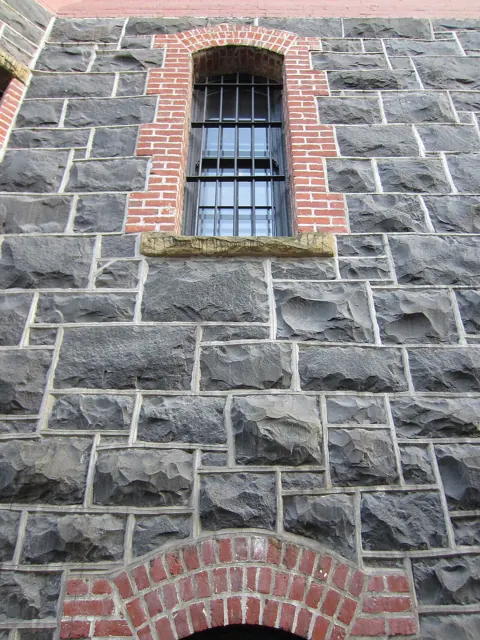
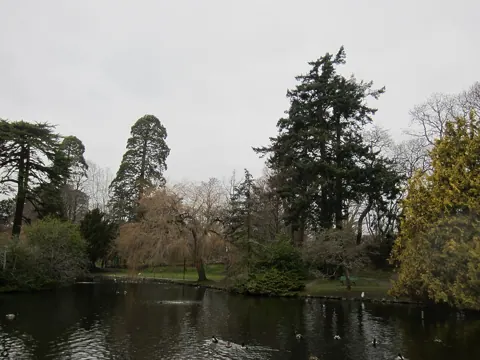

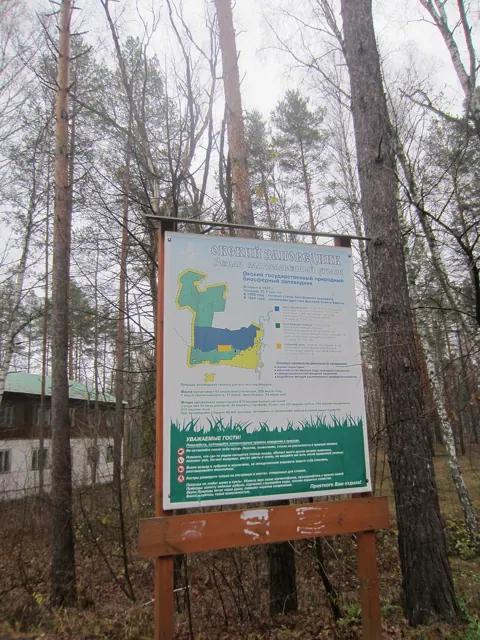


Photos taken with this camera, from Wikimedia Commons, credited under each picture.
On eBay right now
Live listings for this camera, supplied by eBay and updated automatically. We earn a commission if you buy through them.
The little wins
_-_65.JPG)


_-_12.JPG)
_-_15.JPG)
_-_07.JPG)
.JPG)


_-_36.JPG)

32 scenes in Smart Auto
Canon's Smart Auto gained Advanced Subject Detection to track pets and vehicles, and a total of 32 defined scenes.1
Movie Digest
The camera could record a short clip in the seconds before each still and build a digest movie, Canon said.1
Slow motion and miniature
Cameralabs listed Super Slow Motion and Miniature mode movie options, and found it matched its pricier sibling's movie modes frame for frame.4
Where it let you down
Imaging Resource listed minimal manual options, a weak flash, a flimsy-seeming port door and no calendar view in playback, and advised buying a spare battery.2 Performance was mixed, with full-autofocus shutter lag of 0.54 seconds at wide angle and a shot about every 2.04 seconds.2 PhotographyBLOG's list of what it lacked: GPS, a 3D mode, moisture resistance and a broad focal range.3
What the reviewers said in 2011
| Outlet | Date | Verdict |
|---|---|---|
| PhotographyBLOG | 8 Apr 2011 | Design 4, features 4, ease of use 4, image quality 4, value 5 out of 5. A Recommended award for an undemanding, good-value pocket camera.3 |
| Imaging Resource | 25 Apr 2011 | 4 out of 5 and a Dave's Pick: a good-quality everywhere camera for not a lot of money.2 |
| Cameralabs | Page dated 14 Dec 2011 | The best-selling point-and-shoot in Canon's 2011 range, with a balance of lens range, size and price.4 |
The timeline
- February 2011Canon's museum lists it as marketed.1
- March 2011Ships in the US, according to Imaging Resource.2
- 8 April 2011PhotographyBLOG publishes its review.3
- 25 April 2011Imaging Resource posts its review.2
Should you buy one now?
Buy one if you want a slim, wide-angle, Full HD-capable compact that does well in dim light and is easy to use, and you can live with 24 fps video and a modest flash. It sold for $250 at the time;2 what it sells for now is a question for the sold listings, not for us. If you would rather spend more for more camera, Imaging Resource names the Canon S95 and G12 as the step up, though not at so wide an angle; ours is the S95 retrospective.2 Before you bid, check these:
- The name. It was sold as the IXUS 220 HS outside North America and the IXY 410F in Japan, so search all three.1
- The battery. It uses an NB-4L;1 Imaging Resource advises a spare: Amazon ↗.
- The card. It takes SD, SDHC and SDXC cards, and Imaging Resource said Full HD video wants at least a Class 6 card.2
- The port door. Imaging Resource found it flimsy; check that it closes.2
- The lens. Check that it extends and retracts cleanly.
If you are wondering why cameras like this are being hunted down again, we tell that story once, in Pictures that never left the card.
See recent sold prices on eBay ↗Shop on eBay ↗NB-4L battery ↗
New to the jargon (CCD, ISO, xD cards, IXUS vs ELPH)? Read our plain-English digicam glossary.
Sources
- Canon Camera Museum: IXY 410F / PowerShot ELPH 300 HS / IXUS 220 HS (launch text, specifications, marketing date)
- Imaging Resource, Canon PowerShot ELPH 300 HS review by David Elrich and Stephanie Boozer (posted 25 Apr 2011)
- PhotographyBLOG, Canon IXUS 220 HS review by Gavin Stoker (8 Apr 2011)
- Cameralabs, Canon ELPH 300 HS / IXUS 220 HS review by Gordon Laing (verdict page dated 14 Dec 2011)
Camera photos by Xanor (CC0) and Hanniball76 (public domain); sample photographs are credited under each one, all via Wikimedia Commons. Links to eBay and Amazon are affiliate links.