Nikon Coolpix · on sale spring 2002 · a retrospective
The Nikon Coolpix 2500: the swivel camera that was pretty on purpose
In 2002 Nikon, known for black professional gear, made a silver-and-blue 2-megapixel pocket camera whose lens swivels sideways to protect itself, point at the photographer, and shoot from the hip.
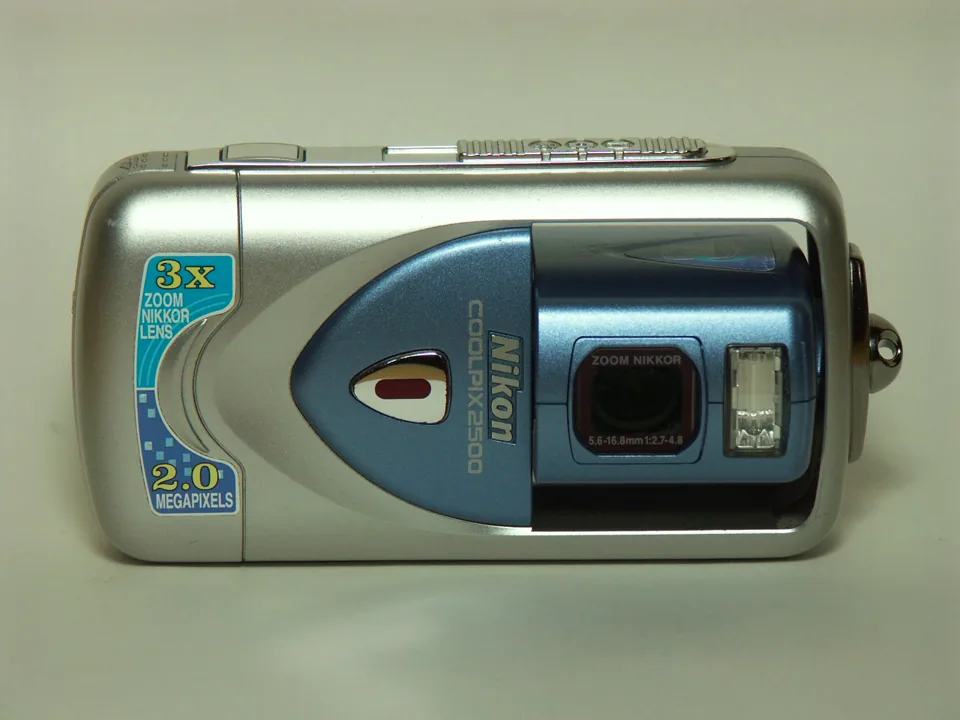
Meet the camera
DPReview's Phil Askey said Nikon announced the 2500 on 21 February 2002 at the PMA show, a stylish departure from the 775 and 885 that nonetheless echoed the split-and-twist bodies of the Coolpix 900, 950, 990 and 995.1 Imaging Resource's Dave Etchells, writing the same day, said Nikon had gone beyond mere ease of use to true style, with what had to be one of the prettiest cameras he had ever reviewed.2 CreativePro called it one of the nicest, most compact designs it had encountered, small enough for a shirt pocket.5
It had one name everywhere in our sources: Coolpix 2500. DPReview listed a street price under $400,1 Imaging Resource a suggested price of $399 on its first look,2 and CreativePro said street prices were around $350.5 DPReview described the body as plastic, in a split design with an internal swivel, in silver and blue.1
Why this one was interesting
The swivel
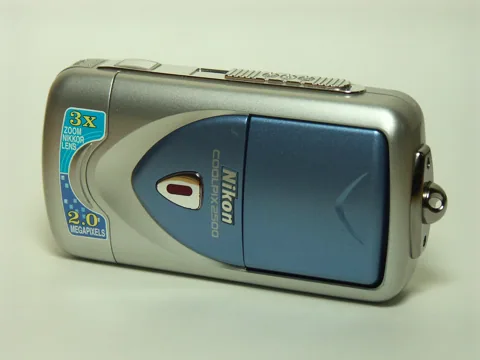
The lens, flash and sensor sit in a section that rotates, and when it turns to the vertical position the surrounding bezel protects it, so there is little need for a case and no lens cap.1 DPReview said the surround design was new to the family and that the double-sided swivel avoids flex at the hinge.1 CreativePro called it an idea borrowed from earlier, costlier Coolpix cameras but better implemented here.5
Aim it at yourself
The same swivel lets you reverse the lens, which CreativePro said allows you to aim the camera at yourself and friends while still viewing the screen to compose.5 DPReview added that the twist lens opens waist-level and overhead shooting possibilities.1
Aimed at people who did not own one
DPReview said the camera was clearly targeted at a relatively young, trendy market that wanted something quick and easy to use and stylish, with a certain level of image quality.1 Imaging Resource thought the style and features were aimed at the casual picture taker rather than the enthusiast, though it felt the menu structure was still a bit enthusiast in tone.4 Its reasoning for design mattering: cameras that sit in drawers do not take many pictures.4
For a much later Nikon take on the idea of a plain, friendly compact, see our Coolpix S3000 retrospective.
No viewfinder, and a very small screen
Nikon had dropped the optical viewfinder altogether; CreativePro said it was about time, since the tiny optical viewfinders on other cameras in the class were basically useless.5 DPReview praised the 1.5-inch screen as good, bright and detailed, with an anti-reflective coating,1 even though its spec list shows only 110,000 pixels.1
How it drew the picture
DPReview found excellent colour, good white balance in most situations, very good metering thanks to Nikon's 256-segment Matrix metering, and smooth, clean images, but only average resolution, barrel distortion at wide angle, highlight clipping and occasional odd yellow and magenta Bayer artefacts on highlights.1 Imaging Resource found it showed soft corners at wide angle, probably the result of squeezing the optics into the swivel head, but with excellent colour and generally very appealing pictures.3 It also said you needed the manual white balance to get good colour under household incandescent light.4



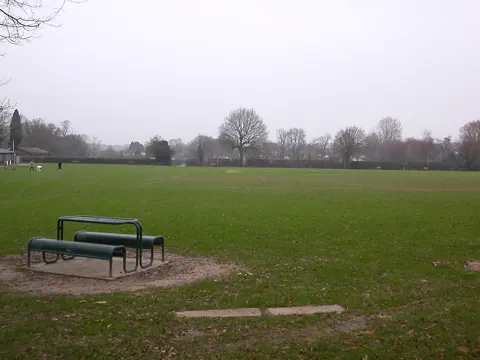




Photos taken with this camera, from Wikimedia Commons, credited under each picture.
On eBay right now
Live listings for this camera, supplied by eBay and updated automatically. We earn a commission if you buy through them.
The little wins

.JPG)


Manual white balance
DPReview called manual white balance unusual in a camera at this level.1
Macro to 4 cm
DPReview listed excellent macro performance for a camera at this level, focusing from 4 cm.1
A sturdy battery door
CreativePro liked that the combined battery and memory door was much sturdier than the flimsy flaps on many cameras.5
Where it let you down
DPReview's list of cons included poor low-light autofocus with no AF assist lamp, no manual ISO, no video output, an under-powered flash that produced red-eye, and average-to-slow start-up and autofocus.1 Its movie mode recorded no audio and was limited to 15 seconds.1 CreativePro noted the small flash next to the lens gives unflattering front lighting and red-eye.5
What the reviewers said in 2002
| Outlet | Date | Verdict |
|---|---|---|
| Imaging Resource | 21 Feb and 27 Mar 2002 | Delighted by the design on first sight; after testing a production unit, excellent photos with great colour, a friendly interface and an affordable price. Expected it to be tremendously popular.23 |
| DPReview | 13 Mar 2002 | Recommended. Ratings out of 10: construction 8.5, features 7, image quality 8, lens/CCD 8, ease of use 8, value 9.1 |
| CreativePro | 23 Apr 2002 | Unremarkable on a spec checklist, but set apart by its design and firmware; an excellent choice for creative people who need a simple snapshot camera.5 |
The timeline
- 21 February 2002Announced at PMA; Imaging Resource posts a first look.12
- 13 March 2002DPReview publishes its review.1
- 27 March 2002Imaging Resource updates its review after testing a production camera.3
- 23 April 2002CreativePro publishes its review.5
Should you buy one now?
Buy one if you want a charming, very early-2000s 2-megapixel camera with a unique swivel body, and you are happy with 1600 by 1200 pictures and a tiny screen. It sold for $350 to $400 in 2002;15 what it sells for now is a question for the sold listings, not for us. Before you bid, check these:
- The swivel. Check that the lens section turns smoothly and clicks into both positions, and that the flash and lens are clean.1
- The battery. It uses a Nikon EN-EL2;1 a fresh one is on Amazon ↗.
- The card. It takes CompactFlash Type I cards, not SD.1
- The battery door. CreativePro found it sturdy; check that it closes firmly.5
- The accessories. It came with a charger;1 it connects by USB 1.1, which is slow by later standards, so a card reader is the easy way to copy pictures.1
If you are wondering why cameras like this are being hunted down again, we tell that story once, in Pictures that never left the card.
See recent sold prices on eBay ↗Shop on eBay ↗EN-EL2 battery ↗
New to the jargon (CCD, ISO, xD cards, IXUS vs ELPH)? Read our plain-English digicam glossary.
Sources
- DPReview, Nikon Coolpix 2500 review by Phil Askey (13 Mar 2002; specifications table)
- Imaging Resource, “First Look review posted for Nikon Coolpix 2500” by Dave Etchells (21 Feb 2002)
- Imaging Resource, “Coolpix 2500 review updated!” by Dave Etchells (27 Mar 2002)
- Imaging Resource, Nikon Coolpix 2500 review (2002)
- CreativePro, “Nikon Coolpix 2500: Handy 2-Megapixel Point-and-Shoot with Cool Design” (23 Apr 2002)
Camera photos by Hanabi123 (CC BY-SA 3.0) and plbcr (public domain); sample photographs are credited under each one, all via Wikimedia Commons. Links to eBay and Amazon are affiliate links.