Canon PowerShot ELPH · on sale March 2007 · a retrospective
The Canon PowerShot SD750: the beautiful one with the big screen
In 2007 Canon gave its prettiest ELPH a three-inch screen and a touch-sensitive dial. Reviewers fell for the looks, then mostly told buyers to get the SD1000 instead.
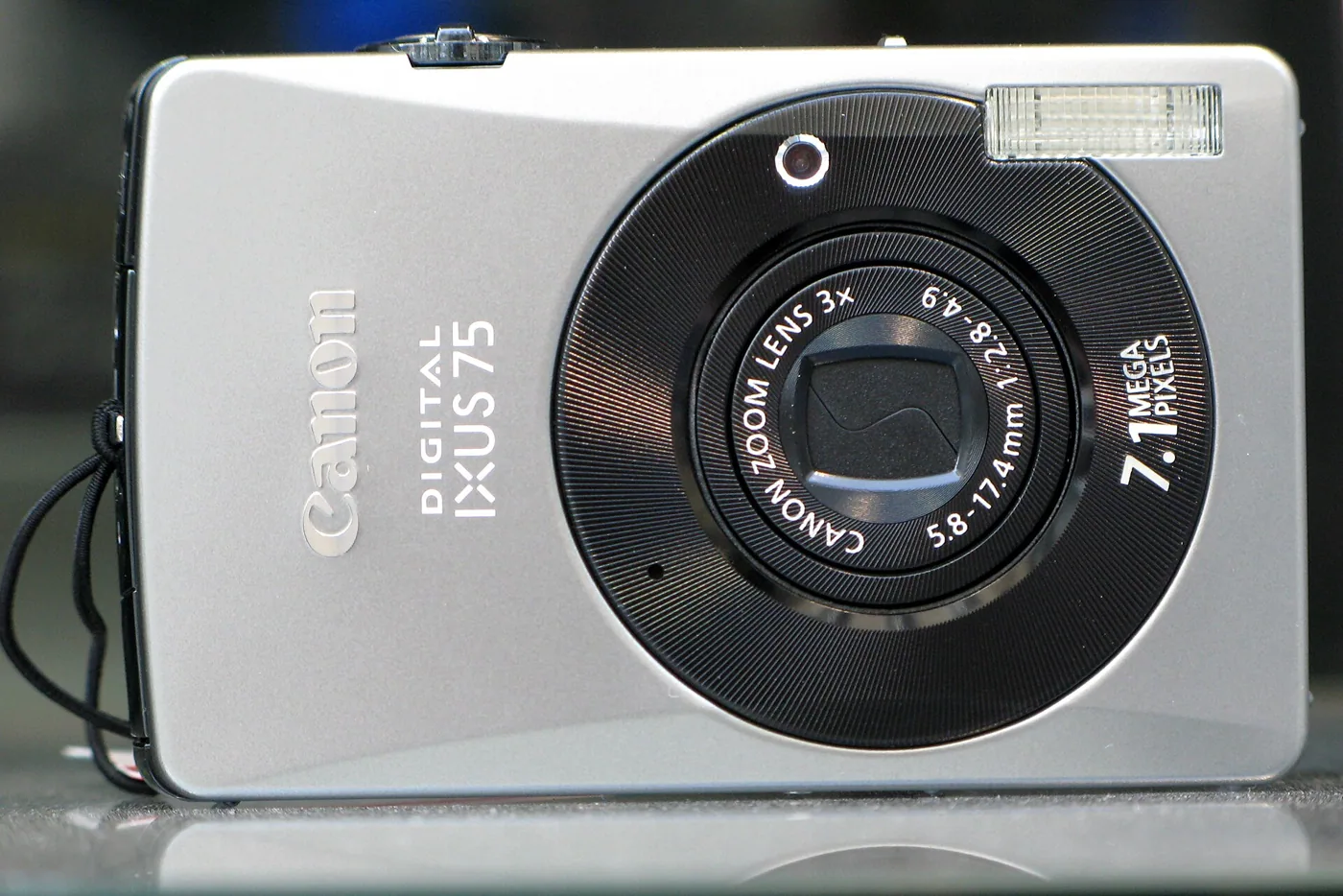
Meet the camera
It is flat, tapered and almost all screen. Canon's own museum text calls the shape Edge Design, and says a smaller lens barrel let the body get slimmer than the camera it replaced.1 Imaging Resource's reviewer was smitten: the SD750 "may be the prettiest ELPH of all," in the reviewer's words, and the two-tone black model, with a silver face plate around the lens, was the one the reviewer fell for.4 It measures about 92 by 57 millimetres and 19.6 thick and weighs 130 grams without the battery.1
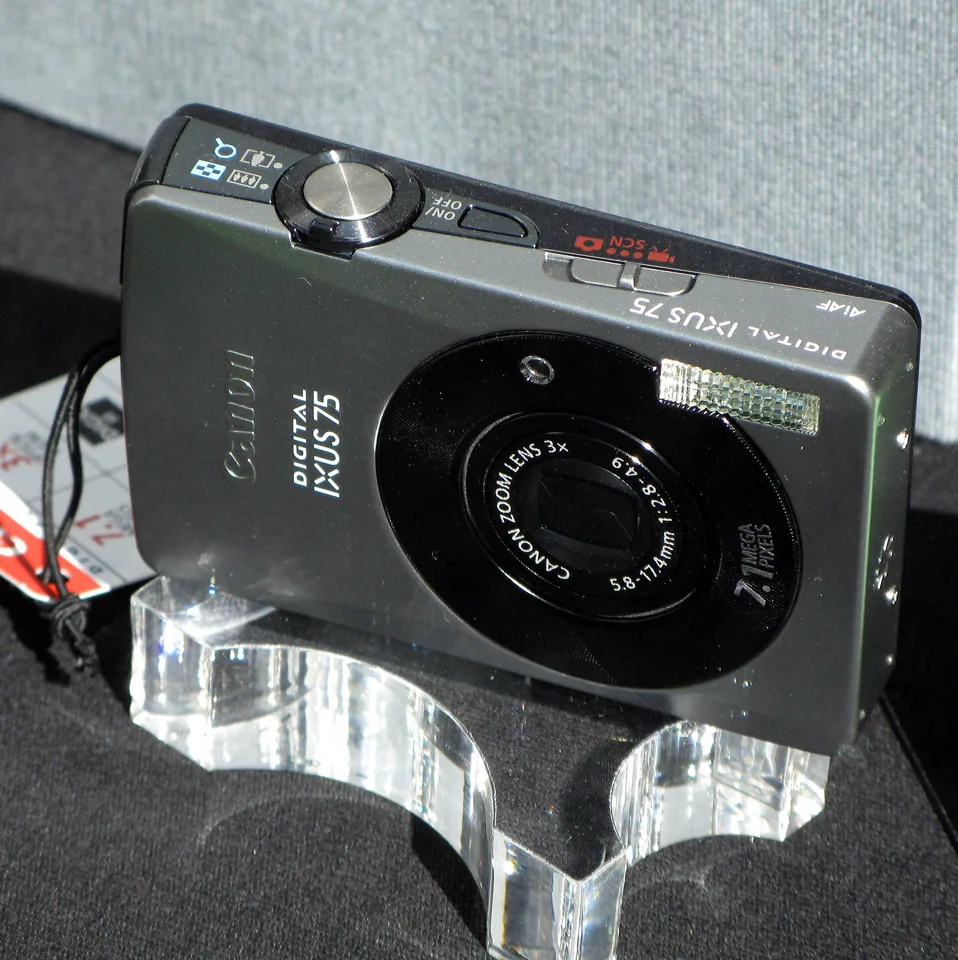
Canon announced it on February 21, 2007, alongside the SD1000, and DPReview's note on the pair picked out the SD750's 3.0-inch screen and the SD1000's thinness as the difference between them.23 The price was $350 in the US from March.2 Canon calls it the successor to the IXY Digital 80 of April 2006, which had been acclaimed for its large screen, and gave it the same roughly 230,000 dots as the SD1000, plus a 7.1-megapixel CCD in place of 6.0 and the DIGIC III processor.1
Why this one was interesting
A screen bigger than the camera's rivals
The three-inch screen was the whole pitch. Imaging Resource called it a "whopping" 3.0 inches, the only way to frame a picture because the camera forwent any optical viewfinder.2 The pros list in the full review added a scratch-resistant, anti-reflection coating.4 The reviewer's warning was that the screen could make you forget to take pictures: it was hard to stop staring at it long enough to use the camera.4
A dial that responded to touch
On the back, a Touch Control Dial replaced the usual four-way pad. Canon described it as a major improvement in ease of operation and added a customisable playback button.1 The reviewers were less convinced. Imaging Resource found the touch-sensitive dial a little insensitive and "more gimmick than convenience," never comfortable except when used the traditional way.4
Was it a new chip?
Yes: DIGIC III, which Imaging Resource said brought face detection and ISO 1600 to the ELPH range,4 and which Imaging Resource noted was new to the PowerShot line that year.2 Not a new lens: it was a standard 3x zoom, from 35 to 105 mm.2
If you want to compare, our SD1000 retrospective covers the thinner sibling launched the same day, and the SD1100 IS shows what Canon added next.
The dark, with a fast shutter and no stabiliser
ISO 1600 was new, but the SD750 had no image stabiliser. Imaging Resource's reviewer found that even at ISO 1600 the shutter speed was just under 1/30 of a second, at ISO 800 about 1/14 and at ISO 400 about 1/6, which is why the reviewer missed stabilisation even on so modest a zoom.4 A picture of a doll in a dark room barely worked at 1/25 second and ISO 1600.4 The pros list nevertheless praised ISO 1600 and a generous Auto High ISO setting.4 CNET noted that the SD750 lacked the stabilisation of Canon's SD800 IS.5



_20100512_2.jpg)



_by_shakko_05.jpg)
Real photographs taken with this camera family (sold in Europe as the Digital IXUS 75). The sensitivity shown is recorded in each file's own EXIF data.

Like that look? See what SD750s have recently sold for on eBay ↗
On eBay right now
Live listings for this camera, supplied by eBay and updated automatically. We earn a commission if you buy through them.
The little wins
For a camera that gave up on viewfinders and stabilisers, the SD750 had charms.
Battery life that surprised
Imaging Resource called the battery life unusually good: its reviewer did not charge it before the first shots, then charged it once more after several days and it recharged quickly.4
Fast to start, fast to shoot
Start-up and shutdown never got in the way, and the shutter was responsive enough for the reviewer to forget about shutter lag.4
Face detection
DIGIC III brought face detection to the line,4 and the pros list gave it credit alongside the 7.1-megapixel sensor.4
A lens that barely stuck out
The lens extended just three-quarters of an inch at wide angle and only a little more at telephoto, and stayed tucked behind its cover if you switched the camera on with the playback button.4
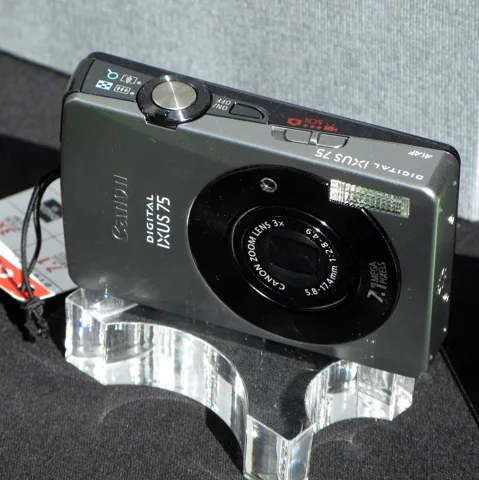 The black SD750 from the front. · Rama · CC BY-SA 2.0 fr · Commons
A camera that stood up
It could sit on its bottom or on its short left side, Canon having sloped the opposite side forward so that all the lettering on the face and the lens read correctly when it stood upright.4
Fun little modes
Imaging Resource enjoyed the Digital Macro setting and the Aquarium scene mode, though it suspected the fish pictures would have been better in a darkened room.4 A widescreen 16:9 still format also made the list.4
A shutter button worth having
Many small cameras skimp on the shutter button; Imaging Resource found the SD750's large and sensitive enough that pressing it did not shake the camera.4
How it drew the picture
Here Imaging Resource was blunt: image quality was a surprisingly mixed bag and the biggest disappointment. Most images were soft, skies were strangely blue and shade shots had a pronounced blue cast, none of it visible on the bright screen.4 The 4x digital zoom, a crop upsampled to full size, added more softness.4 CNET took a kinder view, praising the design and large screen and adding that, to its reviewer's eyes at least, the photo quality was better.5







.JPG)
Photos taken with this camera, from Wikimedia Commons, credited under each picture.
Where it let you down
The list is short and consistent. There were no Creative Zone modes, so no aperture or shutter priority; the 3x zoom seemed short outdoors; flash recycling was below average at 8.9 seconds; and the touch dial was awkward.4 Reviewers also noted there was no optical viewfinder, which PCMag called the SD1000's edge.26
What the reviewers said in 2007
| Outlet | Date | Verdict |
|---|---|---|
| CNET | Apr 2007 | Lacks the stabilisation of the SD800 IS and the tiny appeal of the SD1000, but has a more elegant design, a large screen and, to its reviewer's eyes, better photo quality.5 |
| Imaging Resource | 20 Jun 2007 | One of the prettiest cameras the reviewer had reviewed, with fast start-up, a quick shutter and good battery life. But soft images and a blue cast led the review to recommend the cheaper SD1000 unless the big screen was essential.4 |
| PCMag | Oct 2007 | Very similar to the SD1000, its Editors' Choice compact, "inside and out," but the SD1000 had slightly better image quality and an optical viewfinder.6 |
The timeline
- April 2006The IXY Digital 80, the large-screen camera Canon names as the SD750's predecessor.1
- 21 February 2007Canon announces the SD750 and SD1000.23
- March 2007The SD750 goes on sale at $350.12
- 6 April 2007CNET's review is reported.5
- 20 June 2007Imaging Resource publishes its review.4
- 24 October 2007PCMag's review is reported.6
Should you buy one now?
Buy one if the screen is the point: a three-inch display on a camera that fits in a pocket was a showpiece in 2007, and you can still enjoy it. Do not expect the sharpest pictures from it. Imaging Resource's verdict was that the SD1000 was the better choice, and PCMag agreed.46 It launched at $350;2 what it sells for now is a question for the sold listings, not for us. Before you bid, check these:
- The screen. It is the camera's whole appeal, so ask for a photo of it powered on, with no scratches or dead patches.
- The battery. The NB-4L was good for days in 2007;4 an old one will not be. A fresh one is cheap on Amazon ↗.
- The card. It takes SD and SDHC;1 the 32 MB card in the box is long gone.4
- The dial. The touch-sensitive dial still works in the traditional way,4 so check the buttons around it respond.
- The name. It was sold as the Digital IXUS 75 in Europe and the IXY Digital 90 in Japan, so search all three.1
If you are wondering why cameras like this are being hunted down again, we tell that story once, in Pictures that never left the card.
See recent sold prices on eBay ↗Shop on eBay ↗NB-4L battery ↗
New to the jargon (CCD, ISO, xD cards, IXUS vs ELPH)? Read our plain-English digicam glossary.
Sources
- Canon Camera Museum: IXY Digital 90 / PowerShot SD750 (specifications, IXY Digital 80 lineage, Touch Control Dial, marketing date)
- Imaging Resource, “Canon announces PowerShot SD750 (UPDATED)” by Mike Tomkins (21 Feb 2007)
- DPReview, “Canon SD750 and SD1000” (21 Feb 2007)
- Imaging Resource, Canon SD750 review by Mike Pasini (20 Jun 2007)
- CNET, Canon PowerShot SD750 review (April 2007), as quoted by PhotographyBLOG (6 Apr 2007)
- PCMag, Canon PowerShot SD750 review (October 2007), as quoted by PhotographyBLOG (24 Oct 2007)
Camera photos by Rama (CC BY-SA 2.0 France); other photographs are credited under each one, all via Wikimedia Commons. Links to eBay and Amazon are affiliate links.