Canon PowerShot ELPH · launched March 2007 · a retrospective
The Canon PowerShot SD1000: the pocket camera of spring 2007
Also sold as the Digital IXUS 70 and the IXY Digital 10.
A square silver compact with a new processor, a camera that learned to look at faces, and a $299 price tag. Here is what it was, what made it special, and what reviewers said at the time.
Meet the camera
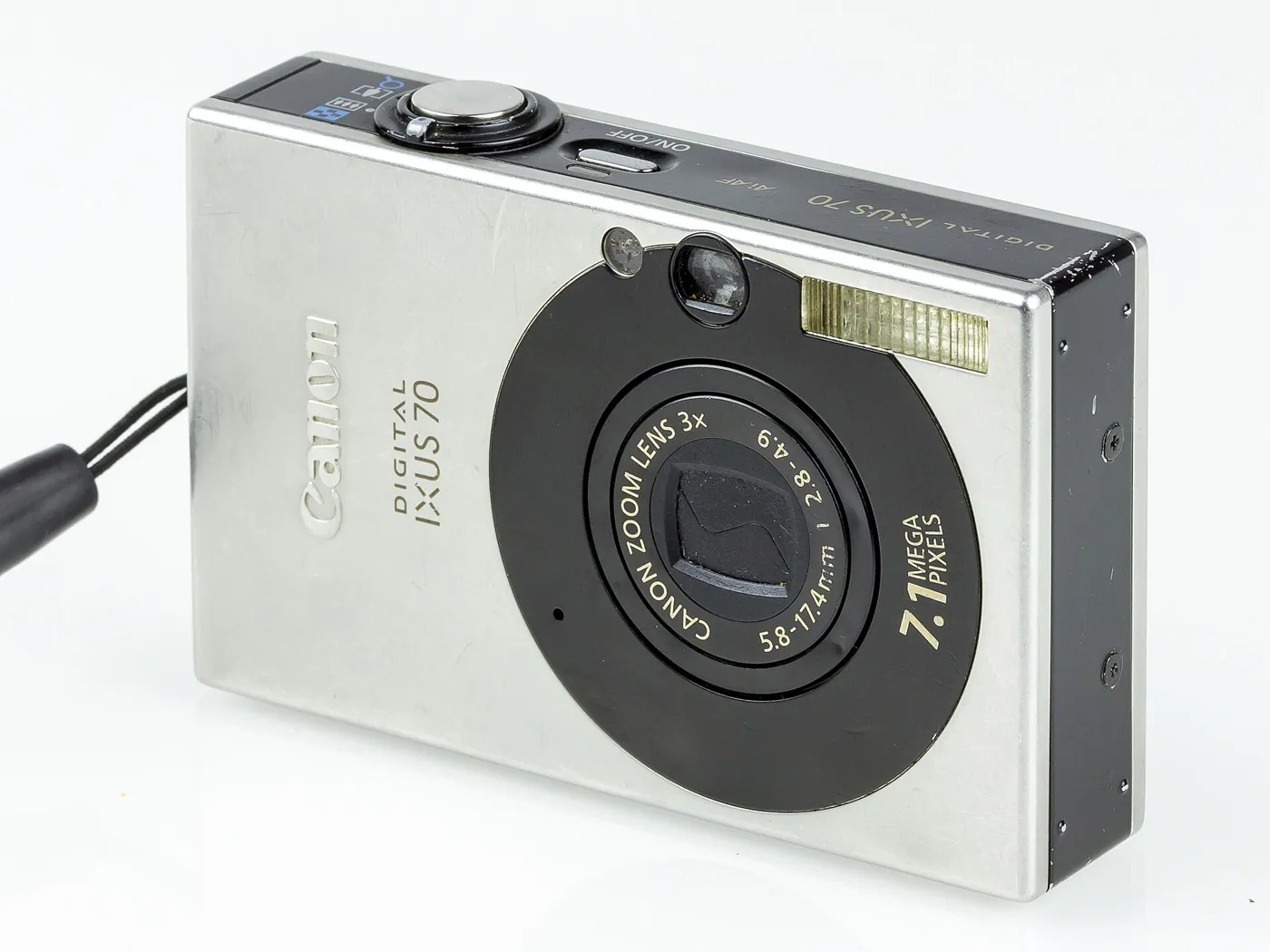
Pick it up in a photograph and the first thing you see is how little there is. A slab of metal 86 mm wide and 19 mm thick that weighs 125 grams,1 a black ring of lens with its zoom range printed around the edge, a slot of flash beside it, and on the back a 2.5-inch screen that takes up most of the face.
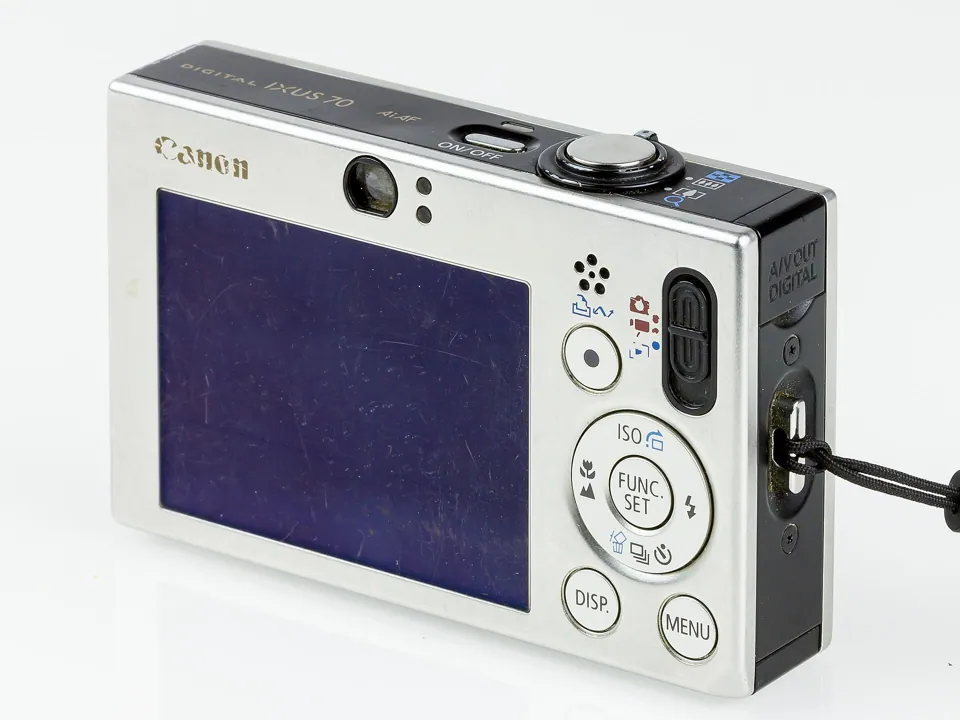
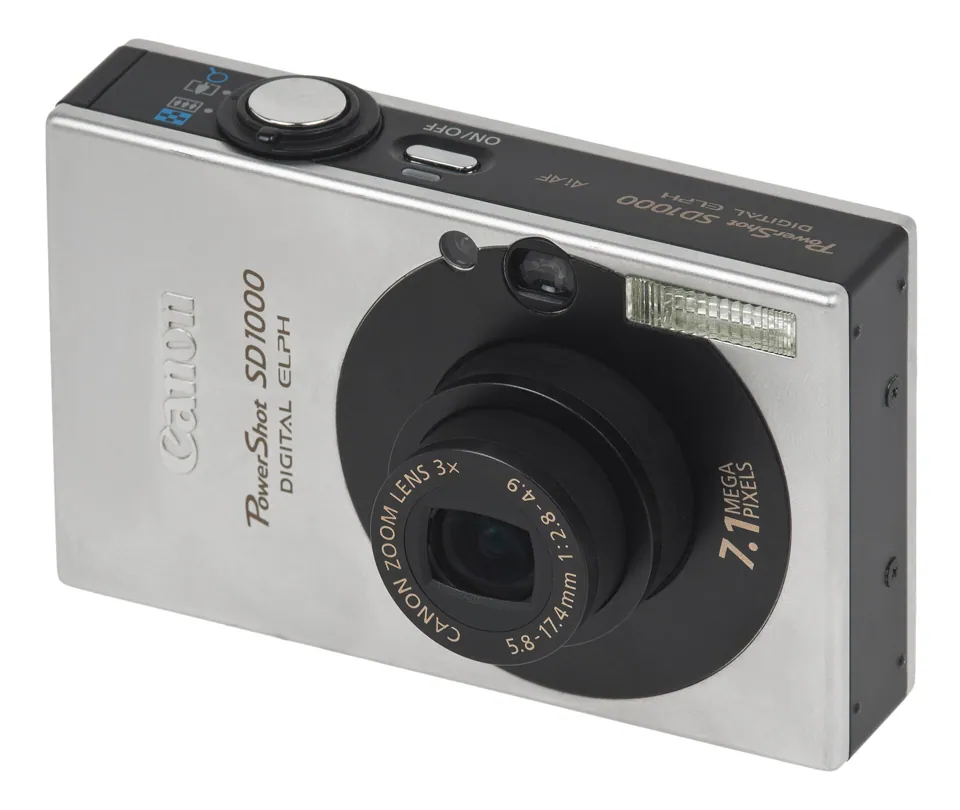
Canon announced it on February 21, 2007, at $299 for a March release, and positioned it as the entry-level Digital ELPH.2 In the UK it was £249 as the Ixus 70.7 Its look was the point. Canon's media director linked the square corners to the 1996 APS-film ELPH,2 and Canon's own museum text says the designers removed ornament to let the slimness show.1 Reviewers loved how it felt in the hand and quickly learned its flaw, which was that the metal body collects fingerprints within a couple of hours.7
The spring it came out
In 2007 the compact digital camera was big business. IDC counted about 131 million digital cameras shipped worldwide that year, up 24 percent, with Canon leading overall, Sony second at 16 percent of the market (20.1 million units) and Samsung fourth at 10 percent.10 Digital SLRs were the glamorous end, about 7.5 million of those units.10 The SD1000 sat at the opposite end, Canon's entry-level pocket ELPH.2 The UK version came with a 32 MB card that held about twenty pictures at full size.7
And then the world moved. On January 9, 2007, Apple announced the iPhone, with a 2 megapixel camera, and it went on sale in the US on June 29 at $499 for the 4 GB model with a contract.12 The SD1000 landed in the gap between those two dates: a dedicated camera at the moment the phone-as-camera was only beginning.
The day the camera learned to look at faces
Ask what the SD1000 could do that Canon's previous model, the SD600, could not, and the headline is face detection.2 It sounds small now. Phones do it without telling you. In 2007 it was the feature that defined a whole new wave of cameras, and it is the single best reason the SD1000 deserves a place in the story.
The problem it solved was old and universal. A camera that simply focuses on whatever sits under its focus points will happily sharpen the wrong thing. TechCrunch, hands-on with Fujifilm's face-detecting S6000fd in December 2006, described the classic failure as a prom picture in which the corsage is sharp and the people are not.13 Even on the SD1000, Imaging Resource watched its nine-point autofocus choose the grass beside a flower instead of the flower.4
Face detection was the camera trying, for the first time at pocket size and pocket money, to work out what the picture was of. Canon's system, introduced on its DIGIC III cameras in autumn 2006, finds up to nine faces, as long as they are looking straight at the camera, and keeps them sharp.11 Canon's specification sheet adds that exposure takes facial brightness into account,1 and Imaging Resource says the camera sets focus, exposure and even flash output for the faces it finds.4 Fujifilm had stamped “fd” for face detection into the name of its S6000fd that summer, and by December 2006 TechCrunch noted that many cameras had it.13 The SD1000 brought it to Canon's cheapest ELPH.
Reviewers did not agree on how much it mattered. Imaging Resource found it faster and more accurate than competing systems, especially with several people in the frame.4 PhotographyBLOG thought it made little practical difference, since people tend to focus on the subject first anyway.6 Both can be true. It matters most in the situation it was designed for: a group, a hurry, and a camera handed to someone else.
Put the pieces together and you have a camera that, in a dim room with the flash on, exposes for the people and lets the background go dark. That is the classic digicam flash photo, and in 2007 it was a selling point: nobody had to know how to set a flash.
On eBay right now
Live listings for this camera, supplied by eBay and updated automatically. We earn a commission if you buy through them.
The little wins
Face detection gets the credit, but the SD1000 was full of smaller decisions that reviewers noticed and that explain why it felt so good to use.
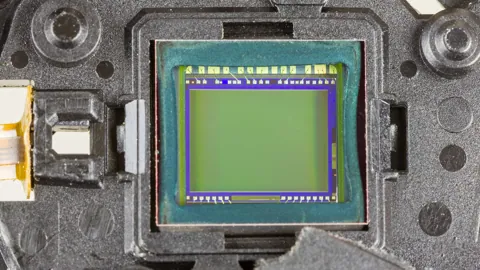 The CCD image sensor, photographed inside a dismantled IXUS 70. · Raimond Spekking, CC BY-SA 4.0, Commons
The sensor itself
A 1/2.5-inch CCD with 7.1 effective megapixels,1 producing 3,072 × 2,304 pixel pictures of about 1.3 MB each at normal quality.7 Canon raised the count from 6 megapixels on the SD600.2 The green rectangle in this photo, from a camera taken apart, is the sensor.
One button for steadier shots
Auto ISO Shift raised the sensitivity to a maximum of ISO 800 on demand, giving faster shutter speeds against hand shake. Imaging Resource thought this gentler than the “anti-shake” modes of the day that pushed ISO very high and filled pictures with noise.4
Fun in the movie menu
Time-lapse and fast-frame-rate modes impressed Imaging Resource,4 and the camera listed Color Accent and Color Swap, which on Canon's compacts of the time kept one colour and turned the rest black-and-white, or swapped one colour for another.14 Video was VGA at 30 frames per second.7


Awake in under a second
Tech Digest found it ready to shoot in less than a second after pressing the power switch.7 Imaging Resource liked the shot-to-shot response and the accurate autofocus, with an amber assist lamp for dark rooms.4
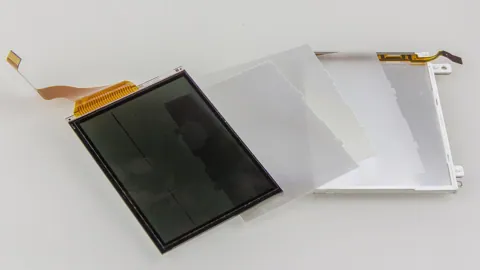 The LCD panel from a dismantled IXUS 70. · Raimond Spekking, CC BY-SA 4.0, Commons
A screen that earned its coating
The 2.5-inch screen went from 173,000 to 230,000 pixels, and Canon gave it a triple-layer “Pure Color” coating meant to resist fingerprints, scratches and glare.2 Imaging Resource found it clear in bright light and usable in low light, with a grid overlay for levelling horizons.4
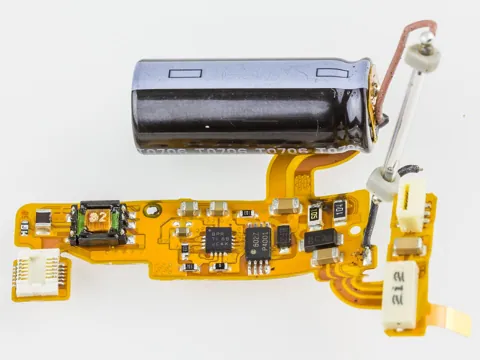 The flash unit and its capacitor, out of a dismantled IXUS 70. · Raimond Spekking, CC BY-SA 4.0, Commons
A flash with manners
The flash recycles in 10 seconds or less,1 reaches about 12 feet at wide angle,4 and with red-eye reduction nearly eliminated red-eye in PhotographyBLOG's indoor tests.6 The photo shows the flash module and its capacitor, taken out of a dismantled camera.
A viewfinder on a camera this thin
The SD1000 had an optical viewfinder, which Imaging Resource called unusual at this size and handy in bright sun, though small and hard to use. The slimmer SD750 had none.4
How it drew the picture
This is where the reviewers disagreed, and the disagreement is the honest picture. Imaging Resource found noise well controlled up to ISO 400, treated ISO 800 as the practical limit, and thought ISO 1600 was only good for small prints.4 PhotographyBLOG found the 7 megapixel files already noisy and a little soft at ISO 400 and told readers to avoid 800 and 1600.5 Both agreed on the useful part: in good light it made rich, natural, slightly warm colour. Imaging Resource noted that auto white balance ran warm under household bulbs,4 and PhotographyBLOG saw purple fringing only in high-contrast scenes.6 Years later, What Digital Camera also noticed softness toward the edges of the frame, which it said would matter only in prints larger than A4.9








Photos taken with this camera, from Wikimedia Commons, credited under each picture.
What the reviewers said in 2007
| Outlet | Date | Verdict |
|---|---|---|
| TechCrunch (first look) | 22 Feb 2007 | Called them attractive, good-value cameras and held judgement until testing.3 |
| PhotographyBLOG | 9 Apr 2007 | 4.1 out of 5. Design 4.5, ease of use 4.5, features 4, image quality 4, value 3.5. Praised the design and build; noise was the main weakness.5 |
| Engadget roundup | 11 Apr 2007 | Collected reviews: DigiCamReview 8/10, PhotographyBLOG 4.1/5, DPExpert “highly recommended.” Nobody was blown away; image quality could be a little better; it was seen as a serious camera, more than a fashion item.8 |
| Imaging Resource | 8 May 2007 | Dave's Pick. Loved the simplicity and looks, frustrated by buried menus, and thought $299.99 a little high for a point-and-shoot.4 |
| Tech Digest | 8 May 2007 | Three stars. Well built, instant start-up, indoor shots with little noise; fingerprints, fiddly menus and a high £249 list price held it back.7 |
The timeline
- 9 January 2007Apple announces the iPhone with a 2 megapixel camera.12
- 21 February 2007Canon announces the SD1000 at $299 for a March release.2
- 9 April 2007PhotographyBLOG publishes its review.5
- 8 May 2007Imaging Resource and Tech Digest publish theirs.47
- 29 June 2007The iPhone goes on sale in the US.12
Should you buy one now?
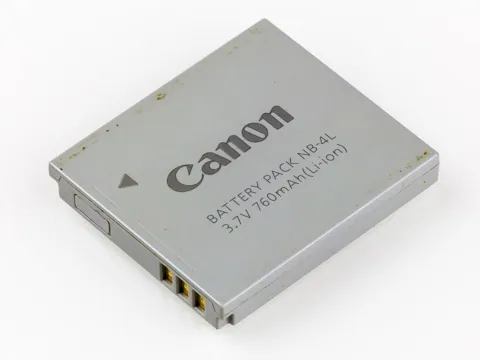
It is a CCD camera,1 and the same body was sold as the IXUS 70 and IXY Digital 10, so search all three names. Plan on a few practical things. It takes SD and SDHC cards but Canon lists no SDXC, so use a card of 32 GB or smaller.1 The NB-4L battery is the part most likely to be tired after all these years. And there is no stabiliser and no manual exposure, so treat it as a camera for light, faces and flash, as the reviewers did in 2007.
If you are wondering why cameras like this are being hunted down again, we tell that story once, in Why everyone wants a 2007 camera again.
Used prices move around, so instead of printing a number that will be wrong next month, the buttons below go straight to recent sold listings.
Recent sold prices on eBay ↗Shop on eBay ↗NB-4L battery ↗
New to the jargon (CCD, ISO, xD cards, IXUS vs ELPH)? Read our plain-English digicam glossary.
Sources
- Canon Camera Museum: IXY Digital 10 / PowerShot SD1000 / Digital IXUS 70 (specifications and launch text)
- Reviewed.com, “Canon launches Pure Color LCD on SD1000 and SD750” (21 Feb 2007)
- TechCrunch, “Canon's two merry ELPHs” (22 Feb 2007)
- Imaging Resource, Canon SD1000 review by Theano Nikitas (8 May 2007)
- PhotographyBLOG, Canon Digital IXUS 70 review, conclusion (9 Apr 2007)
- PhotographyBLOG, Canon Digital IXUS 70 review, image quality page (9 Apr 2007)
- Tech Digest, “Review: Canon Digital Ixus 70” (8 May 2007)
- Engadget, “Canon SD1000 Digital ELPH review roundup” (11 Apr 2007)
- What Digital Camera, Canon IXUS 70 review (page dated 2014; camera from 2007)
- Reviewed.com, “2007 worldwide digital camera market share review” (IDC figures)
- Reviewed.com, “Canon adds three new SD models” (DIGIC III and face detection, Sept 2006)
- Wikipedia, iPhone (1st generation) (announcement, camera, price, on-sale date)
- TechCrunch, “Fujifilm FinePix S6000fd hands-on” (15 Dec 2006)
- Imaging Resource, Canon SD400 review (describes Color Accent and Color Swap on the same ELPH line)
Product and teardown photos of the IXUS 70 are by Raimond Spekking (CC BY-SA 4.0) and Evan-Amos (public domain), via Wikimedia Commons; sample pictures are credited under each one. Where outlets disagreed on a price (TechCrunch swapped the SD1000 and SD750 prices), we used the figures from Reviewed and Imaging Resource. Links to eBay and Amazon are affiliate links.