Guide · batteries
Which CCD digicams run on AA batteries? A checked list of 29 cameras
Yes: at least 29 CCD digicams run on AA batteries, and they are listed below with the page that confirms each one. Two-cell models are the smaller bodies; four-cell models are larger. NiMH rechargeable cells give 1.5 to 6.7 times the shots of alkaline in the 14 cameras where a page prints both figures, so buy NiMH cells and a charger. This page covers used cameras from about 1999 to 2012, not new ones, and it lists what we could not confirm.
What is on this page
- Which CCD digicams run on AA batteries?
- Which of them take four AA cells?
- Is there a digital camera that takes AA batteries?
- What is the best compact digital camera that uses AA batteries?
- Do AA digicams last longer on NiMH or alkaline cells?
- Which AA batteries and charger should I buy?
- Can I use lithium AA, Oxyride or USB-rechargeable cells?
- Why do so few CCD digicams take AA batteries?
- What should I check before buying an AA camera?
- What we could not confirm
- Where to find cells and cameras
- How we checked
1. Which CCD digicams run on AA batteries?
At least 29 CCD cameras made between 1999 and 2012 run on AA cells, and this page lists each one with the page that says so. 20 take two AA cells (the smaller bodies) and 9 take four (larger bodies and long zooms). Each row below was included only because a Canon museum page, a manual or a full review that we opened states both the CCD sensor and the AA cells; where a source gives shots per set of cells, the table shows them.
This is a list of used cameras, mostly 2003 to 2012. It is not a buyer's guide to new cameras, and it is not complete: it holds the cameras we could confirm, not every camera that fits. 17 of the 29 cameras have a full review on this site, linked in the first column. The "Launched" column is the date or year on the cited page. "Shots" are the page's own figures, shown as alkaline first and NiMH second; "n/a" means the source gives no number for that cell type. The standards behind them are explained in the glossary.
Two-cell cameras
| Camera | Launched | Sensor | Cells | Shots: alkaline / NiMH | Source |
|---|---|---|---|---|---|
| Canon PowerShot A460 | Mar 2007 | CCD, 1/3.0-inch, 5.0 MP | 2 AA | 120 / 400 (CIPA, screen on) | 1 |
| Canon PowerShot A550 | Mar 2007 | CCD, 1/2.5-inch, 7.1 MP | 2 AA | 140 / 500 (CIPA, screen on) | 2 |
| Canon PowerShot A560 | Mar 2007 | CCD, 1/2.5-inch, 7.1 MP | 2 AA | 140 / 500 (CIPA, screen on) | 3 |
| Canon PowerShot A570 IS | Mar 2007 | CCD, 1/2.5-inch, 7.1 MP | 2 AA | 120 / 400 (CIPA, screen on) | 4 |
| Canon PowerShot A720 IS | Aug 2007 | CCD, 1/2.5-inch, 8.0 MP | 2 AA | 140 / 400 (CIPA, screen on) | 5 |
| Canon PowerShot A590 IS | Feb 2008 | CCD, 1/2.5-inch, 8.0 MP | 2 AA | 200 / 450 (CIPA, screen on) | 67 |
| Canon PowerShot A700 | Apr 2006 | CCD, 1/2.5-inch, 6.0 MP | 2 AA | Not stated on the page we read | 8 |
| Canon PowerShot A1200 | Mar 2011 | CCD, 1/2.3-inch, 12.1 MP | 2 AA | 200 / 450 (CIPA; CCD per Imaging Resource) | 910 |
| Nikon Coolpix L3 | Feb 2006 | CCD, 5.1 MP | 2 AA (alkaline, NiMH or lithium) | 200 / 330 (IR table, CIPA and/or maker conditions; lithium 630) | 11 |
| Nikon Coolpix L22 | Feb 2010 | CCD, 1/2.3-inch, 12.0 MP | 2 AA | 240 / 420 (CIPA; NiMH is Nikon's EN-MH2) | 12 |
| Nikon Coolpix 3200 | Mar 2004 | CCD, 3.2 MP | 2 AA, or one CR-V3 | Not stated on the page we read | 13 |
| Kodak EasyShare C875 | Aug 2006 | CCD, 1/1.8-inch, 8.0 MP | 2 AA, or CR-V3 or KAA2HR | n/a / 250 (CIPA, NiMH) | 1415 |
| Kodak EasyShare Z700 | Apr 2005 | CCD, 4.0 MP | 2 AA, or CR-V3 or Kodak NiMH pack | Not stated on the page we read | 16 |
| Fujifilm FinePix A900 | May 2007 | Super CCD HR, 1/1.6-inch, 9.0 MP | 2 AA | Not stated on the page we read | 17 |
| Sony Cyber-shot DSC-S600 | Mar 2006 | CCD, 6.0 MP | 2 AA | 160 / 460 (Sony figures, screen on) | 18 |
| Sony Cyber-shot DSC-H2 | May 2006 | CCD, 6.0 MP | 2 AA (NiMH and charger in the box) | 60 / 400 (IR table, CIPA and/or maker conditions) | 19 |
| Sony Cyber-shot DSC-P72 | 2003 | CCD, 3.2 MP | 2 AA (NiMH and charger in the box) | Not stated on the page we read | 2021 |
| Panasonic Lumix DMC-LZ5 | 2006 | CCD, 1/2.5-inch, 6.0 MP | 2 AA | 235 on the supplied Oxyride cells, CIPA | 22 |
| Panasonic Lumix DMC-LZ8 | Feb 2008 | CCD, 8.1 MP | 2 AA | n/a / 470 (CIPA, NiMH) | 23 |
| Pentax Optio E50 | Mar 2008 | CCD, 1/2.5-inch, 8.1 MP | 2 AA | 250 / n/a (CIPA, alkaline) | 24 |
Our reading: two cells keep the body small, and the listed weights fit that: Imaging Resource gives the Canon A1200 as 185 grams with batteries, the Nikon L22 as 183 grams and the Panasonic LZ8 as 188 grams.10,12,23 Several of these are reviewed in full here, and our power page quotes the manual lines for the AA cameras we cover.25
2. Which of them take four AA cells?
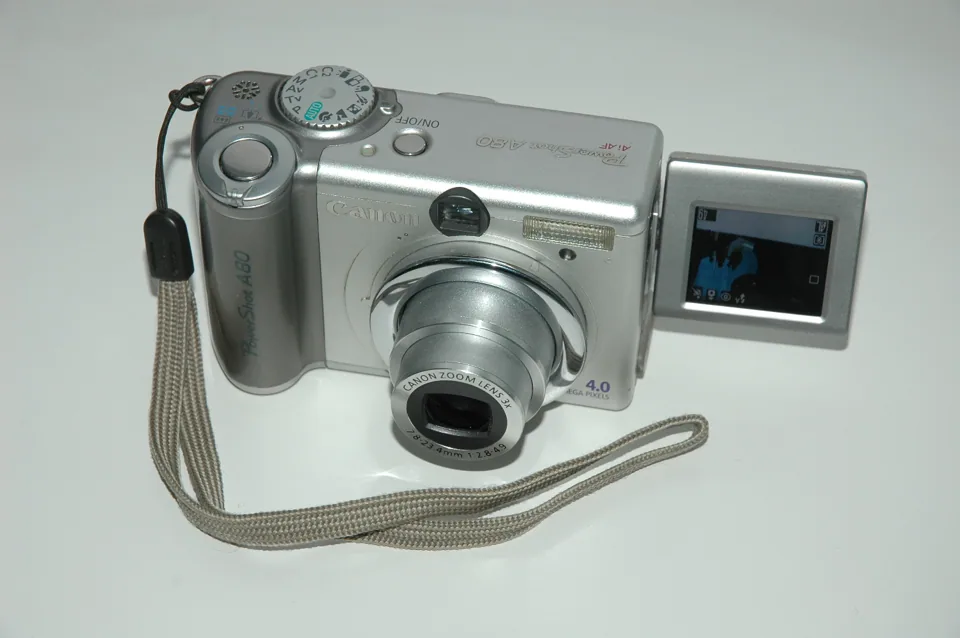
9 of the cameras above take four AA cells: the Canon A80, S3 IS, A640, S5 IS and SX20 IS, the Nikon Coolpix 950 and L810, the Fujifilm S602 Zoom and the Olympus SP-570 UZ. Four cells mean a bigger grip and, in the sources we read, more weight.
| Camera | Launched | Sensor | Cells | Shots: alkaline / NiMH | Source |
|---|---|---|---|---|---|
| Canon PowerShot A80 | Oct 2003 | CCD, 1/1.8-inch, 4.0 MP | 4 AA | Not stated on the page we read | 26 |
| Canon PowerShot S3 IS | Feb 2006 | CCD, 1/2.5-inch, 6.0 MP | 4 AA | 110 / 550 (Canon figures per IR, CIPA, screen on) | 2728 |
| Canon PowerShot A640 | Sep 2006 | CCD, 1/1.8-inch, 10.0 MP | 4 AA | 280 / 500 (supplied alkaline / optional Canon NB-2AH; the page does not say NB-2AH is NiMH, so no ratio) | 29 |
| Canon PowerShot S5 IS | Jun 2007 | CCD, 1/2.5-inch, 8.0 MP | 4 AA | 170 / 450 (CIPA, screen on) | 30 |
| Canon PowerShot SX20 IS | Aug 2009 | CCD, 1/2.3-inch, 12.1 MP | 4 AA | page prints CIPA figures 340, 350 and 220 without naming the cell type, so none is used | 31 |
| Nikon Coolpix 950 | 1999 | CCD, 1/2-inch, 2.1 MP | 4 AA (alkaline, NiCd, NiMH or lithium) | Not stated on the page we read | 32 |
| Nikon Coolpix L810 | Feb 2012 | CCD, 1/2.3-inch, 16.1 MP | 4 AA | 300 / 450 (Nikon's rating as reported; lithium AA 740) | 33 |
| Fujifilm FinePix S602 Zoom | Jun 2002 | Super CCD, 1/1.7-inch, 3.1 MP | 4 AA (box contents differ between IR pages) | Not stated on the page we read | 3435 |
| Olympus SP-570 UZ | Mar 2008 | CCD, 1/2.33-inch, 10 MP | 4 AA | 390 CIPA, cell type not stated | 36 |
The weights show the cost. Imaging Resource lists the Nikon L810 at 430 grams with batteries,33 the Fujifilm S602 Zoom at 499 grams (that sheet does not say whether batteries are included),34 and the Olympus SP-570 UZ at 555 grams with batteries, and says its big grip is home to the four cells.36 Against 183 to 188 grams for the three two-cell cameras whose weights we read, that is roughly two to three times the weight. The reward is reach and resolution, not battery life by itself: the SP-570 UZ has a 20x zoom lens and 10 megapixels,36 the L810 a 26x lens and a 16-megapixel CCD,33 and the A640 a 10-megapixel CCD.29 The Canon SX20 IS pairs a 20x zoom with 12.1 megapixels.31
The oldest row, the Nikon Coolpix 950 of 1999, is a 2.1-megapixel camera that Imaging Resource says runs on four AA alkaline, NiCd, NiMH or lithium cells,32 and the Fujifilm S602 Zoom of 2002 runs on four AA cells instead of the small NP-80 pack used in the 6900 and other earlier FinePix models, a departure Imaging Resource points out.35 (Imaging Resource's data sheet says four NiMH cells and a charger came in the box; its review lists four alkaline cells.)34,35 The oldest row dates from 1999, so AA power in this class goes back at least that far.
3. Is there a digital camera that takes AA batteries?
Yes, and there were many of them. This page covers the used market: CCD compacts, grip cameras and bridge cameras from 1999 to 2012 that run on ordinary AA cells. We link no new camera here.
That shape of the question matters, because the phrase "camera that takes AA batteries" brings up many pages about new models. This guide answers a different one: which old CCD cameras can you still buy, and still feed from a shop-bought cell, without hunting for a discontinued battery pack? The table gives 29 confirmed answers, from Canon's A-series and PowerShot S-series to Nikon's Coolpix L line, Kodak, Fujifilm, Sony, Panasonic, Olympus and Pentax.
The checking rule is strict on purpose. Retailers' "AA battery camera" lists are not evidence, and neither are forum posts. Where a camera appears in forums as an AA model but we could not open a page that states its sensor and its cell count, it is not in the table. The list headed "What we could not confirm" below says what fell out and why.
4. What is the best compact digital camera that uses AA batteries?
There is no single best, and we have not tested any unit. The sources point to different winners by need: the Canon A550 and A560 have the highest NiMH rating among the two-cell cameras (500 shots), the Canon S3 IS (550) and A640 (500, on an optional pack) have the highest figures among the four-cell cameras that have one, and the lightest bodies whose weight we read are the A1200, L22 and LZ8 at 183 to 188 grams with batteries.
Take the pocket case first. Among the two-cell cameras with a NiMH figure, Canon rates the A550 and A560 at 500 shots, the A590 IS and A1200 at 450 and the A570 IS and A720 IS at 400,2,3,6,9,4,5 Sony rates the S600 at 460 on its 2500 mAh cells,18 and Panasonic's LZ8 is listed at 470.23 Those are rated numbers from different makers, so the ranking between brands is loose. The A590 IS museum page lists a lens-shift image stabiliser and a 4x zoom;6 our reading is that if sharp handheld pictures matter more than a few dozen shots per set, that is the reason to look at it first.
The long-zoom case has fewer candidates. Imaging Resource prints 110 alkaline and 550 NiMH shots for the Canon S3 IS,28 the A640 is rated at 500 shots on the optional Canon cells,29 and the L810 is the camera in the table with a long-zoom lithium figure as well (300 alkaline, 450 NiMH, 740 lithium).33 If you want an early, cheap, simple camera, the A80 is the oldest Canon in the table, a four-cell camera with a vari-angle screen that Canon says was a first for the A series.26 If you want the biggest zoom, the SP-570 UZ and L810 are listed at 20x and 26x.36,33
Read the full reviews before choosing: we have written 17 of them, and they cover what these tables cannot, such as picture quality, handling and what reviewers disliked at the time. The cards and cables for each of these cameras are on our card lookup and cable lookup.
5. Do AA digicams last longer on NiMH or alkaline cells?
Yes, NiMH lasts longer, in every case where a source gives a figure for both cell types and says the second is NiMH. Across 14 cameras the NiMH figure is 1.5 to 6.7 times the alkaline one, and for 7 two-cell Canons it is 2.3 to 3.6 times.
The table shows the figures. The ratios are our arithmetic on the page's own numbers: NiMH shots divided by alkaline shots.
| Camera | Alkaline | NiMH | Ratio (our arithmetic) | Source |
|---|---|---|---|---|
| Sony Cyber-shot DSC-H2 | 60 | 400 | 6.7x | 19 |
| Canon PowerShot S3 IS | 110 | 550 | 5.0x | 28 |
| Canon PowerShot A550 | 140 | 500 | 3.6x | 2 |
| Canon PowerShot A560 | 140 | 500 | 3.6x | 3 |
| Canon PowerShot A460 | 120 | 400 | 3.3x | 1 |
| Canon PowerShot A570 IS | 120 | 400 | 3.3x | 4 |
| Sony Cyber-shot DSC-S600 | 160 | 460 | 2.9x | 18 |
| Canon PowerShot A720 IS | 140 | 400 | 2.9x | 5 |
| Canon PowerShot S5 IS | 170 | 450 | 2.6x | 30 |
| Canon PowerShot A590 IS | 200 | 450 | 2.3x | 7 |
| Canon PowerShot A1200 | 200 | 450 | 2.3x | 9 |
| Nikon Coolpix L22 | 240 | 420 | 1.8x | 12 |
| Nikon Coolpix L3 | 200 | 330 | 1.7x | 11 |
| Nikon Coolpix L810 | 300 | 450 | 1.5x | 33 |
The spread is wide. The best ratio is the Sony Cyber-shot DSC-H2 at 6.7 times; the lowest is the Nikon Coolpix L810 at 1.5 times. The two highest are the H2 (6.7) and S3 IS (5.0); the three lowest are the L22 (1.8), L3 (1.7), L810 (1.5). The seven two-cell Canons from the Canon museum and manual sit between 2.3 and 3.6 times. These are different makers' ratings, made in different years with different cells (Sony's are on 2100 and 2500 mAh packs), so we do not draw a rule from the gap. Canon's own manual for the A590 IS warns that alkaline performance differs by brand and that the cells you buy may not last as long as the ones in the box, and it recommends NiMH for cold weather and long sessions.7 Its SX130 IS manual says NiMH lasts much longer than alkaline, especially in the cold.37
The oldest evidence agrees. In 2002 Imaging Resource's Dave Etchells bench-tested sets of four cells outside any camera. The three alkaline sets delivered 3.3 to 3.4 watt-hours, roughly half of the 6.7 watt-hours from the best NiMH sets, and he called ordinary alkaline cells close to useless in AA digicams.38 That was a constant-load test on 2002 cells, and he later noted that some newer cameras had become much more efficient with their batteries.39 So treat it as a direction, not a figure for any camera on this page.
A final caution about the table: a few rows are partial. The Kodak C875 has only a NiMH rating on the page we read, the Panasonic LZ5's 235 shots are on the Oxyride cells supplied with it, not on NiMH,15,22 and the Canon A640's 500 shots are on an optional Canon pack that the museum page does not call NiMH.29 They are shown in the first table, not in the ratio table, because the pair is not alkaline against NiMH.
6. Which AA batteries and charger should I buy?
Rechargeable NiMH AA cells and a charger. Every source above that rates both cell types gives NiMH the higher figure, and Canon names its own NiMH cells as the rechargeable it recommends. We do not rank cell brands, because we tested none and the sources do not agree on one.
Canon's A590 IS manual lists a Battery and Charger Kit (CBK4-300) with a charger and four AA NiMH cells (NB-3AH), and notes that two batteries are used for this camera.7 The manual's cautions are specific: it says NiCd cells can be used but performance is unreliable, and it does not recommend them.7 Some of the cameras above came with the right cells in the box. The Sony H2 and Sony P72 each shipped with NiMH cells and a charger, according to Imaging Resource (for the Fujifilm S602 Zoom its data sheet says the same, but its review lists alkaline cells);19,20,34,35 the Canon A590 IS and A640 and the Nikon L3 and L22 shipped with alkaline cells.7,29,11,12 Etchells' view in 2002 was that an AA camera owner needs high-capacity NiMH cells and a good charger, and that cell brands and especially chargers vary a lot.38 A used camera often arrives without either.
Practical buying: two cells for the pocket cameras, four for the grip and bridge cameras, and a second set so one is always charged, which is also Etchells' advice to carry spare sets.38 The links below are searches for the cell type, not a statement that a listing fits a particular camera. Charger and cell compatibility with your camera is something to read in your own manual; the Canon pages we read name Canon's own cells, and we did not test third-party ones.
7. Can I use lithium AA, Oxyride or USB-rechargeable cells?
It depends on the maker, and we cannot give one rule. Some pages we read list lithium AA as supported, Canon's SX130 IS manual says it cannot recommend cells other than alkaline and Canon NiMH, and we found no maker page for USB-rechargeable lithium-ion AA cells at all.
Where lithium AA is named as supported, the page is a maker's guide or a reviewer's spec sheet, and we tested none. Kodak's own C875 guide lists "2-AA lithium" among the power options.14 Imaging Resource lists lithium for the Nikon Coolpix 950, the Sony P72 and the Nikon L3 (630 shots on lithium against 200 on alkaline),32,20,11 and gives the Nikon L810 a rating of 740 shots on lithium AA against 450 on NiMH.33 The same site's Panasonic LZ8 and Pentax E50 data sheets list lithium disposables as usable.23,24
The counter-evidence is just as direct. Canon's SX130 IS manual answers the question in its own words: it cannot recommend batteries other than the ones it lists because performance varies widely.37 Imaging Resource's review of the Sony H2 says alkaline, manganese, lithium and NiCd cells are not recommended for it.19 The two positions are not contradictory; they apply to different cameras. The takeaway is to read the manual of the camera you buy before you trust a general answer, including this one.
Oxyride is the case we can say least about. The one page we read that mentions it is PhotographyBLOG's review of the Panasonic LZ5, which says an Oxyride cell pack was supplied with the camera and gives 235 shots on CIPA;22 we did not read a maker page that says whether Oxyride is safe or advisable in other cameras. The same is true of USB-rechargeable lithium-ion cells shaped like AA batteries: we found no maker statement, so we do not say they work or do not work. These are in the list of things we could not confirm below.
8. Why do so few CCD digicams take AA batteries?
In the one maker we could count, AA models were a minority of CCD compacts. The only share we can measure is Canon's: about 37 percent of the museum pages that name a CCD also name AA cells, and the other 94 do not name them.
Canon is the only maker we could count. Of the 150 Canon compacts whose museum page names a CCD, 56 also name AA cells in the power line (about 37 percent), out of 240 Canon pages in our catalogue; 12 of the other 94 CCD pages have no power line in our catalogue, so "do not name AA" is not the same as "take another battery".40 We have no equivalent count for other makers. Our reading of the Canon figure is that AA power was a deliberate product line, not a curiosity: in our table the smaller A-series models take two cells and the A80, A640, S3 IS and S5 IS take four.41,42
It also explains why the tables are dominated by Canon. The Canon Camera Museum prints the sensor type and the power source for most models, so Canon rows were checkable from one maker page; other makers needed a manual or a full review for each row, and those that we could not open are left out. The balance of the table says as much about our sources as about the market.
The practical reason people look for AA cameras now is on our power page: a camera with a proprietary pack needs that exact code, found on the maker's manual, while an AA camera takes cells sold in any shop. The battery and USB charging page has the manual quotes for the cameras we cover, and the Canon battery codes page lists the codes for every Canon compact. Our reading: for a first used digicam, an AA model removes the need to match a battery code.25
9. What should I check before buying an AA camera?
Check how many cells it takes and what is in the box, the memory card type, and the cable. Those three decide whether the camera is usable the day it arrives, and each is documented for the cameras above.
Cells and box. Two or four cells decides the body. What comes with it varies: the A590 IS box held two alkaline cells,7 while the A640 shipped four supplied alkaline cells,29 so a used one may have been sold with neither. If the listing says rechargeable, ask which cell type, and ask for a photo of the battery compartment.
Cards. AA cameras span every card family of their time. The Canon A590 IS manual lists SD memory cards,7 the Sony S600 takes Memory Stick Duo,18 and the Olympus SP-570 UZ takes xD-Picture cards of up to 2 GB.36 A card from a newer camera may not fit or may not be supported; the card lookup and the memory card guide show the maker-stated limits.43
Cables. The Canon A590 IS manual lists an IFC-400PCU interface cable in the box,7 and Imaging Resource lists the same cable with the S3 IS.28 Other makers differ, so check the cable lookup and the cable guide before buying a lead.44
The rest. Our ten-point buying checklist covers screen, lens, speed and eBay's condition words, and the comparison pages set pairs of cameras side by side. We print no used prices: the sold-listings links below show what these cameras fetch.
What we could not confirm
- Canon PowerShot SX130 IS: Canon's manual confirms two AA cells and 130 / 370 shots, but no page we read states its sensor type, so the camera is not in the table. Canon's museum page gives no sensor type either.
- Nikon Coolpix L20 and L100: Imaging Resource's pages give the AA counts (2 and 4) and rate the alkalines at 240 and 350 shots, but they do not state the sensor type, and the pages that do (DPReview) could not be opened by our scripts.
- Kodak EasyShare Z740, Sony DSC-P92 and other models seen on forum lists: the pages that would state both facts were not available to us, so they are not listed.
- Oxyride cells: mentioned only as the cells supplied with the Panasonic LZ5 (PhotographyBLOG). No maker page we read says whether they are suitable in other cameras.
- Lithium AA cells: listed as supported by some pages and not recommended by others (Canon SX130 IS manual, Sony H2 review). We give no general answer.
- USB-rechargeable lithium-ion AA cells: no maker statement found, so no claim either way.
- Real battery life: we have not tested any unit. All shot counts are the page's own figures, from different makers and years, and are not comparable across brands.
- Battery leakage and corrosion in used cameras, and clock or date resets when cells are swapped: no source we read speaks to these, so we do not state them.
- Cameras from makers we did not read for this page (Casio, Ricoh, Minolta, Samsung and others): none is listed, which does not mean none takes AA.
Where to find cells and cameras
- A used AA-powered camera, Canon A590 IS: Recently sold on eBay Live eBay listings
- A used AA-powered camera, Canon A640: Recently sold on eBay Live eBay listings
- A used AA-powered camera, Nikon Coolpix L810: Recently sold on eBay Live eBay listings
- NiMH AA cells and a charger: NiMH AA rechargeable batteries and charger on Amazon
- Spare NiMH AA cells: NiMH AA rechargeable batteries on Amazon
Affiliate links: we may earn a commission. As an Amazon Associate I earn from qualifying purchases. We print no used-camera prices; the sold listings show what these actually fetch.
The eBay links are affiliate links through the eBay Partner Network, and the Amazon links are Amazon Associates links; both are marked sponsored. They are searches, so check the listing against your own camera's manual.
How we checked
For each camera we opened one or more of: the Canon Camera Museum page, the maker's own user guide, or a full review or data sheet, and noted the sensor type, the AA count and any shots per set the page gives. A row appears only if the same sources state both the CCD and the AA count; where two sources were needed (for example the Canon A1200, whose museum page gives the cells and whose sensor type comes from Imaging Resource), both are in the Source column. Shots are copied as printed, not converted. All pages were opened on 2026-10-22. The maker pages do not always say how the figure was measured, so we mark CIPA where the page does.
Related: batteries and USB charging · Canon battery codes · memory cards · cables · comparisons · ten things to check before you buy · all reviewed cameras
Sources
- Canon Camera Museum, PowerShot A460 (marketed March 2007)
- Canon Camera Museum, PowerShot A550 (marketed March 2007)
- Canon Camera Museum, PowerShot A560 (marketed March 2007)
- Canon Camera Museum, PowerShot A570 IS (marketed March 2007)
- Canon Camera Museum, PowerShot A720 IS (marketed August 2007)
- Canon Camera Museum, PowerShot A590 IS (marketed February 2008)
- Canon PowerShot A590 IS Camera User Guide (PDF; box contents on the Confirming the Package Contents page, battery notes p. 171, battery capacity p. 191)
- Canon Camera Museum, PowerShot A700 (marketed April 2006)
- Canon Camera Museum, PowerShot A1200 (marketed March 2011)
- Imaging Resource, Canon PowerShot A1200 specifications and overview (posted 5 January 2011)
- Imaging Resource, Nikon Coolpix L3 review (available 2006-02-28)
- Imaging Resource, Nikon Coolpix L22 specifications (available 2010-02-15)
- Imaging Resource, Nikon Coolpix 3200 review (available March 2004)
- Kodak, EasyShare C875 user's guide, Camera specifications
- Imaging Resource, Kodak EasyShare C875 data sheet (available 2006-08-01)
- Imaging Resource, Kodak EasyShare Z700 review (available April 2005)
- Imaging Resource, Fujifilm FinePix A900 specifications (ships May 2007)
- Imaging Resource, Sony Cyber-shot DSC-S600 review (available March 2006)
- Imaging Resource, Sony Cyber-shot DSC-H2 review (available 2006-05-01)
- Imaging Resource, Sony Cyber-shot DSC-P72 review
- Imaging Resource, Sony Cyber-shot DSC-P32, P52, P72 and P92 announcement (February 2003)
- PhotographyBLOG, Panasonic Lumix DMC-LZ5 review (2006)
- Imaging Resource, Panasonic Lumix DMC-LZ8 data sheet (available 2008-02-27)
- Imaging Resource, Pentax Optio E50 data sheet (available 2008-03-30)
- Digicam Atlas: Digicam batteries and USB charging (maker-manual quotes for AA cameras)
- Canon Camera Museum, PowerShot A80 (marketed October 2003)
- Canon Camera Museum, PowerShot S3 IS (marketed February 2006)
- Imaging Resource, Canon PowerShot S3 IS review
- Canon Camera Museum, PowerShot A640 (marketed September 2006)
- Canon Camera Museum, PowerShot S5 IS (marketed June 2007)
- Canon Camera Museum, PowerShot SX20 IS (marketed August 2009)
- Imaging Resource, Nikon Coolpix 950 review (February 1999)
- Imaging Resource, Nikon Coolpix L810 specifications (available 2012-02-15)
- Imaging Resource, Fujifilm FinePix S602 Zoom data sheet (available 2002-06-30)
- Imaging Resource, Fujifilm FinePix S602 Zoom review, power section
- Imaging Resource, Olympus SP-570 UZ review (available 2008-03-31)
- Canon PowerShot SX130 IS Camera User Guide (PDF copy hosted by a Canon retailer; battery FAQ p. 16, specifications p. 169)
- Imaging Resource newsletter vol. 4 no. 3, The Great Imaging Resource Battery Shootout (8 February 2002)
- Imaging Resource, The Great Battery Shootout page by Dave Etchells (marked no longer maintained)
- Digicam Atlas catalogue of the Canon Camera Museum compacts (240 pages, sensor and power lines as the museum prints them)
- Digicam Atlas: Which Canon PowerShot cameras have a CCD sensor?
- Digicam Atlas: Canon battery codes
- Digicam Atlas: Which memory card does my digicam take?
- Digicam Atlas: Digicam cables explained