Nikon Coolpix · on sale spring 1999
The Nikon Coolpix 950: the swivel camera that made 2 megapixels look serious
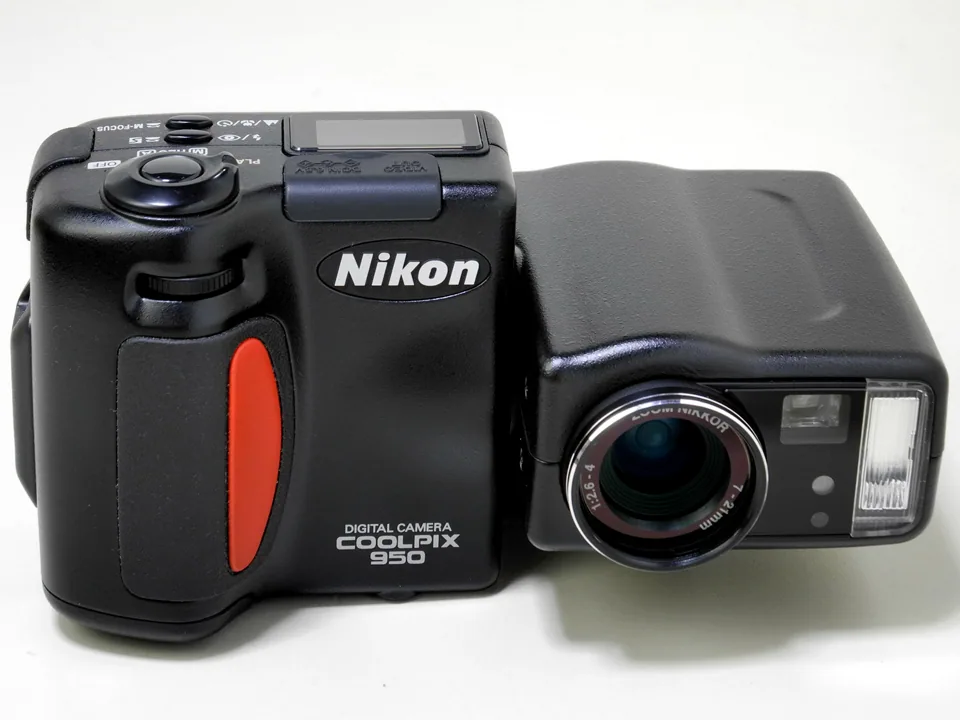

In 1999 Nikon put a 2.1-megapixel sensor, a metal body and real exposure controls into a camera whose lens half twists over its grip, and asked about $1,000 for it. Reviewers listed the flaws and recommended it anyway.
- Launched
- February 1999
- Sensor
- 2.1 MP CCD
- Lens
- 38–115 mm, 3×
- Card
- CompactFlash Type I
- Battery
- 4 x AA (alkaline, NiCd, NiMH or lithium)
Nikon Coolpix 950 specs: sensor, lens, battery, memory card and cable
The Nikon Coolpix 950 came out in February 1999 as a 2.1 MP CCD compact with a 38–115 mm (35 mm equivalent) 3× zoom lens. It takes CompactFlash Type I cards and runs on 4 x AA (alkaline, NiCd, NiMH or lithium) batteries. Sources
- Sensor
- CCD, 1/2", 2.1 MP source
- Lens
- 38–115 mm equivalent, 3× zoom source
- Memory card
- CompactFlash Type I source
- Battery
- 4 x AA (alkaline, NiCd, NiMH or lithium) source
- USB / A/V cable
- SC-EW2, RS-232C, SC-EM2, EG-900 Confirmed · all Nikon cables
Meet the camera
Imaging Resource opened its review by calling the 950 the first camera in Nikon's popular line to break the 2-megapixel barrier,2 and wrote that the all-metal body felt more solid than it remembered the Coolpix 900 being; Nikon advertised it as magnesium.2 The body is two halves joined by a swivel bearing: lens, flash and sensor in one, grip, screen and controls in the other. Cameralabs' Gordon Laing, writing in 2022, said the lens half turns through just over 270 degrees with notches at 90-degree intervals, and called the mechanism an ergonomic triumph.6
It had one name in our sources. DPReview, whose review says the story broke in mid-February 1999, listed an undated street price of US$880;1 Macworld's May 1999 issue listed $999,4 and Nikon's own January 2000 price-cut release put the original MSRP at $999 and the new one at $899.5 So we do not have one confirmed launch price; the sources below disagree. The Digital Kamera Museum lists an MSRP of $995, a small conflict with the $999 figure.7 Cameralabs recalled a launch price of roughly $850 to $1,000.6
Why this one was interesting
It followed a camera people loved and distrusted
DPReview wrote that much of the excitement came from the Coolpix 900 series, which had shown what a digital camera could do, though its swivel joints broke, its zoom buttons failed and some units locked up. Nikon had announced it was no longer producing the 900s, and the review said there were high expectations for the 950; it also said the excitement grew out of the 900s' reputation.1 Imaging Resource said the new swivel looked much like the 900's but with a beefed-up bearing.2 DPReview described it as much stiffer than the previous type.1
A prosumer camera in a pocketable body
Imaging Resource concluded that the 950 represented a significant advance for what it called prosumer digital photography, citing its resolution, image quality, creative controls and user interface.2 The controls are the reason: most settings sit on three buttons and a front selector wheel, and a status screen on top lets you check them without waking the power-hungry rear display.2 The camera offered program, aperture-priority and shutter-priority exposure, spot and centre-weighted metering besides its 256-segment matrix mode, and manual focus in ten steps from 10 cm to infinity.2
Priced against the film cameras it hoped to replace
Cameralabs said the picture quality and, above all, the level of control were good enough to persuade many photographers to move from film, at least for some jobs.6 DPReview recommended it both to first-time digital buyers and to people coming from 35 mm SLRs or point-and-shoots.1
The same swivel idea, in a much smaller and friendlier package, came back three years later in our Coolpix 2500 retrospective.
What it did not do
There is no USB. DPReview regretted that Nikon had not chosen it, listing a serial connection at up to 115 kbps on a PC and 230 kbps on a Mac,1 and Cameralabs called serial transfer very slow.6 The card slot takes Type I CompactFlash only, so a Type II card such as a Microdrive will not fit.1 Nikon packed in an 8 MB card, which DPReview's file-size table showed holds one uncompressed TIFF of 5,633 KB or about ten Fine JPEGs at full resolution;1 DPReview called that a poor bundle for a 2-megapixel camera.1
The dark: its weak point
On low light the two main reviews we read pulled in slightly different directions. Imaging Resource's main review page gave two figures: semi-usable images down to EV 4, but a "more usable" lower limit of around EV 6 to 7.2 Its test page said usable images to EV 5, softer below about EV 7 because the contrast-detection autofocus ran short of signal, and mall night shots at ISO 320 (1.0 to 1.4 seconds) rated very impressive.3 DPReview listed sometimes-poor low-light focusing as a con and said an autofocus assist lamp would have helped.1
Noise was a mixed picture. DPReview found noise low across the sensitivity steps and the Fine JPEG very clean;1 Imaging Resource said noise rose visibly with ISO, especially at 320, and noted that Nikon attributed this to prototype electronics, expecting improvement in the final design.3 Long exposures were another weak spot: DPReview saw "stuck" pixels on exposures longer than one second,1 and Imaging Resource saw them at about eight seconds.3
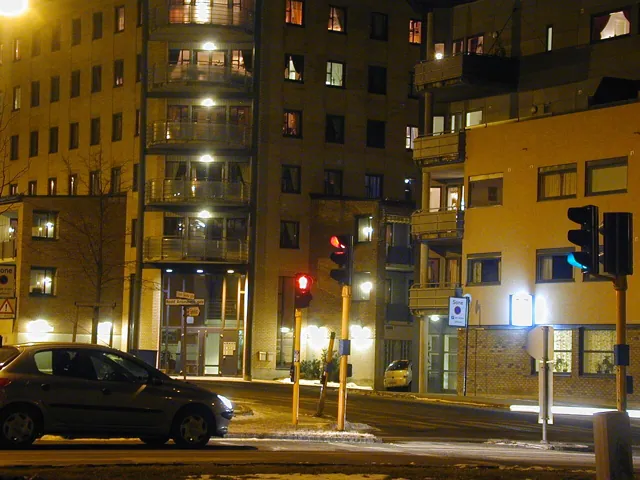

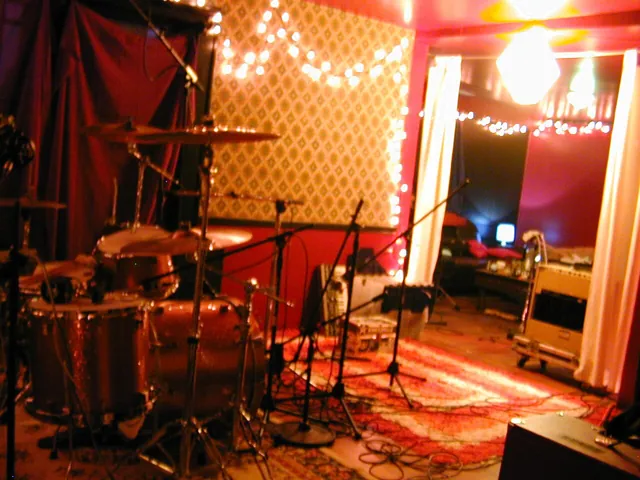

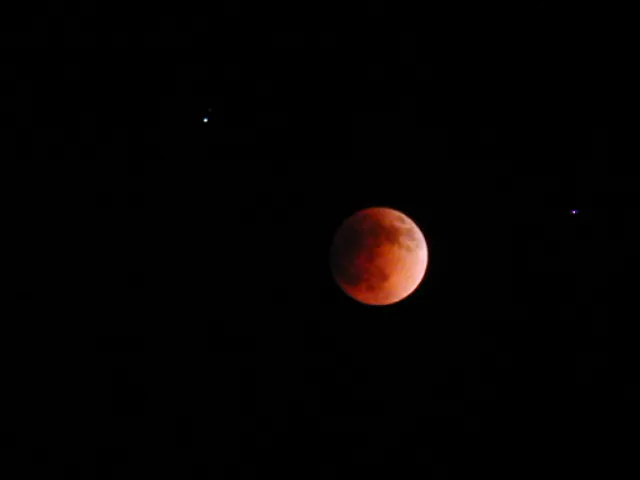

Real photographs taken with this camera. The sensitivity shown is recorded in each file's own EXIF data.
Like that look? See recent eBay sold listings for this camera ↗
On eBay right now
Live listings for this camera, supplied by eBay and updated automatically. We earn a commission if you buy through them.
The little wins
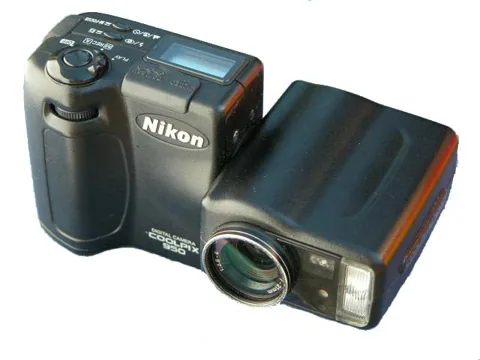 The Coolpix 950 with its lens half turned away from the grip. · W. M. Connolley · CC BY-SA 3.0 · Commons

A swivel that moves with purpose
Imaging Resource described four locked 90-degree positions for the lens section (Cameralabs counted notches at three 90-degree intervals), and DPReview listed the swivelling barrel among its pros.261
Best Shot Selector
Hold the shutter and the camera shoots a burst and keeps one frame. DPReview said BSS takes up to eight frames, roughly one a second, and that in a handheld half-second test it gave a sharper result than a single shot;1 Macworld's listing and Imaging Resource's review text said five frames (Imaging Resource's feature list elsewhere says ten).42
Controls on the outside
Imaging Resource called the user interface one of Nikon's most impressive achievements on the 950, helped by the front selector wheel and the top status screen.2 DPReview listed quick and easy menus thanks to the new command wheel.1
How it drew the picture
Imaging Resource measured visual resolution of about 800 line pairs per picture height horizontally and 650 to 700 vertically, and called that the best it had seen to date, as of 14 February 1999.3 DPReview described very fine detail, bright and accurate colour, almost perfectly exposed matrix-metered pictures and little need for sharpening.1 Imaging Resource found natural flesh tones but blues that leaned toward red and could print purplish, and said high-key scenes were often underexposed so that it usually applied +0.7 EV.3

















Photos taken with this camera, from Wikimedia Commons, credited under each picture.
Where it let you down
DPReview's cons list: barrel distortion, colour fringing on high-contrast areas, 3.5 seconds to zoom from wide to tele, a tripod mount so placed that the card and batteries are out of reach while mounted, no Type II cards, a serial port, the small card and a choice of uncompressed TIFF where a smaller raw format would have been better.1 Imaging Resource measured 0.9 percent barrel distortion at wide angle,2 found the rear screen hard to see in bright sunlight, and called the plastic card door flimsy.2 DPReview said the same door could flop open and, separately, found the screen very hard to use in bright light.1
Timings differ by method. Imaging Resource measured about 0.8 seconds of shutter lag with full autofocus and about 0.1 seconds prefocused, with about 3.5 seconds to start up;2 DPReview's table listed about 0.1 seconds, and about 3.5 seconds from off to record.1 On batteries, DPReview said alkaline AAs were too short-lived to fill an 8 MB card and got about five hours, roughly 180 shots, from a set of 1300 mAh NiMH cells, using the screen most of the time for composing, against an official figure of about 500 shots with the screen off.1
What the reviewers said in 1999
| Outlet | Date | Verdict |
|---|---|---|
| Imaging Resource | 15 Feb, 10 Mar and 22 Jul 1999 | A significant advance for prosumer digital photography; tests began on a prototype and the review was updated with a production unit.23 |
| DPReview | 24 Aug 1999 | Highly recommended. Ratings out of 10: construction 10, features 10, image quality 9, lens/CCD 8, ease of use 9, value 10, inspiration 9.1 |
| Cameralabs (retrospective) | 14 Oct 2022 | The twisting mechanism remains an ergonomic triumph; no USB, slow zoom, continuous-autofocus chatter. Named the 950, with the 990 and 995, among the most desirable early Coolpix cameras.6 |
The timeline
- February 1999Announcement, per DPReview; Imaging Resource posts its initial review on 15 February from a prototype.12
- 10 March 1999Imaging Resource's full review.2
- 30 April 1999Macworld lists the CoolPix 950 at $999.4
- 22 July 1999Latest revision of Imaging Resource's review.2
- 24 August 1999DPReview publishes its review.1
- 10 January 2000Nikon cuts the 950's list price from $999 to $899.5
Should you buy one now?
Buy one if you want a landmark early digicam with a solid metal body and proper exposure controls, and you accept 1600 by 1200 pictures, serial-only transfer and a card reader habit. It was listed at $999 in 1999 (sources conflict, see above);45 what it sells for now is a question for the sold listings, not for us. Before you bid, check these:
- The swivel. Check that the lens half turns smoothly and locks at each 90-degree stop, since the swivel joints on earlier 900-series cameras were a known failure point.21
- The card door. Reviewers called the plastic door flimsy and said it could flop open; check that it closes.21
- The card. It takes CompactFlash Type I only;1 see our CompactFlash guide and cards on Amazon ↗.
- The power. It runs on four AA cells; DPReview found alkalines short-lived and used NiMH.1 Fresh rechargeable AAs on Amazon ↗ are the easy route.
- The tripod. The tripod thread blocks the card and battery doors when mounted.16
- Getting pictures off. It has serial ports and no USB,12 so plan to use a card reader.
- Hot pixels. DPReview saw stuck pixels on longer exposures; try a few-second exposure in the dark.1
If you are wondering why cameras like this are being hunted down again, we tell that story once, in Pictures that never left the card.
See recent sold prices on eBay ↗Shop on eBay ↗Rechargeable AA batteries ↗
Sources
- DPReview, Nikon Coolpix 950 review by Phil Askey (24 Aug 1999; specifications, design, timing, battery life, conclusion)
- Imaging Resource, Nikon CoolPix 950 review (initial 15 Feb 1999, full 10 Mar 1999, last revised 22 Jul 1999)
- Imaging Resource, Nikon CoolPix 950 pictures page (tests dated 14 Feb 1999, some updated 30 May 1999)
- Macworld, “New cameras” (30 Apr 1999; May 1999 issue, p. 29), listing the CoolPix 950 at $999
- DPReview, Nikon price cuts article (9 Jan 2000, with Nikon's 10 Jan 2000 press release)
- Cameralabs, “Nikon Coolpix 950 retro review” by Gordon Laing (14 Oct 2022)
- Digital Kamera Museum, Nikon CoolPix 950 (MSRP $995, size and weight)
Camera photos by Hiyotada (CC BY-SA 3.0) and W. M. Connolley (CC BY-SA 3.0); other photographs are credited under each one, all via Wikimedia Commons. Links to eBay and Amazon are affiliate links.