Canon PowerShot A · October 2003
The Canon PowerShot A80: the budget Canon with a screen that swung out
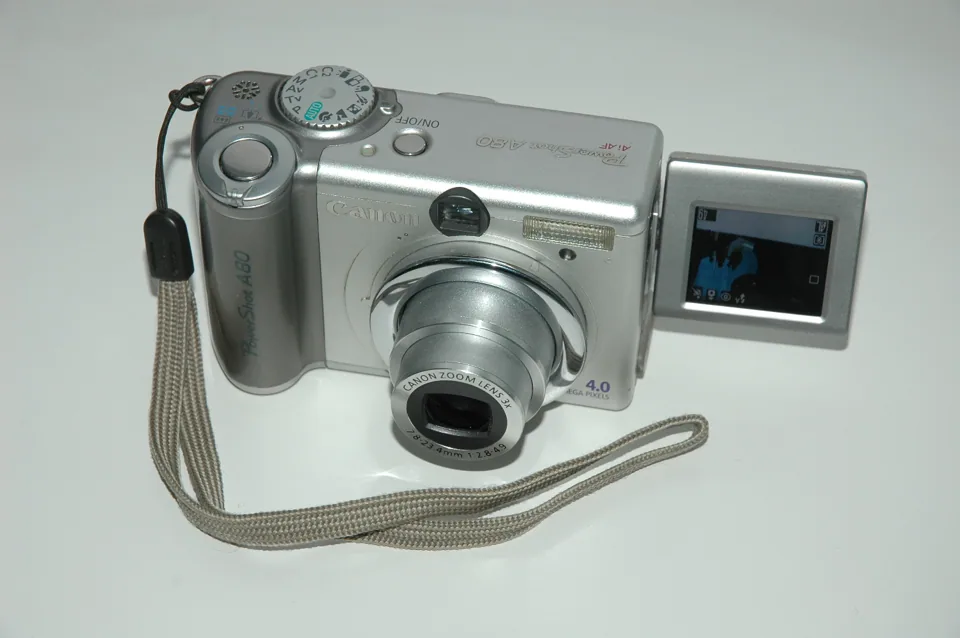

In late 2003 Canon gave its cheapest enthusiast line a 4-megapixel sensor, two programmable custom modes and a Vari-Angle screen borrowed from the G series. Imaging Resource praised the colour and battery life, and the three reviewers disagreed about the noise.
Canon PowerShot A80 specs: sensor, lens, battery, memory card and cable
Launched in October 2003 at $399, the Canon PowerShot A80 is a 4 MP CCD compact with a 38–114 mm (35 mm equivalent) 3× zoom lens. Inside: it takes CompactFlash cards and runs on AA batteries. Sources
- Sensor
- CCD, 1/1.8", 4 MP source
- Lens
- 38–114 mm equivalent, 3× zoom source
- Memory card
- CompactFlash source
- Battery
- AA source
- USB / A/V cable
- IFC-300PCU, AVC-DC100 Confirmed · all Canon cables
Meet the camera
The A80 is a silver, slightly boxy compact with a fat grip on the right, and it is not small. Canon lists it at 103 by 64 by 35 millimetres and about 250 grams, body only;1 Imaging Resource, weighing it with batteries and a card, got 368 grams and said it would not fit a shirt pocket.3 Reviewed.com called the design boxy and functional, thicker than the Pentax Optio S4i and Panasonic DMC-LC43 it compared it with.5
The reviewers disagree about what it is made of. Canon calls it a compact metal body,1 Bob Atkins found a mostly metal shell that felt solid,4 and Imaging Resource described a plastic body with metal decorative panels (the same page also calls it all-plastic once).3 Reviewed.com mentioned only a darker grey plastic handgrip.5
It succeeded the A70, which Canon's museum says was acclaimed worldwide for its value after its March 2003 launch.2 Imaging Resource listed the A80 at a suggested $399 at introduction.3 Reviewed.com, on an undated page, called it a $299 camera,5 so we show both and cannot say whether the lower figure was a later street price.
- Sensor
- 4.0 MP CCD, 1/1.8" (about 4.1 MP total)1
- Lens
- 3x, 38–114 mm equiv., f/2.8–f/4.91
- ISO
- Auto, 50, 100, 200, 4001
- Screen
- 1.5", about 67,000 dots, swivelling; optical viewfinder1
- Video
- 320 × 240 or 160 × 120, about 15 frames a second1
- Card and power
- CompactFlash Type I · four AA batteries1
- Size
- 103.1 × 64.4 × 34.7 mm, about 250 g, body only1
Why this one was interesting
A screen from the G series
Canon's museum says it was the first PowerShot A model with a Vari-Angle monitor, a feature it describes as usually found on the G series. The screen turns through 180 degrees horizontally and 270 degrees vertically, or folds back into the body.1 Atkins adds that it can fold in screen-side out for use or screen-side in for storage.4 Imaging Resource liked the protection: close the screen facing in and the camera powers the display off and shuts the aperture.3 Atkins noted the image stays the right way up when the screen faces forward, so self-portraits work.4
Two sets of settings you could recall
The mode dial gained two custom positions, C1 and C2, which store a set of exposure settings. Imaging Resource's example was a wedding photographer moving between indoor and outdoor scenes.3 Canon counts them among the high-end features it brought down to this camera.1
Where it sat in the line
Imaging Resource said Canon's A40 had topped its readers' popularity chart the year before, and that the A70 had followed it with a larger CCD and more manual control.3 Atkins called the A70 widely regarded as one of the best point-and-shoot cameras and the A80 a significant upgrade, and said the A70 usually sold for about $100 less.4 The camera that followed, the A75 of March 2004, went back to a 3.2-megapixel sensor with a bigger, fixed 1.8-inch screen.25 Reviewed.com called the A75 the previous model, released earlier in 2004; Canon's museum dates the A75 March 2004, five months after the A80, so the two sources conflict.521
Later AA-powered A-series cameras we have reviewed include the PowerShot A700 (2006), the PowerShot A640 (2006) and the PowerShot A590 IS (2008).
What was lost
Canon says the new lens design reduced the camera's overall thickness despite the larger sensor.1 One visible cost was the screen. Reviewed.com called its 67,000 dots very unimpressive,5 and Canon's A75 arrived the following March with a larger fixed screen.2 The optical viewfinder suffered too: Imaging Resource measured it at about 80 percent of the frame at wide angle and 82 percent at telephoto,3 while Atkins found it distorted, soft at full telephoto and without diopter adjustment,4 and Reviewed.com thought it too small for comfortable use.5
The dark: its weak point
The three reviewers split on noise. Imaging Resource found excellent low-light ability, with bright images down to the limit of its test (0.67 lux) at ISO 100 and above and noise that was quite acceptable even at ISO 400.3 Reviewed.com's Imatest noise test found adequate resolution and clarity at ISO 100 and below, called ISO 400 images fraught with noise and distortion, and said the camera needs additional lighting in moderately lit scenes.5 Atkins offered a possible reason for part of the difference: in his comparison with an EOS 10D the A80's labelled ISO values read about one stop conservative, so he put the real range nearer ISO 100–800 than 50–400.4 The A80's longest exposure is 15 seconds,1 and Atkins noted noise reduction kicks in from 1.3 seconds.4
Flash is modest. Canon lists a normal range of 0.45 to 4.4 metres at wide angle and 0.45 to 2.5 metres at telephoto.1 Imaging Resource found the flash overexposed close-ups, and Atkins noted there is no external flash connection and the pre-flash fires in every mode.34
Like the look of 2003? See recent eBay sold listings for this camera ↗
On eBay right now
Live listings for this camera, supplied by eBay and updated automatically. We earn a commission if you buy through them.
The little wins
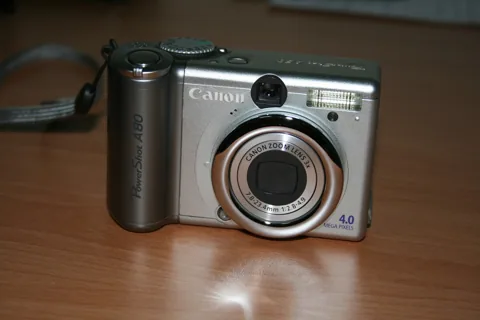 The A80 from the front. · Yi-Ting Chen · CC BY-SA 2.0 · Commons

Colour and exposure
Imaging Resource called the colour excellent, with slightly oversaturated strong reds and blues and slightly pinkish skin tones, and exposure better than average.3 Reviewed.com's Imatest chart gave a mean saturation of 114.7 percent, which it said is common for digital cameras, and judged the colour result in line with Canon's reputation.5
Batteries you can buy anywhere
Four AA cells instead of a Li-ion pack: Atkins said they are cheap and easy to find and may last longer.4 Imaging Resource's worst-case run time with 1600 mAh cells was almost three hours, and 18 hours with the screen off in capture mode.3
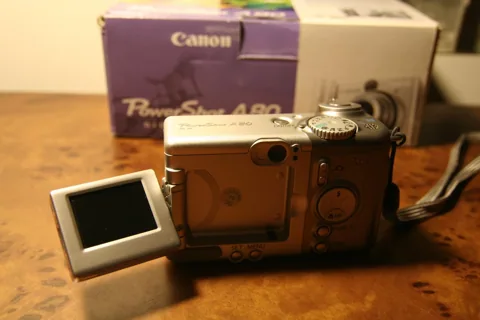 The A80 from the back, screen swung open. · Yi-Ting Chen · CC BY-SA 2.0 · Commons

A real macro mode
Imaging Resource measured a minimum area of 59 by 44 millimetres and very high resolution.3 Canon lists macro focus from 5 centimetres at wide angle.1
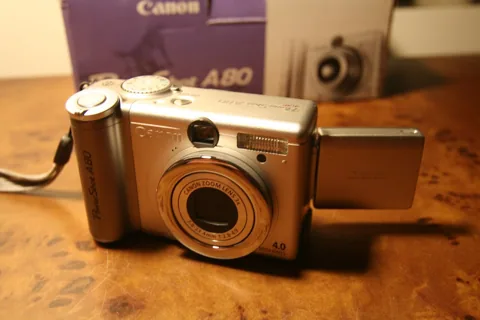 The A80 from the front, screen angled out. · Yi-Ting Chen · CC BY-SA 2.0 · Commons

A friendly dial
Reviewed.com scored ease of use 8 out of 10 and called its handling among the best, with basics reachable without digging through menus.5 Imaging Resource thought the interface cryptic at first but quick to learn within an hour.3
How it drew the picture
Imaging Resource rated picture quality Very Good and found resolution good but slightly soft: artifacts from about 650–700 lines per picture height, strong detail to at least 1,150 and extinction near 1,450.3 Reviewed.com's Imatest run gave 2.73 real megapixels, which it said was about 70 percent of the stated count and a good score.5 Atkins said image quality was good and chromatic aberration well controlled, and that 4 megapixels is enough for good 8 by 10 prints.4 Imaging Resource measured barrel distortion of about 0.7 percent at wide angle and about 0.03 percent at telephoto.3
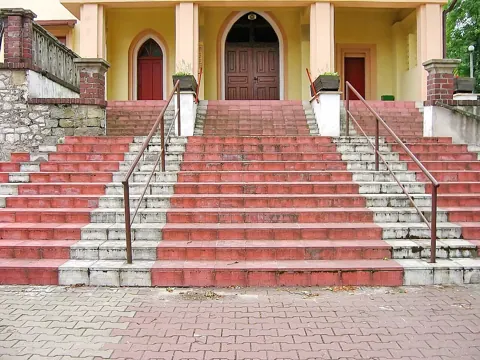







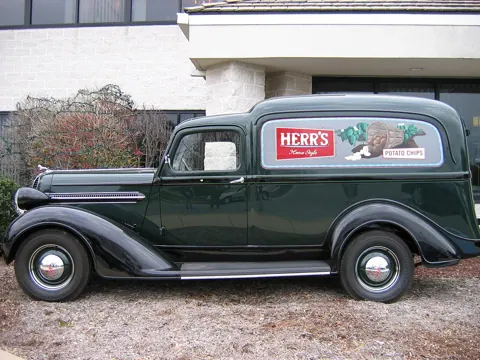

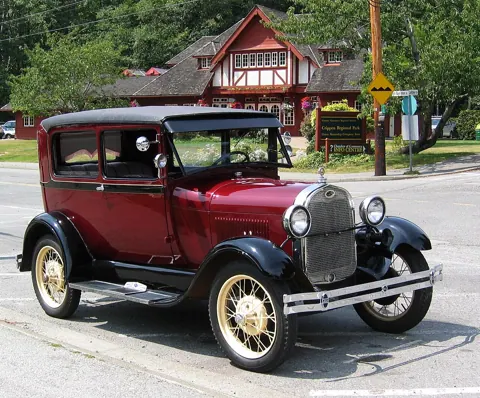

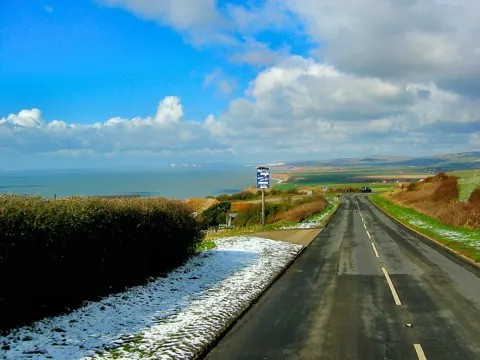



Photos taken with this camera, from Wikimedia Commons, credited under each picture. We chose them for variety, not to prove anything about quality.
Where it let you down
Speed was the complaint. Atkins put switch-on at about 2.5 seconds and shutter lag at about 0.65 seconds in manual focus (his estimate from stopwatch images), usually a second or more with autofocus;4 Reviewed.com measured about 3.3 seconds to the first shot and shutter lag of 1.13 seconds zoomed out and 0.6 at telephoto.5 It also found the power button had to be held for a few seconds.5 Continuous shooting is about 2.4 frames a second with the screen off by Canon's figure, while Atkins got 1.6 with the screen on and 2.5 with it off, in bursts of five full-size pictures.14
The rest is small. Video is only 320 by 240 at about 15 frames a second;1 Reviewed.com said not to buy a 4-megapixel compact if movies matter.5 The camera shoots JPEG only and takes only CompactFlash Type I, so microdrives and Type II cards are out.4 Reviewed.com found the small tab on the card door hard to open and warned that forcing the screen the wrong way could damage the swivel.5 Imaging Resource noted the battery door sits so close to the tripod mount that swapping batteries on a tripod is awkward, and that auto white balance struggled under household incandescent light.3 The camera has no fuel gauge for the batteries.4
What the reviewers said in 2003
| Outlet | Date | Verdict |
|---|---|---|
| Imaging Resource | 28 Dec 2003 | Picture quality Very Good and a Dave's Pick: a great all-round digicam for novices and experienced amateurs, with a friendly interface and first-rate image quality.3 |
| Bob Atkins | Undated | Rated A, for beginners to experienced shooters; the gaps he listed were no raw and no CF Type II, and he found the viewfinder mediocre.4 |
| Reviewed.com | Undated | A solid and reliable camera for most buyers, with a fun movable screen; bulky, noisy at ISO 400, and not for manual-control fans.5 |
The timeline
- March 2003Canon's A70 launches; the museum later calls it acclaimed for value.2
- October 2003Canon markets the A80.1
- 28 December 2003Imaging Resource dates its review.3
- March 2004Canon markets the A75, with a 3.2-megapixel sensor and a fixed 1.8-inch screen.2
Should you buy one now?
Buy one if you want a 2003-era CCD compact with real exposure control, a swivelling screen and ordinary AA batteries, and you can live with slow autofocus and a small, low-resolution screen. It had a suggested price of $399 at launch;3 what it sells for now is a question for the sold listings, not for us. Before you bid, check these:
- The card. It takes CompactFlash Type I only;4 see our CompactFlash guide and the glossary. Imaging Resource's unit shipped with a 32 MB card, so plan to buy a bigger one.3
- The batteries. It uses four AA cells, alkaline or NiMH;1 a set of rechargeables and a charger ↗ is the usual pairing.
- The swivel screen. Open and turn it through its whole travel gently, and make sure it folds back in.5
- The card door. Check that its small tab still opens.5
- The lens. Check that it extends and retracts cleanly.
If you are wondering why cameras like this are being hunted down again, we tell that story once, in Pictures that never left the card.
See recent sold prices on eBay ↗Shop on eBay ↗AA batteries and charger ↗
Sources
- Canon Camera Museum, PowerShot A80 (marketed October 2003; outline and specifications)
- Canon Camera Museum, PowerShot A75 (marketed March 2004; says it replaces the A70, released March 2003)
- Imaging Resource, Canon PowerShot A80 review (review date 28 Dec 2003; $399 suggested price at introduction)
- Bob Atkins Photography, Canon PowerShot A80 review by Bob Atkins (undated page)
- Reviewed.com, Canon PowerShot A80 review by Elena Rue (undated page; lab scores and $299 price)
Camera photos by Alexei Kouprianov (CC BY 3.0) and Yi-Ting Chen (CC BY-SA 2.0); other photographs are credited under each one, all via Wikimedia Commons. Links to eBay and Amazon are affiliate links.