Nikon Coolpix L · on sale February 2006
The Nikon Coolpix L3: the slim two-AA compact that cost $199.95 and stopped at ISO 200
We found no other regional name for it: Nikon's US release and all four reviews we read call it the Coolpix L3.12456
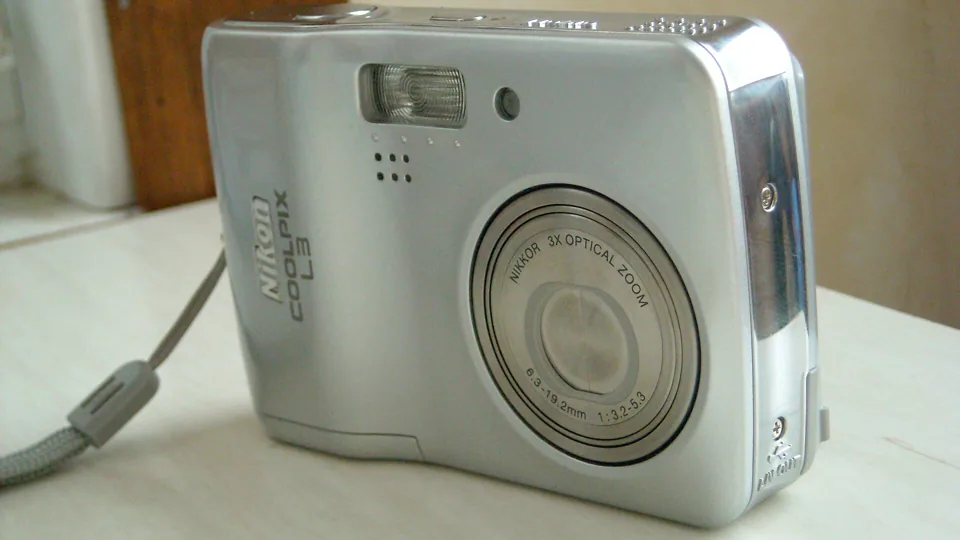

In February 2006 Nikon launched three budget cameras on one day. The L3 sat in the middle, with five megapixels and a body that Imaging Resource found the best-looking one it had seen with AA batteries. The reviewers liked the shape and argued about the pictures.
- Launched
- February 2006
- Launch price
- $199.951
- Sensor
- 5.1 MP CCD
- Lens
- 38–116 mm, 3×
- Card
- SD, MMC
- Battery
- 2 x AA
Nikon Coolpix L3 specs: sensor, lens, battery, memory card and cable
Launched in February 2006 at $199.95, the Nikon Coolpix L3 is a 5.1 MP CCD compact with a 38–116 mm (35 mm equivalent) 3× zoom lens. Inside: it takes SD and MMC cards and runs on 2 x AA batteries. Sources
Meet the camera
The L3 is a flat, curved little camera about 91 by 60.5 by 26 millimetres by Nikon's figures, which leave out projections.3 Imaging Resource listed it at 153 grams with batteries and a card,2 and described the body as mostly polycarbonate with a stainless steel band over the left side and top, plus a solid metal shutter button.2 CNET put the thickness at just under 1.5 inches, against Nikon's 1.0 inch, and thought the camera a little too fat for a jeans pocket.5
Nikon announced it on 21 February 2006 together with the 6-megapixel L2 at $249.95 and the 4-megapixel L4 at $149.95; the L3 was planned at $199.95, shipping in late February.1 CNET gives its release date as 27 February,5 and Imaging Resource's page lists 28 February.2 It also cost about $150 less than the L1 of the year before and was almost an inch slimmer, helped by a 3x zoom where the L1 had a 5x.2
Why this one was interesting
A camera that ran on batteries from the shop down the road
Steve's spec list names the cells Nikon allows: LR6 alkaline, ZR6 oxyride, lithium, or two EN-MH1 NiMH rechargeables.3 Steve's introduction, in wording that reads like manufacturer copy, called AA one of the most widely available battery sizes in the world.3 Nikon's own release called the L-series the slimmest in its class among cameras taking AA batteries.1 Imaging Resource went further: the best-looking such camera it had seen.2 None of the sources we read says anything about how the CCD sensor and the AA cells relate; the battery figures here are Nikon's shot ratings and the reviewers' remarks.
Help for beginners, built in
Nikon's launch release listed in-camera red-eye fix, Face-Priority AF, D-Lighting, which makes a brightened copy of backlit or under-flashed pictures, a Blur Warning and a Best Shot Selector that keeps the sharpest of ten frames.1 Imaging Resource called Face Priority AF the real gem of the system, though it needs to see two eyes and so cannot lock onto a profile.2 Fifteen scene modes included four with on-screen framing guides.21
Sound in the video, unlike the L4
CNET noted that the L3's VGA video at 30 frames per second carried sound, a step up from the L4's silent clips.5 For a sibling of this camera see our Coolpix S3300, Nikon's budget CCD six years on, and for the AA idea writ large the Coolpix L810.
What was lost
Against the L1, the longer zoom went.2 There is no stabiliser,15 and no manual ISO: the camera stays near ISO 50 and raises it by itself in dim light, to a ceiling of 200.2 Most entry-level cameras of the day, it noted, offered at least 400.2 The screen, at 86,000 dots, gave playback a muddy, slightly oversaturated look, and the L4 had a screen with 115,000 dots.21 There is no mode dial; a switch on the back picks Auto, Scene or Movie.25
The dark: its weak point
Imaging Resource said the camera stays at ISO 50 until the light is poor and then gains up to 200, which it called less than adequate for most low light; it saw moderate noise around ISO 100.2 It called the flash slightly weak, needing plus 2 EV of compensation in its indoor test, though its flash-range shots stayed strong to about 10 feet at wide angle.2 It could focus unassisted down to about half a foot-candle, and it produced fairly bright results in Night Portrait mode at that light level, with Night Landscape a little dim at one foot-candle.2 Steve's Digicams found the flash range disappointing too: fine for individual and couple portraits, too weak for small and mid-sized rooms, and best used as fill-in with plenty of ambient light.4 It also noted that D-Lighting brightens indoor shots at the price of more visible noise.4
These three strips are ISO 200, the camera's top setting, read from each file's own data.






On eBay right now
Live listings for this camera, supplied by eBay and updated automatically. We earn a commission if you buy through them.
The little wins
Help on the screen
Steve's Digicams liked the Portrait Assist modes for beginners and was surprised how well autofocus worked in low light with no focus-assist lamp.4
A screen you could see
Steve's found the glare-resistant 2-inch screen worked very well outdoors, and that it gains up indoors to help framing.4
Battery life, with the right cells
Nikon's CIPA ratings were about 200 shots on alkaline, 330 on EN-MH1 NiMH and 630 on lithium,3 and Imaging Resource repeated those figures, calling alkaline life short and lithium better.2 Steve's got about 110 test shots, with some short movie clips, from 2500 mAh NiMH cells before a low-battery warning and called that very impressive; it is a different kind of count from CIPA's.4
How it drew the picture
The four reviewers judged the same kind of pictures very differently. Imaging Resource called detail sharp, with strong lines to about 1,100 lines per picture height, but found some oversharpening and noise reduction flattening fine detail, and colour slightly oversaturated in reds, blues and yellows, with blues pushed well past what it was used to.2 Steve's called its 5-megapixel Fine pictures very good: sharp, well exposed, with pleasing saturation and good sky detail.4 CNET found details crisp and colour accurate if slightly cool, with some vignetting.5 Pocket-lint was harshest: soft landscapes, lost highlights and greens and reds so boosted they looked artificial.6


















Photos taken with this camera, from Wikimedia Commons, credited under each picture. Thousands exist, and a handful of uploaders account for many of them; the nine here were picked for variety, so judge the blues and the sharpness yourself.
Fringing split the panel. Imaging Resource saw 4 to 5 pixels of bright colour at the edges of its test target at wide angle, and 0.95 percent barrel distortion there, which it called quite high.2 CNET noticed a slight purple fringe on high-contrast edges,5 and Pocket-lint called the blue-purple fringing some of the worst it had seen in its recent camera reviews.6 Steve's said chromatic aberration was very well controlled, with only slight traces.4 Imaging Resource's fringing was at wide angle only; it fell to low levels at telephoto.2 It added that 8 by 10 inch prints were crisp and 11 by 14 softer but usable.2
Where it let you down
Speed was the common complaint. Three reviewers timed it (Pocket-lint gave no timings), each in their own way, so the figures differ:
| Imaging Resource | Steve's Digicams | CNET | |
|---|---|---|---|
| Switch on to first shot | 3.0 s2 | 3.2 s4 | 4.5 s5 |
| Shutter lag with autofocus | 0.78 s wide, 0.48 s tele2 | 1.3 s4 | 1.2 s in good light, 2 s in dim light5 |
| Shot to shot, no flash | 2.19 s2 | about 2.1 s4 | 2.1 s5 |
| Shot to shot, with flash | – (flash recharge about 7 s after a full-power shot)2 | 6 to 8 s4 | 7 s5 |
| Burst | 1.63 frames a second2 | 7 frames in about 4.6 s4 | 10 frames in 7.6 s5 |
Imaging Resource's review says it is nearly identical to its Coolpix L2 review and carries leftover references to the L1 and L2 in the text, so read its prose with that in mind. Its timing table is headed for the L3, but its prose and its summary disagree on wide-angle shutter lag (0.79 s and "below average" in the text, "very good" in the performance summary), and its print-quality paragraph names the L2 in one sentence; we used only the sentence that names the L3.2 Nikon rated continuous shooting at 1.7 frames a second.1
The rest was handling. Imaging Resource found the buttons small, the zoom rocker narrow, and the zoom slow, with a high-pitched whine.2 CNET found the recessed buttons awkward for thick fingers and the power button needing a long press.5 Steve's noted that the red-eye pre-flash blanks the screen for just under a second.4 For video, Steve's noted that the zoom cannot be used while recording and that continuous autofocus noise ruins the soundtrack,4 and Pocket-lint reported 15 frames a second at most, where Nikon and CNET list 30; Steve's and Imaging Resource list both 30 and 15 as menu choices.61542
What the reviewers said in 2006
| Outlet | Date | Verdict |
|---|---|---|
| Steve's Digicams | 3 Apr 2006 | Pretty much identical to the 6-megapixel L2; good value at $199 or less if you do not need speed and shoot mostly outdoors in sun.4 |
| CNET | 6 Jun 2006 | 6.4 out of 10, "Good": the budget-minded L3 takes good-looking photos but offers few options. Sluggish; no manual ISO; noticeable vignetting. Readers averaged 5.6 out of 10 from 29 votes on the archived page.5 |
| Pocket-lint | 27 Jun 2006 | 3.5 out of 5: simple, stylish and well made, but image quality lets it down.6 |
| Imaging Resource | Undated | A mixed bag with enough good to earn a modest recommendation, but not a Dave's Pick.2 |
Steve's and Pocket-lint compared it with the L2 and L4: Steve's said the L2 included everything for about $50 more;4 Pocket-lint said the L4 had the faster lens, at f/2.8–4.9, despite fewer megapixels.6
The timeline
- 21 February 2006Nikon USA announces the L2, L3 and L4 and Steve's Digicams posts a first look.13
- 27–28 February 2006Release date per CNET (27th) and Imaging Resource (28th).52
- 3 April 2006Steve's Digicams posts its full review.3
- 6 June 2006CNET reviews it.5
- 27 June 2006Pocket-lint reviews it.6
Should you buy one now?
Buy one if you like the idea of a pocket camera that eats ordinary AA batteries, you shoot in daylight, and you can live with a slow start and soft, strongly coloured pictures. It launched at $199.95;1 what it sells for now is a question for the sold listings, not for us. Before you bid, check these:
- The name. Search the Coolpix L3. The L2 has 6 megapixels, the L4 has 4 and a faster lens.16
- The batteries. It takes two AA cells, and Steve's recommended NiMH batteries when possible, and Imaging Resource advised rechargeables over alkaline (it named NiMH or lithium).24 Imaging Resource's box list has two alkaline AA cells; Steve's list of supplied accessories has two EN-MH1 NiMH cells and a charger, and says supplied items differ by country, so do not assume what a used one comes with.23 A set is on Amazon ↗. Check the battery door and its sprung contacts for corrosion.
- The card. Nikon lists SD and MMC cards.1 None of the sources says whether it reads high-capacity SDHC cards, so test one before relying on it; see our memory card guide.
- The lens. The lens telescopes out when the camera is switched on,2 so make sure it extends and retracts cleanly and the shutter-like cover opens.
- The cable. Steve's lists a UC-E6 USB cable and an EG-CP14 video cable among the supplied accessories, noting that these may differ by country;3 see our UC-E6 page.
If you are wondering why cameras like this are being hunted down again, we tell that story once, in Pictures that never left the card.
See recent sold prices on eBay ↗Shop on eBay ↗AA rechargeable batteries ↗
Sources
- Imaging Resource, Nikon: Three new L-series digicams, by Mike Tomkins (21 Feb 2006; includes Nikon USA's press release and spec tables)
- Imaging Resource, Nikon Coolpix L3 review (undated page; says it is nearly identical to the Coolpix L2 review; availability 28 Feb 2006)
- Steve's Digicams, Nikon Coolpix L3 introduction and specifications (first look 21 Feb 2006, full review 3 Apr 2006; archived Jan 2007)
- Steve's Digicams, Nikon Coolpix L3, Steve's Conclusion (full review 3 Apr 2006; archived Jan 2007)
- CNET, Nikon Coolpix L3 review by Will Greenwald (6 Jun 2006; page archived Jan 2008)
- Pocket-lint, Nikon Coolpix L3 digital camera review by Doug Harman (27 Jun 2006)
Photographs are credited under each one, all via Wikimedia Commons. Links to eBay and Amazon are affiliate links. Nikon's release gives 32 MB of built-in memory, while Steve's, Imaging Resource and Pocket-lint give 23 MB.1326