Sony Cyber-shot P · announced February 2003
The Sony Cyber-shot DSC-P72: a fast, pocketable 2003 compact with a 3x zoom and no manual controls
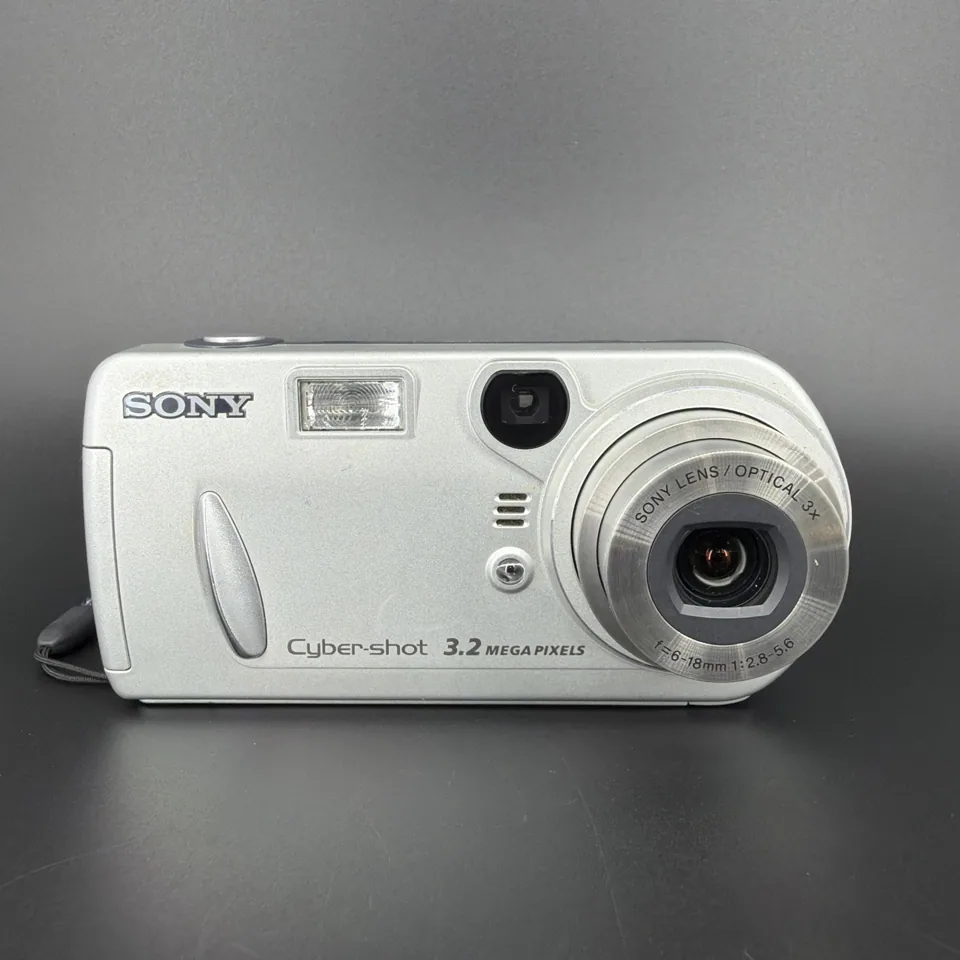
Sony's mid-priced 3.2-megapixel compact of spring 2003 ran on two AA cells and had a zoom lens Imaging Resource said was the one Sony used on the P9. Reviewers liked its colour, speed and battery life, and criticised how little you could adjust; two of the three disliked the viewfinder.
Sony Cyber-shot DSC-P72 specs: sensor, lens, battery, memory card and cable
The Sony Cyber-shot DSC-P72 is a 3.2 MP CCD compact camera with a 39–117 mm (35 mm equivalent) 3× zoom lens, launched in February 2003 at $329. It takes Memory Stick and Memory Stick PRO cards and runs on AA batteries. Sources
- Sensor
- CCD, 1/1.8", 3.2 MP source
- Lens
- 39–117 mm equivalent, 3× zoom source
- Memory card
- Memory Stick, Memory Stick PRO source
- Battery
- AA source
- USB / A/V cable
- See our Sony cable page
Meet the camera
Sony announced the P72 on 24 February 2003, together with the P32, P52 and P92, and Imaging Resource reported that the new P32, P52 and P72 replaced the P31, P51 and P71.1 It was the top of the three that replaced them and, per Imaging Resource, the first to arrive: it expected the P72 in March, with wide availability in late March or early April, while Sony's release said all four cameras would be available in April.12 It had a 1/1.8-inch 3.2-megapixel CCD, a retracting 3x zoom of 39 to 117 mm in 35 mm terms and a 1.5-inch screen, and Imaging Resource noted that the lens was the one Sony had used on the DSC-P9.1 The cheaper P52 beside it had a smaller 1/2.7-inch sensor and a 2x lens; Pocket-lint called the P72 the P52's bigger brother, with one more step of zoom.25
Two things in the announcement are easy to miss. Imaging Resource wrote that the new line cut shutter lag and start-up times significantly, showed the active focus points on the screen and added Snow and Beach scene modes, and that movie capabilities were greatly extended.1 We found no second regional name for it: every source we read calls it the DSC-P72.
- Sensor
- 3.2 MP Super HAD CCD, 1/1.8"1
- Lens
- 3x, 6–18 mm (39–117 mm equiv.), f/2.8–5.61
- ISO
- Auto, 100, 200, 4003
- Card and power
- Memory Stick and Memory Stick PRO, 16 MB card in the box · two AA NiMH cells with charger, rated 2100 mAh in Sony's specification and by Tek.no; Imaging Resource's review says the pair shipped was 1850 mAh1435
Why this one was interesting
Quick for its class
The timings on this page come from Tek.no's test; the other two reviews we read give no stopwatch figures. They timed start-up at 3.06 seconds, the second quickest of the seven 3-megapixel cameras in their table, and shutter lag at 0.00 seconds without flash and 0.19 with it, which they blamed on the pre-flash. They also got autofocus times of 1.13 seconds at wide angle and 1.46 at telephoto, slower than most of the others in the table, but said these were worst cases they provoked: in normal use they saw 0.31 seconds and found focus fast.4 Their burst numbers, 7 shots in 10 seconds and 36 in 60 at the best quality, were the best in the group.4 Shutdown was the slow part: 4.05 seconds, or 5.42 right after a shot.4
A lens with a small body
Imaging Resource found the body all plastic apart from a metal tripod socket, with the battery and card compartments reached from the sides so a tripod need not block them, and a small sculpted ridge on the front that gripped better than they expected.3 At 9.1 ounces with batteries it fitted a shirt pocket, though it was larger than Sony's P8 and P9 or Canon's ELPH models.3 Pocket-lint described plenty of rubber grips and a weight that felt comfortable but leaned heavy; Tek.no, which weighed it at 268 g, found the balance poor because of its width, fine if the little finger supports it.5
Colour and exposure
Imaging Resource rated colour very good, with good saturation and mostly accurate hue, and exposure on the good side of average. They saw detail to at least 1,200 lines and a limit around 1,400 in their resolution chart.3 Tek.no thought fine detail was sharper than the Canon A70's in their tests.4 Pocket-lint, with no lab figures, said pictures printed clear at 8 by 10 inches.5 For a later Sony pocket compact with a bigger sensor, see our DSC-P200 retrospective.
What was lost
Tek.no's list is the longest. The P72 had no true manual focus (only fixed distances), no manual white balance, no shutter- or aperture-priority modes, no contrast, saturation or sharpness controls and no real continuous mode, only a two-shot burst; advanced settings were tucked behind a Program mode, and the self-timer had to be set again for each shot.4 Pocket-lint added that most functions ran through an on-screen display rather than buttons, which saves buttons but makes you rely on a screen that drains the battery.5 Imaging Resource found the flash options narrow, with slow-sync only in Twilight Portrait and no flash in Twilight, Landscape or Movie modes.3 Imaging Resource also noted that the Twilight modes stopped at a 2-second exposure, which limits low-light work.3
The dark, and the viewfinder
For night shots Imaging Resource found Twilight mode gave acceptable brightness down to about 1 foot-candle (11 lux), roughly city street lighting, and ISO 400 stayed bright to about half that. They described noise as low at ISO 100 and moderately high at ISO 400.3 Tek.no said exposure could come out too dark in low light and that fill-in flash against a backlit subject was weak.4 Imaging Resource also saw the flash overexpose a macro shot and suggested another light for close-ups.3 The optical viewfinder drew the sharpest comments from two of the three (Tek.no called it relatively large and a decent fallback, though without parallax marks). Imaging Resource measured it showing about 80 percent of the frame at wide angle and 84 at tele, shifted toward the lower left, while the screen showed about 99 percent;3 Pocket-lint found heavy parallax from the big lens housing and, for close subjects, ended up using the screen.5
On eBay right now
Live listings for this camera, supplied by eBay and updated automatically. We earn a commission if you buy through them.
The little wins
An AF lamp and fixed distances
Imaging Resource found an autofocus assist lamp that could be switched off, and five fixed focus distances (0.5 m, 1 m, 3 m, 7 m and infinity) when autofocus gave trouble.3
A sharp screen
Tek.no counted the 1.5-inch, 123,200-dot screen among the best in its class, though it froze while focusing and, in sun, was about as usable as others in its class.4
Snow and Beach modes
Two scene modes were new for this generation: Snow raises saturation so white scenes keep their colour, and Beach aims to keep blues accurate.35
Faster card transfer
Tek.no measured about 0.84 MB/s with an ordinary Memory Stick and about 3.0 MB/s with Memory Stick PRO.4 They also noted the Memory Stick media cost about twice as much as CompactFlash.4
Run on AAs
The box held a charger and NiMH cells.15 Imaging Resource warned against alkalines, and its worst-case run time, projected from 1600 mAh cells, was about 100 minutes, or about 220 minutes in capture mode with the screen off.3 Tek.no found capacity close to the Canon A70, which uses four cells.4
How it drew the picture
Imaging Resource's lens notes were less happy: barrel distortion of about 1.0 percent at wide angle and 0.4 at tele, corner softness at wide angle, and some flare on the left of the frame. They also saw limited dynamic range in harsh light with some highlight loss, and Caucasian skin tones leaning pink.3 The samples below are not test shots; they come from Commons users and show the camera's colour and 3.2-megapixel files at ordinary sizes.
















Photos taken with this camera, from Wikimedia Commons, credited under each picture. We chose them by looking, and confirmed the camera model in each file's data.
Where it let you down
Tek.no also disliked the playback: zoom stopped at 5x and was slow, and there was no auto-rotation, histogram or shooting data. They could not find a reset option.4 The movie mode recorded 640 by 480 for as long as the card had room, which Imaging Resource called unusual, at 15 or 16 frames a second depending on the source.134 The card is Memory Stick only; our Memory Stick guide and the glossary explain what to look for.
What the reviewers said in 2003
| Outlet | Date | Verdict |
|---|---|---|
| Imaging Resource | 8 May 2003 | A good all-around three-megapixel camera; colour, tone and function excellent, held back by the viewfinder and pink skin.3 |
| Tek.no | 8 Oct 2003 | "Quite pleased" (godt fornøyd): a simple point-and-shoot with no major weakness, too basic for some buyers; no score.4 |
| Pocket-lint | 16 Dec 2003 | 4 out of 5; very good for 3 megapixels, but with a small screen and viewfinder.5 |
Pocket-lint's review is short and has no measurements. We found no contemporary full review of the cheaper P52, so this page covers its bigger sibling.
The timeline
- 24 February 2003Sony announces the P32, P52, P72 and P92; the P72 is $329.1
- March to April 2003Shipping, per Imaging Resource and Sony.12
- 8 May 2003Imaging Resource review, suggested price $349.3
- 8 October 2003Tek.no review.4
- 16 December 2003Pocket-lint review.5
Should you buy one now?
It suits someone who wants a quick, honest 2003 compact that takes AA batteries and does not tempt them to fiddle. It is not for anyone who wants manual control. Its launch price was $329;1 what it sells for now is a question for the sold listings, not for us. We have not tested a unit. Before you bid, check these:
- The model. The P72 has the 3x zoom and 1.5-inch screen; the P52 has a 2x lens and a 1.6-inch screen.2
- The batteries. It runs on two AA cells, and Imaging Resource advised NiMH rather than alkaline; check what you will use, and see AA cells and chargers on Amazon ↗.3
- The card. Memory Stick or Memory Stick PRO; only PRO gave the fast transfer rate Tek.no measured.4
- The lens. Check that it extends and retracts cleanly.
- The screen and viewfinder. Look for scratches; expect the optical finder to be small.
If you are wondering why cameras like this are being hunted down again, we tell that story once, in Pictures that never left the card. For a later Sony from the same shelf, see our DSC-W55 retrospective.
See recent sold prices on eBay ↗Shop on eBay ↗AA batteries ↗
Sources
- Imaging Resource news, Sony announces four new Cyber-shot cameras (24 Feb 2003)
- DPReview news, Sony Cyber-shot DSC-P32, P52, P72 and P92 (23 Feb 2003, with Sony's press release dated 24 Feb)
- Imaging Resource, Sony Cyber-shot DSC-P72 review (8 May 2003, unsigned; suggested price $349)
- Tek.no, Test av Sony Cyber-shot DSC-P72 by Martin Lexow Wirak (8 Oct 2003, in Norwegian)
- Pocket-lint, Sony DSC-P72 review by Stuart Miles (16 Dec 2003)
Photographs are credited under each one, all via Wikimedia Commons. Links to eBay and Amazon are affiliate links.