Canon PowerShot A series · on sale spring 2007
The Canon PowerShot A570 IS: image stabilisation for $280, on two AA batteries
We found no other regional name for it: Canon's museum lists the same name for Japan, the US and Europe.1
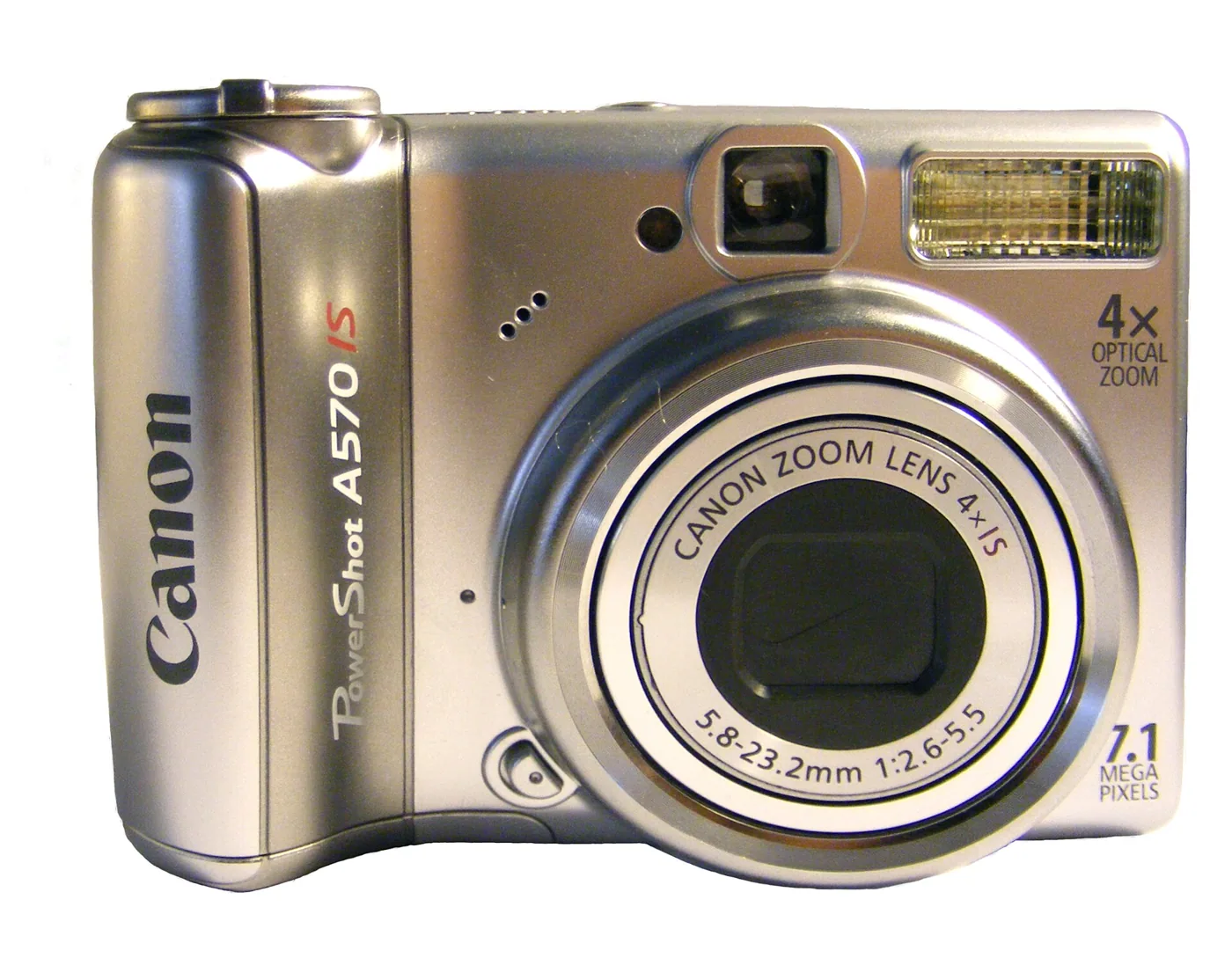

In February 2007 Canon put optical stabilisation, face detection and full manual exposure into a $279.99 compact with a grip, a viewfinder and a pair of AA cells. Reviewers rated the value highly, and four of the five we read also had something to say about the batteries.
- Launched
- March 2007
- Launch price
- $279.992
- Sensor
- 7.1 MP CCD
- Lens
- 35–140 mm, 4×
- Card
- SDHC, SD, MultiMediaCard
- Battery
- AA
Canon PowerShot A570 IS specs: sensor, lens, battery, memory card and cable
The Canon PowerShot A570 IS came out in March 2007 at $279.99 as a 7.1 MP CCD compact with a 35–140 mm (35 mm equivalent) 4× zoom lens. It runs on AA batteries. Sources
- Sensor
- CCD, 1/2.5", 7.1 MP source
- Lens
- 35–140 mm equivalent, 4× zoom source
- Memory card
- SDHC, SD, MultiMediaCard source
- Battery
- AA source
- USB / A/V cable
- IFC-400PCU, AVC-DC300 Confirmed · all Canon cables
Meet the camera
It looks like a small, stocky film camera. Imaging Resource called the body retro, silver only, boxy rather than slim, with an optical viewfinder and a big grip, and said the grip is formed by the AA battery compartment.5 Canon lists about 175 grams for the camera body only; Imaging Resource gave 236 grams with two AAs and an SD card installed.15 Canon's museum page says it succeeds the A540 of March 2006, keeps that camera's 4x zoom and adds optical image stabilisation and a DIGIC III processor.1
Imaging Resource's launch note of 21 February 2007 gave a price of $279.99 and shipping from March 2007;2 the spec table on its later review lists availability as 30 March.5 Reviewed.com reported the same day that the cheaper A560 would sell for $229.99.3 Street prices were lower: Reviewed.com said just over $200, and DPReview's spec table gives a street price of $200 in the US and £150 in the UK.67 Photo Review, an Australian site, gave two recommended retail prices: "just under $450" in the text and $499 in its rating box.8
- Sensor
- 7.1 MP CCD, 1/2.5"1
- Lens
- 4x, 35–140 mm equiv., f/2.6–5.5, optical stabilisation1
- ISO
- 80 to 16001
- Screen
- 2.5", about 115,000 dots, plus optical viewfinder1
- Batteries
- 2 × AA, alkaline or NiMH; about 120 shots on alkaline, about 400 on NiMH (CIPA)1
- Card
- SD / SDHC / MMC1
- Size
- 89.5 × 64.3 × 42.8 mm, about 175 g, body only1
- Launch price
- $279.992
Why this one was interesting
Stabilisation, at the bottom of the range
CNET called it the least expensive Canon camera with optical image stabilisation, and the least expensive A-series camera with full exposure controls.4 Imaging Resource called Canon's implementation excellent and said it effectively gave two to three more stops of light, so that a hand-held shutter speed of about 1/30 second became chancy only at about 1/4.5 DPReview's hand-held test at 140 millimetres found sharp or only mildly blurred pictures down to 1/50 second with stabilisation on, against a majority of sharp frames only at 1/200 or faster with it off.7 Reviewed.com added that stabilisation only helps while the subject stays still.6
Face detection and a new processor
The A570 IS and A560 were the first A-series cameras with DIGIC III, according to Reviewed.com, which reported Canon's Chuck Westfall as saying the processor brings face detection, better noise reduction, ISO 1600 and longer battery life.3 Photo Review called face detection, automatic red-eye correction in playback and ISO settings up to 1600 noteworthy firsts for the A series, and said the camera could pick out up to nine faces to set focus and exposure.8 CNET's field tests found the system quick and accurate.4
Manual control, with a caveat
Aperture priority, shutter priority and full manual exposure all sat on the mode dial.5 Imaging Resource liked that the Print/Share button could be assigned to ISO and other functions, and DPReview noted that Canon had again left an ISO button off the A series.57 Reviewed.com was less impressed, saying the manual controls were not nearly convenient enough to use all the time.6
Why not the A560?
DPReview called the two cameras almost identical, with stabilisation as the A570 IS's extra.7 CNET said that if you do not care for stabilisation and never use manual exposure controls, the A560 is the sensible step down,4 and Imaging Resource put the A570 IS at $50 over it.5 Canon's museum page for the A590 IS of February 2008 names this camera as its predecessor;9 see our A590 IS retrospective. For earlier AA-powered Canons, see our reviews of the PowerShot A700 and the PowerShot A640. The A570 IS is a CCD camera: see our glossary entry on CCD sensors.
The AA question: what each source said
Every source noted that the camera takes two AA cells, and most had a view on how long they lasted. We give each source's own words and figures, because the numbers come from different kinds of test.
| Source | What it said about batteries |
|---|---|
| Canon | Lists two AA alkaline cells, two AA NiMH cells or the ACK800 AC adapter kit. Stated shot counts (CIPA, screen on, fully charged): about 120 on alkaline, about 400 on NiMH; about 540 minutes of playback on alkaline and about 660 on NiMH.1 |
| Imaging Resource | Its table lists 120 shots on alkaline with the screen on and 400 with it off, and 400 on NiMH with the screen on and 900 with it off, citing CIPA and manufacturer test conditions. Two alkalines were in the box. Its own sample was a little finicky, shutting down after relatively few shots unless given good high-capacity cells, and low-power warnings usually cleared if the battery door was opened and closed again; the reviewer suspected a defective door and noted some play in it.5 |
| DPReview | Repeated Canon's 120 and 400, said using the optical viewfinder instead of the screen could stretch a set of NiMH cells to almost 900 shots, and called battery life in general "quite disappointing (with AA batteries)", advising a spare set. It also noted that continuous stabilisation uses more power and that flash recycling can reach almost ten seconds when batteries are weak.7 |
| Reviewed.com | Said it "went through batteries quickly, even high-capacity NiMH rechargable cells", and scored its battery 4.75 on its own scale; noted the advantage that AAs are sold nearly everywhere.6 |
| Photo Review | Listed the power supply as alkaline, lithium or rechargeable AAs, where Canon's page names only alkaline and NiMH. The supplied batteries went flat less than halfway through its tests; NiMH replacements then lasted just over 100 further shots with power to spare, and the reviewer suspected the supplied cells had been used before.81 |
| CNET | Made no battery-life measurement; noted that, like all A-series cameras, it runs on AAs, so a flat set does not mean waiting for a charger.4 |
The pattern is consistent without being conclusive. Canon, Imaging Resource and DPReview all print 120 shots for alkaline cells under CIPA conditions,157 and none of the sources gave a figure for lithium AAs. Two sources suspected their sample, not the design: Imaging Resource a battery door, Photo Review a used set of cells. The practical reading, which is ours, is to budget for NiMH rechargeables and a spare set.
The dark, on a budget
The reviewers split on how far the sensitivity range could be pushed. CNET found noise under control through ISO 200, a dense snowy covering at ISO 800, and advised ISO 400 and below.4 Reviewed.com's lab found noise acceptable from ISO 80 to 200, a big jump at 400, and ISO 1600 images obviously low in quality even at small sizes.6 DPReview said Canon's noise reduction was light-handed, with mild noise in shadows even at ISO 100 and strong noise by ISO 800.7 Imaging Resource found ISO 1600 usable for 4 by 6 inch prints, with ISO 400 soft but usable to 8 by 10 and ISO 800 to 5 by 7;5 Photo Review said ISO 1600 was too noisy to be really usable,8 and Reviewed.com put it flatly: not a low-light camera.6 What helped in dim light was the stabiliser: Imaging Resource hand-held a low-light shot at 1/10 second.5
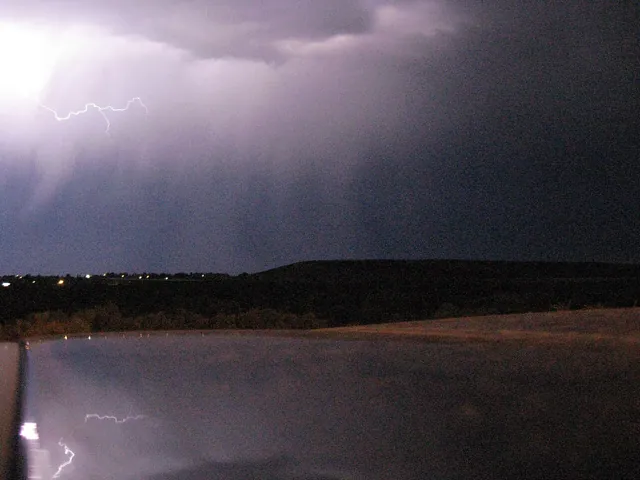



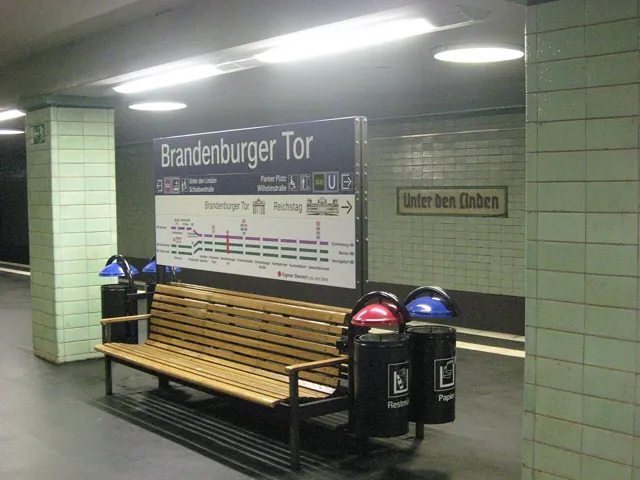

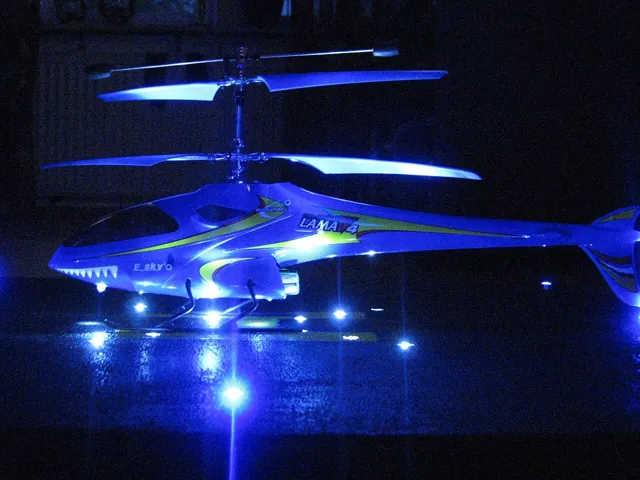

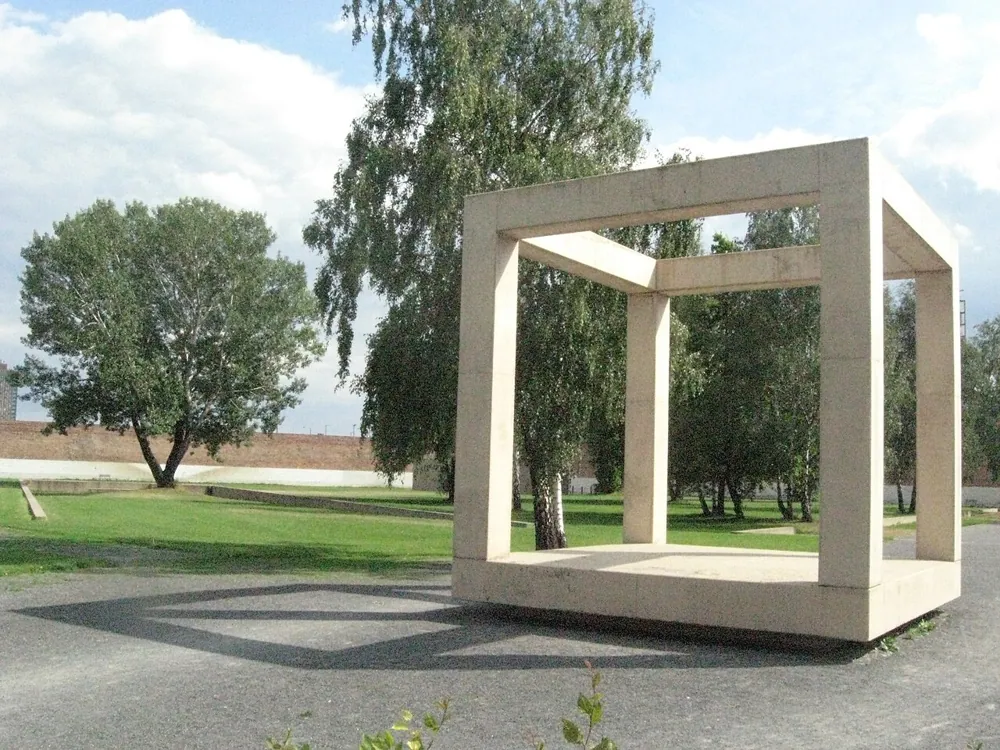
Real photographs taken with this camera, all at ISO 800. The sensitivity shown is recorded in each file's own EXIF data.
Like that look? See what A570 ISs have recently sold for on eBay ↗
On eBay right now
Live listings for this camera, supplied by eBay and updated automatically. We earn a commission if you buy through them.
The little wins
Beyond the headline features, a few small things made it better to live with than its price suggested.
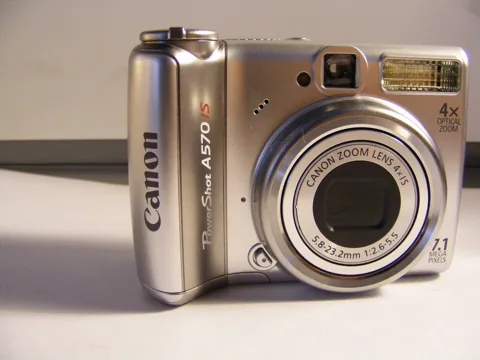 The A570 IS, seen from the front. · Vibrantspirit · CC BY 3.0 · Commons

A grip you can use one-handed
DPReview called the grip fairly small but very helpful with one hand, and the shutter release and zoom control well placed;7 Photo Review said it suited small hands and was secure enough to operate with one hand.8
A macro to 5 centimetres
Canon lists macro focus from 5 centimetres at wide angle;1 Imaging Resource measured a minimum area of about 55 by 42 millimetres and found excellent detail, though its macro flash exposure was not usable.5
Stabilisation you can steer
DPReview described continuous, shooting-only and panning modes, with continuous steadying the preview image at the cost of battery power.7
How it drew the picture
In daylight the reviewers liked the colour more than the sharpness. Imaging Resource found colour natural, with slight oversaturation of reds, blues and greens and slightly warm skin tones.5 Reviewed.com measured colour accuracy it called better than many professional-level cameras, but its resolution test, at 1794 line-widths per picture height horizontally and 1656 vertically with sharpening errors of about 11 and 12 percent, left it calling the result disappointing.6 Photo Review found resolution slightly below expectations, with images left soft by under-sharpening,8 and DPReview said pictures could look soft at 100 percent and benefit from a little sharpening.7 Digital zoom split them: Imaging Resource was disappointed by the upsampling, Photo Review called its digital zoom shots outstanding for the camera's resolution and zoom range.58




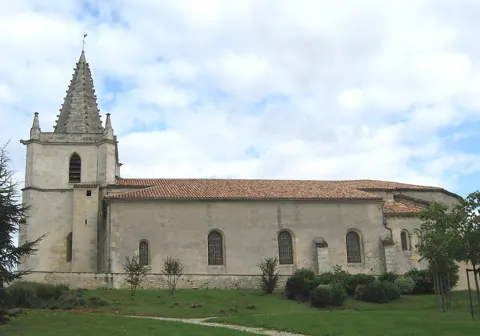









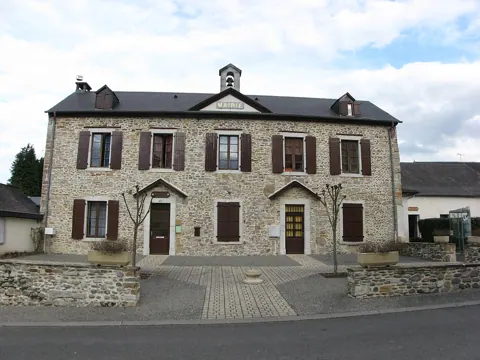


Photos taken with this camera, from Wikimedia Commons, credited under each picture.
Where it let you down
Flash recycling was the loudest complaint: Imaging Resource clocked 10.7 seconds, DPReview said almost ten with weak batteries, and Reviewed.com called the flash small, weak and close to the lens.576 Photo Review, in contrast, found its flash performance better than average and well balanced from ISO 100 to 1600.8 The 115,000-dot screen was called low-resolution by Imaging Resource, DPReview and Reviewed.com, though DPReview found it bright and usable even in direct sunlight where Reviewed.com found it a little dim outdoors.576 The viewfinder drew a similar split: the three who gave a figure put its coverage between 75 and 82 percent, Imaging Resource found it tight and tilted but still welcome, and Reviewed.com called it tiny, inaccurate and hard to see.576 On build, DPReview found it solid despite a lot of plastic, while Reviewed.com called its seals against dirt and moisture poor and said the buttons did not seem durable.76 The combined battery and card door was criticised by DPReview as fiddly, by Photo Review as flimsy and hard to close, and by Reviewed.com for letting batteries slide out when changing cards.786 Imaging Resource found the mode dial stiff.5 Continuous shooting drew mixed verdicts: Imaging Resource measured about 1.25 frames a second and called it a little sluggish, CNET about 1.6 and Reviewed.com about 1.5, which it called very slow. DPReview measured 1.7, matching Canon's own listing, and called that very good for a budget camera.54671
What the reviewers said
| Outlet | Date | Verdict |
|---|---|---|
| CNET | 21 Mar 2007 (page metadata) | Rated 7.6 on the page. An excellent value and an impressive feature set in its category, held back by excessive noise at higher ISOs.4 |
| Imaging Resource | 29 May 2007 | Dave's Pick: a bargain at $50 over the A560, thanks to its stabiliser and usable ISO. Faults: slow flash recycling, a low-resolution screen, a stiff mode dial.5 |
| Reviewed.com | 15 Jun 2007 (page metadata) | A bargain for casual users at just over $200, with colour and stabilisation as strengths; criticised the build, battery life, dynamic range and video.6 |
| DPReview | 22 Oct 2007 | Highly Recommended: value scored 9 out of 10, optics 8, ergonomics 8, build, features, image quality and performance 7.5. Faults: flash recycling, battery life, a low-resolution screen.7 |
| Photo Review | Undated page | 9 out of 10 overall; a camera families can grow with, despite reservations about noise, slow response and poor auto white balance under incandescent light.8 |
The timeline
- March 2006The PowerShot A540, which Canon's museum names as this camera's predecessor.1
- 21 February 2007Canon announces the A570 IS at $279.99, alongside the A560.23
- March 2007Canon's museum lists the camera as marketed; Imaging Resource gives 30 March as its availability date.15
- 21 March 2007CNET's review (date from the page's metadata).4
- 29 May 2007Imaging Resource publishes its review.5
- 15 June 2007Reviewed.com's review (date from the page's metadata).6
- 22 October 2007DPReview publishes its review.7
Should you buy one now?
Buy one if you want a sturdy-handling, stabilised compact with real manual exposure, you are happy to feed it AA batteries, and you can accept ordinary high-ISO pictures. It launched at $279.99;2 what it sells for now is a question for the sold listings, not for us. Before you bid, check these:
- The battery door. Three reviewers criticised it,786 and Imaging Resource's sample had a loose hinge and drained batteries until the door was reseated.5 Open and close it, and look for corroded contacts left by old cells.
- The batteries. It takes two AAs;1 a set of NiMH rechargeables lasts about three times as long as alkalines on Canon's numbers (400 shots against 120, our arithmetic),1 and Imaging Resource found its sample insisted on high-capacity cells.5 A set is cheap on Amazon ↗.
- The card. It takes SD, SDHC and MMC;1 Reviewed.com wrote to a 4 GB card.6 See our memory card guide.
- The cables. Imaging Resource lists a USB cable (IFC-400PCU) and an AV cable in the box, and Canon lists a USB 2.0 mini-B port.51
- The lens and dial. The lens extends on power-up and the lens ring is removable for converters;5 check that it extends fully and that the stiff mode dial still clicks through its positions.5
If you are wondering why cameras like this are being hunted down again, we tell that story once, in Pictures that never left the card.
See recent sold prices on eBay ↗Shop on eBay ↗AA batteries ↗
Sources
- Canon Camera Museum: PowerShot A570 IS (specifications, power sources and shot counts, marketing date, A540 lineage)
- Imaging Resource, Canon: New image-stabilized PowerShot, by Mike Tomkins (21 Feb 2007, updated; launch price, availability, specification table)
- Reviewed.com, Canon Adds A570IS and A560 with Digic III Processor (21 Feb 2007)
- CNET, Canon PowerShot A570 IS review by Phil Ryan (page metadata dated 21 Mar 2007)
- Imaging Resource, Canon A570 IS review by Mike Pasini (review date 5/29/07)
- Reviewed.com, Canon PowerShot A570IS Digital Camera Review (page metadata dated 15 Jun 2007)
- DPReview, Canon PowerShot A570 IS Full Review by Lars Rehm and Simon Joinson (22 Oct 2007)
- Photo Review (Australia), Canon PowerShot A570 IS (undated page)
- Canon Camera Museum: PowerShot A590 IS (marketing date, names the A570 IS as its predecessor)
Camera photos by Vibrantspirit; other photographs are credited under each one, all via Wikimedia Commons. Links to eBay and Amazon are affiliate links.