Kodak EasyShare Z · announced January 2005
The Kodak EasyShare Z700: the 2005 snapshot camera with a printer dock and a tiny viewfinder
We found no other regional name for it; Kodak's January 2005 announcement and the reviews we read all call it the Z700.12

In January 2005 Kodak announced a 4-megapixel, 5x-zoom compact with partial manual control, sold with a printer dock at $399. Reviewers liked its simple controls and value; they split on its speed and colour, and agreed on noise at ISO 400 and a tight viewfinder.
- Launched
- January 2005
- Sensor
- 4 MP CCD
- Lens
- 35–175 mm, 5×
- Card
- SD, MultiMediaCard
- Battery
- 2x AA, CR-V3, Kodak NiMH pack
Kodak EasyShare Z700 specs: sensor, lens, battery, memory card and cable
The Kodak EasyShare Z700 came out in January 2005 at $399 as a 4 MP CCD compact with a 35–175 mm (35 mm equivalent) 5× zoom lens. It uses SD and MultiMediaCard and runs on 2x AA or CR-V3 or Kodak NiMH pack batteries. Sources
- Sensor
- CCD, 1/2.5", 4 MP source
- Lens
- 35–175 mm equivalent, 5× zoom source
- Memory card
- SD, MultiMediaCard source
- Battery
- 2x AA, CR-V3, Kodak NiMH pack source
- USB / A/V cable
- See our Kodak cable page
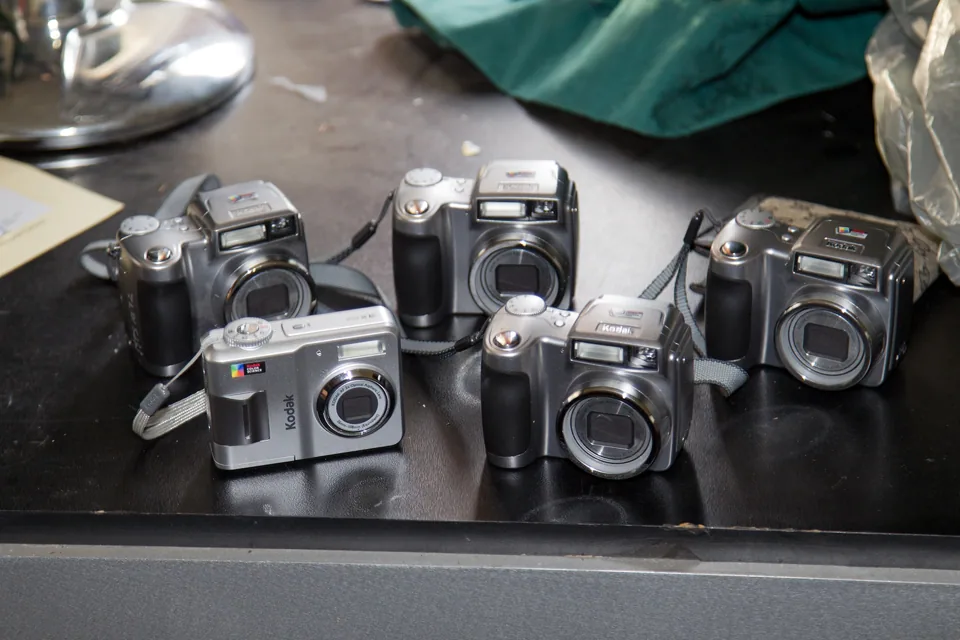
We found no clean free product photo of a single Z700; this Commons picture shows four of them beside a smaller C433.
Meet the camera
Kodak announced the Z700 on 5 January 2005 alongside the 10x-zoom Z740, and called the pair the start of a new "Z" category inside the EasyShare line.1 It has a 4-megapixel CCD, a 5x lens covering 35 to 175 mm in 35 mm terms, a 1.6-inch screen and a real-image optical viewfinder.21 Imaging Resource called the body all-plastic, 3.7 by 2.8 by 2.2 inches, and 7.7 ounces without battery or card; Photo Review described its shape as the boxy one Kodak used for its high-zoom models.24 It runs on two AA cells, a single CR-V3, or a Kodak NiMH pack that charges in the printer dock.2
The price is where the sources part. Kodak's announcement priced the Z700 with the new Printer Dock Series 3 at $399, shipping "next month".1 Imaging Resource's review lists $299 for the camera alone and $399 with the dock, and an availability of April 2005.2 An archived CNET page lists an MSRP of $199.95 and a release date of 15 February 2005, but shows no date for that price, so we do not treat it as a launch figure.3
Why this one was interesting
Easy first, manual second
Imaging Resource's verdict was that the Z700 suited kids and novices who wanted to learn gradually, while experienced users would enjoy its compact size, flexible controls and 5x zoom.2 CNET was more specific about its value: programmed, aperture-priority and shutter-priority modes, a 5x zoom with "unexpected telephoto reach" and decent image quality, all more than it expected from a camera in this class.3 Photo Review gave it 9.0 out of 10 for ease of use, its highest score of the four, and noted that the three exposure modes share a single dial position, which made picking one "tricky".4
The printer dock
Kodak sold the camera mostly as half of a system. The new Printer Dock Series 3 printed borderless 4 by 6 inch pictures in about 90 seconds, according to the announcement.1 Imaging Resource noted a new connector on the camera's base that made the Z700 incompatible with older EasyShare docks, and said Kodak was the first manufacturer to announce a camera with that new IMAGELINK connector.2 CNET called the dock a convenient companion that charges the battery and lets you view, print and transfer pictures.3 For a later Kodak that kept the idea of a fast, no-fuss snapshot machine, see our EasyShare C875 review and V570 review, or the Kodak hub.
Small touches
Both Imaging Resource and Photo Review noticed the diopter adjustment on the viewfinder, which Photo Review called unusual for an EasyShare camera.24 CNET liked a burst mode that keeps the five shots taken before you lift your finger, and the one-touch Share button for printing and e-mail.3
What was lost
The viewfinder and the screen took the hit. Imaging Resource measured the optical finder at about 80 percent of the frame, and CNET gave the same figure.23 Imaging Resource measured the 1.6-inch screen at about 97 percent frame accuracy; CNET, by contrast, called it a coarse, 72,000-pixel display that blanked out between shots and ghosted when the camera or subject moved.23 Photo Review found the optical finder very small with a zero eyepoint, and lists the screen as an indoor/outdoor display.4 CNET also found the green ready lamp next to the finder distractingly bright.3
The dark: its weak point
Noise was the common complaint, but the reviewers disagreed on how early it began. Imaging Resource called it moderate at low sensitivities, noticeable at ISO 200 and objectionable at ISO 400, and found ISO 200 prints rough at 8 by 10 inches but acceptable at 5 by 7.2 CNET reported multicoloured noise flecks at every setting, noticeable at ISO 80 and prominent at ISO 400.3 Photo Review saw noise in ISO 400 low-light shots but said it was not obvious in prints made from them.4
Night pictures fared better than that suggests. Imaging Resource rated low-light performance very good despite high noise at ISO 400: with no autofocus-assist lamp, it still focused in light a little under a quarter as bright as a typical city night scene, and it exposed correctly down to one sixteenth of street-lighting brightness at ISO 400, with heavy noise and lost detail.2 CNET, meanwhile, called the autofocus poky and not lamp-assisted.3 The flash was also disputed: Imaging Resource called it fairly powerful but in need of a small exposure boost, CNET said the claimed 12-foot range at ISO 140 was stretching it (Imaging Resource's own test reached 10 feet at ISO 80), and Photo Review said the flash needed at least ISO 200 to light an average room.234
The free sample photos we found were taken at ISO 80 to 140, so this page shows no low-light strip.
On eBay right now
Live listings for this camera, supplied by eBay and updated automatically. We earn a commission if you buy through them.
The little wins
Plain-English menus
Imaging Resource praised the short menus with plain-English descriptions instead of cryptic icons, and noted a setup option that shows a mode description when you first select a mode.2
A real close-up mode
Imaging Resource measured a minimum macro area of 62 by 46 mm with strong detail, though the flash was blocked by the lens at the closest distance.2
Quick to respond
Imaging Resource measured shutter lag of 0.46 to 0.61 seconds, and 0.076 seconds when pre-focused, calling it more responsive than the majority of cameras out there.2
Colour that sells prints
Imaging Resource called the colour very bright and oversaturated, but pleasing, and said auto white balance handled mixed light better than average.2
How it drew the picture
Imaging Resource saw "strong detail" out to about 1,100 lines and measured 1.13 percent barrel distortion at wide angle, above average, against 0.2 percent pincushion at full zoom.2 Photo Review's Imatest results called resolution reasonably good, good enough for A4 prints, and chromatic aberration low.4 CNET found photos crisp with plenty of highlight and shadow detail but underexposed, and saw purple fringing at long focal lengths.3
Colour is where they split. Photo Review described bright, saturated colour and relatively high contrast, as did Imaging Resource; CNET said colours tended to be muted and not fully saturated.423 Imaging Resource added that skin tones ran slightly reddish.2













Sample photos taken with this camera, from Wikimedia Commons, credited under each picture.
Where it let you down
Speed was split between the reviewers. Imaging Resource called the camera quicker than average, with about 1.5 seconds between shots and a measured continuous rate of 2.33 frames per second, but said start-up and shutdown were leisurely.2 CNET timed start-up at 4.18 seconds, 1.65 seconds between shots (2.35 with flash), and shutter lag of 0.9 to 1.4 seconds in its tests, a gap it blamed on the autofocus.3 Photo Review recorded lag of over two seconds when the camera had to focus and 0.2 seconds when pre-focused.4
Imaging Resource called battery life a bit shorter than average. Its worst case was 86 minutes with the screen on, using 1600 mAh NiMH cells (it estimated about 108 minutes with modern high-capacity cells), and almost 5 and a half hours with the screen off; it advised buying two sets of high-capacity cells.2
What the reviewers said
| Outlet | Date | Verdict |
|---|---|---|
| Imaging Resource | 11 June 2005 | Good choice for novices who want to learn as they go; fast for its class, noisy at high ISO.2 |
| CNET | 14 December 2005 (Photography Blog linked it on 15 December) | Overall 5.8 out of 10; a good value for new digital photographers; disliked the LCD blackout and ghosting, and the noise.35 |
| Photo Review | Not shown | Ratings out of 10: build 7.5, ease of use 9.0, image quality 7.5, value 8.0; summary calls it "Straightforward to use".4 |
We read three reviews (Photo Review's is the shortest). All three report noise at ISO 400 and an easy camera to use; Imaging Resource and CNET both give the finder as 80 percent. They differ on colour saturation, shutter lag, the screen and how early noise starts.
The timeline
- 5 January 2005Kodak announces the Z740 and Z700 with the Printer Dock Series 3, to ship the next month.1
- 15 February 2005Release date listed on CNET's product page.3
- April 2005Availability month given in Imaging Resource's review.2
- 11 June 2005Date of Imaging Resource's review.2
- 14 December 2005CNET's review is dated; Photography Blog links it the next day.35
Should you buy one now?
Buy one if you want a chunky, easy 2005 camera with real manual modes and bright colour (CNET found colour muted), and you will shoot in daylight. Skip it if you want a good screen or clean pictures above ISO 200. It launched at $399 with the dock;1 what it sells for now is a question for the sold listings, not for us. Before you bid, check these:
- The dock. The camera's base connector fits Kodak's newer docks such as the Printer Dock Series 3, not older EasyShare docks;21 a USB cable and an A/V cable came in the box too.2
- The batteries. It takes two AA cells, a CR-V3 or the Kodak NiMH pack;2 bring NiMH rechargeables; Imaging Resource called battery life a bit short.2 AA rechargeables on Amazon ↗
- The card. It takes SD and MMC cards and no card came in the box.4 Internal memory is listed as 16 MB by Photo Review, CNET, Kodak's announcement and most of Imaging Resource, and as 12 MB in one passage of Imaging Resource.4312 See our memory card guide.
- The screen. The screen was coarse and ghosted when new, so check it is not worse now.3
- The lens. Check that it extends and retracts cleanly and the lens cover slides open.2
If you are wondering why cameras like this are being hunted down again, we tell that story once, in Pictures that never left the card.
See recent sold prices on eBay ↗Shop on eBay ↗AA rechargeable batteries ↗
Sources
- Imaging Resource, Kodak announces two new EasyShare digicams, by Mike Tomkins (5 Jan 2005)
- Imaging Resource, Kodak EasyShare Z700 review (11 June 2005; the page header reads 6/11/2005, US month-first order, as the site's Z740 review dated 4/21/2005 shows; author not printed)
- CNET, Kodak EasyShare Z700 review by David D. Busch (reviewed 14 Dec 2005; archived copies: the full text sits on one page, and the second archived copy of the same text carries the date, byline and 5.8/10 score)
- Photo Review (Australia), Kodak EasyShare Z700 (undated; ratings and Imatest results; the shortest of the three reviews)
- Photography Blog, Kodak EasyShare Z700 Review at CNET (15 Dec 2005, link to CNET)
Sample photographs are credited under each one, via Wikimedia Commons. Links to eBay and Amazon are affiliate links.