Kodak EasyShare C · on sale August 2006
The Kodak EasyShare C875: the budget 8-megapixel camera that came with manual controls
We found no other regional name for it; Kodak's August 2006 announcement and the 2007 reviews all call it the C875.14
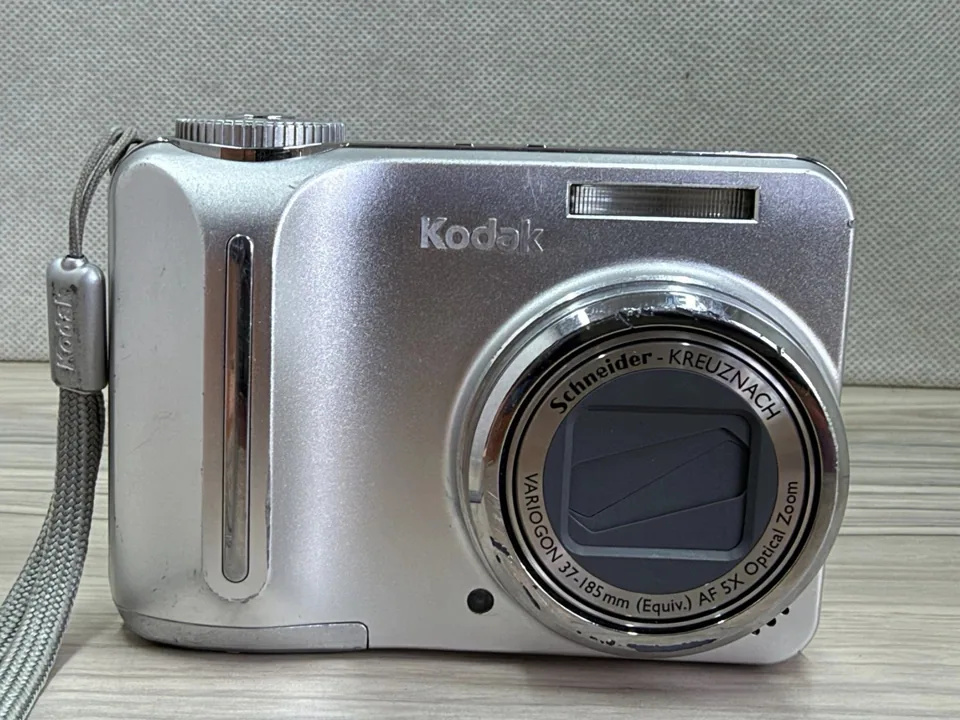
In August 2006 Kodak put full manual exposure, a 5x zoom and eight megapixels into the top of its entry-level range at $299.95. By mid-2007 it was selling for about $200, and reviewers called it a good first camera with a dim screen and heavy noise reduction.
- Launched
- August 2006
- Sensor
- 8 MP CCD
- Lens
- 37–185 mm, 5×
- Card
- SD, MMC
- Battery
- 2x AA, CR-V3
Kodak EasyShare C875 specs: sensor, lens, battery, memory card and cable
The Kodak EasyShare C875 is an 8 MP CCD compact camera with a 37–185 mm (35 mm equivalent) 5× zoom lens, launched in August 2006 at $299.95. It takes SD and MMC cards and runs on 2x AA or CR-V3 batteries. Sources
- Sensor
- CCD, 1/1.8", 8 MP source
- Lens
- 37–185 mm equivalent, 5× zoom source
- Memory card
- SD, MMC. We found no maximum size in the maker's guide, so we show none Card type only source · card guide · all cards
- Battery
- 2x AA, CR-V3 source
- USB / A/V cable
- See our Kodak cable page
What is the biggest SD card the Kodak EasyShare C875 takes?
The Kodak EasyShare C875 takes SD, MMC. We found no maximum size in the maker's guide, so we show none. A 64 GB card is SDXC, which this row does not name. Card type only source
More: SD, SDHC and SDXC guide · lookup table · the full memory card guide
Meet the camera
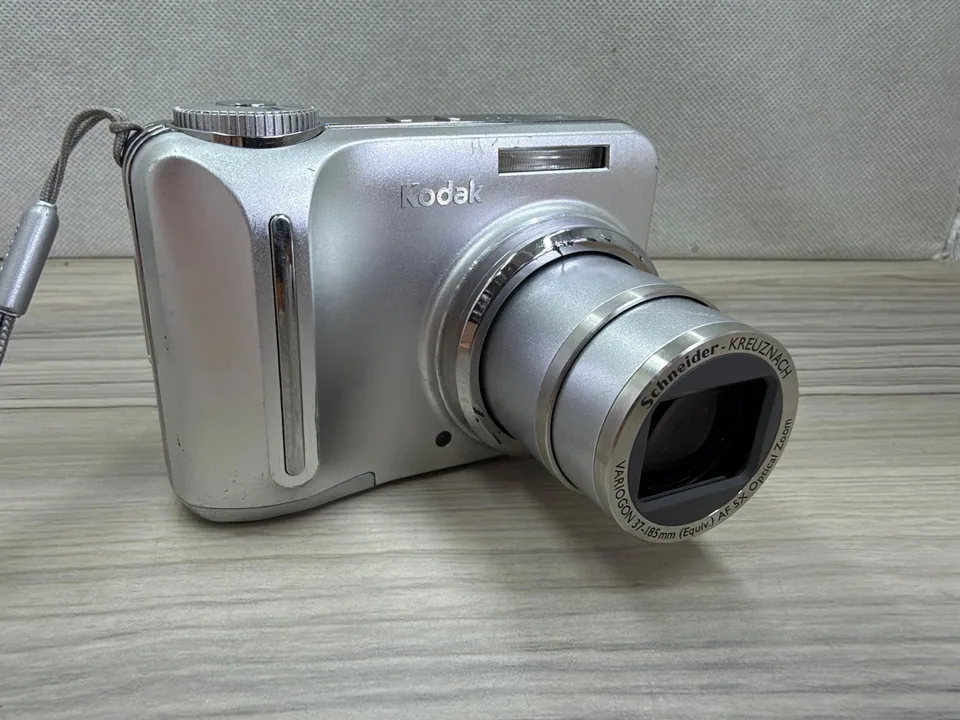
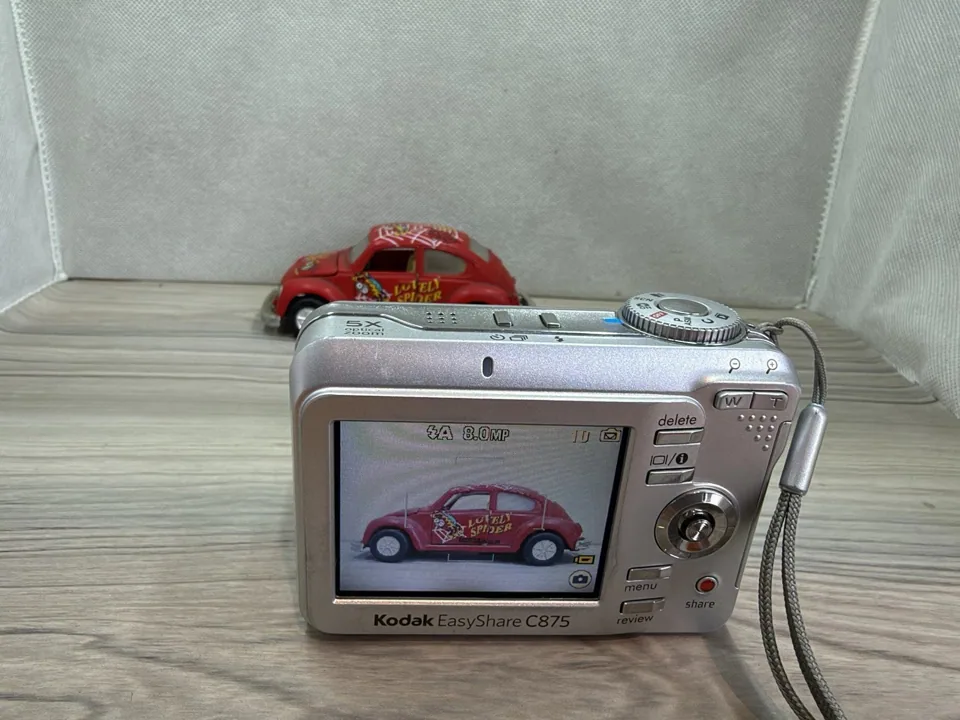
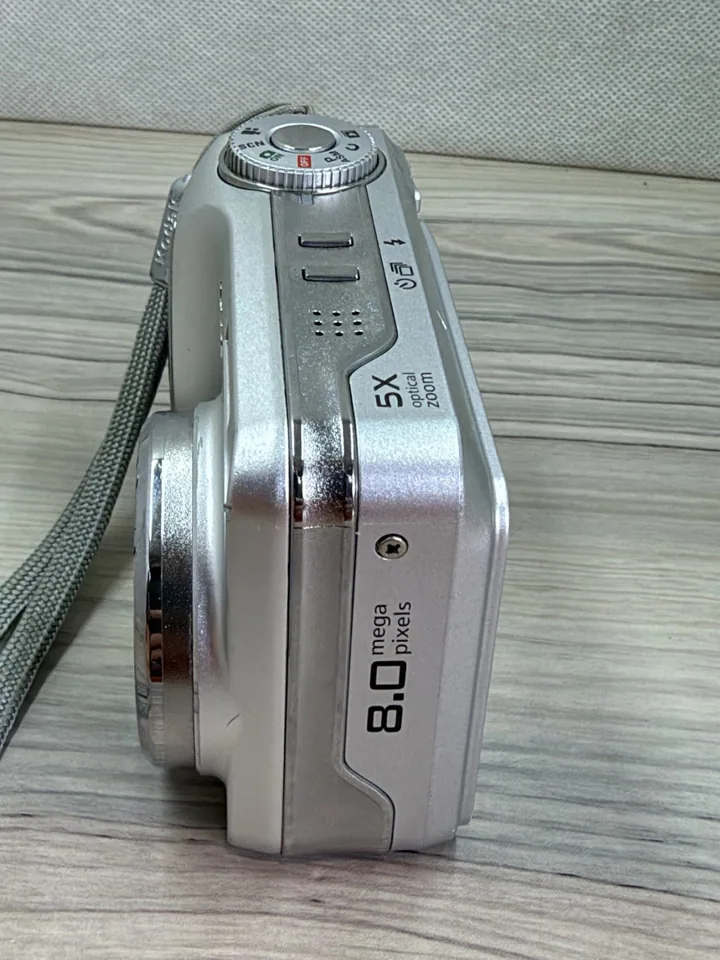
Kodak announced the C875 on 8 August 2006 as the best-equipped model of its entry-level C zoom line, alongside the C743 and C433.1 It has an 8-megapixel CCD, a 5x Schneider-Kreuznach zoom covering 37 to 185 mm in 35 mm terms, and a 2.5-inch screen but no viewfinder and no image stabilisation.15 The reviews describe the body differently: Imaging Resource called it mostly polycarbonate with metal accents (3.6 by 2.5 by 1.4 inches), DPReview said about half the exterior is metal, and Trusted Reviews called it all-metal.546 It runs on two AA batteries, and Kodak included alkaline cells in the box.3
Reviewed.com reported a price of $299.95 and availability at the end of August 2006; the report called Kodak's entry-level line "perfect for the second time buyer".2 Macworld listed it at $200 in July 2007 and DPReview said it was well under $200.74
Why this one was interesting
Manual control at entry-level money
DPReview's central point was that Kodak had brought the control of its higher-end Z and P cameras down to the cheap C range: program, aperture-priority, shutter-priority and full manual exposure, a Custom mode that stores your settings, and an on-screen blur warning.4 Macworld added exposure bracketing and a histogram display, and said it was easy to learn but had room to grow, which made it a good fit for first-time digital photographers.7 Trusted Reviews said it offered a wider range of creative control than most compacts, and found the controls simple.6
A long zoom
The lens reaches 185 mm, a 5x range at f/2.8 at the wide end falling to f/4.4 at full zoom.3 Trusted Reviews thought 37 mm not wide enough for good panoramic shots.6 Macworld called the screen "large, bright", which is not how DPReview saw it.74
Part of the EasyShare system
Imaging Resource noted that it works with Kodak's EasyShare docks, and Macworld priced the optional camera dock at $50.57 Kodak's launch material also listed EasyShare software version 6.0.2 For an earlier, odder Kodak, see our EasyShare V570 review.
What was lost
To reach the price, the screen and the processing took the hit. DPReview called the screen dim, low-resolution and hard to see in bright light, and said JPEGs were over-compressed with no quality settings and there was no custom white balance.4 Imaging Resource called the screen's resolution mediocre for playback and noted that the full manual is only available online.5 Macworld disliked that reaching the manual modes takes an extra step compared with a plain mode dial, and that the camera shipped without a memory card.7
The dark: its weak point
Noise itself was low, but the cure was heavy. DPReview measured very little noise from ISO 64 to 400 and only slightly more at ISO 800, and attributed that to heavy noise reduction, particularly from ISO 200 up, which smeared fine texture such as hair.4 Imaging Resource found indoor pictures flat, muddy and often blurry, the default flash exposure indoors underexposed, the flash dim at telephoto, and noise suppression at higher ISOs blurring subtle detail, though 8×10 prints at ISO 800 were soft but usable.5 Trusted Reviews found noise minimal even at ISO 800, at the cost of some contrast and detail.6 DPReview also called flash exposure hit and miss and focus slow in low light,4 and Trusted Reviews found the flash fell short of its claimed 4.1 metre wide-angle range and over-exposed at close range.6 The flash reaches 4.1 metres at wide and 2.6 metres at full zoom, according to Kodak's announcement.1
The free sample photos we found do not record their ISO in the file, so this page shows no low-light strip.
On eBay right now
Live listings for this camera, supplied by eBay and updated automatically. We earn a commission if you buy through them.
The little wins
Daylight pictures
Imaging Resource praised its daylight image quality, Trusted Reviews its colour reproduction, and DPReview called colour and detail good at ISO 64 and 100, with reliable focus, exposure and auto white balance in most conditions.564
Playback tools
DPReview listed a 3×3 thumbnail view and up to 8× magnification in playback.4
Helpful on-screen guidance
DPReview liked the joystick-driven on-screen controls and plain-language menus, while Macworld said the thumb joystick takes getting used to.47
An orientation sensor
Macworld noted a built-in orientation sensor that rotates pictures automatically.7
Everyday video
Kodak's launch coverage listed VGA video at 30 frames per second with the ability to print stills from it.2
How it drew the picture
DPReview scored image quality 7.0 out of 10 and optics 7.0, citing measured barrel distortion of 1.3 percent at wide and slight corner softness at full zoom.4 Imaging Resource measured resolution around 1,400 lines in daylight, with visible edge enhancement on high-contrast subjects.5 Macworld rated image quality good, with balanced, accurate colour in its still-life and flash tests, but said several shots could have been sharper.7





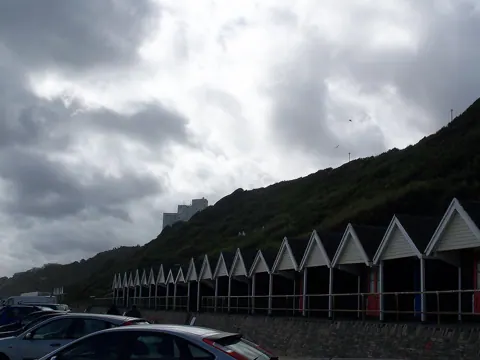











Sample photos taken with this camera, from Wikimedia Commons, credited under each picture.
Where it let you down
Speed and batteries were the common complaints. DPReview measured focus lag of about 0.3 to 0.5 seconds at wide and about 0.8 seconds at full zoom, shot-to-shot time of about 1.4 seconds with the flash off, and bursts of about 2 frames per second for 5 frames.4 Imaging Resource measured shutter lag of about 0.34 seconds at wide angle, 1.43 seconds at full zoom and 0.109 seconds pre-focused, with about 2.8 seconds between shots, and called the camera slow overall.5 The two sites measured it differently, so treat the numbers as a range.
Alkaline cells were the trap. Macworld got only 73 shots from the bundled alkalines and rated battery life poor.7 DPReview recommended good NiMH rechargeables and cited about 250 to 300 shots per charge, with Ni-Mn cells managing only about 60 to 70.4 Imaging Resource gave about 200 to 300 shots on NiMH and said alkalines drained quickly.5
What the reviewers said in 2007
| Outlet | Date | Verdict |
|---|---|---|
| DPReview | 27 Feb 2007 | Recommended, narrowly. Scores out of 10: build 8.0, value 8.5, ergonomics 7.5, features 7.5, image quality 7.0, optics 7.0, performance 6.5.4 |
| Imaging Resource | 2007 | Good daylight pictures but weak indoors, with a weak flash and slow handling; recommended mainly to beginners.5 |
| Trusted Reviews | Not shown | "A very good compact digital camera": good image quality and colour, wide manual controls, high build quality; slow, with poor low-light focus and flash, and large for a pocket compact. Shows a Value score of 10 and an Image Quality score of 8; we could not see an overall score.6 |
| Macworld | 4 Jul 2007 | "A good, inexpensive camera" for first-time digital photographers; poor battery life with the bundled cells. No overall score.7 |
We read four full reviews. They agree on the manual controls, good daylight pictures and weak low-light focus and flash, and differ on the screen, the build material and how much the noise reduction hurt.
The timeline
- 8 August 2006Kodak announces the C875, C743 and C433.1
- End of August 2006On sale at $299.95, according to Reviewed.com.2
- 27 February 2007DPReview publishes its review.4
- 4 July 2007Macworld publishes its review, listing the camera at $200.7
Should you buy one now?
Buy one if you want a simple, cheap 2006-era camera with real manual controls and good daylight pictures, and you will shoot mostly outdoors. Skip it for night and indoor work. It launched at $299.95;2 what it sells for now is a question for the sold listings, not for us. Before you bid, check these:
- The name. Search the Kodak EasyShare C875; Kodak's range also had the C743 and C433, which are different cameras.1
- The batteries. It takes two AA cells or one CR-V3;3 bring NiMH rechargeables, since alkalines gave poor life in testing.74 AA rechargeables on Amazon ↗
- The card. It takes SD and MMC cards but not SDHC, according to DPReview.4 Built-in memory is listed as 28 MB by Imaging Resource, and as 32 MB by Macworld and by DPReview, which says 28 MB of it is usable.374 See our memory card guide.
- The screen. The screen was dim even when new, so check it is not worse now.4
- The lens. Check that it extends and retracts cleanly and the glass is free of scratches.
If you are wondering why cameras like this are being hunted down again, we tell that story once, in Pictures that never left the card.
See recent sold prices on eBay ↗Shop on eBay ↗AA rechargeable batteries ↗
Sources
- Imaging Resource, Kodak announces C875, C743 and C433 (news item, 11 Aug 2006; press release 8 Aug 2006)
- Reviewed.com, Kodak updates C series with three new models (August 2006: $299.95)
- Imaging Resource, Kodak EasyShare C875 specification table
- DPReview, Kodak EasyShare C875 review by Simon Joinson (27 Feb 2007)
- Imaging Resource, Kodak C875 review by Dan Havlik (2007)
- Trusted Reviews, Kodak EasyShare C875 review (undated on the page; its sample captions mention February; author not shown)
- Macworld, Kodak EasyShare C875 review by Paul Jasper (4 Jul 2007)
Sample photographs are credited under each one, via Wikimedia Commons. Links to eBay and Amazon are affiliate links.