Fujifilm FinePix A · US announcement July 2003
The Fujifilm FinePix A210: the 3-megapixel starter camera with the awkward start-up
We found no other regional name for it. Fujifilm's US announcement and the reviews we read call it FinePix A210; PhotographyBLOG and Steve's Digicams add "Zoom" in places.124
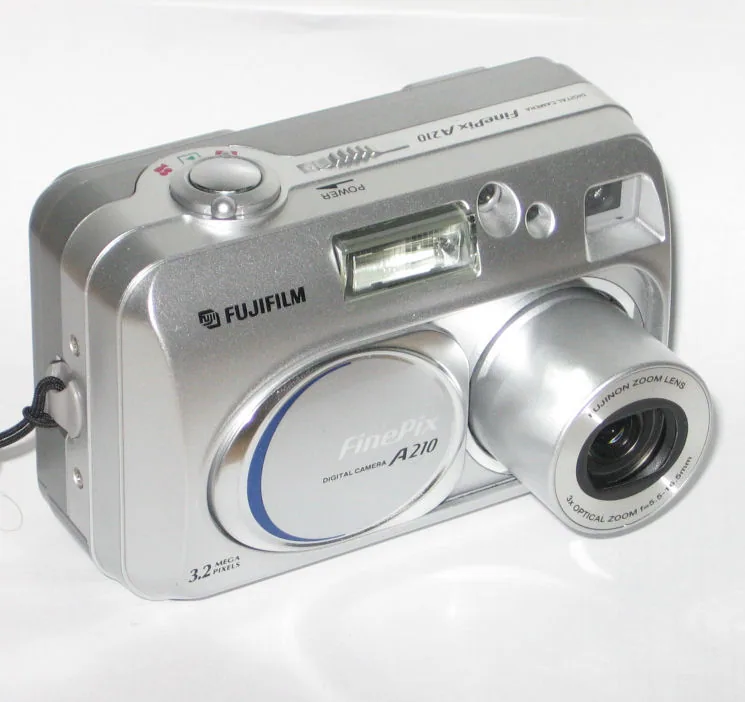

In July 2003 Fujifilm priced a 3.2-megapixel CCD, a 3x zoom and two AA batteries at $279.99. Five reviewers found its daylight pictures good for the money, then timed its start-up, shutter lag and battery runs very differently.
- Launched
- July 2003
- Launch price
- $279.99 list1
- Sensor
- 3.2 MP CCD
- Lens
- 36–108 mm, 3×
- Card
- xD-Picture Card
- Battery
- AA
Fujifilm FinePix A210 specs: sensor, lens, battery, memory card and cable
Launched in July 2003 at $279.99, the Fujifilm FinePix A210 is a 3.2 MP CCD compact with a 36–108 mm (35 mm equivalent) 3× zoom lens. Inside: it uses xD-Picture Card and runs on AA batteries. Sources
- Sensor
- CCD, 1/2.7", 3.2 MP source
- Lens
- 36–108 mm equivalent, 3× zoom source
- Memory card
- xD-Picture Card source
- Battery
- AA source
- USB / A/V cable
- CP-FXA10 Confirmed · all Fujifilm cables
Meet the camera
Fuji's US arm announced the A205 and the A210 on 28 and 29 July 2003 at $199.95 and $279.99, with shipping due in August. Imaging Resource added that one of the two had already been announced in Japan, Canada, the United Kingdom and elsewhere the previous May; its page does not say which.1 The A210 had the larger sensor, 3.2 megapixels against 2.0. The Digital Camera Resource Page called it the latest update of Fujifilm's old 2600-series cameras, with a faster lens than the FinePix 2650 (f/3.0 against f/3.7) and a video-out port.16
The body is all plastic. Imaging Resource listed 99 by 65 by 53 millimetres and 225 grams with batteries and card, a little too large for most shirt pockets.9 CNET called it square and ugly. Tek.no's reviewer found the silver finish handsome but the thin shell fragile, a worry that faded after a short time of use; the Digital Camera Resource Page rated the build a notch below comparable Canon and Olympus plastic, and the body surprisingly thick.786
- Sensor
- 1/2.7" conventional CCD, 3.2 MP effective (3.34 MP total)1
- Lens
- 3x Fujinon, 36–108 mm equiv.; f/3.0 to f/7.0 at wide angle, f/4.8 to f/10.8 at telephoto1
- Screen
- 1.5" TFT, 60,000 pixels by Fujifilm's count (Tek.no printed 55,000), plus an optical viewfinder18
- Video
- 320 × 240 for up to 60 s or 160 × 120 for up to 240 s, 10 fps, no sound1
- Card and battery
- xD-Picture Card (maker lists 16 to 512 MB; a 16 MB card in the box) · 2 AA (alkaline in the box) or the NH-10 NiMH pack1
- Launch price
- $279.99 list1
Why this one was interesting
A plain sensor, a low price
PhotographyBLOG noted that both new cameras used conventional CCDs, not the Super CCD of Fujifilm's other models, and Fujifilm's own table agrees; Steve's feature list says "Super CCD HR", but its specification table, supplied by the maker, says conventional.214 The price was the pitch. Imaging Resource thought three megapixels and a 3x zoom for less than many two-megapixel rivals compelling, and said the camera narrowly missed a Dave's Pick over incandescent colour casts and weak low light.9
A dock, borrowed from Kodak's idea
Imaging Resource noticed that the A205, A210 and the new A310 shared one optional cradle through an adapter packed with each camera, the same approach as Kodak's EasyShare.1 The $74.95 cradle came with an NH-10 NiMH pack and charged that pack in the camera, but not other batteries such as ordinary AA NiMH cells.1 The Digital Camera Resource Page priced the cradle at $99, thought the $20 pack overpriced, and said you did not need the dock if you bought your own batteries and charger.6
Every decision made for you
Exposure was automatic in both of its modes. The "Manual" setting only unlocked exposure compensation, from minus 2.1 to plus 1.5 EV, and white balance presets, as Imaging Resource, Steve's and the Digital Camera Resource Page described it.956 Tek.no found a less obvious snag: out of the box the camera was set to one megapixel, an odd default for buyers who had paid for three. A smaller size gained no speed, the reviewer concluded, because the camera still captured at 3 megapixels before shrinking the file.8
What was lost
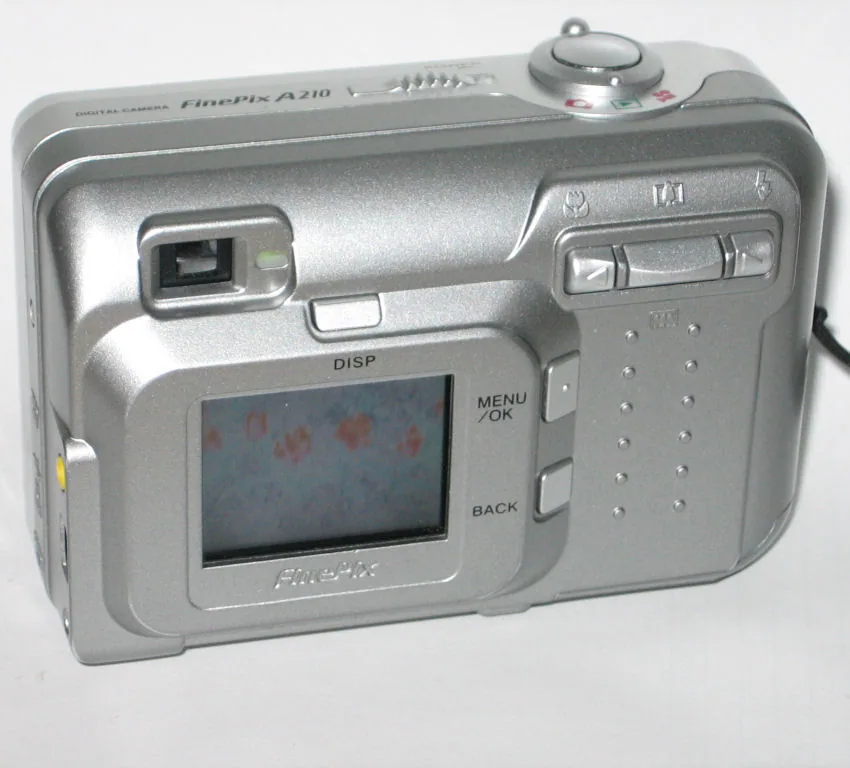
The five reviews disagreed about the screen. Tek.no found it low in resolution, poor in bright sun and in the dark, and prone to freezing on moving subjects, so the viewfinder was the better frame.8 CNET called the 1.5-inch LCD acceptably sharp and usable outdoors, Steve's usable in most daylight and in low light, and the Digital Camera Resource Page bright and fluid.756 The optical viewfinder showed 76 to 78 percent of the frame in Imaging Resource's test, 80 in the Digital Camera Resource Page's and about 85 by Steve's count; CNET found it small and distorted, though a bit sharper than most in its class.9647
The handling drew complaints too. Both Tek.no and Steve's counted only five distinct steps in the zoom, and Tek.no timed 1.95 seconds from wide to tele and disliked the long, awkward zoom bar; the Digital Camera Resource Page, which found the camera easy to hold and use, put the same run at about 1.5 seconds.856 Movies ran at 10 frames a second with no sound and the optical zoom locked at wide angle. Macro mode also held the zoom (at wide angle, the Digital Camera Resource Page said; a little in from wide angle, said Tek.no) and focused down to 10 centimetres.684 Both reviewers also clocked playback at over two seconds between pictures.68
How it drew the picture
CNET called the test photos comparatively sharp, detailed and smooth, with mostly accurate, vibrant colour and some noise and compression artefacts.7 Imaging Resource found accurate hues and good saturation, an incandescent cast with both the auto and incandescent presets, and a high native contrast that lost highlight and shadow detail in harsh sun. Its chart showed strong detail to about 1,000 lines per picture height, which it called good for an entry-level three-megapixel camera.9
The Digital Camera Resource Page saw accurate colour, low noise in good light, no purple fringing and no vignetting, but a brownish cast on the white wall of its macro shot and no great success freezing roller coasters.6 Tek.no saw some corner softness and vignetting (less than on a Canon A80) and more in-camera sharpening than on a Nikon comparison camera, visible as bright edge halos.8 Steve's found the lens sharp across its range and its outdoor pictures fine for 8 by 10 inch prints.5




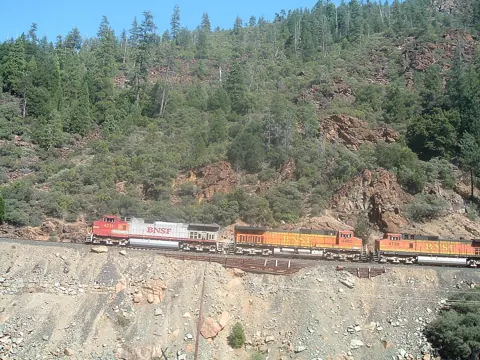



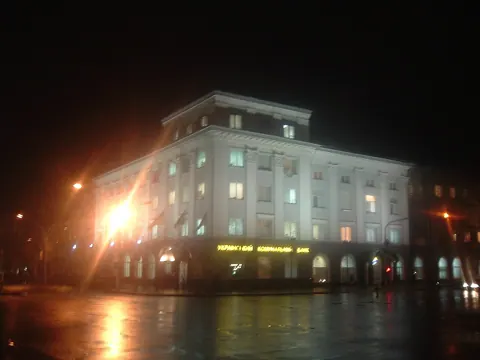





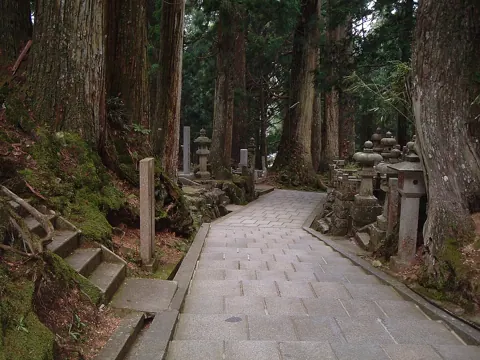

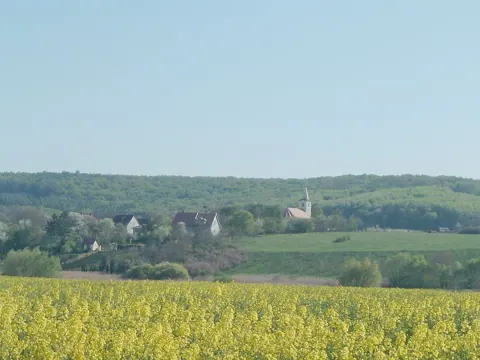

Photos taken with this camera, from Wikimedia Commons, credited under each picture. They may have been resized or edited by their authors. The EXIF data of the bank building against a dark sky (first in the second row) lists 0.38 seconds at f/3 and ISO 100, with the flash recorded as not fired; the dinner plate was shot with the flash.
The dark, and the flash
With its sensitivity fixed at ISO 100 and a longest exposure of half a second, the A210 had little to give when the light went. Imaging Resource's darkness test gave a barely usable picture at 1 foot-candle (11 lux), with good colour but too dark a frame, and it advised the flash for night shots.9 The Digital Camera Resource Page wished for a night mode or at least an automatic slow shutter, and its autofocus struggled in dim rooms, which it blamed partly on the lack of a focus-assist lamp.6 Tek.no was more generous: the camera locked on a single candle a metre away, it said, though without an assist lamp total darkness was out.8
Fujifilm gave the flash a range of 0.8 to 3.5 metres at wide angle and 0.8 to 3.0 at telephoto.16 Steve's judged that enough for portraits of one person or a small group but not for a banquet room.5 The slow recycle was the complaint: Tek.no managed two pictures in ten seconds with flash, against six without, and suspected two batteries were marginal for the job, though better cells did not shorten the wait.8 The Digital Camera Resource Page also saw some red-eye.6
Like the look? See recent eBay sold listings for this camera ↗
Speed and battery, side by side
Each outlet timed the camera its own way, so read the columns as rough neighbours, not as a league table.
| Steve's, Sep 2003 | DCRP, Sep 2003 | CNET, Nov 2003 | Tek.no, Jan 2004 | Imaging Resource, Jan 2004 | |
|---|---|---|---|---|---|
| Start-up | under 4 s to the first picture5 | about 3 s6 | about 6 s7 | 2.6 s, 3.1 s with flash, timed from the switch8 | 3.0 s from power-on to first shot10 |
| Shutter lag | 0.3 s pre-focused, just under 1 s with autofocus5 | autofocus about 0.5 s in good light, about 1 s when it had to work; shutter lag "noticeable", worse at slow speeds6 | about 1 s7 | too short to time; 0.30 s with red-eye reduction on8 | 0.87 s at wide and 0.90 s at tele with autofocus; 0.18 s pre-focused10 |
| Shot to shot | just over 3 s5 | about 2 s, with review off6 | about 4 s7 | 6 shots in 10 s without flash, 2 with8 | 2.8 s at the largest size, 3.0 s at the smallest, with the camera's auto review10 |
| Battery | nearly 100 test shots on 2000 mAh NiMH before the low-battery warning, screen on5 | Fuji's estimate of 350 (NH-10) or 385 (2100 mAh cells), 50% screen use; a full day at an amusement park on the alkalines6 | 845 shots on NiMH AAs, half with flash7 | about 450 on the bundled cells, 894 on other single-use cells it bought8 | 2 h 40 min worst case on 1600 mAh NiMH910 |
Even allowing for different habits, the spread from nearly 100 to 894 shots is wide, and three reviewers, CNET, the Digital Camera Resource Page and Imaging Resource, all called battery life a strength.769 Four of the five recommended NiMH rechargeables over the alkaline cells in the box.9685
On eBay right now
Live listings for this camera, supplied by eBay and updated automatically. We earn a commission if you buy through them.
The little wins
Two AA batteries
The camera ran on two ordinary AAs, and Imaging Resource called its endurance surprisingly good for a two-cell camera.9
The launch price, three ways
Fujifilm's announcement gave a list price of $279.99, which PhotographyBLOG repeated.12 MacTech printed $279.95 for the same camera, as did Steve's in its conclusion, while the Digital Camera Resource Page and Imaging Resource's review rounded it to $279.3569 Tek.no priced it at about 2,000 Danish kroner.8 The spec card carries Fujifilm's figure.
What the reviewers said in 2003 and 2004
| Outlet | Date | Verdict |
|---|---|---|
| Steve's Digicams | 8 Sep 2003 | A simple automatic point-and-shoot that a novice can get good results from, with little creative control; the $80 premium over the A205 is for the reader to judge.5 |
| Digital Camera Resource Page | 22 Sep 2003 | Worth a look for basic outdoor photography; people who want manual controls or speed should look elsewhere, and the reviewer still thought the Canon PowerShot A70 the best in the class.6 |
| CNET | 12 Nov 2003 | 6.2 out of 10, a "fair" on CNET's scale: easy to use, fairly good photos, no looker.7 |
| Tek.no | 4 Jan 2004 | After a poor first impression, a mostly positive surprise, and not a bad buy for a new digital photographer who wants a cheap camera with acceptable picture quality (our paraphrase of the Danish).8 |
| Imaging Resource | 26 Jan 2004 | A solid entry-level camera with good resolution and a zoom at an exceptional price; just missed a Dave's Pick, and best for mostly daytime use.9 |
The Tek.no review is in Danish; we read it directly and the wording above is ours. Archived copies stand in for the original pages of Steve's, the Digital Camera Resource Page and CNET.
The timeline
- May 2003One of the A205 and the A210 is announced in Japan, Canada, the United Kingdom and elsewhere; the source does not say which.1
- 28 and 29 July 2003Fuji's US arm announces both at $199.95 and $279.99.1
- 8 September 2003 to 26 January 2004The five reviews appear, from Steve's Digicams to Imaging Resource (dates in the table above).46789
Should you buy one now?
Buy one if you want a plain, light 2003 snapshot camera on ordinary AA batteries that does well in daylight and does not mind being slow. Skip it for indoor and after-dark shooting, and for anything that moves.965 Before you bid, check these:
- The name. Search FinePix A210. The A205 is the 2-megapixel sibling with, Imaging Resource said, essentially the same features, and a 20-second movie limit against the A210's 60 seconds.91 By Fujifilm's table the A205's screen is rated 55,000 pixels, the figure Tek.no printed for the A210.18
- The batteries. It takes two AAs; the reviewers recommended NiMH.96 Rechargeables on Amazon ↗ Our guide to CCD digicams that run on AA batteries shows how others compare.
- The card. It takes xD-Picture Cards only; Fujifilm's table listed 16 to 512 MB, and a 16 MB card holds 19 pictures at 3 megapixels.16 See our xD-Picture Card page and memory card guide.
- The picture size. Check the menu is on 3M, not the 1M Tek.no found as the default.8
- The start-up. Slide the cover and the power switch, and watch the lens extend and retract; CNET and Tek.no both found the two steps awkward.78
- The tripod socket and door. The tripod socket is plastic and sits by the card and battery door, so neither can be changed with the camera on a tripod.968
The Digital Camera Resource Page listed other low-priced 3-megapixel, 3x-zoom cameras to try, and we have reviewed five of them: the PowerShot A70, Camedia D-560 Zoom, Lumix DMC-LC33, Cyber-shot DSC-P72 and DSC-P8.6 For a later A-series camera, see our FinePix A340 review. Why cameras like this are being hunted down again is told once, in Pictures that never left the card.
See recent sold prices on eBay ↗Shop on eBay ↗AA NiMH batteries ↗
Sources
- Imaging Resource, Fuji USA announces FinePix A205, A210 (Mike Tomkins, 28 Jul 2003; includes Fujifilm's press release of 29 Jul 2003 and its specification tables)
- PhotographyBLOG, Fuji Announce FinePix A205/210 Zoom (Mark Goldstein, 29 Jul 2003)
- MacTech, Fujifilm releases batch of new digital cameras (29 Jul 2003)
- Steve's Digicams, Fujifilm FinePix A210 review, pages 1 to 4: introduction, specifications, features, menus (posted 8 Sep 2003; read through the Internet Archive copy)
- Steve's Digicams, Fujifilm FinePix A210 review, Steve's Conclusion page (read through the Internet Archive copy)
- The Digital Camera Resource Page, Review: Fuji FinePix A210 (Jeff Keller, 22 Sep 2003; read through the Internet Archive copy)
- CNET, Fujifilm FinePix A210 review (Eamon Hickey, 12 Nov 2003; read through the Internet Archive copy)
- Tek.no, Test af Fuji Finepix A210 (Jens Hansen, published 4 Jan 2004; the review is written in Danish and the translations on this page are ours)
- Imaging Resource, Fuji FinePix A210 review (review date 26 Jan 2004; lab and shooting tests; the page shows no author)
- Imaging Resource, Picky Details for the Fujifilm FinePix A210 (timing and power measurements)
Photographs are credited under each one, all via Wikimedia Commons. Links to eBay and Amazon are affiliate links.