Canon PowerShot A · March 2003
The Canon PowerShot A70: an entry-level compact with manual modes and a five-hour battery test
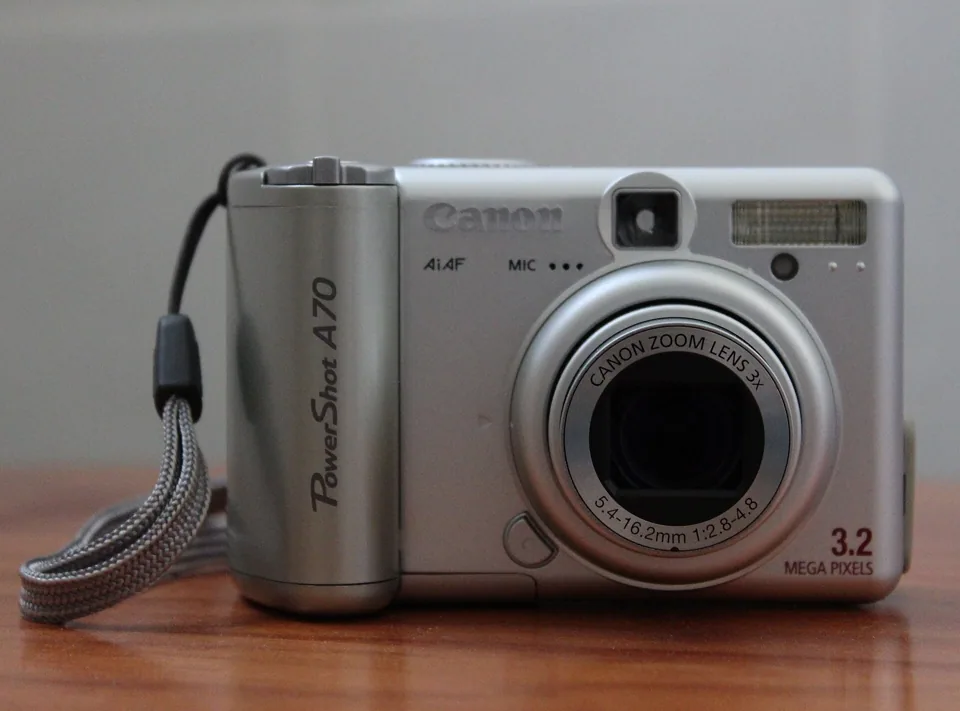

In spring 2003 Canon's entry-level A line offered shutter- and aperture-priority, manual focus and 15-second exposures at a suggested $349. Four full reviews recommended it, and one battery test ran it for just over five hours on four AA cells.
- Launched
- March 2003
- Launch price
- $349 suggested retail (Imaging Resource)2
- Sensor
- 3.2 MP CCD
- Lens
- 35–105 mm, 3×
- Card
- CompactFlash
- Battery
- AA
Canon PowerShot A70 specs: sensor, lens, battery, memory card and cable
The Canon PowerShot A70 came out in March 2003 at $349 as a 3.2 MP CCD compact with a 35–105 mm (35 mm equivalent) 3× zoom lens. It takes CompactFlash cards and runs on AA batteries. Sources
- Sensor
- CCD, 1/2.7", 3.2 MP source
- Lens
- 35–105 mm equivalent, 3× zoom source
- Memory card
- CompactFlash source
- Battery
- AA source
- USB / A/V cable
- IFC-300PCU, AVC-DC100 Confirmed · all Canon cables
Meet the camera
The A70 is a mid-size silver compact with a deep grip on the right, where the four AA cells sit. Canon lists it at 101 by 64 by 31.5 millimetres and about 215 grams without batteries or card;1 DPReview lists it with batteries at 335 grams, and Imaging Resource gives 327 grams with batteries and a card.32 Steve's Digicams put the A series between the tiny Digital ELPH and the full-size G3.4 DPReview stood it beside Nikon's Coolpix 3100: the same height and depth, but the Nikon was about two thirds the width and 122 grams lighter, a gap DPReview put down to that size difference and to the Nikon taking two AAs rather than four.3
The reviewers disagreed on the shell: DPReview's spec table says plastic, Imaging Resource found plastic with metal decorative panels, the Digital Camera Resource Page (DCRP) called it a mix of metal and plastic that felt solid, and Steve's Digicams listed an aluminum-clad front.3254 Three outlets shared one irritation: DPReview and CNET disliked the mirror-finish ring around the screen, which DPReview said can be almost blinding on a bright day, and DCRP, at the same point in its tour, wrote that it hates mirrored camera parts.365
Canon marketed the A70 in March 2003 as the replacement for the A40; the 2-megapixel A60 replaced the A30.13 Canon's museum page gives no price; Imaging Resource listed a suggested $349, and DPReview's spec table showed a US street price of $350.123 DCRP also quoted $349 and said the A60 cost $100 less.5
- Sensor
- 3.2 MP CCD, 1/2.7" (about 3.3 MP total)1
- Lens
- 3x, 35–105 mm equiv., f/2.8–4.81
- ISO
- Auto, 50, 100, 200, 4001
- Screen
- 1.5", optical viewfinder; Canon's museum page says about 118,000 dots, DPReview and Steve's say 78,000 pixels134
- Video
- 640 × 480 for about 30 s; 320 × 240 and 160 × 120 for about 3 min; about 15 frames a second. Canon's times are for its optional FC-256MH card, and DPReview says the 3-minute modes need a high-speed card13
- Size
- 101 × 64 × 31.5 mm, about 215 g without batteries or card1
- Launch price
- $349 suggested retail (Imaging Resource)2
Why this one was interesting
Manual control at the bottom of the range
Imaging Resource called the A70 unusual because it was marketed and priced as entry level while its features went well past that.2 The mode dial carries program, shutter-priority, aperture-priority and full manual positions beside the scene modes, and the Function menu sets ISO, white balance (including a custom setting), metering and exposure compensation.25 DCRP also noted true manual focus, rare at the price, but missed the user-memory position found on dearer Canons;5 DPReview's pros list called the range almost an affordable G1.3
What changed from the A40
Imaging Resource listed a larger CCD, more manual controls, a 1/2000 second top shutter speed and a custom white balance, and noted the A40 had topped its readers' popularity chart the year before.2 DCRP added that the A70 used the same DIGIC processor as Canon's high-end models, which it credited with better performance and photo quality.5
Fifteen seconds
The longest exposure is 15 seconds, in shutter-priority and manual modes, with noise reduction on exposures slower than 1.3 seconds (DPReview writes 1.3 seconds or slower).13 DCRP called that unheard of on a $350 camera a month earlier and found the noise in its 15-second night frame acceptable; DPReview called its 4- and 15-second ISO 50 frames clean and detailed, and noted that Night Scene mode stops at 1 second.53
Where it sat in the line
The 4-megapixel PowerShot A80 followed in October 2003 with a swivelling screen,9 and the A75 of March 2004 replaced the A70, keeping its sensor and lens and adding a new grip, a larger 1.8-inch screen and six special scene modes.8 AA-powered A-series cameras we have reviewed since include the PowerShot A700 (2006), the PowerShot A640 (2006) and the PowerShot A590 IS (2008).
What was lost
The optical viewfinder was tight. Imaging Resource measured it at 81 percent of the frame at wide angle and 79 percent at telephoto, and found that its test unit's pictures framed through it came out slightly slanted.2 DPReview put the figure at about 81 percent in its text and about 84 percent in its spec table, and noted no diopter control and no parallax marks, while Steve's gave about 82 percent.34 DCRP also noted the missing diopter control.5
The screen drew milder complaints: DPReview called it bright and clear but less sharp than the 110,000-plus-pixel screens on dearer cameras, and DCRP said the resolution could be better and noted the brightness is not adjustable.35 It shows no histogram in record or playback mode, which DPReview and DCRP both listed as a gap, and DPReview added there is no orientation sensor.35
Smaller items add up. DPReview found the plastic tripod mount sat proud of the base and made the camera wobble on a hard surface, and Imaging Resource noted the battery door sits so close to the mount that changing batteries on a tripod is awkward.32 DCRP called the CompactFlash door somewhat flimsy and CNET listed the same door under its cons.56
The dark: its weak point
Most of what the reviewers found in the dark was good. Imaging Resource got clear, bright, usable pictures down to its limit of 0.67 lux, with good colour at all four ISO settings, and found ISO 400 noise high but in a tight, fine grain.2 DPReview saw noise rise steadily from ISO 50 and judged the A70 about a stop more sensitive than a Minolta DiMAGE Xt at the same indicated ISO.3
They disagreed about the autofocus lamp. Steve's said focus stayed accurate and fast to total darkness thanks to it, while Imaging Resource and DCRP said it helped in dim or low light,425 but DPReview's test needed a dim ambient light (focus down to 6.6 lux at wide angle) and called the orange lamp weak and diffuse.3
Flash drew complaints. Canon lists a range of 0.46 to 4.2 metres at wide angle and 0.46 to 2.5 metres at telephoto.1 DPReview found good colour but underexposure, and DCRP found red-eye pretty bad even with reduction switched on.35 In Imaging Resource's tests the camera underexposed an indoor portrait with and without flash, needing positive compensation, and the flash overexposed in macro.2
Like the look of 2003? See recent eBay sold listings for this camera ↗
On eBay right now
Live listings for this camera, supplied by eBay and updated automatically. We earn a commission if you buy through them.
The little wins
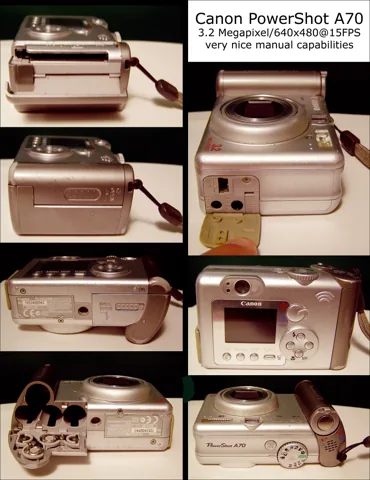 Views of the A70, including the open battery bay. · Accuruss · Public domain · Commons

Battery life
DPReview's battery test (screen on, a flash shot every fifth frame) ran four 1600 mAh NiMH cells for 5 hours 8 minutes and 515 shots, against 3 hours 9 minutes and 320 shots for the next-best camera on its chart, a two-AA Photosmart. It added that this beat the G5 by half an hour.3 Imaging Resource called power consumption excellent, and CNET said alkaline cells last a surprisingly long time but still recommended NiMH for the longest life.26 Steve's said alkalines give only about a third as many pictures as high-capacity NiMH, and quoted Canon's ratings of about 250 shots on alkaline and 800 on 1700 mAh NiMH with the screen on.4
Manual modes on a budget
Program, Tv, Av and full manual, five-point AiAF or centre-point focus, and manual focus with a distance scale on screen.32 DCRP's reaction: “bravo to Canon” for putting full manual controls on an inexpensive camera.5
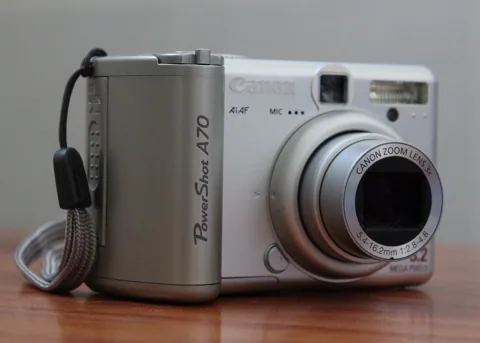 The A70 from the side, strap attached. · HelenOnline · CC BY-SA 3.0 · Commons

Add-on lenses and an underwater case
Remove the ring around the lens and an adapter takes converters: DPReview listed the LA-DC52C adapter with a 2.4x tele, a 0.7x wide and a close-up lens, plus a WP-DC700 case. DPReview and DCRP gave its depth as 30 metres, while Steve's said 130 feet on its first page and 100 feet on its features page.354
How it drew the picture
All four full reviews found the pictures good. DPReview called the pictures well exposed, with natural but not under-saturated colour, and measured about 1,100 lines of horizontal resolution with extinction at 1,300.3 Imaging Resource picked 1,100 lines too, noting artifacts from about 700 vertical lines, and saw slight oversaturation of strong primaries.2 Steve's thought 2048 by 1536 pixels good for 8 by 10 inch prints,4 and CNET found reds slightly off-hue.6 Against the Coolpix 3100, DPReview measured equal resolution and found the Canon's lens much sharper near the edges.3
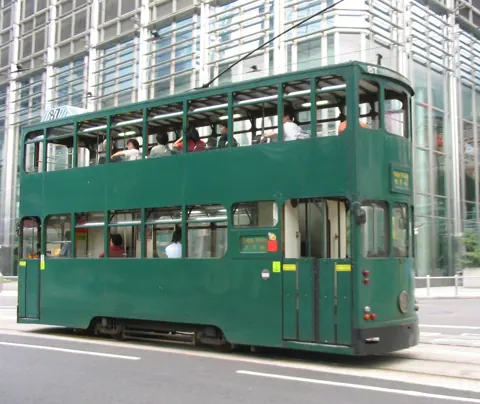















Photos taken with this camera, from Wikimedia Commons, credited under each picture. The last three were shot at 1/13 or 1/8 second according to the files' own metadata, which carries no ISO value. We chose them for variety, not to prove anything about quality.
Lens faults were minor, and the measurements differ. Imaging Resource found about 0.7 percent barrel distortion at wide angle and higher-than-average flare, which puzzled it because the lens looked identical to the A40's.2 DPReview measured 0.9 percent and found fringing hard to find in everyday shots, while DCRP saw occasional purple fringing and softness that muddied grass and trees.35
Where it let you down
Speed drew qualified praise. DPReview measured 3.5 seconds from off to the first shot, including a 0.7 second hold on the power button, 1.7 seconds shot to shot and 0.9 seconds of total lag at wide angle; continuous shooting managed 1.88 frames a second for 12 Fine frames, against Canon's 2.2.31 Steve's measured a shutter lag of 0.6 to 0.7 seconds.4
The rest is small. Automatic white balance struggled under household incandescent light: DPReview's sample shows a strong orange cast, and Imaging Resource said the Auto setting had quite a bit of trouble and needed the Incandescent or manual setting.23 DPReview found playback slow because the camera shows nothing until it has loaded the full image.3 It saves JPEG only, with no RAW or TIFF,3 and DCRP noted that the Type I slot rules out Microdrives.5 DPReview says the A60 is identical apart from the sensor and Steve's that the two differ only in resolution and price, while DCRP says the A60 also lacks the VGA movie mode.345
What the reviewers said in 2003
| Outlet | Date | Verdict |
|---|---|---|
| DCRP | 7 Mar 2003 (updated 8 Sep) | Liked it a lot: very good photo quality and plenty of manual control, against red-eye, soft details and no diopter or histogram.5 |
| Steve's Digicams | 10 Mar 2003 | An excellent choice for an easy, fully featured, compact three-megapixel camera, with the two-megapixel A60 as the cheaper alternative.4 |
| Imaging Resource | 10 Apr 2003 | Highly recommended as an all-round digicam; its two complaints were the lens flare and a viewfinder that is still not accurate enough.2 |
| CNET | 21 Apr 2003 | 7.6; for enthusiasts, the features and price are the draw; flimsy card cover and reflective screen frame are the cons.6 |
| DPReview | 13 Aug 2003 | Highly Recommended, with scores from 8 to 9 out of 10 in six categories and a conclusion that the price was the best part.3 |
The timeline
- 27 February 2003Photography Blog posts Canon's launch text: the A60 and A70 on sale from March 2003 at around 229 and 299 RRP including VAT, with the currency symbol garbled in the archived copy we read (the VAT wording suggests UK prices).7
- March 2003Canon markets the A70; DPReview says both cameras were introduced in time for the PMA trade show in Las Vegas.13
- March to April 2003DCRP posts its review on 7 March, Steve's Digicams heads its own '3/10/03' (we read 10 March), and Imaging Resource and CNET follow on 10 and 21 April.5426
- 13 August 2003DPReview publishes its review.3
- October 2003Canon markets the A80.9
- March 2004The A75 replaces the A70.8
Should you buy one now?
Buy one if you want a 3-megapixel CCD compact with real exposure control and ordinary AA batteries, and you can live with a tight viewfinder, a mirror-ringed screen and modest speed. Imaging Resource listed a suggested price of $349 in April 2003;2 what it sells for now is a question for the sold listings, not for us. Before you bid, check these:
- The card. It takes CompactFlash Type I only;15 see our CompactFlash guide and the glossary. The original card was 16 MB, so plan to buy a bigger one.2
- The batteries. It uses four AA cells, alkaline or NiMH;1 a set of rechargeables and a charger ↗ is the usual pairing.
- The clock cell. A CR1220 lithium cell in a pull-out slot behind the connector flap keeps the clock and settings alive when the AAs are out; check that it does.2
- The card door. Two reviewers called it flimsy: check that it closes and latches.56
- The lens. Check that it extends and retracts cleanly.
If you are wondering why cameras like this are being hunted down again, we tell that story once, in Pictures that never left the card.
See recent sold prices on eBay ↗Shop on eBay ↗AA batteries and charger ↗
Sources
- Canon Camera Museum, PowerShot A70 (marketed March 2003; outline and specifications)
- Imaging Resource, Canon PowerShot A70 review (review date 10 Apr 2003; lists a $349 suggested retail price)
- DPReview, Canon PowerShot A70 review by Phil Askey (published 13 Aug 2003; 16 pages, read from an archived copy)
- Steve's Digicams, Canon PowerShot A70 review (pages headed 'Review posted 3/10/03'; read from archived copies of the introduction, specifications, features, record-mode and conclusion pages; the original site is gone)
- Digital Camera Resource Page, PowerShot A70 review by Jeff Keller (originally posted 7 Mar 2003, last updated 8 Sep 2003; archived copy)
- CNET, Canon PowerShot A70 by Theano Nikitas (21 Apr 2003; a short write-up with a 7.6 score, pros and cons)
- Photography Blog, 'More Canon Digital Releases' (27 Feb 2003; quotes Canon's launch text with RRP including VAT; archived copy)
- Canon Camera Museum, PowerShot A75 (marketed March 2004; says it replaces the A70)
- Canon Camera Museum, PowerShot A80 (marketed October 2003)
Camera photos by HelenOnline (CC BY-SA 3.0) and Accuruss (public domain); other photographs are credited under each one, all via Wikimedia Commons. Links to eBay and Amazon are affiliate links.