Panasonic Lumix LC · on sale in Japan from April 2003
The Panasonic Lumix DMC-LC33: Leica glass, two AA batteries and a $299 price
We found no other regional name: Phile Web (reporting Panasonic Japan), Imaging Resource, DPReview, the Digital Camera Resource Page and 3DNews all call it the DMC-LC33.57813 Its 4-megapixel twin is the DMC-LC43.
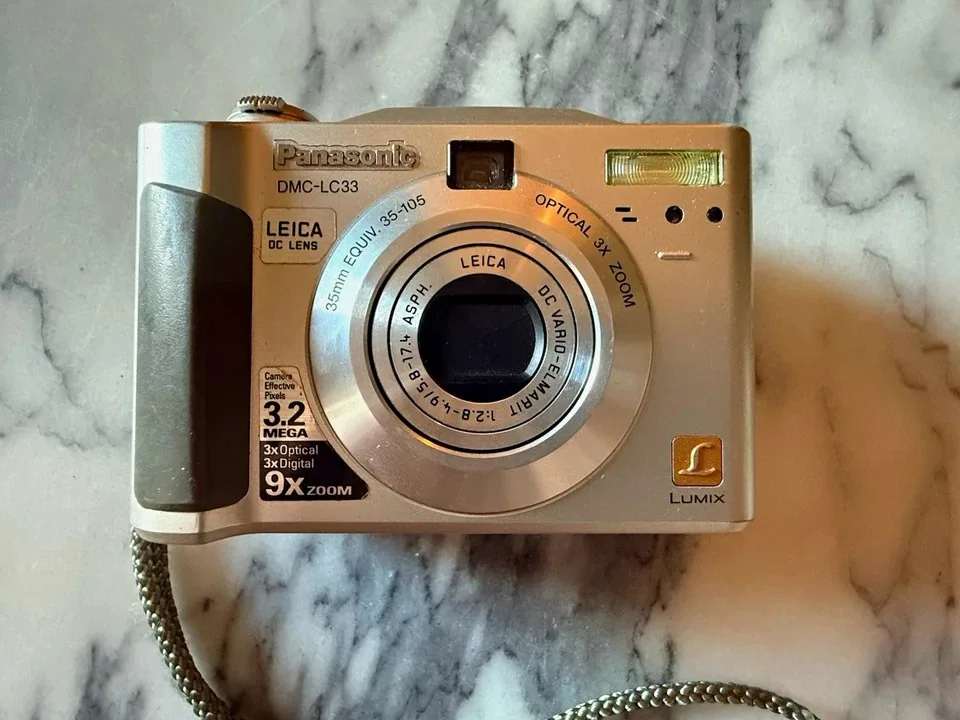
In spring 2003 Panasonic fitted a Leica-branded f/2.8 zoom, a new image-processing chip and a Simple mode for beginners into a compact that ran on ordinary AA batteries. Reviewers liked the pictures and argued about the speed.
- Launched
- April 2003
- Sensor
- 3.2 MP CCD
- Lens
- 35–105 mm, 3×
- Card
- SD, MultiMediaCard
- Battery
- AA
Panasonic Lumix DMC-LC33 specs: sensor, lens, battery, memory card and cable
Launched in April 2003, the Panasonic Lumix DMC-LC33 is a 3.2 MP CCD compact with a 35–105 mm (35 mm equivalent) 3× zoom lens. Inside: it uses SD and MultiMediaCard and runs on AA batteries. Sources
- Sensor
- CCD, 1/2.5", 3.2 MP source
- Lens
- 35–105 mm equivalent, 3× zoom source
- Memory card
- SD, MultiMediaCard source
- Battery
- AA source
- USB / A/V cable
- See our Panasonic cable page
Meet the camera
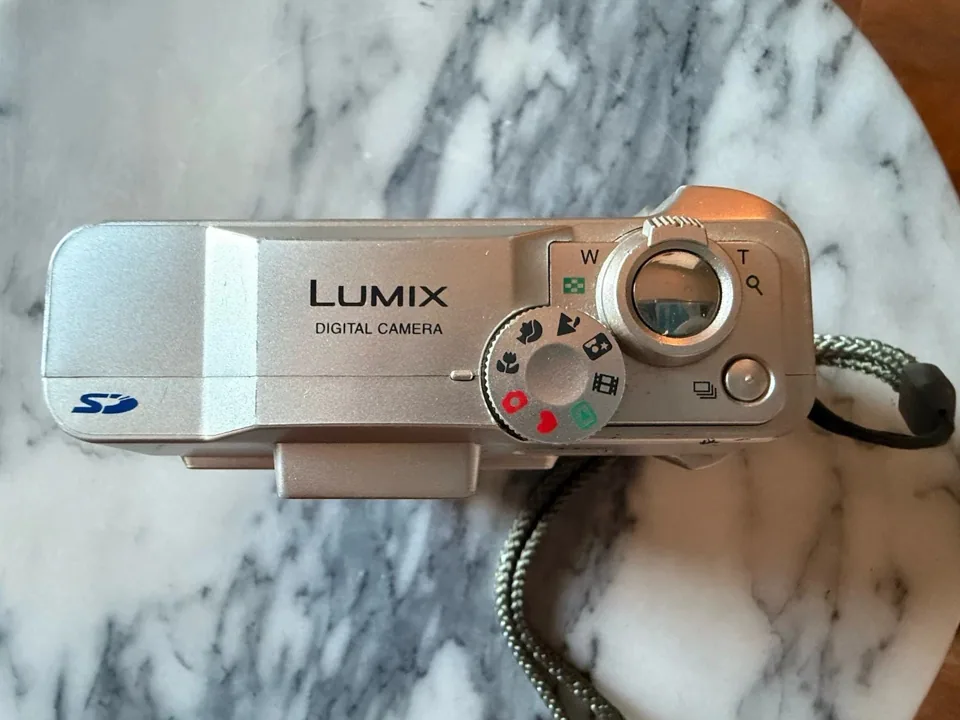
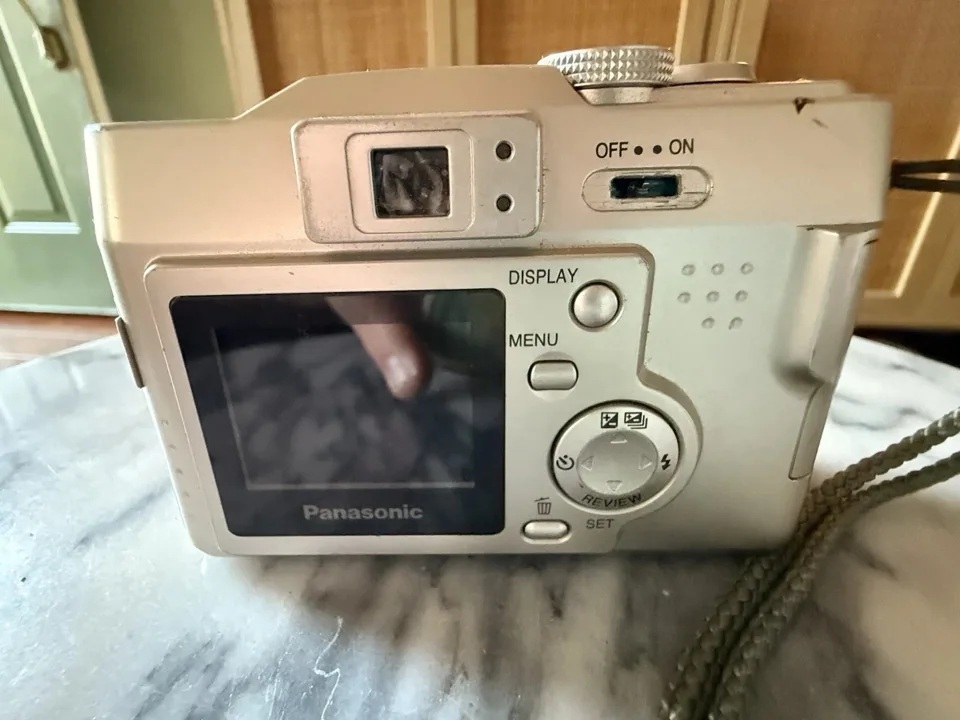
It is a compact with a grip on the left, mostly plastic but, DCRP found, pretty solid, with every important control within reach of the fingers.1 DCRP listed it at 3.8 by 2.5 by 1.3 inches and 215 grams empty, the same figure it gave for Canon's PowerShot A70;1 3DNews gave 167.5 grams without batteries and card (220 with batteries) and Phile Web's spec line about 170 for the body, so the sources disagree.35 3DNews added that the battery compartment forms the grip and that part of it is magnesium.3
Phile Web reported on 12 March 2003 that Panasonic Japan would sell it from 18 April, at an open price with a street price expected near 35,000 yen.5 DCRP listed the US price as $299 (and $399 for the LC43), and Steve's Digicams called $300 the MSRP.12 3DNews put it at about $450 (it does not say for which market) and thought that a little high.3 Imaging Resource wrote in August that both cameras had been announced in March at the PMA show and that the LC33 was already shipping in the US and Japan.7
Why this one was interesting
A chip that read the sensor differently
Phile Web's launch report said the Venus Engine LSI, shared with the DMC-F1, built brightness from the red and blue pixels as well as the green, which raised diagonal resolution; it called that a step up for a three-megapixel camera.5 The testers were calmer. DCRP put quality right in line with other three-megapixel cameras, with good exposure, nice colour and sharp images;1 Steve's Digicams found very sharp images and vibrant, accurate colour,2 and 3DNews called colour rendition very high.3
A Leica name on a bright lens
The lens was the second generation of Panasonic's Leica DC design, a 3x zoom of seven elements in six groups, three of them aspherical, opening to f/2.8 at the wide end and f/4.9 at full zoom.57 Steve's Digicams said image quality leans heavily on the lens and that this one did not disappoint.2
Two AA cells
Phile Web noted that ordinary AA alkaline cells would do, so a flat rechargeable did not end the day, and 3DNews counted AA power among the camera's main virtues.53 Steve's Digicams rated alkalines at about 75 minutes with the screen on, roughly 150 pictures, and 2000 mAh nickel-metal-hydride cells at about 120 minutes, roughly 240.2
A twin that traded sensitivity for pixels
The LC43 shared the body and lens and added a 4-million-pixel sensor, which DPReview believed was the smallest four-megapixel CCD used in a camera so far.8 Imaging Resource listed its top ISO as 200 against the LC33's 400, and said it came with rechargeable batteries and a charger instead of alkalines.7 DCRP still named the PowerShot A70, with its manual controls, the best three-megapixel camera of the class, and said the Panasonic held its own beside it.1 For a later Panasonic compact that also ran on AA cells, see our Lumix DMC-LZ5 review.
What was lost
This was a point-and-shoot. DCRP found white balance the only manual control, with no say over shutter speed, aperture or focus, and no TIFF or raw option;1 Steve's Digicams agreed that exposure was automatic,2 and CNET's summary listed no aperture or shutter priority and only two quality settings.4 There was no external flash connection and no dioptre adjustment for the viewfinder,2 no histogram,1 and no optical zoom while filming.21
The dark: its weak point
The flash reached 0.3 to 2.4 metres at wide angle and 0.5 to 1.4 at full zoom, which DCRP called poor; Steve's Digicams listed the same range in feet and said it suited small groups and small rooms but not dance floors.12 Both missed a focus-assist lamp, and Steve's Digicams said the camera would sometimes fail to focus in a dim room.12 (3DNews, though, listed an autofocus and self-timer lamp on the front.3) DCRP found its night shot sharp and somewhat noisy, and a red-eye test shot at automatic ISO, which turned out to be 200, quite noisy.1 The slowest shutter was 8 seconds, which could not be chosen by hand; DCRP named Night Portrait mode as one way to get it.1








Real photographs taken with this camera. The sensitivity shown is recorded in each file's own EXIF data; the camera's top setting was ISO 400.
Like that look? See recent eBay sold listings for this camera ↗
On eBay right now
Live listings for this camera, supplied by eBay and updated automatically. We earn a commission if you buy through them.
The little wins
The Simple mode
The dial had a Simple position with its own short menu, which DCRP thought beginners might appreciate.1 Steve's Digicams noted that its size choices were called Enlarge, 4x6 inch and Internet rather than pixel counts.2
How it drew the picture
Steve's Digicams found sharp images with slight pincushion distortion;2 DCRP saw very little barrel distortion, a hint of vignetting and minor purple fringing, but noise higher than it liked, which it linked to heavy in-camera sharpening.1 3DNews saw a blue fringe on high-contrast edges at the top of one frame, none at the bottom, and advised a white balance preset because the automatic setting ran cool.3 A 16 MB card held 10 fine or 20 standard pictures at the full 2048 by 1536.1


















Photos taken with this camera, from Wikimedia Commons, credited under each picture. Their uploaders may have edited them after shooting.
Where it let you down
Speed split the reviewers. CNET's summary listed formidable shutter lag and told buyers to expect poky performance.4 DCRP found the lag barely noticeable, about a second between shots and focus in under a second in good light, but under four seconds for the lens to extend and warm up;1 Steve's Digicams measured two tenths of a second from pre-focus;2 3DNews reported start-up of half a second plus a second and a half to ready the lens, and called two seconds a record.3 These figures do not reconcile, and we have not tested a unit.
Steve's Digicams said the screen lacked an anti-reflection coating and could be hard to read on the brightest days, which is what the optical viewfinder was for.2 DCRP disliked the flimsy plastic doors over the ports and the card slot and found the manual detailed but confusing.1 CNET listed the small 1.5-inch screen.4 The sources also split on video: Steve's Digicams and Imaging Resource give 10 frames a second, and 3DNews prints 10 in its text and 15 in its specification table.273
What the reviewers said in 2003
| Outlet | Date | Verdict |
|---|---|---|
| Steve's Digicams | 7 Jul 2003 | A very good value with sharp pictures and fast bursts; no manual exposure, no focus-assist lamp.2 |
| DCRP | 20 Jul 2003 | Very good photo quality, nice movie and playback modes; held its own beside the Canon A70, which DCRP still preferred; held back by noise, red-eye and plastic doors.1 |
| 3DNews | 29 Jul 2003 | A pleasant mid-class compact with strong colour and AA power; a little overpriced; small distortion and fringing. No score.3 |
| CNET (editor's summary) | Undated in our copy | 7.0 out of 10, "very good": excellent quality for its class, fast burst mode, easy operation; shutter lag and a small screen.4 |
The timeline
- 12 March 2003Phile Web reports that Panasonic Japan will sell the LC33 from 18 April.5
- 7 July 2003Steve's Digicams posts its review.2
- 20 July 2003DCRP posts its review.1
- 29 July 20033DNews publishes its review.3
- 1 August 2003CNET's page lists this as the release date.4
- 11 August 2003DPReview and Imaging Resource report on the LC43; Imaging Resource also covers the black LC33.87
- 23 August and 20 September 2003The black LC33 and the LC43 go on sale in Japan.67
Should you buy one now?
Buy one if you want a small CCD compact that takes plain AA cells, makes sharp, saturated pictures in daylight and asks only that you press the button. Skip it for dim rooms and for anything needing control. DCRP listed it at $299 in 2003;1 what it sells for now is a question for the sold listings, not for us. Before you bid, check these:
- The name. Search for the DMC-LC33; a black one existed in Japan, and the LC43 looks the same apart from its colour.671
- The batteries. Two AA cells;7 DCRP advised rechargeable nickel-metal-hydride cells of 1850 mAh or more,1 and there are AA rechargeables on Amazon ↗.
- The card. SD and MMC, and the burst speed needs SD;72 the reviews state no size limit and we have not tested one, so see our memory card guide.
- The doors. The ports and the card slot sit behind plastic doors that DCRP called flimsy, so check that they close.1
- The cable. 3DNews lists a mini-B USB port; see our cable guide.3
- The lens. It has a built-in cover:1 check that the lens extends and retracts cleanly and the cover opens fully.
If you are wondering why cameras like this are being hunted down again, we tell that story once, in Pictures that never left the card.
See recent sold prices on eBay ↗Shop on eBay ↗AA rechargeable batteries ↗
Sources
- Digital Camera Resource Page, Panasonic Lumix DMC-LC33 review by Jeff Keller (posted 20 Jul 2003, updated 22 Jul 2003; read from an Internet Archive copy)
- Steve's Digicams, Panasonic Lumix DMC-LC33 review (posted 7 Jul 2003, pages 1 to 5; read from an Internet Archive copy)
- 3DNews, Panasonic Lumix DMC-LC33 review by Pavel Kapysh (29 Jul 2003, in Russian; our translation)
- CNET, Panasonic Lumix DMC-LC33 editor's summary page (release date 1 Aug 2003; read from an Internet Archive copy of 7 Sep 2005; the full review text was not available to us)
- Phile Web, news report on the Panasonic Japan DMC-LC33 launch (12 Mar 2003, in Japanese; our translation)
- Phile Web, news report on the Panasonic Japan LC43 and black LC33 (11 Aug 2003, in Japanese; our translation)
- Imaging Resource, Panasonic DMC-LC33 updated, LC43 nearing, by Mike Tomkins (11 Aug 2003; specification tables for both cameras)
- DPReview, Panasonic Lumix DMC-LC43 and DMC-LC33 announcement (11 Aug 2003)
The camera photos show a used unit supplied by the site owner; sample photographs are credited under each one, all via Wikimedia Commons. Links to eBay and Amazon are affiliate links.