Sony Cyber-shot P · announced February 2003
The Sony Cyber-shot DSC-P8: the metal pocket compact with VGA video
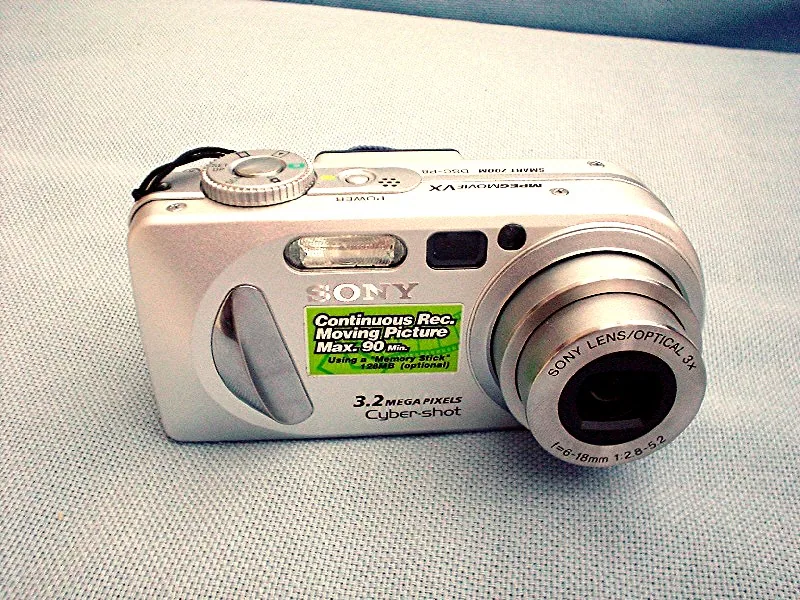

In February 2003 Sony announced a 3.2-megapixel pocket camera with a metal body for about $400, and a video mode that ran as long as the card did. Two full reviews and CNET's summary liked its speed and ease of use. Their complaints differed: a tight viewfinder and lost highlights at one, purple fringing at another, and, in both full reviews, a battery that wanted a spare.
- Launched
- April 2003
- Sensor
- 3.2 MP CCD
- Lens
- 39–117 mm, 3×
- Card
- Memory Stick, Memory Stick PRO
- Battery
- NP-FC11, NP-FC10
Sony Cyber-shot DSC-P8 specs: sensor, lens, battery, memory card and cable
The Sony Cyber-shot DSC-P8 came out in April 2003 at about $400 as a 3.2 MP CCD compact with a 39–117 mm (35 mm equivalent) 3× zoom lens. It takes Memory Stick and Memory Stick PRO cards and runs on the NP-FC11 or NP-FC10 battery. Sources
- Sensor
- CCD, 1/2.7", 3.2 MP source
- Lens
- 39–117 mm equivalent, 3× zoom source
- Memory card
- Memory Stick, Memory Stick PRO source
- Battery
- NP-FC11, NP-FC10 source
- USB / A/V cable
- See our Sony cable page
Meet the camera
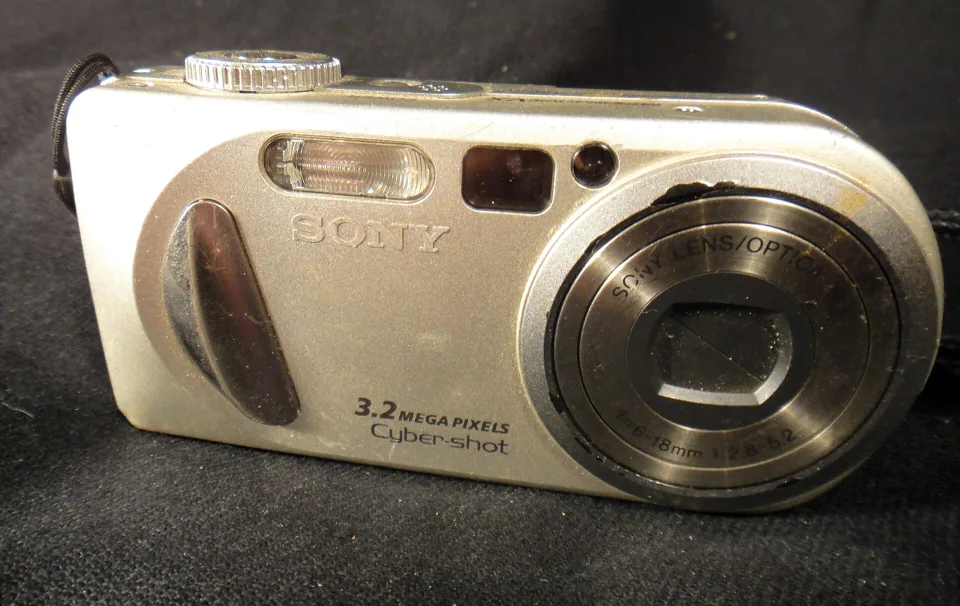
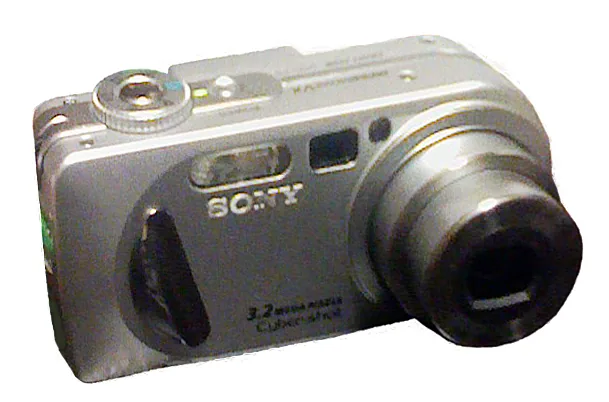
Sony's US press release for the P8 is dated 24 February 2003 (DPReview posted it on the 23rd, "pre-PMA"), and it announced the 5-megapixel P10 alongside.1 The US release promised both for April, the P8 at about $400 with a 16 MB Memory Stick in the box.1 Sony's Japanese arm was quicker: it put the P8 on sale on 21 March, at an open price, in four colours, which it named champagne white, brilliant silver, bordeaux red and ocean blue.2 Steve's Digicams called it smaller than Sony's P32, P52, P72 and P92.7 Imaging Resource described a streamlined silver body only slightly longer than a business card, which passed its shirt-pocket test and would also fit a small handbag.3 We found no regional second name; Sony Japan's release also calls it DSC-P8.2


- Lens
- 3x, 6–18 mm (39–117 mm equiv.), f/2.8–5.6 per DPReview, Imaging Resource and Steve's, f/2.8–5.2 in Sony Japan's table1372
- ISO
- Auto, 100, 200, 4003
- Screen
- 1.5", about 123,000 pixels, plus an optical viewfinder per Steve's and Imaging Resource's review73
- Video
- 640 × 480 at 16 fps, with sound7
- Card
- Memory Stick and Memory Stick PRO, 16 MB card in the box; Steve's tested up to 1 GB7
- Battery
- Sony InfoLITHIUM, NP-FC11 per Sony Japan (in the box), DPReview, Steve's and Imaging Resource's data sheet; Imaging Resource's review text says NP-FC10, which Sony Japan's table also lists21763
Where sources disagree we show both. The lettering on the lens ring in the Commons photograph above reads 1:2.8-5.2, which matches Sony Japan's table. DPReview's table and Imaging Resource's data sheet list no viewfinder,16 but the window is visible on the front of the camera in the photographs above, and both full reviews describe it. Release dates also differ: 21 March in Japan,2 "April" in Sony's US release,1 31 March in Imaging Resource's data sheet,6 and 15 April on CNET's page.8
Why this one was interesting
Video that lasted as long as the card
The headline 2003 Cyber-shot feature was MPEG Movie VX: 640 × 480 video with sound at 16 frames a second, limited only by free space on the card.7 Imaging Resource called full-size recording to card capacity new in Sony's line that year.3 Sony Japan said it doubled each dimension of the previous top video size, and that a 1 GB Memory Stick PRO would hold about 44 minutes and 20 seconds.2 Steve's noted that you could not zoom while filming, since the microphone would pick up the lens motor.7 CNET's list of good points included the video capacity.8
Quick, by the clock
The number that stood out was shutter lag. With autofocus, Imaging Resource measured 0.64 seconds at wide angle and 0.70 at full telephoto, and called that much faster than average, since most cameras it had tested took over 0.8 seconds; prefocused, the lag fell to 0.127 seconds. Full-size fine shots cycled every 1.25 seconds behind a four-shot buffer. Start-up was the slow part at 2.89 seconds, which it rated about average.4 Sony's own Japanese figures were about 2.5 seconds to start, 0.40 seconds of shutter lag and 1.6 seconds between full-size shots; the release does not say how it measured them.2 Steve's put shot to shot at one to two seconds, with another one to two if the flash fired.7 CNET's summary page opened its list of good points with fast performance.8
A lens that leaned long
Most 3x digicam lenses of the day ran from about 35 to 105 mm; Imaging Resource noted the P8's 39–117 mm sat slightly toward the telephoto end.3 Steve's praised the relatively fast f/2.8 maximum aperture at wide angle, which it said made the camera better than average in low light, and a macro mode that reached about four inches.7 Imaging Resource measured the smallest macro area at 3.33 × 2.50 inches and called that about average.3
What was lost
The optical viewfinder was tight. Imaging Resource found it showed only about 80 percent of the final image at both ends of the zoom, while the LCD was almost 100 percent accurate;3 Steve's also gave about 80 percent and noted there was no diopter adjustment.7 Exposure control was thin: Imaging Resource said the P8 was under automatic exposure control at all times, and Steve's said there was no direct control of shutter speed or aperture, only Twilight scene modes for dim light.37 The slow-shutter limit is reported inconsistently. Imaging Resource's review said normal modes could run to one second without a Twilight mode, a change from Sony's earlier 1/30 second limit, while its test-image page gives 1/30 second for normal Program mode;35 Steve's said Program mode still limited the slow shutter to 1/30 second;7 and Sony Japan's table lists Program Auto at 1 to 1/2000 second.2
Bursts stopped at two frames, 0.43 seconds apart, which both Imaging Resource and CNET flagged.48 The 16 MB card in the box held ten full-size fine pictures; Imaging Resource advised at least 32 MB, preferably 64.4
The dark: what the lamp and f/2.8 bought
Imaging Resource's light-level tests found usable pictures down to about 5.5 lux at ISO 200 and 400, with good colour; at ISO 100 images stayed bright only to about 11 lux, which it equated with average city street lighting.3 Noise was low at ISO 100 and moderately high at ISO 400.3 The bright focus-assist lamp let the camera focus in near-total darkness, which the same review called a plus for flash photographs after dark.3 Steve's said the Twilight modes allowed exposures up to two seconds and that noise reduction ran automatically at exposures longer than half a second.7 CNET listed minor image noise among its bad points.8








Real photographs taken with this camera. The sensitivity shown is recorded in each file's own EXIF data; they were not made under test conditions, and the camera's top setting was ISO 400.
Like that look? See recent eBay sold listings for this camera ↗
On eBay right now
Live listings for this camera, supplied by eBay and updated automatically. We earn a commission if you buy through them.
The little wins
Three ways to focus
Single, monitoring and continuous autofocus were all selectable, and a three-area system chose among points in the centre of the frame.32
A contrast control that worked
In a portrait shot under deliberately harsh lighting, the in-camera minus contrast setting largely kept highlights and shadows in check, though the white shirt still lost some detail, in Imaging Resource's test.5 Steve's lists adjustable saturation, contrast and sharpness.7
How it drew the picture
Imaging Resource found colour good and nearly accurate, slightly warm, with trouble on deep blues and on incandescent light. Exposure was generally accurate with a slight lean to overexposure; high-key subjects came out better than on most cameras it had tested, but tonality seemed a little weaker than on other Cyber-shots it had tested, and the camera was a bit more prone to losing highlight detail.3 It found strong detail to at least 1,050 lines horizontally and 1,000 vertically, enough for sharp 8 by 10 inch prints, 1.0 percent barrel distortion at wide angle and 0.4 percent pincushion at telephoto, and only slight chromatic aberration.3
Steve's put the image quality, sharpness and colour balance on a par with similar-sized cameras of higher resolution, and called the camera a good choice for prints up to 8 by 10.7 CNET's summary page listed minor image noise, compression artifacts and purple fringing.8 On fringing the sources differ: Imaging Resource found chromatic aberration slight, while CNET's list names purple fringing as a flaw, though they may be describing different things.38
















Photos taken with this camera, from Wikimedia Commons, credited under each picture.
Where it let you down
Every battery figure we found was modest, and none agreed. Imaging Resource's worst case, estimated from its power-draw measurements on a 2.4 Wh cell, was 83 minutes of shooting with the screen on and about 2.3 hours with it off.43 Steve's, quoting Sony, gave about 70 minutes with the screen on and 90 with it off, and described the battery as about an hour per charge.7 Sony Japan's own release claimed about 100 minutes and about 200 shots, 60 percent better than the P7, under conditions it described in detail.2 Both full reviews told buyers to carry a spare. Close-up flash was also a problem: it overexposed macro shots, and Imaging Resource advised outside light for them.3 Under household bulbs the automatic and incandescent white balance settings both left a strong warm cast.5 The camera records only to Memory Stick or Memory Stick PRO, and Steve's says it did not support the high-speed transfer function;7 see our Memory Stick guide and the glossary.
What the reviewers said in 2003
| Outlet | Date | Verdict |
|---|---|---|
| Imaging Resource | 30 Apr 2003 | An excellent compact point-and-shoot for people who want size without giving up much quality; quick, with good colour and sharp 8 by 10 prints.34 |
| Steve's Digicams | 3 May 2003 | An automatic point-and-shoot that delivers good pictures; a good choice for a pocket or purse, but buy a bigger Memory Stick and a second battery.7 |
| CNET | 28 May 2003 | 7.6 out of 10, "very good": its summary calls the P8 fast on its feet, good-looking and easy to use, but says its feature set could stand some refinement.8 |
CNET's detailed pages are not archived, so we read only its summary page (scores, good and bad lists, bottom line). Imaging Resource's page carries some leftover references to sibling models; we used only statements that match the P8's own specifications. Steve's said a review of the P10 would follow.7
The timeline
- 24 February 2003Sony's US press release for the P8 and P10 is dated this day (DPReview posted it on the 23rd); it promises April availability and about $400 for the P8.1
- 25 February 2003Sony Japan issues its release, listing 21 March as the sale date.2
- 31 March 2003Imaging Resource's data sheet gives this as the availability date.6
- 15 April 2003CNET lists this as the release date.8
- 30 April 2003Imaging Resource's review is dated.3
- 3 May 2003Steve's Digicams posts its review.7
- 28 May 2003CNET's review is dated.8
Should you buy one now?
Buy one if you want a small, solid 2003 CCD compact that you will use outdoors in good light and can feed with a charged spare. Its launch price was about $400;1 what it sells for now is a question for the sold listings, not for us. We have not tested a unit. Before you bid, check these:
- The battery. Sony Japan, DPReview and Steve's say the camera shipped with an NP-FC11,217 while Imaging Resource's review text lists an NP-FC10;3 check which the camera has and test it, because the full reviews put it at about an hour to an hour and a half per charge with the screen on.47 A replacement search is on Amazon ↗.
- The card. It takes Memory Stick or Memory Stick PRO; Steve's tested it with up to 1 GB.7
- The port. Sony Japan's table lists a mini-B USB connector.2
- The lens. Check that it extends and retracts cleanly and the built-in cover closes.3
- The screen. Look for scratches on the 1.5-inch LCD.
- Extras. Sony Japan listed a 0.7x wide and a 1.7x tele conversion lens and an adapter for them, and an underwater case rated to 40 m.2
If you are wondering why cameras like this are being hunted down again, we tell that story once, in Pictures that never left the card. A same-season sibling that runs on AA batteries is our DSC-P72 retrospective; a later pocket Sony is the DSC-P200, and the DSC-W80 came after that.
See recent sold prices on eBay ↗Shop on eBay ↗NP-FC11 battery ↗
Sources
- DPReview, Sony DSC-P8 and P10 (news item of 23 Feb 2003, carrying Sony's US press release dated 24 Feb 2003)
- Sony Marketing Japan, press release on the Cyber-shot P series, 25 Feb 2003 (in Japanese; includes the specification table)
- Imaging Resource, Sony Cybershot DSC-P8 review (dated 04/30/2003)
- Imaging Resource, Picky Details for the Sony DSC-P8 (timing, power and storage)
- Imaging Resource, Sony DSC-P8 test images and analysis
- Imaging Resource, Sony Cyber-shot DSC-P8 data sheet ('Date Available 2003-03-31', retail price $399)
- Steve's Digicams, Sony DSC-P8 review (posted 3 May 2003; read from an archived copy)
- CNET, Sony Cyber Shot DSC-P8 review by Theano Nikitas (28 May 2003; summary page only, archived copy)
Photographs are credited under each one, all via Wikimedia Commons. Links to eBay and Amazon are affiliate links.