Olympus Camedia · on sale spring 2003
The Olympus Camedia D-560 Zoom (C-350 Zoom, X-200): the AA-powered starter digicam with almost nothing to adjust
Sold in Europe as the Camedia C-350 Zoom and in Japan as the Camedia X-200.810 DPReview names the D-560 and C-350 as one camera;8 no source we read says that of the X-200, but its published specifications match and the camera's file metadata names all three.10411
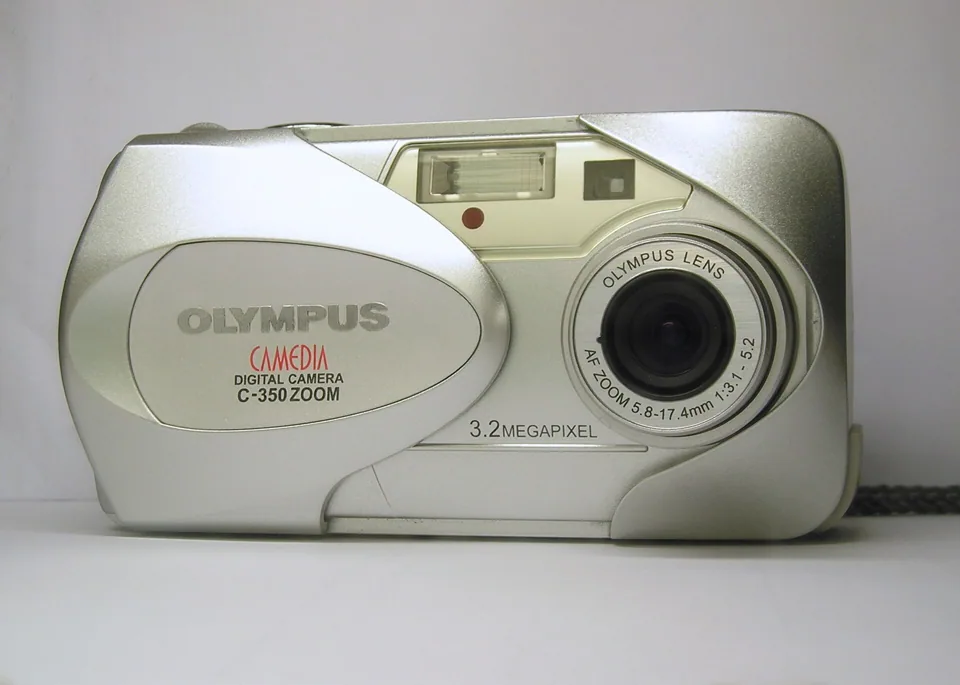
In March 2003 Olympus replaced its D-550 with a smaller, plainer 3.2-megapixel AA-powered compact that sold for about $300. Reviewers liked the pictures and the quick prefocused shutter, and counted the missing controls.
- Launched
- March 2003
- Sensor
- 3.2 MP CCD
- Lens
- 35–105 mm, 3×
- Card
- xD-Picture Card
- Battery
- 2 x AA, CR-V3
Olympus Camedia D-560 Zoom specs: sensor, lens, battery, memory card and cable
The Olympus Camedia D-560 Zoom (also sold as the Camedia C-350 Zoom and Camedia X-200) is a 3.2 MP CCD compact camera with a 35–105 mm (35 mm equivalent) 3× zoom lens, launched in March 2003 at $299. It uses xD-Picture Card and runs on 2 x AA or CR-V3 batteries. Sources
- Sensor
- CCD, 1/2.5", 3.2 MP source
- Lens
- 35–105 mm equivalent, 3× zoom source
- Memory card
- xD-Picture Card source
- Battery
- 2 x AA, CR-V3 source
- Also sold as
- Camedia C-350 Zoom · Camedia X-200
- USB / A/V cable
- CB-USB4 Confirmed · all Olympus cables
Meet the camera
Imaging Resource gave its size as 108 by 58 by 40 millimetres, slightly smaller than the D-550's, and its weight as 229 grams with batteries in a molded plastic body;1 Olympus's own figure, quoted by Steve's Digicams, is 170 grams without batteries or card.4 The lens hides behind a sliding cover that is also the power switch: slide it open and the camera wakes and the lens extends another 5/8 inch.1 The Digital Camera Resource Page (DCRP) thought the plastic still felt well built, the camera super easy to hold and a fit for the pocket;5 Gadgetspeak, which tested the C-350, would not want to carry it there for long.6 ITmedia saw a slightly larger μ-10 DIGITAL in plastic instead of metal, with what looked like the same lens.7
It had three names and three price tags. DPReview reported the PMA announcement on 2 March 2003 with a US street price of $299 and a UK recommended price of £249;8 Imaging Resource listed a $349 suggested price and the same $299 street price in early May,1 and Gadgetspeak gave £249.99 for the C-350.6 In Japan Phile-web reported the X-200 the next day at ¥38,000 before tax, on sale from late March,10 and ITmedia put its real selling price near ¥29,800, about ¥10,000 under Olympus's main 3-megapixel zoom of the year, the μ-10 DIGITAL.7
- Sensor
- 3.2 MP effective (3.3 MP total) CCD, 1/2.5"4
Why this one was interesting
Smaller, simpler, and a new card
DPReview's announcement listed the smaller body and a new, easier menu,8 and the Digital Camera Resource Page added the other change that mattered to buyers: the camera dropped SmartMedia for the new xD-Picture Card.5 ITmedia found the body a size smaller than that of the 2002 C-300 ZOOM.7 Power came from two AA cells, with Olympus supplying alkaline ones and leaving rechargeables to the buyer.15 A CR-V3 lithium pack fitted too.1 Other AA-powered CCD cameras are in our guide.
Three markets, three pitches
The cameras were sold to different people. ePHOTOzine's C-350 announcement addressed the intermediate user who wants more than point-and-shoot,9 while Phile-web's X-200 article called it a standard model for beginners,10 and Imaging Resource listed novice-to-amateur family and travel use.1 ITmedia agreed with the Japanese pitch: it saw a camera for older film-compact owners who find machines hard.7
For another xD-era Olympus compact, see our Stylus Verve review.
What was lost
To reach a lower price Olympus took out the ISO, sharpness and contrast adjustments of the D-550, Imaging Resource wrote,1 and Steve's noted that the noise-reduction option was now automatic, in Night Scene mode only.4 DCRP went further and wrote that the camera had no manual controls of any kind,5 although its menu list still offers exposure compensation of plus or minus 2 EV and five white-balance settings.51 ITmedia found the scene modes fiddly to reach, behind several presses of small cross-keys.7 The pop-up flash was gone too: DCRP was glad to see it go, and noted that red-eye got worse with the flash so close to the lens.5
The dark: its weak point
Olympus capped the shutter at half a second in normal modes and two seconds in Night Scene, which DCRP and Imaging Resource both noted.51 Imaging Resource's lab found usable pictures down to one foot-candle, about 11 lux and roughly city street lighting at night, with low noise; the reviewer thought the automatic ISO boost did not start quite early enough.2 Steve's said the automatic noise reduction in Night Scene mode removed most of the speckle, at the cost of a few seconds of processing.4 The flash lit its test target out to 14 feet by raising the sensitivity to ISO 400 at that distance, and the far shots were noisy.2 DCRP missed an autofocus illuminator: in low light the camera often could not lock focus.5 ITmedia saw the same caution indoors: at 1/5 second the camera stayed at ISO 128, so shake was a bigger worry than noise.7

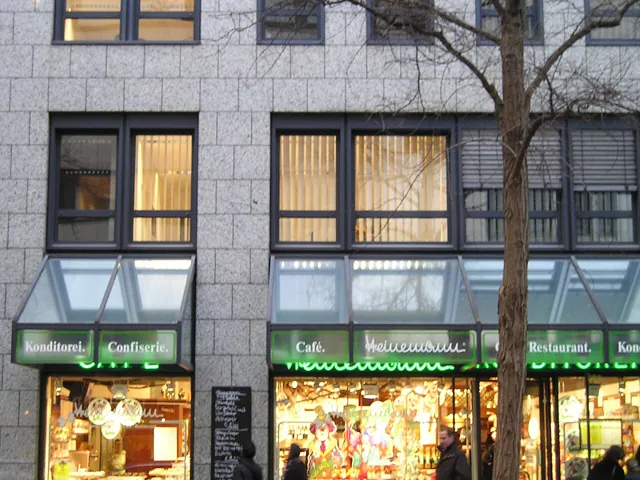


Real photographs taken with this camera. The sensitivity shown is recorded in each file's own EXIF data.
Like that look? See recent eBay sold listings for this camera ↗
On eBay right now
Live listings for this camera, supplied by eBay and updated automatically. We earn a commission if you buy through them.
The little wins
A fast shutter, if you pre-focus
With the shutter half-pressed first, Imaging Resource timed 0.113 seconds, and called that faster than average; full autofocus took 0.925 seconds at wide angle and 1.137 at telephoto.3 Steve's also found that the capture is almost instant once the green focus light is on.4


How it drew the picture
Imaging Resource found strong detail out to about 1,000 lines vertically and 1,050 horizontally on its resolution chart, found the colour pleasing but never dead-on, with a reddish-pink or magenta cast in the auto white balance, and thought contrast a little high but the snappy results would please most buyers.21 It also measured about 0.9 percent barrel distortion at the wide end and found it inclined to underexpose some shots slightly.1 DCRP praised Olympus's sharpness and accurate colour, found noise acceptable, and saw blown highlights in a few shots.5 Steve's thought image processing robust for the price and the white balance good in normal light.4 ITmedia described vivid colour but a hard look, with strong contrast and edge enhancement in bright sun, and automatic white balance that wavered under incandescent lighting, which it suspected might be one unit.7

















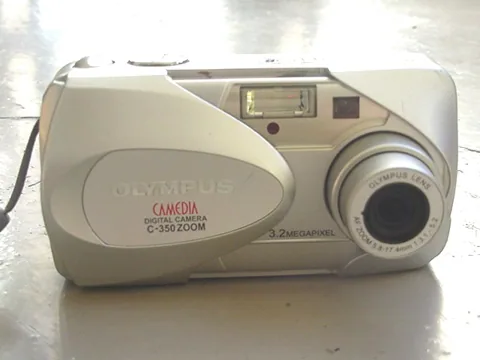
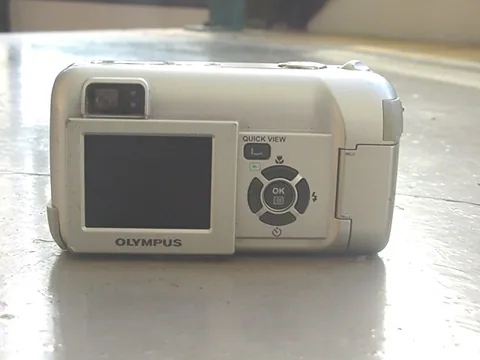
Photos taken with this camera, from Wikimedia Commons, credited under each picture. They come from nine different photographers.
Where it let you down
Imaging Resource found the optical viewfinder showed only about 74 percent of the frame at wide angle and 78 percent at telephoto, against 97 to 98 percent on the screen.2 Its macro frame was large, 7.7 by 5.8 inches, with the flash falling off in the corners.2 DCRP found the lens cover too easy to bump, which switches the camera off, and the xD door much flimsier than the battery door, and thought the movie mode probably the weakest of its class.5 Clips ran 15 seconds at 320 by 240 and 60 seconds at 160 by 120, with no sound.54 Gadgetspeak warned that closing the cover too sharply could damage the lens.6
The sources also disagree on small points, so treat these numbers with care:
- Burst. Imaging Resource measured about 1.4 frames a second and a buffer of six shots at the best quality;3 Steve's listed up to seven high-quality (HQ) frames in its spec sheet and fourteen in its conclusion;4 DCRP said up to 11.5
- Digital zoom. Imaging Resource, Steve's Digicams and Phile-web give 3.3x, and the first two say ten times in all;1410 Gadgetspeak said the two zooms add up to 9x, and ePHOTOzine and DCRP each called the digital zoom 3x.695
- Aperture. Imaging Resource, Steve's, ITmedia and Phile-web give f/3.1 at wide angle; DCRP wrote f/3.0.147105
- Card type. Imaging Resource's storage page says CompactFlash, though the same review and every other source say xD.31
What the reviewers said in 2003
| Outlet | Date | Verdict |
|---|---|---|
| DCRP | 1 Mar 2003, final 27 Mar | A fairly average camera in the cheap 3-megapixel class, with competitive photos and probably the weakest movie mode; the Canon PowerShot A70 stayed the reviewer's top pick.5 |
| Steve's Digicams | 29 Mar 2003 | Expected it to be a successful product: reasonably priced, easy to use, with enough resolution for prints up to 8 by 10.4 |
| Imaging Resource | Undated; prices of early May 2003 | Called "a good digicam at a great price", suited to a family, and an entry-level camera with more than entry-level features.1 |
| ITmedia | 28 May 2003 | A cut-down beginner's camera; no problem for ordinary snapshots, and very good value for the price.7 |
| Gadgetspeak | 7 Nov 2003 | Generally impressed by the pictures; the sliding cover and the scarcity of xD card readers counted against it.6 |
The timeline
- 1 March 2003DCRP posts its first review, finalised on 27 March with a production camera.5
- 2 March 2003Olympus announces the D-560 Zoom / C-350 Zoom at PMA.8
- 3 March 2003ePHOTOzine runs the C-350 announcement, and Phile-web reports the X-200 for late March.910
- 29 March 2003Steve's posts its review.4
- 28 May 2003ITmedia publishes its X-200 review.7
- 7 November 2003Gadgetspeak reviews the C-350 Zoom.6
Should you buy one now?
Buy one if you want a plain, pocketable 2003 compact that takes AA cells and makes sharp, contrasty snapshots in daylight, and you can live without exposure control. It launched at $299 on the street;81 what it sells for now is a question for the sold listings, not for us. Before you bid, check these:
- The name. It is the D-560 Zoom in the US, the C-350 Zoom in Europe and the X-200 in Japan, so search all three.810
- The batteries. It takes two AA cells or a CR-V3 pack.1 Alkalines are the weak choice, as ITmedia said;7 rechargeables are on Amazon ↗.
- The card. It takes xD-Picture Cards, supplied at 16 MB; Steve's listed 16 to 256 MB.4 The panorama mode needs an Olympus-branded card.15 See our xD-Picture Card page and memory card guide.
- The cable. ITmedia lists a USB mini-B port, and the camera shows up on the computer as a storage drive;7 see our Olympus cable page.
- The lens cover. It powers the camera, so check that it slides smoothly and does not switch the camera off when bumped.56
- The xD door and the lens. DCRP found the xD door flimsier than the battery door, so check its hinge too, and that the lens extends and retracts cleanly.5
If you are wondering why cameras like this are being hunted down again, we tell that story once, in Pictures that never left the card.
See recent sold prices on eBay ↗Shop on eBay ↗AA batteries ↗
Sources
- Imaging Resource, Olympus D-560 Zoom review (no author or date on the page; prices given "as of early May, 2003")
- Imaging Resource, Olympus D-560 Zoom test images and analysis (same review)
- Imaging Resource, Olympus D-560 Zoom "Picky Details": timing, power and storage (same review)
- Steve's Digicams, Olympus Camedia D-560 Zoom review (posted 29 Mar 2003; intro, specification and conclusion pages; Internet Archive snapshot of 10 Dec 2004)
- Digital Camera Resource Page, Olympus D-560 Zoom review by Jeff Keller (posted 1 Mar 2003, final version 27 Mar 2003; Internet Archive snapshot of 31 Dec 2004)
- Gadgetspeak, Olympus C-350 Zoom review by mfereday (7 Nov 2003)
- ITmedia PC USER, Olympus CAMEDIA X-200 review by 荻窪圭 (28 May 2003; two pages, in Japanese)
- DPReview, Olympus D-560 Zoom / C-350 Zoom announcement (2 Mar 2003)
- ePHOTOzine, Olympus C-350 Zoom digital camera unveiled (3 Mar 2003)
- Phile-web, Olympus CAMEDIA X-200 announcement with specification table (3 Mar 2003; in Japanese)
- Wikimedia Commons, Category: Taken with Olympus X-200 / D-560Z / C-350Z (the camera's own file metadata names all three)
The reviews of Imaging Resource, Steve's Digicams and the Digital Camera Resource Page are US reviews of the D-560 Zoom; Gadgetspeak reviewed the C-350 Zoom, and ITmedia the X-200. Camera photos by Ptom (public domain), Plbcr and AlepouTheFox (CC BY-SA 3.0); other photographs are credited under each one, all via Wikimedia Commons. Links to eBay and Amazon are affiliate links.