Fujifilm FinePix A · announced February 2004
The Fujifilm FinePix A340: the budget 4-megapixel camera with a sliding door
We found no other regional name for it; Fujifilm's US announcement and the reviews we read all use FinePix A340 (PhotographyBLOG's headline for PC Magazine's review adds "Zoom").124
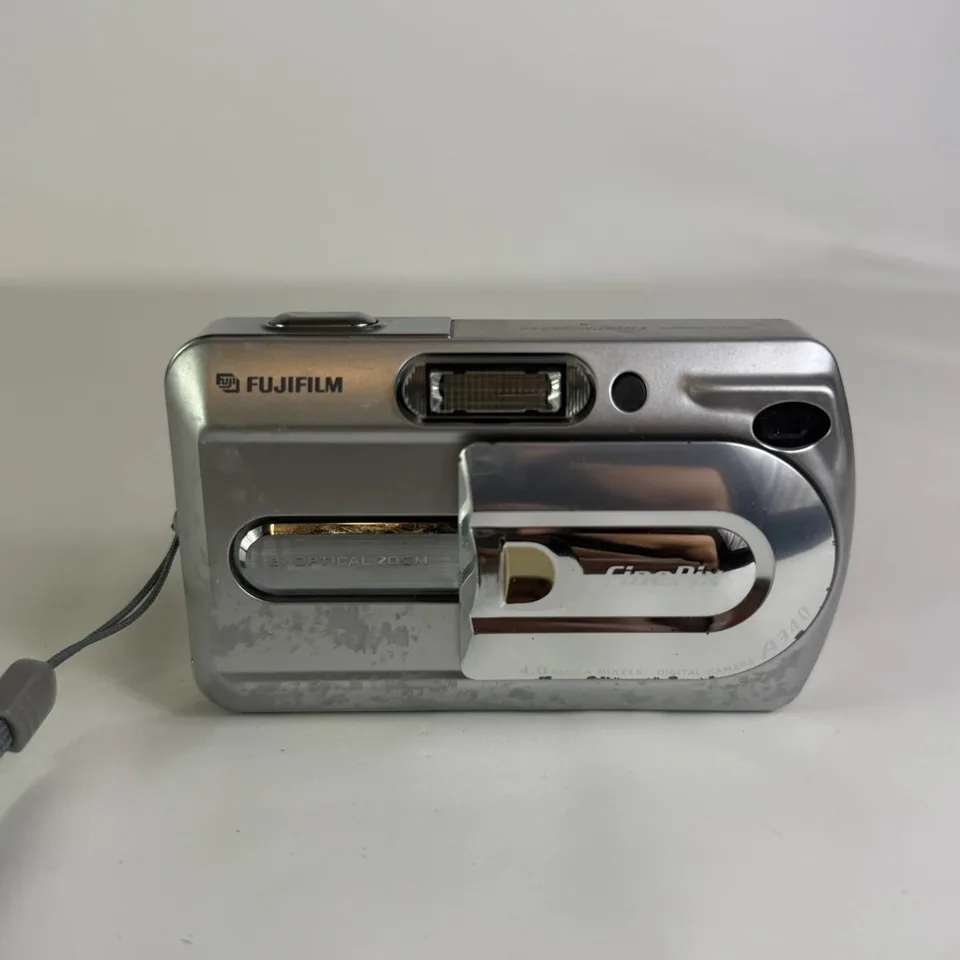
In February 2004 Fujifilm put a 4-megapixel CCD, a 3x zoom and four scene modes behind a sliding lens cover, for a list price of $249.99. Reviewers liked its daylight pictures and its price, then disagreed about its battery life, its low-light performance and how much fine detail it kept.
- Launched
- February 2004
- Launch price
- $249.99 list1
- Sensor
- 4 MP CCD
- Lens
- 38–114 mm, 3×
- Card
- xD-Picture Card
- Battery
- AA
Fujifilm FinePix A340 specs: sensor, lens, battery, memory card and cable
The Fujifilm FinePix A340 came out in February 2004 at $249.99 as a 4 MP CCD compact with a 38–114 mm (35 mm equivalent) 3× zoom lens. It uses xD-Picture Card and runs on AA batteries. Sources
- Sensor
- CCD, 1/2.7", 4 MP source
- Lens
- 38–114 mm equivalent, 3× zoom source
- Memory card
- xD-Picture Card source
- Battery
- AA source
- USB / A/V cable
- See our Fujifilm cable page
Meet the camera
Fujifilm's US arm announced two near-twins on 5 February 2004: the 3.2-megapixel FinePix A330 and the 4-megapixel A340. The A330 was due in March at $199.99 and the A340 in May at $249.99.1 Steve's Digicams, which reviewed the A340 in June, called the A330 physically and functionally identical, with 3.2 megapixels "for about $50 less".3 Both occupied the A310's slot in the line-up and added a sliding "clamshell" cover that also works as the power switch.1
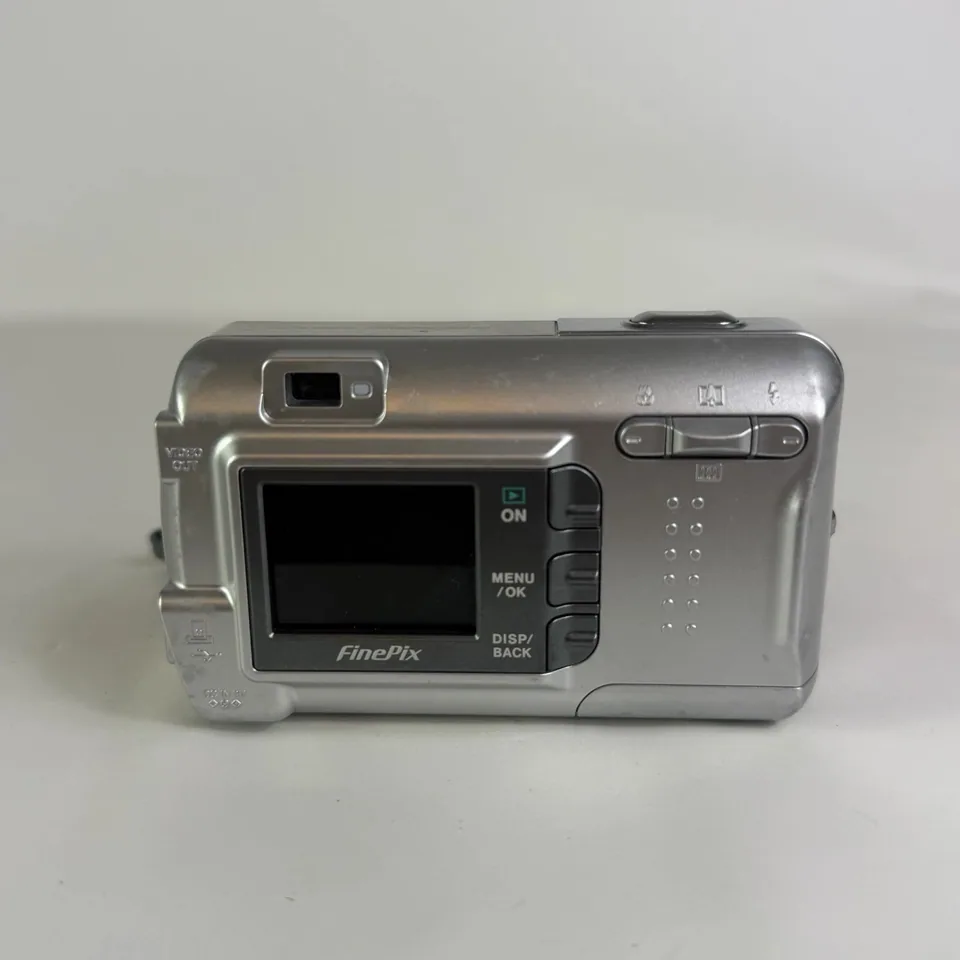
Imaging Resource listed 104 by 62 by 31 millimetres and 198 grams with batteries and card: an all-plastic body, a little too large for most shirt pockets but at home in a purse.4 PC Magazine described a silver, "cigarette box-shaped" body, mostly plastic but reasonably sturdy, and the AV, USB and DC sockets on the left side exposed.7 Imaging Resource agreed the sockets are uncovered.4
Why this one was interesting
A door instead of a dial
Imaging Resource noted that Fujifilm dropped the mode dial of the earlier A205 and A210 for a menu on the screen, a sleeker body and fewer controls.4 The sliding cover took its place as the way in. Slide it open and the lens extends; slide it part-way shut and the lens retracts and the camera powers off. Imaging Resource liked the design because it makes accidental switching-on in a bag less likely, but warned that the door can hit the lens before the lens retracts.4 With the cover closed, the Playback button still turned the camera on to review pictures, which cut the start-up time because the lens stayed in.12
Scene modes at a low price
Fujifilm's announcement said the four scene modes (portrait, night, sports and landscape) were usually found in more advanced Fujifilm cameras.1 Exposure stayed automatic in every mode. The "Manual" setting only added exposure compensation of plus or minus 2 EV and white balance presets, as Steve's, Photo Review and Imaging Resource all described.264
PictBridge, a first for the brand
The press release called the A330 and A340 the first Fujifilm digital cameras with PictBridge, the standard for printing straight from a camera to a compatible printer.1 Both also worked with an optional Picture Cradle that charged an NH-10 battery pack and handled downloads.12
What was lost
Steve's tried the screen outdoors and found it "almost useless" in bright light, with no anti-reflective coating; it had to cup a hand around it, and told readers they would be forced to use the optical viewfinder.3 There was no continuous mode (Steve's and Photo Review), the screen showed neither shutter speed nor aperture (Imaging Resource),364 and movies had no sound, with the lens locked at wide angle while recording.42 Imaging Resource's news story put the frame rate at 15 frames per second, but Fujifilm's own table and release, Steve's and Photo Review all say 10.126 In macro mode the optical zoom was disabled and only digital zoom remained, Steve's added, which it advised against.3
How it drew the picture
Imaging Resource called its colour "significantly oversaturated" but fairly accurate in hue, and judged that most buyers would like it. White balance left a slight warm cast, and under tungsten bulbs pictures were a little yellow or red, but acceptable.4 Steve's liked its outdoor samples, mostly well exposed and nicely saturated, with fine sky detail and enough sharpness for 8 by 10 inch prints.3 Photo Review found resolution good and colour accurate and saturated, but contrast elevated.6 Imaging Resource saw high contrast in a few shots, mostly its sunlit portrait, and added 0.7 EV to a very bright outdoor portrait, which it called typical of the cameras it tests.4
Imaging Resource's chart test found artefacts at about 800 lines per picture height and strong detail out to roughly 1,200, with the patterns vanishing near 1,350. That was good for a cheap 4-megapixel model, it said, but over-aggressive noise reduction took subtle detail from hair and foliage and left brickwork looking as if painted with "finger-paints". It expected 4 by 6 inch prints to hide the loss and 8 by 10 enlargements to show it,4 a different verdict from Steve's on the larger print. For the lens, Imaging Resource measured about 0.7 percent barrel distortion at wide angle and almost none at telephoto;4 Steve's, judging by eye, saw some barrel distortion at the wide end and pincushioning at full telephoto.3
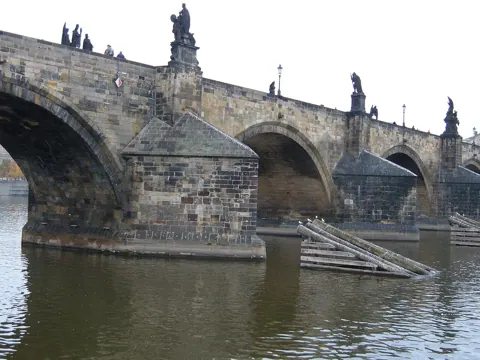

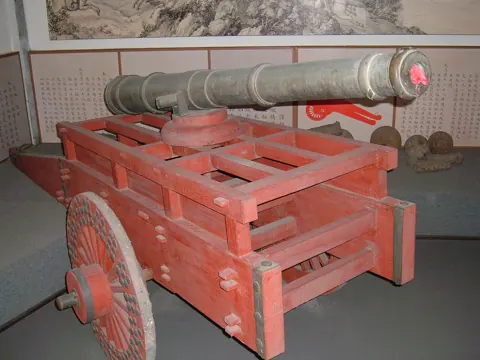

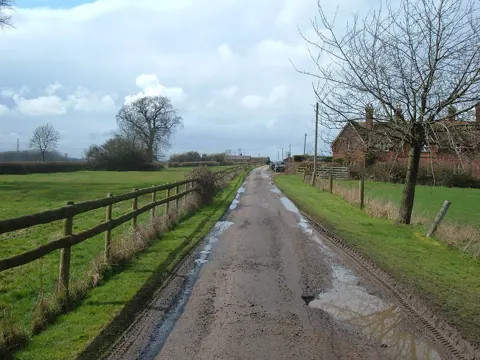

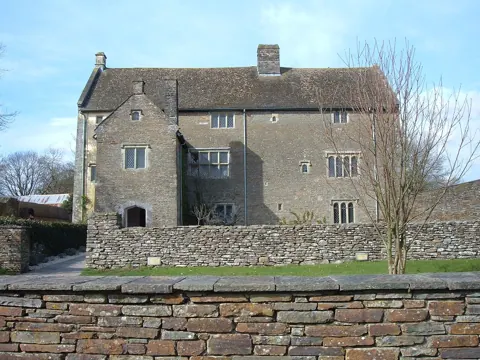



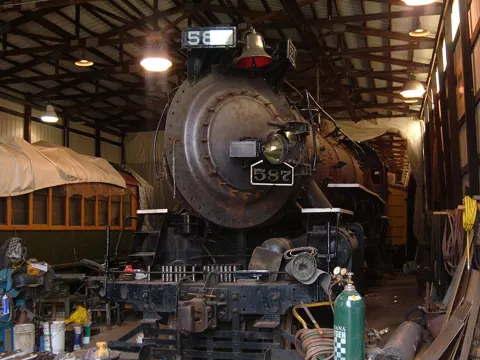

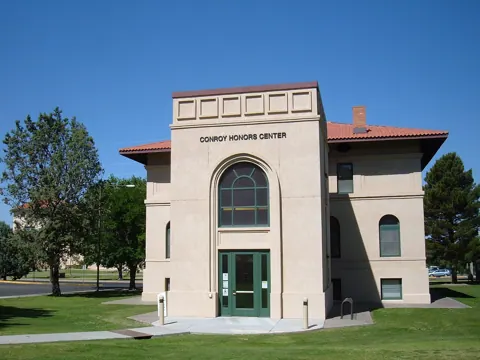




Photos taken with this camera, from Wikimedia Commons, credited under each picture. They may have been resized or edited by their authors.
The dark, and the flash
Imaging Resource's darkness test stopped at about the light of a city street at night: 1 foot-candle, or 11 lux, was the lowest level that gave usable pictures, with warm colour and noise that was high but faint. The autofocus gave out at about the same level, so the reviewer advised keeping something brighter near the middle of the frame.4 Steve's was disappointed with the low-light results: the camera often failed to lock focus, and the reviewer said the autofocus would greatly benefit from a focus-assist lamp.3 Photo Review was gentler: low-light shooting is limited by the two-second shutter, it said, but performance was generally good; it also listed a weak flash among the weaknesses.6
The flash covered 2.0 to 11.5 feet at wide angle and 2.0 to 9.8 feet at telephoto, Fujifilm said.1 Steve's judged that enough for one person or a small group but not for a large room, and would not recommend the A340 as an indoor or flash camera;3 Imaging Resource found flash exposures dim and not adjustable.4 Up close it was mixed: Imaging Resource measured a macro field of 3.13 by 2.35 inches, found the flash throttled down too far and suggested external lighting, while Steve's found it suppressed its flash well in macro and thought the camera acceptable for auction product shots.43
Like the look? See recent eBay sold listings for this camera ↗
Speed and battery, side by side
Each source timed it differently, so read the columns as rough neighbours, not a ranking.
| Fujifilm (announcement) | Steve's, June 2004 | Imaging Resource, Dec 2004 | Photo Review | |
|---|---|---|---|---|
| Start-up | 3.3 s1 | about 3 s3 | not given in the pages we read | not given |
| Shutter lag | not given | 0.5 s with autofocus, 0.1 s pre-focused3 | 0.68 to 0.83 s with autofocus, 0.19 s pre-focused4 | 0.8 s6 |
| Shot to shot | 1.7 s1 | 2 s, or 3.6 s with flash3 | 2.2 s at large/fine4 | not given |
| Battery | 220 shots on alkaline, 460 on 2300 mAh NiMH (flash half the time, screen off)1 | about 150 test shots on 2400 mAh NiMH before the low-battery warning; "good"3 | 124 minutes worst case with the screen on, just over 6 hours with it off, on 1600 mAh NiMH; "good side of average"4 | listed "power hungry" as a weakness6 |
Imaging Resource put the lag a little below the 0.8 to 1.0 second it found typical.4 Both it and Steve's recommended NiMH rechargeables over the alkaline cells in the box.43
On eBay right now
Live listings for this camera, supplied by eBay and updated automatically. We earn a commission if you buy through them.
The little wins
A cover that doubles as a switch
Closed, it kept the front panel nearly flat, so the camera slipped into a pocket or purse without snagging, Imaging Resource said.4
The launch price, disputed
Fujifilm's announcement gave a list price of $249.99, shipping in May 2004, and Steve's review repeats the same release text.12 Imaging Resource's December review printed a suggested retail price "at time of introduction" of $199, and called the camera the cheapest 4-megapixel zoom model on the market at street prices that month.4 The same announcement gave $199.99 as the A330's list price, close to that $199, though we cannot tell whether the two are connected.1 We found no source that settles the gap, so the spec card carries Fujifilm's figure. What it sells for today is a question for sold listings, not for us.
What the reviewers said in 2004
| Outlet | Date | Verdict |
|---|---|---|
| Steve's Digicams | 25 Jun 2004 | A simple point-and-shoot for beginners with extras for intermediate users; a good choice if you want an inexpensive 4-megapixel camera that works well outdoors, but not an indoor or flash camera.23 |
| PC Magazine (excerpt) | 5 Aug 2004 | No verdict in the excerpt we read. It describes only the body: mostly plastic, reasonably sturdy, with exposed side sockets.7 |
| Imaging Resource | 22 Dec 2004 | "A good entry-level digital camera" with good resolution and a zoom at a very low price; made a Dave's Pick for its price bracket.45 |
| Photo Review | Date unknown | Strengths: good picture quality for the resolution and price, simple to use. Weaknesses: limited low light capability, a weak flash, heavy battery use.6 |
We did not read PC Magazine's full review (the excerpt reaches us second-hand through PhotographyBLOG), so it gives no verdict here. Photo Review's page is short. Only Steve's and Imaging Resource are full reviews, so treat the comparisons on this page as two voices, not a consensus.
The timeline
- 5 February 2004Fujifilm announces the A330 and A340 in the US.1
- May 2004The A340 is due to ship at $249.99.1
- 25 June 2004Steve's Digicams posts its review.2
- 22 December 2004Imaging Resource dates its review and names the A340 a Dave's Pick.4
Should you buy one now?
Buy one if you want a plain, light 2004 snapshot camera that runs on AA batteries, shoots well in daylight and does not mind a heavy hand with colour. Skip it for indoor and after-dark shooting, where the reviewers were least happy. Before you bid, check these:
- The name. Search the FinePix A340. The A330 is the 3.2-megapixel sibling1 and the A205 and A210 are the older models that had a mode dial.4
- The batteries. It takes two AAs; Imaging Resource recommended NiMH.4 Rechargeables on Amazon ↗
- The card. It takes xD-Picture Cards only; Fujifilm's table listed 16 to 512 MB.1 See our xD-Picture Card page and memory card guide.
- The sliding door. Slide it fully open and shut and watch the lens extend and retract; Imaging Resource warned the door can strike the lens.4
- The screen. It is the weak point outdoors, so test it.3
For where Fujifilm took its compacts next, see our FinePix F10 review. And if you are wondering why cameras like this are being hunted down again, we tell that story once, in Pictures that never left the card.
See recent sold prices on eBay ↗Shop on eBay ↗AA NiMH batteries ↗
Sources
- Imaging Resource, Fujifilm announces FinePix A330, A340 (Mike Tomkins, 5 Feb 2004; includes Fujifilm's press release and specification table)
- Steve's Digicams, Fujifilm FinePix A340 review, pages 1 to 3 (posted 25 Jun 2004; read through the Internet Archive copy)
- Steve's Digicams, Fujifilm FinePix A340 review, Steve's Conclusion page (read through the Internet Archive copy)
- Imaging Resource, Fujifilm FinePix A340 review (review date 22 Dec 2004; lab and shooting tests; Dave's Pick)
- Imaging Resource, Fuji FinePix A340 review posted (Dave Etchells, 23 Dec 2004)
- Photo Review (Australia), Fujifilm FinePix A340 (a short summary with strengths and weaknesses; the page carries no review date, only a 2012 web publication date in its metadata, so the review's own date is unknown)
- PhotographyBLOG, PC Magazine Reviews Fujifilm FinePix A340 Zoom (5 Aug 2004; a quoted excerpt only, we did not read PC Magazine's full review)
Photographs are credited under each one, all via Wikimedia Commons. Links to eBay and Amazon are affiliate links.