Canon PowerShot ELPH · announced September 2002
The Canon PowerShot S230 (Digital IXUS v3): the first 3-megapixel ELPH, in the S200's steel case
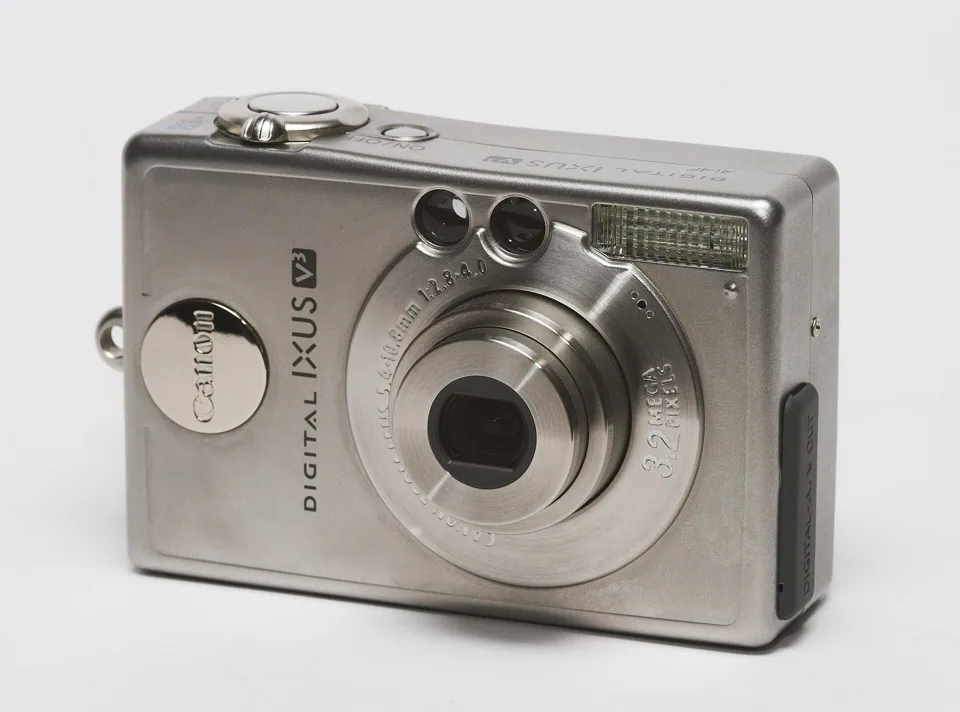

Canon kept the outside of its 2-megapixel S200 and changed what was inside: 3.2 megapixels, nine focus zones instead of three, and video that went straight to the card, up to about 30 seconds at full VGA instead of the S200's 4. Reviewers in 2002 liked the build and the focus. Tek.no found the flash weak, and both reviewers complained about the rubber flap over the port.
- Launched
- October 2002
- Sensor
- 3.2 MP CCD
- Lens
- 35–70 mm, 2×
- Card
- CompactFlash
- Battery
- NB-1L, NB-1LH
Canon PowerShot S230 specs: sensor, lens, battery, memory card and cable
Launched in October 2002 at $399, the Canon PowerShot S230 (also sold as the Digital IXUS v3 and IXY Digital 320) is a 3.2 MP CCD compact with a 35–70 mm (35 mm equivalent) 2× zoom lens. Inside: it takes CompactFlash cards and runs on the NB-1L or NB-1LH battery. Sources
- Sensor
- CCD, 1/2.7", 3.2 MP source
- Lens
- 35–70 mm equivalent, 2× zoom source
- Memory card
- CompactFlash source
- Battery
- NB-1L, NB-1LH source
- Also sold as
- Digital IXUS v3 · IXY Digital 320
- USB / A/V cable
- IFC-200PCU, AVC-DC200 Confirmed · all Canon cables
Meet the camera
Until the autumn of 2002 Canon's Digital ELPH cameras topped out at 2 megapixels, a ceiling Imaging Resource described as increasingly behind the times; the S230 was the first of them to carry a 3.2-megapixel sensor.4 DPReview, announcing it on 18 September 2002 just ahead of the Photokina show, said it was built on the body and lens of the Digital IXUS v² with a new sensor, new image processing and nine-point AiAF autofocus.3 Canon's own tables bear that out: the S230 and the earlier S200 share the same 87 × 57 × 26.7 mm case and the same 180 g body weight.12
Three names cover the one camera. It was the PowerShot S230 Digital ELPH in North America, the Digital IXUS v³ in Europe (DPReview writes the superscript; most reviewers wrote V3) and the IXY Digital 320 in Japan.13 Canon's museum lists it as marketed in October 2002 and gives no price.1 DPReview's announcement gave expected street prices of $399 in the US and €599 in Europe;3 Imaging Resource, reviewing it on 13 November 2002, listed a suggested retail price of $399 and said it was available now.4 In April 2003 the Italian site 01net.it quoted €629 including VAT, which does not match the European figure above, so we show both.8
Why this one was interesting
Same case, new insides
Set Canon's two spec tables side by side and the lens is identical on paper, 5.4–10.8 mm at f/2.8–4. What changed is behind it. The S200 lists a 2-megapixel sensor and 3-point AiAF; the S230 lists 3.2 megapixels and 9-point AiAF. The nearest focus distance moved from 57 cm to 47 cm.12 Canon's museum text for the Japanese model claims the smallest body in the 3-megapixel class, crediting a double-sided chip-mounting technique; that is Canon's claim, not a measurement.1 Imaging Resource put it a little smaller than the S300 and S330 and equal in size to the S200.4
A video mode worth using
The S200's movie mode recorded at most about 4 seconds at 640 × 480 and about 30 seconds at the smallest size.2 The S230 wrote video straight to the card: about 30 seconds at 640 × 480 and about 3 minutes at 320 × 240, at 15 frames a second.16 DPReview noted that the longer clips needed a high-speed CompactFlash card and that Canon launched one alongside the camera.3 Tek.no called it one of the few digital cameras with a usable video mode, though it had no speaker, no exposure adjustment while filming and no zoom.6 That reviewer appears to say that 640 × 480 clips could run for three minutes; Canon's table gives about 30 seconds at that size and three minutes at 320 × 240, so we show Canon's figures in the card above.61
Focus that earned its praise
Imaging Resource found the nine-zone system very precise on subjects that sit off-centre, the case that trips up cameras focusing only on the middle, and welcomed the built-in AF assist lamp for dim rooms.4 Tek.no went further: focus was fast and good even in weak light with the lamp switched off, and, in the reviewer's words, far better than on the top-model G3. Only macro focus was noticeably slower.6 On the clock, Imaging Resource measured 2.99 seconds from power-on to first shot and a shutter lag of 0.97 seconds at wide angle and 1.10 at telephoto with full autofocus, calling that a bit slower than average, but only 0.13 seconds when the shutter was half-pressed first.5 Tek.no's figures were about 3.7 seconds to start and 0.7 and 1.1 seconds of lag.6 Our S45 and G2 retrospectives cover two of the bigger Canons Tek.no compared it with.
Battery: two tests, one missing
Imaging Resource could not run its normal power-drain test, because Canon did not supply the adapter cable. Its stand-in, timing how long the camera ran in capture mode with the screen on, gave a worst-case life of well over 90 minutes, and it advised buying a spare.45 Tek.no counted 398 pictures on the Canon pack with the screen on for every shot, against 1,262 for the G3 and 607 for a Casio QV-R3; a weaker 750 mAh PowerEx pack managed about 300. It also called Canon's 840 mAh battery proprietary and expensive.6 The two measure different things, so read neither as a promise. Third-party packs from Maha (PowerEx) and DigiPower were already on sale in 2002.5
How it drew the picture
Imaging Resource called the colour generally excellent under a wide variety of conditions, with excellent skin tones, though bright reds and blues came out oversaturated; the automatic white balance struggled under household incandescent light, while the incandescent and custom settings worked well.4 Exposure was mostly good, but strong sun left lost shadow and highlight detail. In the lab it held strong detail to about 1,050 lines per picture height, which Imaging Resource called about as much as any 3-megapixel camera, with slightly soft out-of-camera files because Canon sharpened conservatively; it measured 0.6% barrel distortion at wide angle and 0.2% pincushion at telephoto, and saw softness in the corners.4
Tek.no scored image quality 6 out of 10: sharp in the centre, but falling off toward the edges, which the reviewer likened to smeared petroleum jelly on the lens when set against G2 pictures. Colour was good if a touch neutral, skin tones were fine and exposure generally very good, although tripod shots in dim light without flash came out underexposed. Noise was hard to see in 10 × 15 cm prints, ISO 400 was acceptable next to rivals, and long night exposures were noisier than on the S45, G2 and a Sony F717.6 The two reviewers disagreed on macro: Imaging Resource called it average, with a minimum field of 88 × 66 mm and flash that overexposed; Tek.no called it poor.46




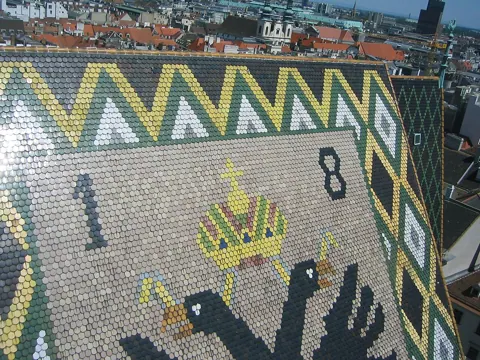

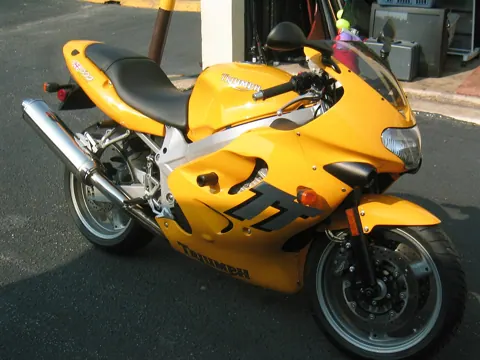









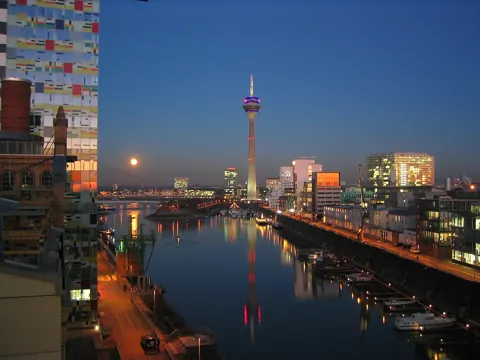

Photos taken with this camera, from Wikimedia Commons, credited under each picture. The EXIF data in the Düsseldorf harbour picture records a 1-second exposure at f/2.8; the Tempelhof hall was 1/13 s at f/2.8.
On eBay right now
Live listings for this camera, supplied by eBay and updated automatically. We earn a commission if you buy through them.
The little wins
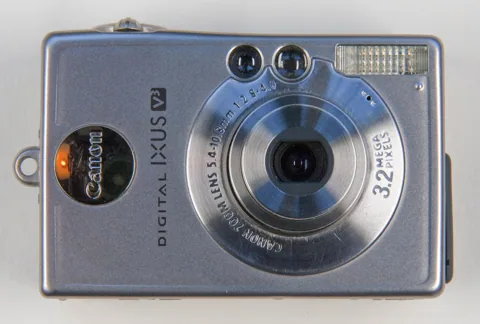 The IXUS v3 from the front. · Hannes Grobe (talk) · CC BY 3.0 · Commons

Nine zones, one lamp
The nine-point AiAF drew green boxes on the screen to show which zones had locked, and the AF assist lamp helped in the dark.4 Tek.no added that the screen did not freeze while the camera focused and metered, as some rivals' did, and stayed usable in fairly dark rooms thanks to strong signal gain.6
Features beyond a snapshot camera
Imaging Resource found a playback histogram, custom white balance and an exposure lock that works with the flash unusual for a camera of this kind. It also found the lock awkward, needing two hands and the up-arrow button.4 Tek.no, too, was surprised to find a histogram.6
Where it let you down
Tek.no called the flash the camera's Achilles heel: weak, often underexposing, close enough to the lens to invite red-eye, and slow to recharge, so that with flash the wait before the next shot could reach 4.5 to 5 seconds.6 It also named the lens as the weakest point, because rivals offered 3x zoom against this camera's 2x.6
Both reviewers had complaints about the rubber cover over the USB and audio-video port: Imaging Resource thought it protected the port well but said it stuck out from the sleek case, and worried that flaps like it break over time, while Tek.no called it ugly, said it fitted badly and would drop off in a pocket. Both also criticised where the tripod socket sat.46 Imaging Resource found the optical viewfinder tight, showing 82 to 83 percent of the frame, while the screen showed nearly all of it.4 Tek.no also disliked having to switch to a separate playback mode before shooting again, and wrote that transferring rotated images needed Canon's software, and that the camera offered PTP but no mass-storage mode.6
What the reviewers said in 2002-03
| Outlet | Date | Verdict |
|---|---|---|
| Imaging Resource | 13 Nov 2002 | An excellent addition to the Digital ELPH line: rugged, portable, good colour, and simple enough for novices with enough control for advanced users; picture quality rated good.4 |
| Tek.no | 24 Nov 2002 | 7 out of 10 overall (build 9, features 6, ease of use 7, image quality 6, value 7): pretty and practical, but better choices existed on picture quality and features; image quality still more than good enough for most buyers.6 |
| 01net.it | 17 Apr 2003 | A short test: good image quality, especially close-ups, quick to be ready (about 3 seconds) and simple to use; the only con listed was weight for its size, although it also lists light weight among the pros.8 |
The timeline
- April 2002The 2-megapixel S200 is marketed, in the same case.2
- 18 September 2002DPReview reports the S230 / Digital IXUS v³ ahead of Photokina.3
- October 2002Canon's museum lists it as marketed.1
- 13 November 2002Imaging Resource publishes its review.4
- 24 November 2002Tek.no publishes its test.6
- 17 April 200301net.it publishes its short test.8
Where Canon's pocket cameras went next is told in our S110 (the Digital IXUS v, two generations earlier: Tek.no gives the order V, V2, V3 and Canon's museum lists the S110 as the Digital IXUS v67), SD400 and SD500 retrospectives.
Should you buy one now?
Buy one if you want a very small steel-cased compact with a real viewfinder and good daylight colour, and you accept 3.2 megapixels, a 2x zoom and a flash that tends to underexpose. It listed at $399 in 2002;4 what it sells for now is a question for the sold listings, not for us. Before you bid, check these:
- Which camera it is. The Digital IXUS v² / S200 uses the same case and the same 5.4–10.8 mm lens but has a 2-megapixel sensor, so check the model name and the megapixel figure.123 Search all three names: S230, Digital IXUS v3 and IXY Digital 320.1
- The battery. It takes an NB-1LH or NB-1L,1 and Imaging Resource advised buying a spare even in 2002:5 NB-1LH on Amazon ↗.
- The card. It takes CompactFlash Type I.1 Imaging Resource recommended at least 32 MB and preferably 64 MB in 2002 (the box held 16 MB);45 we have not confirmed a maximum card size. See our CompactFlash page, or search cards on Amazon ↗.
- The port flap. The rubber cover over the USB and audio-video socket drew complaints from both reviewers;46 check it is there and the contacts are clean.
- The power button. It has to be held for about a second to switch on, a deliberate choice by Canon;4 the lens then telescopes out, so make sure it extends and retracts without a catch.
If you are wondering why cameras like this are being hunted down again, we tell that story once, in Pictures that never left the card.
See recent sold prices on eBay ↗Shop on eBay ↗NB-1LH battery ↗
Sources
- Canon Camera Museum: PowerShot S230 DIGITAL ELPH (IXY DIGITAL 320 / Digital IXUS v3): specifications, marketing date, names, battery, card
- Canon Camera Museum: PowerShot S200 DIGITAL ELPH (IXY DIGITAL 200a): specifications for the earlier model
- DPReview, Canon Digital IXUS v3 / S230 announcement, 18 September 2002 (a short news item, not a review)
- Imaging Resource, Canon PowerShot S230 Digital ELPH review (review date 13 November 2002)
- Imaging Resource, Canon PowerShot S230 "Picky Details": timings, power, storage, download speed
- Tek.no, Test av Canon Digital Ixus V3 by Martin Lexow Wirak (24 November 2002; in Norwegian)
- Canon Camera Museum: PowerShot S110 DIGITAL ELPH (IXY DIGITAL 200 / Digital IXUS v): names, marketing date
- 01net.it, Il test della Canon Digital Ixus V3 by PC Open Labs (17 April 2003; in Italian)
Camera photos by afrank99 (CC BY-SA 2.5) and Hannes Grobe (CC BY 3.0); sample photographs are credited under each one, all via Wikimedia Commons. Links to eBay and Amazon are affiliate links.