Canon PowerShot S · October 2002
The Canon PowerShot S45: a four-megapixel brick with a sliding cover
Sold under the same name in Japan, the Americas and Europe.5
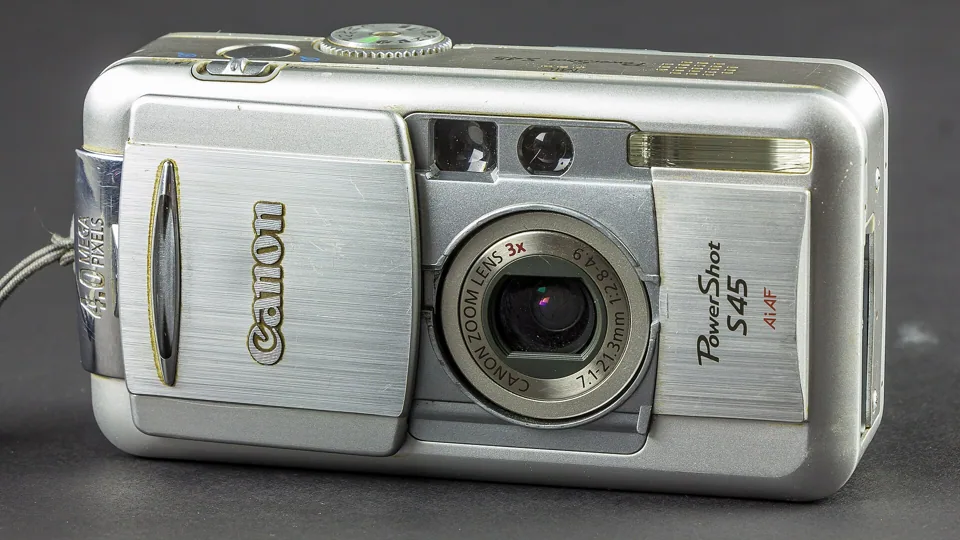
Canon's 2002 update to the S40 looked the same and changed the electronics and menus. Both reviewers who tested it loved the pictures and the build. The macro mode was the weakness both named, and Imaging Resource also wanted a better viewfinder.
Canon PowerShot S45 specs: sensor, lens, battery, memory card and cable
The Canon PowerShot S45 is a 4 MP CCD compact camera with a 35–105 mm (35 mm equivalent) 3× zoom lens, launched in October 2002 at $649. It takes CompactFlash cards and runs on the NB-2L battery. Sources
- Sensor
- CCD, 1/1.8", 4 MP source
- Lens
- 35–105 mm equivalent, 3× zoom source
- Memory card
- CompactFlash source
- Battery
- NB-2L source
- USB / A/V cable
- IFC-300PCU, AVC-DC100 Confirmed · all Canon cables
Meet the camera
The lens cover is the power switch. Slide it open and the lens telescopes out; push it shut and the lens retracts, and DPReview noted you cannot close the cover until the lens is home.2 Imaging Resource called the body solid-feeling, a polycarbonate shell wrapped in brushed and anodised aluminium panels, and said the cover doubles as a finger grip.1 DPReview thought it comfortable to hold despite having no proper grip, and listed excellent build quality, a metallic finish and a solid, brick-like feel among its pros.2
Canon's museum lists the S45 as marketed in October 2002, replacing the S40 of October 2001.5 Canon U.S.A.'s release of 3 December 2002 gave a suggested retail price of $649 and said it would be on sale in December.3 Other prices in our sources do not match. Imaging Resource's review text calls $499 the list price at introduction, but its own data sheet lists $649;14 DPReview, writing in November 2002 before the US launch, gave a street price of $599 in the US and £600 in the UK.2 We show them all. Weights also differ: Canon says about 260 grams for the body alone;5 DPReview gives 315 grams with the battery;2 Imaging Resource's overview says 310.5 grams with battery and card, its design page 314.5.1
- Sensor
- 4.0 MP CCD, 1/1.8" (4.1 MP total)5
- Lens
- 3x, 7.1–21.3 mm (35–105 mm equiv.), f/2.8–4.95
- ISO
- Auto, 50, 100, 200, 4005
- Screen
- 1.8" LCD (about 100% coverage) plus optical viewfinder (82% coverage, Canon's figure)5
- Files
- JPEG (Exif 2.2) or RAW, up to 2272 × 1704; shutter 15 s to 1/1500 s5
- Flash
- Built-in, 35 cm to 4.8 m at wide angle5
Why this one was interesting
Resolution the small lens should not have delivered
DPReview's first pro was excellent resolution, much better than expected from such a small lens, and it called the image quality probably the best among the four-megapixel compacts.2 In its chart test the S45 reached 1,250 lines per picture height horizontally and 1,150 vertically before aliasing, with extinction at 1,450 and 1,400; its horizontal figure was higher than the 1,100 to 1,200 of the Minolta F100, Sony P9 and Olympus C-40 Zoom it was set against.2 Imaging Resource put artifacts in its patterns from about 800 lines, strong detail to at least 1,100, and extinction near 1,450.1
A button for everything
The FUNC button was the headline change in use. Imaging Resource explained that the old habit of pressing the EV/Function button over and over until the setting appeared gave way to one list showing every option, with resolution and quality in the same list.1 DPReview agreed that the new menu made it easier to understand and change settings.2 DPReview's list of new features adds a Custom position on the mode dial that recalls settings saved from P, Tv, Av or M, two stored custom white balances, focus bracketing and a choice of first- or second-curtain flash sync.2
Nine points of focus, and the picture shows where
Canon's launch release says the S45 jumped from the S40's three-point autofocus to nine points in the automatic modes, thanks to the new DIGIC processor, with a movable single point (FlexiZone) in the manual-minded modes.3 DPReview wrote that autofocus felt more responsive than any other compact four-megapixel camera it had used;2 but it also noted that nine-point AiAF was not available in P, Tv, Av, M or C.2 Imaging Resource found the nine areas choose the closest subject they can lock, and the single box can be steered around roughly the central 60 per cent of the frame.1
Raw files and time-lapse
The camera saved raw files, and DPReview listed raw at 12 bits, plus the ability to turn a JPEG into a raw file during record review, as strengths; Canon's release describes the same after-the-fact raw save.23 Imaging Resource described an intervalometer for time-lapse, with intervals of one to 60 minutes and up to 100 frames, and DPReview lists an intervalometer among its pros; Imaging Resource places it in the Record menu, but its software page says interval shooting is only available through the RemoteCapture software, so check that it is on the camera you are buying.12
Both reviewers set it beside Canon's G series. DPReview called the S45 essentially a shrunk PowerShot G3 and said it gave up that camera's faster lens, hot shoe and flip-out screen.2 Imaging Resource likewise said the S45 had almost all the G3's advanced features except the rotating screen and the external hot shoe.1 We cover that family's earlier chapter in our PowerShot G2 review.
What stayed the same
The body, lens and screen carried over from the S40, and DPReview said so directly, writing that much of the first half of its S45 review was based on the S40 review.2 The lens still opens to f/2.8 only at the wide end; Imaging Resource called the f/4.9 at telescopic reach miserly.1 DPReview's cons list the slow tele lens, limited apertures at telephoto and vignetting at wide angle and full aperture, which its test showed as visible corner darkening at f/2.8 that disappeared when stopped down or zoomed.2
The dark: its weak point
This is a camera with a conservative ISO scale. DPReview said that Canon labels its ISO 50 as roughly what other makers call ISO 100, so the S45's real range is closer to ISO 100 to 800 on other brands' dials; in its noise comparison the S45 matched the Minolta F100 one stop apart until the top setting, where the S45 kept noise lower.2 Its pros read: low noise at ISO 50, not as clean at ISO 100.2 Imaging Resource tested the lowest light level in its set-up, 1/16 foot-candle (0.67 lux), and found clear, usable pictures with good colour at ISO 100, 200 and 400, with noise only moderately high at ISO 400; at ISO 50 the 1/8 foot-candle shot was bright and the dimmer one usable in a pinch.1 Exposures run to 15 seconds, with noise reduction on shutter speeds of 1.3 seconds and slower.12
Focus in the dark was something DPReview checked: at 35 mm and f/2.8 the S45 focused in complete darkness with its assist lamp, while at 105 mm and f/4.9 it needed at least 1.8 EV (8.7 lux), and it called the lamp underpowered at telephoto.2 The two reviewers judged the flash differently: DPReview found good colour and output at moderate distances and less at full wide angle and longer range, while Imaging Resource found the output a bit low but not falling off through its 14-foot test limit.21

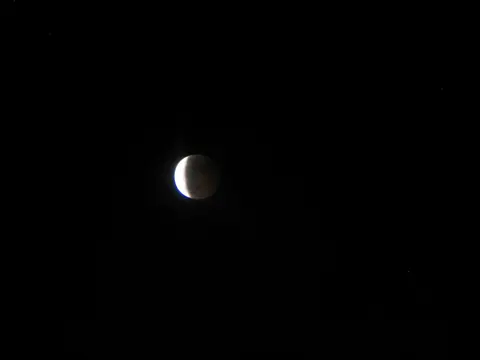
We cannot give an ISO for these two: the EXIF Commons shows for these files carries no ISO value. The shutter times and apertures in the captions are from the EXIF.
Like that look? See recent eBay sold listings for this camera ↗
On eBay right now
Live listings for this camera, supplied by eBay and updated automatically. We earn a commission if you buy through them.
The little wins
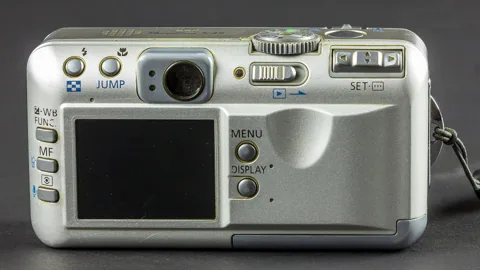 The S45's back panel, with the 1.8-inch screen. · Raimond Spekking · CC BY-SA 4.0 · Commons
A histogram and blinking highlights
In playback the S45 shows a histogram, and Imaging Resource liked even more that blown highlights blink between white and black, so you can see exactly where detail has been lost. It could also enlarge a picture ten times, which the reviewer found enough to judge focus.1
A manual-focus aid
DPReview's pros include a manual focus that magnifies the centre and reads out a distance scale; Imaging Resource found the numeric scale handy for when the scene is too dark to judge the focus visually, and wished for more than the 2x enlargement.21
How it drew the picture
DPReview wrote that colour was very good, vivid but not over-saturated, with a tonal balance that lifts shadow detail so pictures almost never look too contrasty; its one weakness, it wrote, was lens sharpness at maximum aperture, where some pictures had a sharp centre and soft edges, and it judged the camera no worse than other four-megapixel compacts there.2 It scored image quality 8.5 out of 10.2 Imaging Resource said it had seen some of the best colour from a digicam, with only bright reds and primary colours a little oversaturated, and measured about 0.7 per cent barrel distortion at wide angle, against DPReview's just under 1 per cent.12 DPReview found automatic white balance gave a visible orange cast under tungsten light and a yellowish-green cast under fluorescent, and advised using the presets; Imaging Resource's indoor portrait also troubled the automatic setting, though its incandescent and manual settings handled it.21





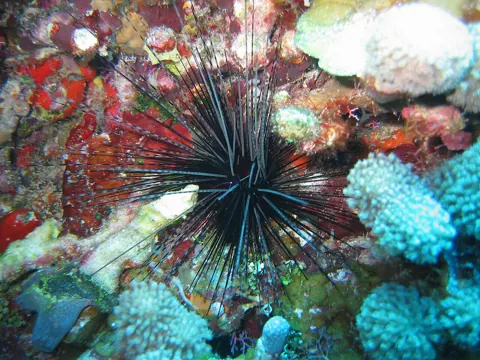


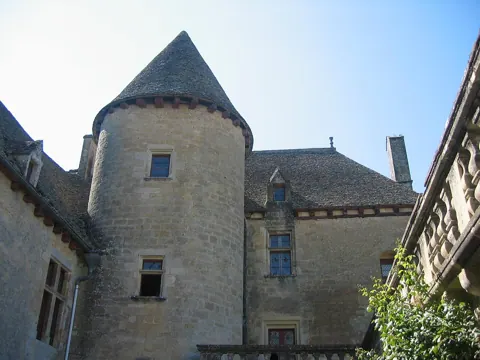


Photos taken with this camera, from Wikimedia Commons, credited under each picture.
Where it let you down
The optical viewfinder was the first complaint. Imaging Resource measured about 84 per cent frame coverage, which it said is typical of digicams but should be better, and noted that the screen's coverage was almost exactly 100 per cent.1 DPReview's text also says approximately 84 per cent, while its spec table gives 82 per cent (Canon's figure); it noted no dioptre adjustment and advised getting used to the screen.25 Imaging Resource added that the eyepoint is unusually high, which suits glasses wearers.1
The macro mode drew complaints from both: Imaging Resource called it average, with a minimum field of about 97 × 73 mm, soft corners, strong barrel distortion and a flash that overexposed at that range;1 DPReview called it poor to average, with the best coverage at wide angle being about 9.2 cm across.2 The sources also differ on the normal focus range: Canon's museum says 50 cm to infinity, while DPReview's spec table and Imaging Resource's text say 80 cm; DPReview's own controls page, though, says 50 cm and up.521
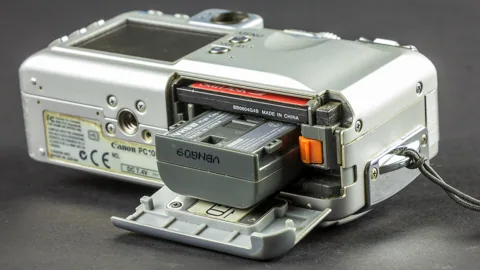
Startup is another place where the sources split. DPReview timed 4.2 seconds for the lens to come out, 4.4 seconds to a first shot, and noted the S45 was identical to the S40 here;2 Imaging Resource measured 3.14 seconds from power-on to first shot and called it about average.1 DPReview also disliked the controller, where pressing Set on the combined four-way control was hit and miss, and listed the battery and card compartment's position as a pain for tripod users; Imaging Resource said the battery door sits so close to the tripod mount that quick swaps are hard.21 On battery life the two ran different tests: DPReview's gave 2 hours 28 minutes and 240 shots, a little above the S40's 2 hours 13 minutes and 225, while Imaging Resource ran the camera for about 110 minutes of continuous capture with the screen on and called that better than average for a mid-sized camera.21
What the reviewers said in 2002 and 2003
| Outlet | Date | Verdict |
|---|---|---|
| DPReview | 12 Nov 2002 | Highly Recommended. Construction 9, features 9, image quality 8.5, lens and CCD 9, ease of use 9, value 9 out of 10; it called the S45 the best subcompact four-megapixel camera available at that point.2 |
| Imaging Resource | 22 Feb 2003 | Highly recommended. It praised the picture quality as exceptional, but wanted a more accurate viewfinder and better macro, and judged it excellent for high-end consumers.1 |
The timeline
- October 2001The S40 is marketed; the S45 replaces it a year later.5
- October 2002Canon's museum gives this month as the marketing date.5
- 12 November 2002DPReview publishes its review, before Canon U.S.A.'s announcement.2
- 3 December 2002Canon U.S.A. announces the S45 at $649 for December.3
- 22 February 2003Imaging Resource's review is first posted.1
Should you buy one now?
Buy one if you want a heavy, metal-bodied compact with manual modes, raw files and a bright f/2.8 wide end, and you are happy with a four-megapixel sensor and a start-up of three to four seconds.521 What it sells for now is a question for the sold listings, not for us. Before you bid, check these:
- The name. Canon used PowerShot S45 in Japan, the Americas and Europe, so one search covers it.5
- The battery. It uses an NB-2L, with a charger in the original kit.53 Amazon ↗
- The card. It takes CompactFlash Type I and II.5 See our CompactFlash guide.
- The cover. It is the power switch, so slide it fully open and shut a few times and watch the lens go out and back.2
- The Set button. DPReview found the combined controller awkward;2 press the centre and each direction to be sure all five work.
- The screen and viewfinder. Look for scratches on the 1.8-inch screen and dust in the viewfinder.
If you are wondering why cameras like this are being hunted down again, we tell that story once, in Pictures that never left the card. For a camera from Canon's later pocket line, see our PowerShot SD500 review.
See recent sold prices on eBay ↗Shop on eBay ↗NB-2L battery ↗
Sources
- Imaging Resource, Canon PowerShot S45 review, twelve pages (first posted 22 Feb 2003; lab timings, resolution and low-light tests)
- DPReview, Canon PowerShot S45 review by Phil Askey (published 12 Nov 2002; read in full, one long page with a sixteen-image sample gallery)
- Imaging Resource news item, “Canon PowerShot S45 comes to the USA” (3 Dec 2002), carrying Canon U.S.A.'s press release: $649 suggested retail, available in December, kit contents
- Imaging Resource data sheet, Canon PowerShot S45 (retail price field $649, availability 2002-12-31, price updated 2007-02-27)
- Canon Camera Museum, PowerShot S45 (marketed October 2002; specifications)
Camera photos by Raimond Spekking (CC BY-SA 4.0); other photographs are credited under each one, all via Wikimedia Commons. Links to eBay and Amazon are affiliate links.