Canon PowerShot G · on sale autumn 2001
The Canon PowerShot G2: four megapixels, ISO 50 and a screen that hides
Sold under the same name in Japan, the Americas and Europe.6
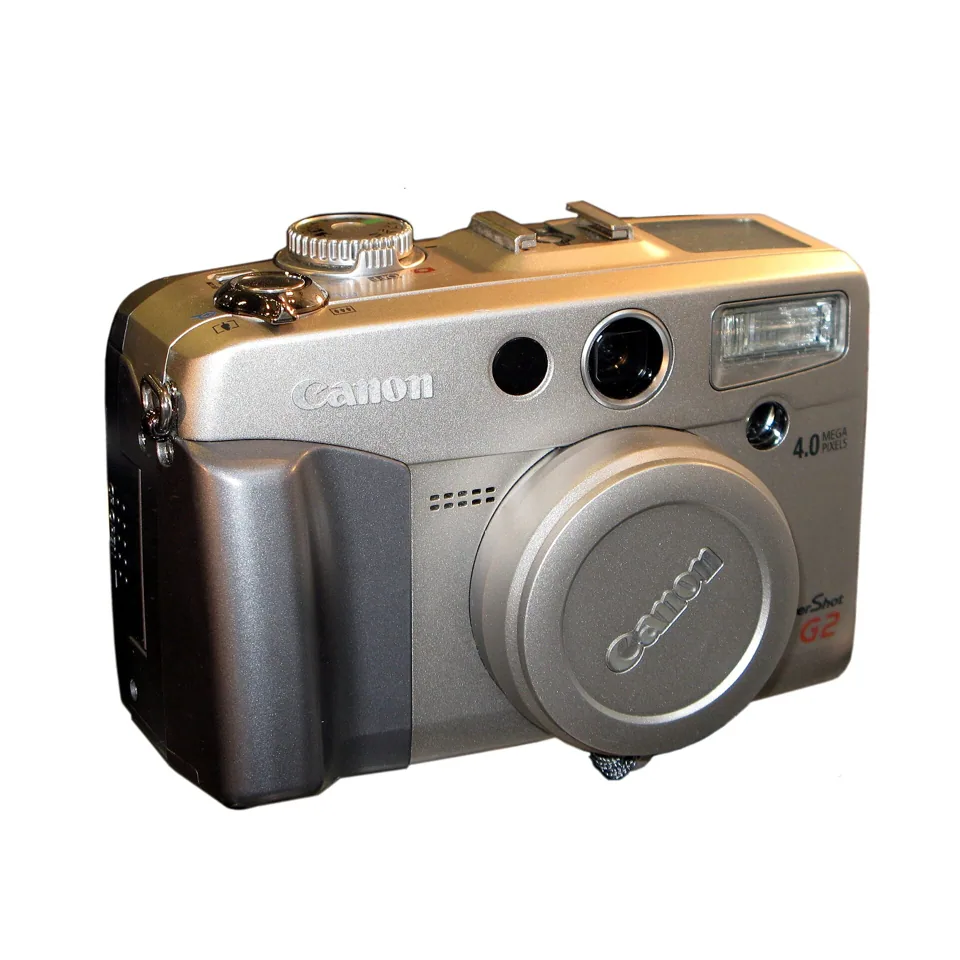
Canon's 2001 update to the G1 kept the lens, moved to four megapixels and added raw files. Three reviewers liked it in August 2001; DPReview, which scored it, still wrote that the viewfinder was lacking next to even the cheapest APS film cameras.
Canon PowerShot G2 specs: sensor, lens, battery, memory card and cable
The Canon PowerShot G2 came out in September 2001 as a 4 MP CCD compact with a 34–102 mm (35 mm equivalent) 3× zoom lens. It takes CompactFlash cards and runs on the BP-511 or BP-512 battery. Sources
- Sensor
- CCD, 1/1.8", 4 MP source
- Lens
- 34–102 mm equivalent, 3× zoom source
- Memory card
- CompactFlash source
- Battery
- BP-511, BP-512 source
- USB / A/V cable
- AVC-DC100 Partly confirmed · all Canon cables
Meet the camera
Start with the screen. The G2's 1.8-inch LCD pops out of the back, swings to face forward, rotates up to 270 degrees, and can be folded back into the body face-in, which Imaging Resource liked because it protects the glass from fingerprints and scratches.1 DPReview listed the fold-out and twist screen, with its anti-reflective coating, among its strengths.2 It sat on a body all three described as solid: a champagne-coloured metal front, plastic elsewhere, and a larger grip than the G1's.213
Canon's museum gives the camera a September 2001 market date and a Japanese price of 115,000 yen.6 US prices in our sources do not agree. Imaging Resource's news item said the introductory list price matched the $899 the G1 launched at;4 the Digital Camera Resource Page printed $999;3 and Imaging Resource's own data sheet lists $799 as the retail price, with an availability date of 30 September 2001, in a field last updated in 2007;5 and DPReview's spec table gives a US street price of $899.2 We show them all rather than pick one. Weight depends on what is counted: Canon says about 425 grams for the body alone,6 while DPReview and Imaging Resource give 510 and 512 grams with battery, and card in IR's case.21
Why this one was interesting
Sharper than four megapixels explains
The lens was the G1's, and Imaging Resource still found the pictures sharper than the step from three to four megapixels would account for, suggesting that Canon had upgraded the image processing.1 In its resolution test the camera showed artifacts from about 700 lines per picture height, strong detail to at least 1,100 and extinction near 1,300.1 DPReview listed the resolution as among the best of its day and wrote that the lens was more than able to resolve a full four megapixels.2
An ISO setting below 100
The G2 offered ISO 50 (the G1's Auto setting already ranged from 50 to 100), which DPReview found very clean; at ISO 100 it saw slightly more noise, as coloured mottle.2 DPReview's table has dynamic range falling from 56 dB at ISO 50 to 40 dB at ISO 400.2 Canon says its Auto setting stays between ISO 50 and 100.6
Controls that grew up
DPReview wrote that a session with the new evaluative metering mode never needed the exposure compensation control.2 The camera gained a choice of three focus points, and manual focus enlarged the centre of the frame on the screen beside a distance scale.12
Raw, and room for a Microdrive
Raw files kept 10 bits of data, which DPReview counted a strength; it also said the supplied raw converter lacked functions.2 Imaging Resource counted eight raw frames on the supplied 32 MB card; the Digital Camera Resource Page and DPReview both counted ten.132 The slot took Type II cards, so IBM's Microdrive worked; DPReview timed a 1 GB drive against the supplied 32 MB card and a Lexar 12x card: the Microdrive was well ahead of the supplied card at saving large files and a little behind the Lexar, and the review called the camera's times with it a little slower but acceptable.2 Keller's review said Type II support set the G2 above Sony's Memory Stick DSC-S85.3
For the G line's later chapter, see our PowerShot G9 review (2007).
What stayed the same
The viewfinder was the weak spot. DPReview called it small, fine when the screen cannot be used and lacking next to the cheapest APS film cameras, and wished Canon had fitted a better one or an electronic one; it put coverage at about 84 per cent, which is Canon's figure too.26 Imaging Resource measured 86 per cent at wide angle and 83 per cent at telephoto.1
The dark: its weak point
The three reviewers did not agree about noise. Imaging Resource produced clear, bright, usable pictures down to about 1/16 foot-candle (0.67 lux) at all four ISO settings and called ISO 400 a little noisy, but with a small, tight grain.1 The Digital Camera Resource Page said things look grainy above ISO 100, with Auto and ISO 50 better.3 DPReview found ISO 50 very clean, ISO 100 slightly noisier and ISO 400 a little too noisy to be useful at full resolution.2 For long exposures, the Digital Camera Resource Page said a noise-reduction pass runs for shutter speeds slower than 1.3 seconds; its own four-second exposure, taken in fog, showed little noise.3 Imaging Resource also praised the slow-shutter noise reduction and wrote that the technology was apparently ported from Canon's EOS D30 SLR.1
The sample photographs below are all daylight shots. We found no free photograph taken with this camera whose EXIF data lets us show a verified night scene, so there is no low-light strip on this page.
Like that look? See recent eBay sold listings for this camera ↗
On eBay right now
Live listings for this camera, supplied by eBay and updated automatically. We earn a commission if you buy through them.
The little wins
Highlights that flash
In playback a small histogram appears, and overexposed areas of the picture flash black and white. Magnification went to 3x and 6x, from 2.5x and 5x on the G1, in a table Canon's technical manager supplied to Imaging Resource.1
A focus loupe
Holding the manual-focus button and pressing up or down moved the focus along a scale on the screen, with the centre of the picture enlarged. Imaging Resource loved it; the Digital Camera Resource Page, which still had some trouble focusing, noted that Fujifilm's FinePix 4900 and 6900 have the same feature.13
A computer-controlled camera
RemoteCapture software showed a live view from the camera on a computer; on the G2, Imaging Resource noted, the video output stayed live during capture and the camera's own shutter button worked, both limits on the G1.1
How it drew the picture
DPReview wrote that the camera loved colour, with deep blue skies as a recurring signature, and that its processing lifted dark areas slightly to keep shadow detail while avoiding a hard cut-off at the highlights.2 It also found jagged diagonal artifacts from sharpening or interpolation, which it said were not easy to see in everyday shots; it listed the artifacts among its cons and scored image quality 8.5 of 10.2 Imaging Resource saw excellent colour and a slight magenta tint in skin tones, measured about 0.51 per cent barrel distortion at wide angle (DPReview measured 1.1 per cent), and counted two or three faint pixels of colour fringing on either side of its chart lines.1 DPReview said purple fringing was far less than on the G1.2 Automatic white balance made Imaging Resource's indoor portrait very warm, though its incandescent and manual settings handled it.1
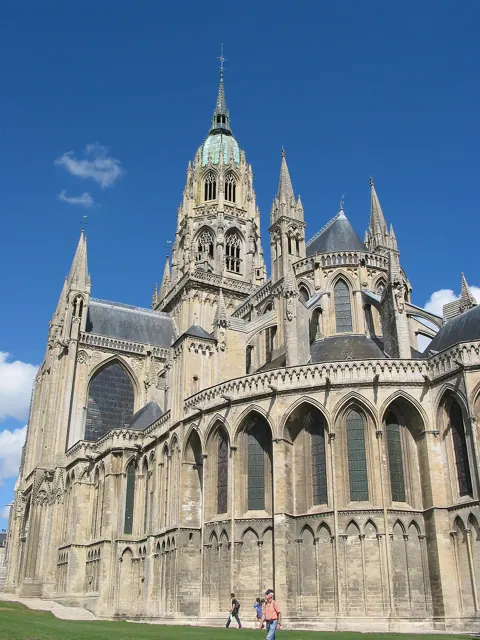

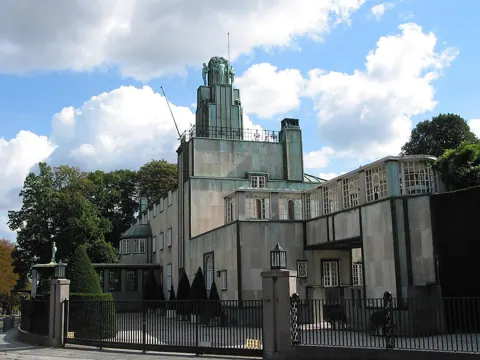
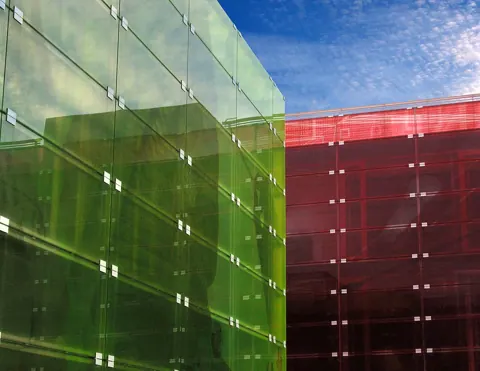






Photos taken with this camera, from Wikimedia Commons, credited under each picture.
Where it let you down
Speed was the sore point, and the sources disagree on how sore. Imaging Resource timed 7.2 seconds from power-on to first shot and called it somewhat slower than average, though it said its initial-production unit ran slower than Canon's specifications and that it would retest.1 DPReview timed 5.8 seconds for the lens to extend and called the startup the thing that crippled an otherwise quick camera.2 The Digital Camera Resource Page said it takes about four seconds, with no noticeable shutter lag.3 Imaging Resource's lag with full autofocus was 0.88 to 1.30 seconds, but only 0.095 seconds when the camera had been pre-focused.1
The build had weak points. DPReview and the Digital Camera Resource Page both disliked a flimsy door, the first on the connections and the second on the card slot; DPReview listed the tripod mount as poorly placed, and Imaging Resource noted that it sits so close to the battery door that changing batteries on a tripod is hard.231 Imaging Resource found both dials need a two-finger grip.1 The Digital Camera Resource Page listed the proprietary battery and the lack of optical zoom during movies among its dislikes, with price the main one.3 Macro drew a split: DPReview called it average, the Digital Camera Resource Page passed it with flying colours, and Imaging Resource found it great but said the flash overexposed at very short range.231
What the reviewers said in 2001
| Outlet | Date | Verdict |
|---|---|---|
| Imaging Resource | 16 Aug 2001 | Very highly recommended. Canon improved performance in virtually every area, at the same suggested retail price the G1 carried when first introduced.1 |
| Digital Camera Resource Page | 16 Aug 2001; updated 13 May 2002 | Its favourite of the three 4-megapixel cameras it had tested. Dislikes: proprietary battery, no zoom in movies, price.3 |
| DPReview | Page dated 27 Aug 2001 | Highly Recommended. Construction 8.5, features 9, image quality 8.5, lens and CCD 9, ease of use 9, value 9 out of 10.2 |
The timeline
- 16 August 2001Imaging Resource and the Digital Camera Resource Page post their reviews; Imaging Resource's news item the same day quotes DPReview's conclusion.134
- 27 August 2001The date printed on DPReview's review page.2
- September 2001Canon's museum gives this month as the marketing date; Imaging Resource's data sheet lists availability on 30 September.65
- 13 May 2002The Digital Camera Resource Page updates its review.3
Should you buy one now?
Buy one if you want a chunky, manual-control compact with raw files, a swivelling screen and a hot shoe, and you accept a slow start. It listed at $899 or $999 depending on source (and $799 on a later data sheet);435 what it sells for now is a question for the sold listings, not for us. Before you bid, check these:
- The name. Canon used PowerShot G2 everywhere, so one search covers it.6
- The battery. It runs on a BP-511 (the BP-512 is an optional alternative).6 A CR2016 lithium cell inside the battery compartment keeps the clock going, so check it if the date is wrong.1 Amazon ↗
- The card. It takes CompactFlash Type I and II.6 See our CompactFlash guide.
- The doors. Reviewers called the connector flap and card door flimsy;23 check they close.
- The screen. Swing it out, rotate it and fold it back to be sure the hinge works and the glass is clean.
- The lens. Check that it extends and retracts without sticking.
If you are wondering why cameras like this are being hunted down again, we tell that story once, in Pictures that never left the card.
See recent sold prices on eBay ↗Shop on eBay ↗BP-511 battery ↗
Sources
- Imaging Resource, Canon PowerShot G2 review, twelve pages (first posted 16 Aug 2001; lab timings, resolution and low-light tests)
- DPReview, Canon PowerShot G2 review by Phil Askey (page dated 27 Aug 2001; its conclusion is quoted in Imaging Resource's news item of 16 Aug 2001)
- Digital Camera Resource Page, PowerShot G2 review by Jeff Keller (posted 16 Aug 2001, updated 13 May 2002; read in a December 2003 Internet Archive copy)
- Imaging Resource news item, Canon PowerShot G2 full review (16 Aug 2001: $899 introductory list price, quotes the other two reviews' conclusions)
- Imaging Resource data sheet, Canon PowerShot G2 (retail price field $799, availability 2001-09-30, price updated 2007-02-27)
- Canon Camera Museum, PowerShot G2 (marketed September 2001, 115,000 yen; specifications)
Camera photo by Rama (CC BY-SA 2.0 fr); other photographs are credited under each one, all via Wikimedia Commons. Links to eBay and Amazon are affiliate links.