Canon PowerShot ELPH · on sale March 2005
The Canon PowerShot SD400 (Digital IXUS 50): the five-megapixel ELPH that hid behind a credit card
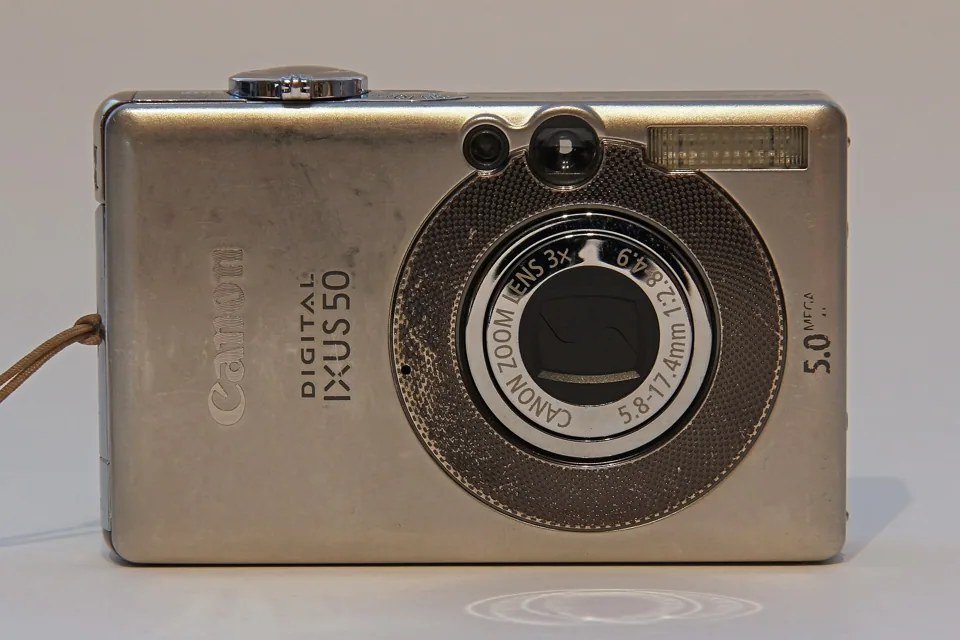

In 2005 Canon fitted its smallest 3x-zoom body with a 5-megapixel sensor and a faster processor. Reviewers liked it, and disagreed about its corners, its flash and its macro.
- Launched
- March 2005
- Sensor
- 5 MP CCD
- Lens
- 35–105 mm, 3×
- Card
- SD
- Battery
- NB-4L
Canon PowerShot SD400 specs: sensor, lens, battery, memory card and cable
The Canon PowerShot SD400 (also sold as the Digital IXUS 50 and IXY Digital 55) came out in March 2005 at $399.99 as a 5 MP CCD compact with a 35–105 mm (35 mm equivalent) 3× zoom lens. It takes SD cards and runs on the NB-4L battery. Sources
- Sensor
- CCD, 1/2.5", 5 MP source
- Lens
- 35–105 mm equivalent, 3× zoom source
- Memory card
- SD source
- Battery
- NB-4L source
- Also sold as
- Digital IXUS 50 · IXY Digital 55
- USB / A/V cable
- IFC-400PCU, AVC-DC300 Confirmed · all Canon cables
Meet the camera
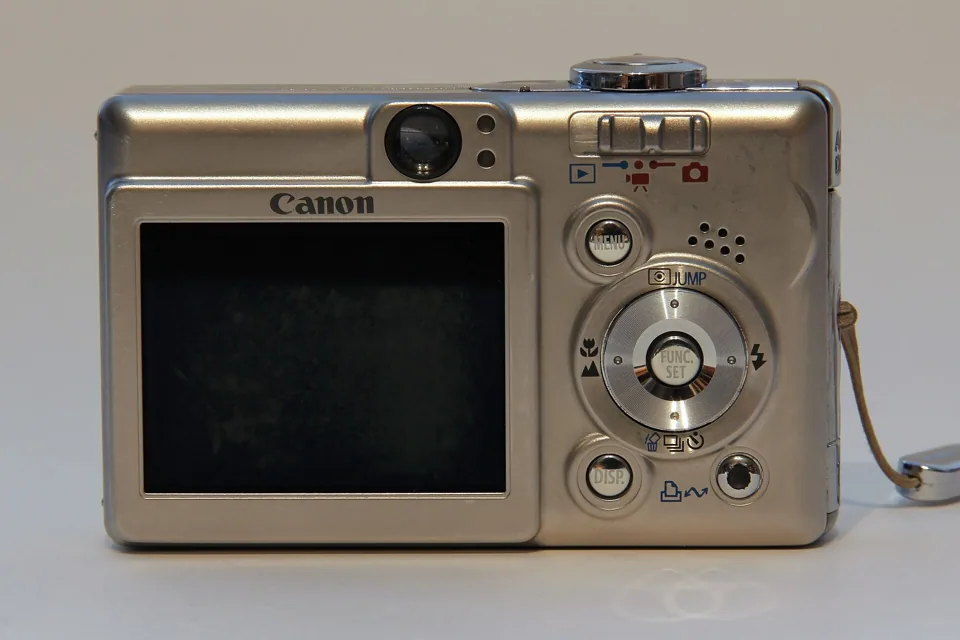
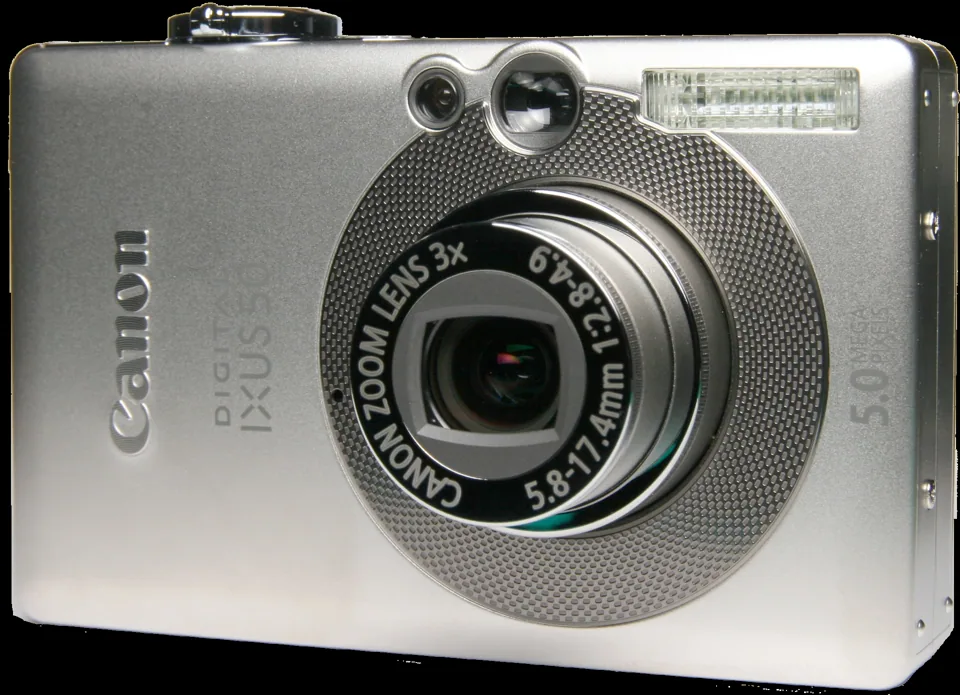
The SD400 is a squared-off metal slab, 86 by 53 by 20.7 mm by Canon's count, with a lens that slides back inside the body when the camera is off.1 DPReview said it is small enough to hide behind a credit card, and noted it looked almost identical on the outside to the 4-megapixel SD300 that came before it.4 Canon's launch text describes the same design as inherited from the IXY Digital 50 of October 2004, with a 5-megapixel sensor added.1
It has three names. Canon sold it as the PowerShot SD400 Digital ELPH in the Americas, the Digital IXUS 50 in Europe, Asia and Oceania and the IXY Digital 55 in Japan, and lists it as marketed in March 2005.1 Imaging Resource gave a suggested retail price of $399.99 at introduction,2 while DPReview quoted street prices of $370 in the US and £230 in the UK.4


Why this one was interesting
The smallest lens Canon had made
Canon called the lens unit, with two glass-molded aspherical elements of very high refractive index, the smallest retractable lens in the IXY Digital series.1 DPReview credited the same two elements, shared with the SD300, for Canon's smallest 3x-zoom cameras to date.4 Imaging Resource found a flat front panel with an automatic lens cover, which meant no lens cap to lose and nothing to smudge.2
A big screen on a small body
DPReview pointed out that a 1.5-inch screen was much more common on ultra-compacts, so the SD400's 2.0-inch panel stood out. The reviewer still thought 118,000 dots was too few for a screen that size, and found it hard to read in direct sun despite an anti-reflective coating.4
Quick for a camera this small
The DIGIC II processor, which Canon's launch text says it shared with the flagship IXY Digital 600 (our SD500 review covers that model),1 was the reason Imaging Resource called it quite responsive for a subcompact. That review measured a full-autofocus shutter delay of 0.48 to 0.55 second, falling to 0.069 second when you half-press first.2 DPReview's figures were close: about 0.5 second for a full press on the screen, and about 0.06 second from half to full press using the viewfinder.4 Both timed shots about 1.3 to 1.5 seconds apart with flash off.24
It also marked a change of card: Imaging Resource described it as an SD-card version of the earlier S400, with a Secure Digital slot in place of CompactFlash.2 Its larger sibling is told in our SD500 review, and the line carries on in the SD600 and SD1000.
Battery life: the viewfinder trick
Both reviews quote about 150 shots with the screen on; Imaging Resource gives it as Canon's CIPA figure and DPReview says CIPA.24 DPReview described the 3.7 V, 760 mAh pack as good for almost 400 shots if you framed through the optical viewfinder and used the screen only to review pictures, and said the charger took around 90 minutes to refill a flat battery.4 Imaging Resource quoted the same 400 with the monitor off, with half the shots using flash.2 It also advised buying a second battery because the camera takes no standard cells.2
The viewfinder was no highlight. DPReview called it "nothing to write home about": small, unclear, without dioptre adjustment and showing about 82% of the scene;4 Imaging Resource measured about 78% at wide angle and 76% at telephoto, against 99% or more for the screen at telephoto.2
My Colors: Photoshop in the camera
Imaging Resource called the My Colors modes extremely unusual and rather cool, and listed nine: Positive Film, Lighter and Darker Skin Tone, Vivid Blue, Green and Red, Color Accent, Color Swap and Custom Color.2 Color Accent keeps one color and turns the rest black and white; Color Swap trades one color for another.42 DPReview filed it as a nice novelty, and not Photoshop.4
How it drew the picture
Imaging Resource's lab found strong detail out to about 1,200 to 1,300 lines per picture height, with artifacts starting near 800.2 Its color was very good, bright but not overdone, with natural skin tones; exposure was accurate but a little contrasty.2 DPReview agreed on color and added that detail and noise were slightly better than the 4-megapixel SD300, though the difference was not huge.4
The two disagreed on corners. Imaging Resource named very soft corners, especially at wide angle, as the biggest shortcoming and said the SD400 had more trouble with this than the SD500.23 DPReview saw some softness at wide angle too, but found it less of a problem than on the SD300 it tested, and thought the difference between the two more likely batch variation than a real change.4
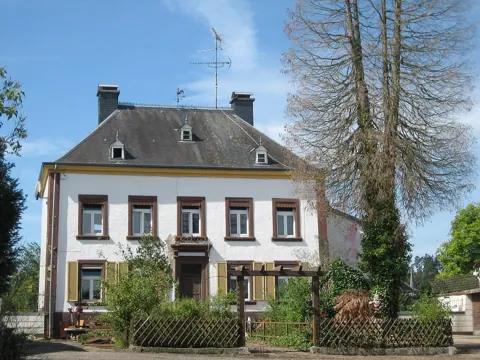





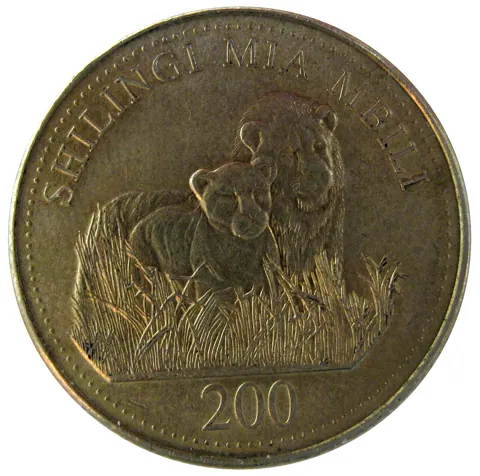



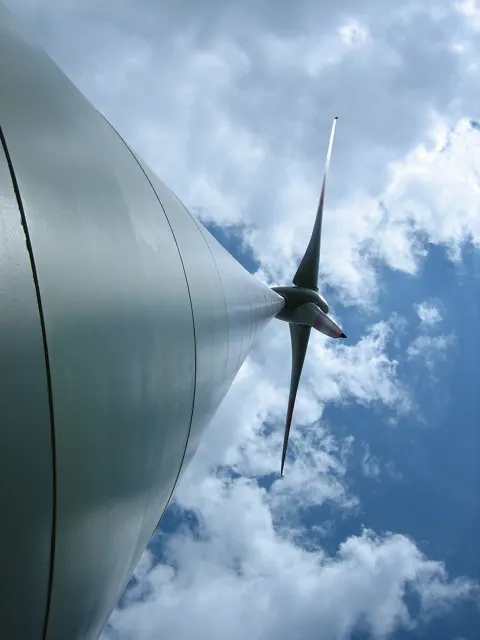



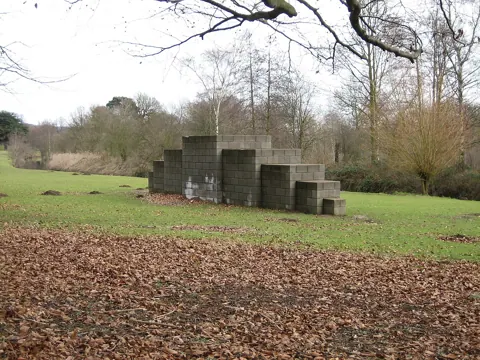

Photos taken with this camera, from Wikimedia Commons, credited under each picture.
On noise, Imaging Resource found ISO 200 quite usable for 8 by 10 prints and ISO 400 soft and grainy at that size, fine at 5 by 7.2 DPReview said ISO 50 was very clean, ISO 100 and 200 perfectly usable, and ISO 400 visibly noisy but no worse than most rivals.4
The flash split them too. DPReview called the built-in flash fantastic in its tests and fast even with red-eye reduction, though it also called it a little under-powered; the quoted range is 3.5 m at wide angle.14 Imaging Resource found it overexposed close-ups badly in macro and advised external lighting for the closest shots.2
On eBay right now
Live listings for this camera, supplied by eBay and updated automatically. We earn a commission if you buy through them.
The little wins
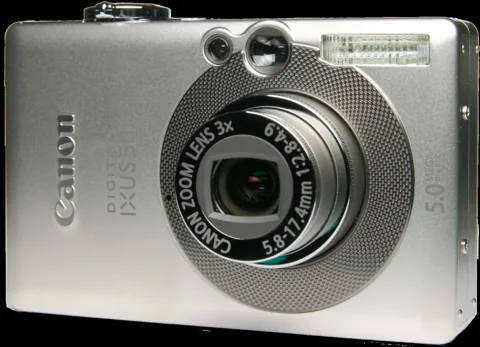 The IXUS 50 from the front. · Andreas Frank (edited by Opspin) · CC BY-SA 2.5 · Commons
Fast frame rate video
Besides 640 by 480 at 30 fps, a Fast Frame Rate mode shot 320 by 240 at 60 fps for up to a minute.14 Imaging Resource said the movie mode went well beyond what it usually saw on subcompacts, and DPReview called it excellent, though it counted nearly 2 MB per second of video at the best setting.24
A custom self-timer
The custom timer could wait up to 30 seconds and then take up to ten pictures about a second apart, which Imaging Resource thought useful for group shots.2
Panorama help
Stitch Assist let you shoot up to 26 frames in a row, showing part of the last frame beside the live view so you could line up the overlap.2
A light for focusing in the dark
DPReview found the AF illuminator could focus in near-total darkness out to about 1.0 m, and in low light out to about 1.8 m.4
Where it let you down
DPReview's cons were some purple fringing, edge softness at wide angle, battery life with the screen on, no exposure information in record or playback, and very little manual control.4 Imaging Resource's list added a slightly high contrast, limited highlight dynamic range and a soft-looking image on the screen.2 DPReview found automatic white balance gave a fairly strong orange cast under incandescent light, and said Canon told them the warmth was intentional; its chart rated that result poor.4
The reviewers also disagreed about close-ups. DPReview measured a wide-angle macro area of 55 by 41 mm, while Imaging Resource measured 25 by 18 mm; both liked the very short focusing distance of 3 cm at wide angle.42 They also differed on bursts. Imaging Resource got six full-size frames at about 2.1 fps,2 while DPReview, using a 1 GB SanDisk Extreme III card, measured about 2.3 fps and could not fill the buffer even after 50 or 60 shots.4
What the reviewers said in 2005
| Outlet | Date | Verdict |
|---|---|---|
| Imaging Resource | 22 Jun 2005 | A very nice little camera and a good value, though softer in the corners than the SD500; named another Dave's Pick for Canon.3 |
| DPReview | 11 Aug 2005 (as printed) | Sharp, clean and colorful images with minimum fuss, near the top of the 5-megapixel ultra-compacts; it missed its top award because of the missing shutter-speed information and the minor edge softness and fringing.4 |
We found two full contemporary reviews. Canon's page is a launch text and specification sheet, not a test.
The timeline
- October 2004Canon launches the IXY Digital 50, the design the SD400 inherits.1
- February 2005DPReview says the SD400 was announced.4
- March 2005Canon's museum lists it as marketed.1
- 22 June 2005Imaging Resource publishes its review.23
- 11 August 2005The date printed on DPReview's review.4
Should you buy one now?
Buy one if you want a very small, solid, quick 2005 compact with a real optical viewfinder, and can live with 5 megapixels, no exposure information and a camera that is now more than twenty years old. It launched at about $400;2 what it sells for today is a question for the sold listings, not for us. Before you bid, check these:
- The name. Search the Digital IXUS 50 and IXY Digital 55 as well as the SD400.1
- The battery. It uses an NB-4L,1 and both reviewers quote about 150 shots with the screen on, so a fresh battery is worth having: Amazon ↗.
- The card. Canon's specification names SD cards only.1 We have not tested larger cards in this model.
- The finish. Imaging Resource warned the silver finish scratches, so a case helps.2
- The battery door. DPReview called the hinged door on the base one of the few plastic parts and slightly flimsy.4
- The focus. DPReview advised turning the nine-point AiAF off in favor of the center point.4
- The lens. Check that it extends and retracts cleanly.
If you are wondering why cameras like this are being hunted down again, we tell that story once, in Pictures that never left the card.
See recent sold prices on eBay ↗Shop on eBay ↗NB-4L battery ↗
Source conflicts
Where sources disagree we show both. Weight: Canon lists about 130 g for the camera body only,1 Imaging Resource 151 g without battery and card,2 DPReview about 150 g fully loaded;4 we cannot explain the gap between the first two. Price: $399.99 suggested versus a $370 street price, which are different kinds of number.24
Sources
- Canon Camera Museum: IXY DIGITAL 55 / PowerShot SD400 DIGITAL ELPH / DIGITAL IXUS 50 (launch text, specifications, marketing date)
- Imaging Resource, Canon PowerShot SD400 Digital ELPH review by Dave Etchells (review date 22 Jun 2005)
- Imaging Resource, “Canon PowerShot SD400 review posted” by Dave Etchells (22 Jun 2005)
- DPReview, Canon PowerShot SD400 Digital ELPH / Digital IXUS 50 review by Simon Joinson (date printed on the page: 11 Aug 2005)
Camera photos by Duke of W4 (CC BY-SA 3.0) and Andreas Frank, edited by Opspin (CC BY-SA 2.5); sample photographs are credited under each one, all via Wikimedia Commons. Links to eBay and Amazon are affiliate links.