Canon PowerShot ELPH · marketed May 2001
The Canon PowerShot S110 Digital ELPH (Digital IXUS v): the 2001 steel ELPH that learned to film
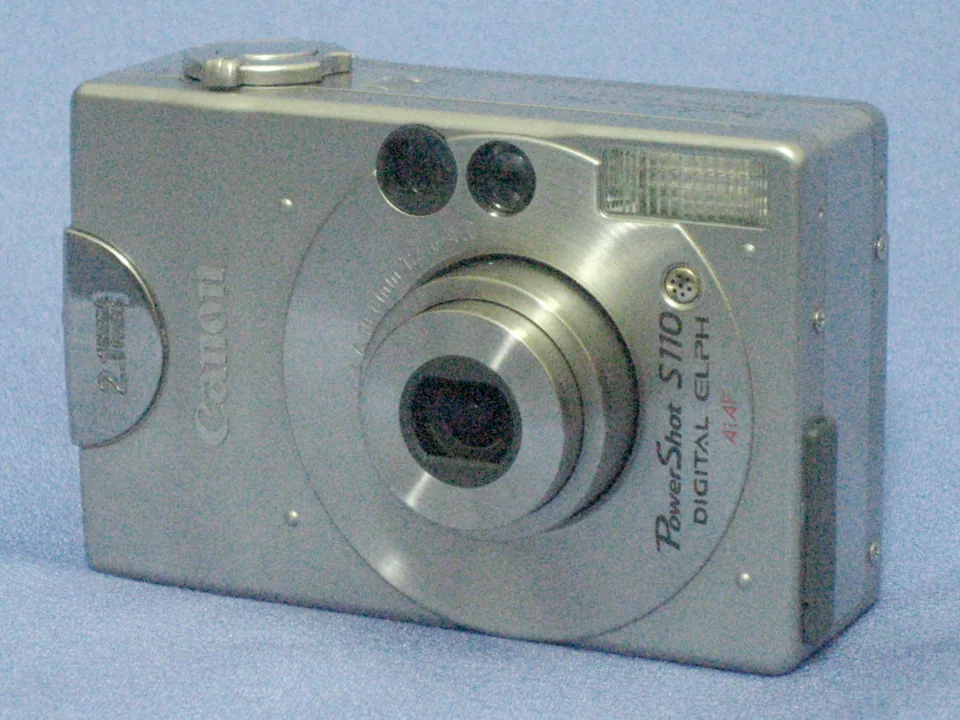
Canon's first digital ELPH had a successor whose only visible change was a small gold microphone. Inside came movie clips with sound, printing straight to a card printer and a new image processor. Imaging Resource and DPReview both liked the steel body and the colour. They split on the lens corners, the distortion figure, the burst speed and the flash.
- Launched
- May 2001
- Sensor
- 2.11 MP CCD
- Lens
- 35–70 mm, 2×
- Card
- CompactFlash
- Battery
- NB-1L
Canon PowerShot S110 Digital ELPH specs: sensor, lens, battery, memory card and cable
The Canon PowerShot S110 Digital ELPH (also sold as the Digital IXUS v and IXY Digital 200) came out in May 2001 at $599 as a 2.11 MP CCD compact with a 35–70 mm (35 mm equivalent) 2× zoom lens. It takes CompactFlash cards and runs on the NB-1L battery. Sources
- Sensor
- CCD, 1/2.7", 2.11 MP source
- Lens
- 35–70 mm equivalent, 2× zoom source
- Memory card
- CompactFlash source
- Battery
- NB-1L source
- Also sold as
- Digital IXUS v · IXY Digital 200
- USB / A/V cable
- See our Canon cable page
Meet the camera
One camera, three names. Canon's museum lists the IXY Digital 200 in Japan, the PowerShot S110 Digital ELPH in the Americas and the Digital IXUS v in Europe, Asia and Oceania, marketed in May 2001.1 It is not the PowerShot S110 of 2012, which shares only the model number and has a review of its own. Imaging Resource, announcing the camera on 10 May 2001, called it an update to the existing S100 and said the tiny gold microphone on the front was about the only visible difference, other than the model number.3 DPReview's Phil Askey said the same: the only visual difference from the year-old Digital IXUS was that microphone.5 The S100 it replaced, introduced in spring 2000, was in Imaging Resource's words the first digital member of the Canon ELPH family.4
The prices come in three kinds. Canon Japan's museum gives an original price of 72,000 yen.1 Imaging Resource said the US camera would ship in June 2001 at a recommended $599,3 and repeated $599 as the list price at introduction in its review.4 DPReview's table prints a US$800 street price and lists price among the cons.5
- Lens
- 2x, 5.4–10.8 mm (35–70 mm equiv.), f/2.8–4.0 (one Imaging Resource page prints f/4.8 at telephoto; Canon, DPReview and the rest of Imaging Resource say f/4.0)154
- ISO
- 100, raised to 150 in low light1
- Video
- Motion JPEG with mono sound, about 20 fps; Canon lists 640 × 480 for about 4 s, 320 × 240 for 10 s, 160 × 120 for 30 s1
- Battery
- NB-1L lithium-ion1
Why this one was interesting
The same body, with a new engine
Imaging Resource's list of changes from the S100 is short and almost all of it sits inside the case: AVI Motion JPEG movies with sound, direct printing to Canon's CP-10 card printer, noise reduction on slow exposures, an extra 1,024 × 768 size, a new image processor and 15 grams more weight, at 190 g without battery. The outside dimensions stayed exactly as they were, and the digital zoom fell from 2x/4x to 2.5x.3 Canon's museum text adds a primary-colour filter and a claimed 40 percent cut in power use against the predecessor, enough for about 120 pictures with the screen on.1 Imaging Resource called the S110 similar in design and image quality to the 3x-zoom S300 shown in February 2001, which was 35 percent bigger by volume, 27 percent heavier and $100 dearer.43
Video, with limits written into the manual
Movies were the headline. Canon lists 20 frames a second with sound and clip limits of about 4 seconds at 640 × 480, 10 at 320 × 240 and 30 at 160 × 120.1 Imaging Resource measured about 6, 15 and 30 seconds, noting that zoom froze once a clip began.4 DPReview got 7 to 15 seconds at 640 × 480, wished for clips longer than 30 seconds, and thought the full-size clips looked like an enlarged 320 × 240.5 The Digital Camera Resource Page repeated Canon's four seconds at 640 × 480, called that size almost useless and noted that zoom could not be used while recording; it also said the camera has no speaker, so clips played back without sound.6 The sources do not agree on clip length.
Quicker than its size suggested
Imaging Resource and DPReview called the camera fast, on different clocks. Imaging Resource clocked 0.64 seconds of shutter lag with full autofocus, 0.063 seconds when the shutter was half-pressed first, and 4.65 seconds from power-on to the first picture.4 DPReview measured a total lag of 0.7 to 1.5 seconds, 3.5 seconds from off to a taken shot and 1.6 seconds shot to shot at the top quality.5 On burst they disagree: Canon says about 2.5 frames a second, DPReview counted 2.0 and called that double the original camera, and Imaging Resource saw roughly 1.1 to 1.5 and said it never came near the manual's figure.154 The Digital Camera Resource Page said it started in just under three seconds, noted a bit of focus and shutter lag and put shot-to-shot time at about three seconds, competitive with most other two-megapixel cameras.6
How it drew the picture
On the lens the two reviewers pull in opposite directions. Imaging Resource found better-than-average corner sharpness, very little colour fringing and 0.48 percent barrel distortion at wide angle, with none at telephoto, a surprisingly good result for such a small lens.4 DPReview measured about 1.1 percent barrel distortion at wide angle and called the lens a little soft in the corners at times, with left-side softness on its unit; fringing was almost absent, but it saw blooming around bright highlights.5 On DPReview's resolution chart the camera held about 830 lines per picture height before aliasing, against 850 for the PowerShot S10 and 750 for the Nikon Coolpix 950 in the same test.5
Colour was the draw. DPReview said Canon had carried work from the IXUS 300, A10 and A20 into this camera: vibrant but not oversaturated, though blues came out pale. Automatic white balance worked well only in natural light (it left a slight blue cast on the daylight colour chart) while the presets worked.5 Imaging Resource's conclusion named excellent colour saturation and resolution, with some limits in low light. In the body of its review the assist lamp worked very well and slow-exposure noise stayed very low, but the one-second longest shutter meant nothing darker than about one foot-candle (11 lux, roughly street lighting) could be recorded.4









Photos taken with this camera, from Wikimedia Commons, credited under each picture. The Commons files record the camera as “Canon PowerShot S110” (the Japanese and European names on a few), the same string the 2012 camera uses, so we kept only 1,600 × 1,200 pictures from 2002 to 2007 whose lens settings sit inside this camera's 5.4–10.8 mm range. The Kobe shrine picture was taken with the flash.
Slow shutter, small light
Three of the pictures below were shot at slow speeds, which the file data records: 1/6 second for a commuter train in a station, 1/10 second for wine glasses on a restaurant table and 1/8 second for a museum case. The files carry no ISO value; Canon's own sheet gives ISO 100, rising to 150 in low light.1




On eBay right now
Live listings for this camera, supplied by eBay and updated automatically. We earn a commission if you buy through them.
The little wins
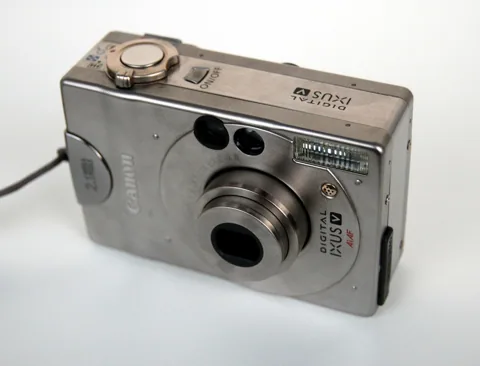 The camera from the front-left. · J-P Kärnä · CC BY-SA 3.0 · Commons

A screen you could trust
DPReview thought the 1.5-inch screen carried probably the best anti-reflective coating it had seen on an LCD, bright and sharp enough to be more useful than many bigger ones, which mattered because the optical finder had no dioptre adjustment or parallax marks.5 Imaging Resource put the finder at 77 to 82 percent of the frame and the screen at 98 percent.4
Stitch Assist
The panorama mode showed the last quarter of the previous frame to help line up the next, and locked exposure and white balance to the first shot. DPReview built a 4,452 × 1,037 panorama from five frames, using third-party software, and wished for vertical and square modes.5 Imaging Resource counted up to 26 frames in a set.4
Pre-focus and the lamp
Half-pressing the shutter first dropped the lag to 0.063 seconds, which Imaging Resource called incredibly fast; DPReview said the assist lamp let the camera focus in near-darkness up to about 5 metres.45 The lamp could not be switched off.5
Fixed skin tones
DPReview praised Canon for fixing the blue cast the original Digital IXUS flash gave skin: tones on the IXUS v were warmer and more accurate.5
Where it let you down
Flash divided the reviewers. DPReview called it underpowered for wide-angle subjects and said it could not cover the frame at 2 metres.5 Imaging Resource found it throttled down well for macro shots and seemed to reach a bit further than Canon's 6.6-foot telephoto rating, doing pretty well out to about 8 feet.4 On battery life the two tests land close together. Canon's claim was about 120 pictures with the screen on.1 Imaging Resource, which could not measure power draw directly, ran the camera continuously and got 60 minutes in capture mode with the screen lit, and judged Canon's own estimates fairly conservative; DPReview got about an hour and a little over 90 frames before the warning icon began flashing. Both advised a spare pack, and Imaging Resource disliked that the camera showed no battery gauge until the charge was very low.45
Controls were thin. Shutter speed, aperture and ISO ran automatically and were not shown on screen, which Imaging Resource said it missed.4 Exposure compensation and white balance appeared only in Manual record mode, and Imaging Resource called the menu somewhat quirky to navigate.45 DPReview found that the digital zoom could not be turned off, put the tripod socket almost on the right edge of the base (fine for a small tabletop tripod, it said, not for anything serious) and said the macro mode should really be named “a little closer”, filling the frame at about 9 cm across at best.5 Build earned praise: both liked the stainless steel, though the plastic CompactFlash door looked the most fragile part to Imaging Resource, which judged the hinge long enough to be reliable, and DPReview said the way the single USB and AV connector was protected spoiled the clean lines.45
What the reviewers said in 2001
| Outlet | Date | Verdict |
|---|---|---|
| DPReview | 9 May 2001 | “Above Average.” Ratings out of 10: construction 9.5, features 7, image quality 8, lens/CCD combination 7.5, ease of use 7, value for money 6. Ultimately pocketable and capable of excellent pictures; its worry was Canon's own IXUS 300 and PowerShot A20, which both had 3x zoom, and it suggested the A20 for anyone on a budget who did not need movie clips.5 |
| Imaging Resource | 24 May 2001 | An excellent option for novice to advanced photographers who want to go digital with class, with excellent colour saturation and resolution and a lens that appeared excellent. It listed limits in low-light shooting. At $599 it expected the camera to find many happy homes.4 |
| Digital Camera Resource Page (Jeff Keller) | 23 June 2001 | No score. A slightly upgraded S100, with movie mode, better colour reproduction and faster shutter speeds. It said the camera “isn't going to make current S100 owners run out and upgrade” but deserved a close look from anyone shopping for a very small, capable point-and-shoot. Liked: looks and portability, photo quality, processing speed, movie mode with sound, the bundle and an available underwater case. Disliked: price for 2 megapixels, movie clips too short with no zoom, no manual controls.6 |
The timeline
- May 2000Canon markets the S100 Digital ELPH (IXY Digital in Japan), for 74,800 yen at home.2
- February 2001The 3x-zoom S300 appears at the Photo Marketing Association show in Orlando.4
- May 2001Canon's museum lists the IXY Digital 200 / PowerShot S110 Digital ELPH / Digital IXUS v as marketed.1
- 9 May 2001DPReview publishes its review.5
- 10 May 2001Imaging Resource announces the S110 and says it will ship in the US in June at $599.3
- 13 May 2001Steve's Digicams posts its page on the camera.7
- 24 May 2001Imaging Resource's review is first posted.4
- 23 June 2001The Digital Camera Resource Page posts its review.6
A later ELPH in the same line, the Digital IXUS v3, is told in our PowerShot S230 retrospective.
Should you buy one now?
Buy one if you want a very small steel-bodied digicam with a real viewfinder and daylight colour that two 2001 reviewers liked, and you accept a 2-megapixel sensor, a 2x lens, little manual control and a flash DPReview found weak at wide angle. It launched at $599;3 what it sells for now is a question for the sold listings, not for us. Before you bid, check these:
- Which camera it is. The year-old S100 looked the same apart from the microphone and the model name; the 2012 PowerShot S110 is a different camera altogether.35 Search the three names: S110 Digital ELPH, Digital IXUS v and IXY Digital 200.1
- The battery. It takes an NB-1L,1 and both reviewers advised a spare in 2001.45 NB-1L on Amazon ↗. We have not tested what a pack of that age holds today.
- The card. CompactFlash Type I only; DPReview says the camera has no support for Type II and so no IBM Microdrive.5 Imaging Resource listed cards up to 320 MB at the time;4 we have not confirmed a larger maximum. See our CompactFlash page, or search cards on Amazon ↗.
- The moving parts. Open the plastic CF door, which Imaging Resource thought the most fragile part, and check the port flap.45 DPReview timed about 1.5 seconds for the lens to extend and said the power button needs a hold (two seconds in its text, 1.2 in its timing note);5 the lens should run out and back without a catch.
- Getting pictures off. Imaging Resource used the supplied USB cable on an aging 350 MHz Pentium II PC, where Canon's driver acted as a TWAIN driver and did not mount the camera as a disk.4 Steve's Digicams' list of what Canon supplied names the USB cable as IFC-200PCU and the AV cable as AVC-DC200.7 We have not tried a modern computer; a USB CompactFlash card reader is the simpler route, which is our own suggestion and untested.
If you are wondering why cameras like this are being hunted down again, we tell that story once, in Pictures that never left the card.
See recent sold prices on eBay ↗Shop on eBay ↗NB-1L battery ↗
Sources
- Canon Camera Museum: PowerShot S110 DIGITAL ELPH (IXY DIGITAL 200 / Digital IXUS v): names, marketing date, original price in Japan, specifications
- Canon Camera Museum: PowerShot S100 DIGITAL ELPH (IXY DIGITAL / Digital IXUS): marketing date, original price in Japan
- Imaging Resource, Canon announces PowerShot S110 Digital ELPH! by Mike Tomkins (10 May 2001): changes from the S100, US price and shipping date, competitors
- Imaging Resource, Canon PowerShot S110 Digital Camera Review (12 pages, first posted 24 May 2001; no byline on the pages we read; its Test Results page says analysis was still to come; its Optics page prints a telephoto aperture of f/4.8 while its other pages say f/4.0)
- DPReview, Canon Digital IXUS v (S110 Digital Elph) Review by Phil Askey (published 9 May 2001; one long page with specifications, timings, test charts and ratings)
- Digital Camera Resource Page, Review: Canon PowerShot S110 Digital ELPH by Jeff Keller (posted 23 June 2001, last updated 23 January 2002; read in the Internet Archive's October 2014 copy because the original page is gone)
- Steve's Digicams, Canon Powershot S110 Review (posted 13 May 2001; largely Canon's launch text and specification sheet plus a package list; read in the Internet Archive's July 2022 copy)
Camera photos by J-P Kärnä (CC BY-SA 3.0) and David Gerard (CC BY-SA 3.0, author assumed by Commons); sample photographs are credited under each one, all via Wikimedia Commons. Links to eBay and Amazon are affiliate links.