Canon PowerShot G · on sale autumn 2010
The Canon PowerShot G12: the dial-covered flagship, squeezed from both sides
Sold under the same name in the Americas, Europe and Japan.6
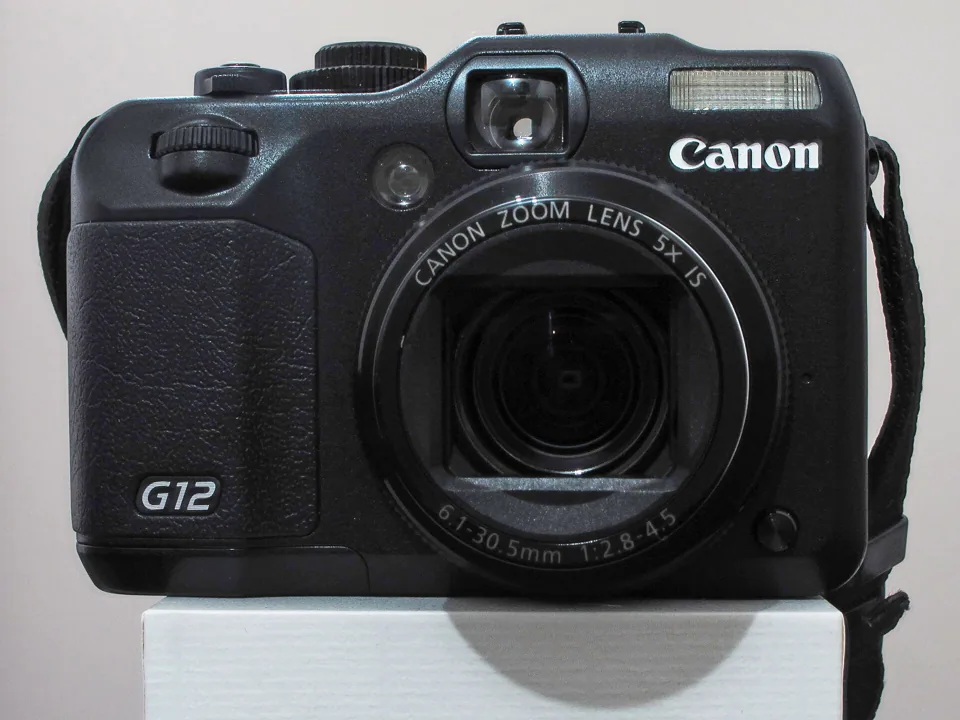
In 2010 Canon kept the G11's 10-megapixel CCD and added a front dial, 720p video and an in-camera HDR mode. Reviewers praised the handling, then pointed out that Canon's own S95 was smaller and the new mirrorless cameras had bigger sensors.
Canon PowerShot G12 specs: sensor, lens, battery, memory card and cable
The Canon PowerShot G12 came out in October 2010 at $499.99 as a 10 MP CCD compact with a 28–140 mm (35 mm equivalent) 5× zoom lens. It runs on the NB-7L battery. Sources
- Sensor
- CCD, 1/1.7", 10 MP source
- Lens
- 28–140 mm equivalent, 5× zoom source
- Memory card
- SDXC, SDHC, SD, MultiMediaCard source
- Battery
- NB-7L source
- USB / A/V cable
- IFC-400PCU, AVC-DC400ST Confirmed · all Canon cables
Meet the camera
It is a block of a camera. Canon gives 112.1 by 76.2 by 48.3 millimetres and about 351 grams without battery and card, 401 with them.6 PhotographyBLOG said it will not fit a trouser or shirt pocket, though a deep coat pocket will do.1 Imaging Resource's reviewer carried it in a jacket pocket and felt the weight pull the jacket down, yet found the Micro Four Thirds Olympus E-PL1 beside it the bigger and heavier camera.2 Cameralabs disagreed in part: it listed the E-PL1 body at 343 grams, called the two roughly the same size and the E-PL1 with a zoom lens not much heavier, and said the G12 is bigger and heavier than many mirrorless cameras fitted with their smallest prime lenses.3 DPReview put it 4 grams lighter than the G11.5
Canon's announcement, reported by TechCrunch on 14 September 2010, gave an estimated selling price of $499.99 and early October availability; Cameralabs also dates the announcement to September.73 PhotographyBLOG printed £539, €649 and $499.99, and Imaging Resource said US sales began in early October at a list price of about $500, the same as the G11's.12 DPReview's January 2011 specification table showed a street price of $565 in the US and £539 in the UK.5 Canon's museum gives October 2010 as the marketing month.6
Not every outlet agrees with Canon on the basics: TechRadar's review gives the screen as 3 inches and the ISO range as 100 to 3200, where Canon lists a 2.8-inch screen and ISO 80 to 3200.46
Why this one was interesting
A front dial, at last
DPReview's section on the front control dial begins by calling it the only significant ergonomic difference from the G11.5 It sits under the shutter finger and, in Manual mode, lets one dial set the aperture and the other the shutter speed, as on an EOS body; the reviewers disagree about which dial does which, and the camera lets you reassign them.342 PhotographyBLOG said the dial, together with the rear ring, makes the G12 as near to a DSLR as they had experienced on a compact, and that anyone who shoots a lot in Manual would find it alone worth the upgrade.1 The ISO dial also moved to third-of-a-stop steps.32
Video that stopped being an embarrassment
The G11 recorded 640 by 480 with mono sound; the G12 records 1280 by 720 at 24 frames a second with stereo microphones either side of the hot shoe.51 Cameralabs had called standard-definition video unforgivable on a premium compact in 2009 and the upgrade essential, and PhotographyBLOG felt the G11 should have had it a year earlier.31 In a clip with bright reflections on water, Cameralabs saw none of the vertical streaks that plague many CCD compacts, and suggested the larger-than-usual sensor might help.3
Small tools for careful photographers
The new list is long: a three-shot HDR scene mode that needs a tripod, an electronic level, hybrid stabilisation, tracking autofocus, five aspect ratios, a filter adapter for 58 mm filters, and separate highlight and shadow correction in place of the G11's i-Contrast.132 PhotographyBLOG put most of it in the nice-to-have column, and Imaging Resource called the G12 more a refinement than a revision that improves on the G11 without a step backward.12 The camera it replaced is covered in our PowerShot G11 retrospective; the G9 before that is here.
What it still did not do
Every reviewer who filmed with it hit the same wall: the optical zoom does not work while recording, and only a digital zoom is available.1342 TechRadar and Cameralabs also found no manual exposure control in movie mode, and DPReview listed the missing movie button.435 Bursts are the other weak spot: Cameralabs timed 50 full-size JPEGs in 24.72 seconds, about 2 frames a second, twice the G11's rate but still too slow for action, and Imaging Resource measured 1.97.32 The new aspect ratios are crops of the 4:3 frame, nothing you cannot do on a computer, said Cameralabs, and battery life slipped on paper from the G11's 390 shots to 370.316
The dark: its weak point
The reviewers describe the same curve and put the cliff at different places. PhotographyBLOG found no visible noise from ISO 80 to 400, some noise and a little desaturation at ISO 800, and a usable ISO 1600, with ISO 3200 not suffering too badly.1 Imaging Resource saw good detail up to ISO 200, smudging from 400 and chroma noise in dark areas from 800; its print guide gave 13 by 19 inches at ISO 200, 11 by 14 at 400, 8 by 10 at 800 and 4 by 6 at ISO 3200, which it called quite good.2 Cameralabs thought ISO 400 fair and 800 acceptable at a push, and likened the full-size ISO 3200 frame to a painting caught in a shower.3 TechRadar still called it a superb low-light camera although its test images softened noticeably after ISO 800, and DPReview scored low-light performance 8.3 out of 10.45



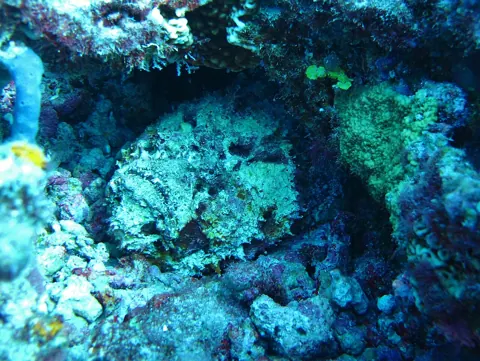
Real photographs taken with this camera. The sensitivity shown is recorded in each file's EXIF data; none is at the 1824 by 1368 size that Low Light mode produces.
Against bigger sensors the verdict was harsher. Cameralabs shot the same scenes with the G12 and an Olympus E-PL1 and found the Olympus cleaner from ISO 100 up, while finding at base ISO no detail advantage for the larger sensor and preferring the G12's natural processing.3 TechRadar said there was precious little difference between its test images from ISO 100 to 800, and called the G12 roughly on par with more expensive cameras such as the E-PL1.4 Cameralabs also warned that in full Auto the camera likes high sensitivities even in bright light, and suggested lowering the Auto ISO limit from its 1600 default to 400.3
Like that look? See recent eBay sold listings for this camera ↗
On eBay right now
Live listings for this camera, supplied by eBay and updated automatically. We earn a commission if you buy through them.
The little wins
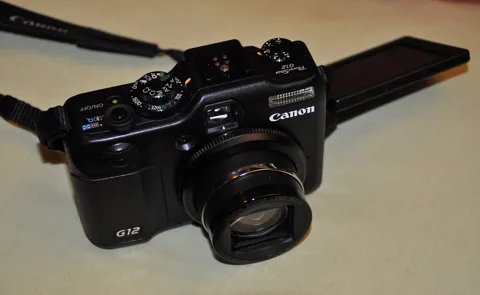 The G12 with its screen swung out from the body. · Speculos · CC BY-SA 3.0 · Commons
The dials
Cameralabs counted three dials on top alone, found them stiff enough to stay put in a pocket and easy to turn in gloves, and called the camera arguably the best compact for physical controls; the shortcut button can take any of 19 functions.3 Imaging Resource, by contrast, found the controls stiff and rough, and its reviewer admits twice failing to find the exposure-compensation dial that was in plain sight.2
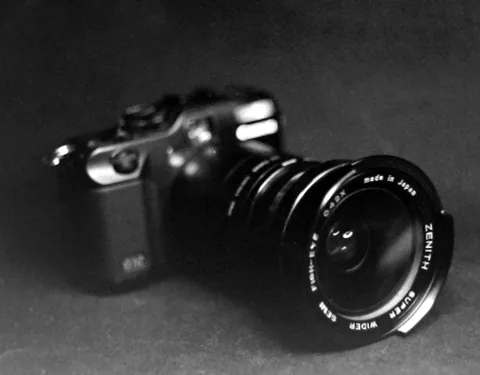 A G12 with a fisheye converter fitted to the 58 mm adapter. · Gerry Lauzon · CC BY 2.0 · Commons
Filters and a 40 metre housing
The FA-DC58B adapter lets the G12 use ordinary 58 mm filters, and it travels with the lens as it zooms; Cameralabs said there is also a built-in three-stop neutral-density filter and a WP-DC34 underwater case rated to 40 metres.3
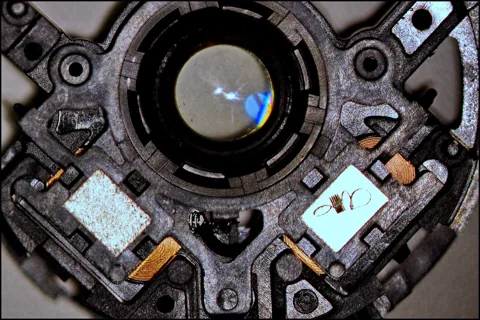 The lens-shift stabiliser module from a taken-apart G12. · Mark Turnauckas · CC BY 2.0 · Commons
A stabiliser, measured two ways
Canon claims four stops.1 Cameralabs's consistent test at 140 mm gave two, 1/20 second stabilised against 1/80 without, though one frame at half a second came out almost sharp.3 Imaging Resource called it excellent and PhotographyBLOG's side-by-side crops at 1/5 and 1/4 second favoured the stabilised frames.21
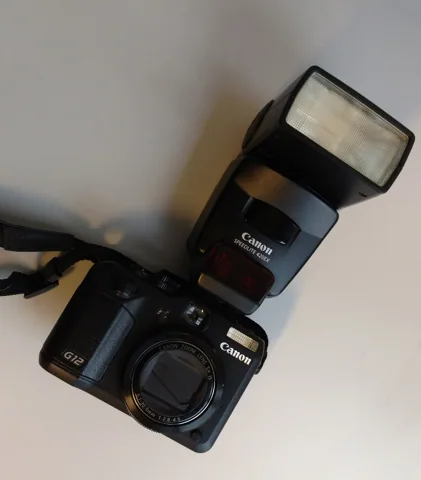 A Speedlite fitted to the G12's hot shoe. · Vera de Kok · CC BY-SA 4.0 · Commons
A real hot shoe
Cameralabs said the 220EX, 270EX, 430EX II and 580EX II give DSLR-style flash control on the camera, though the modest grip is awkward with a big flash.3 Canon also listed a ring light, a twin macro light and a high-power flash unit that attaches at the side.13
Inside one
A G12 owner in Ohio took their camera apart in 2013 and photographed the pieces; the pictures are on Commons under a free licence. The owner's note says carrying it unprotected in a pocket let lint and dust destroy it, and that the replacement lives in a plastic bag.8
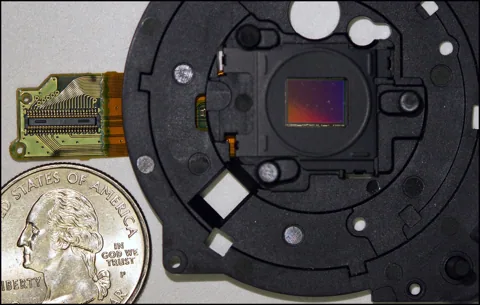
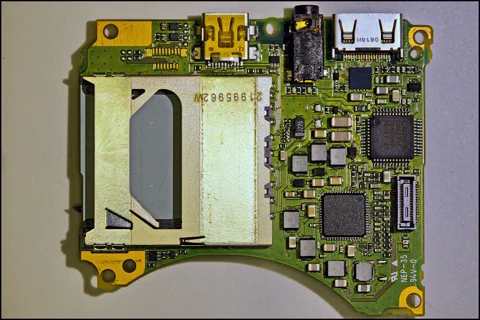
The descriptions come from the uploader's notes on each Commons page; the camera was the uploader's own.
How it drew the picture
PhotographyBLOG called image quality excellent, scored it 4.5 out of 5, and found files a little soft at the default sharpening.1 Imaging Resource's lab chart showed lines down to about 1,500 per picture height horizontally and 1,400 vertically, a barrel distortion of 0.9 per cent at the wide end, moderate chromatic aberration there, and some corner blur at wide angle.2 It found strong reds, greens, browns and blues mildly to moderately oversaturated while bright yellows, aqua and cyan ran a little muted.2 TechRadar found the lens sharp across its apertures and arguably better than the G11's at resisting purple fringing.4 Cameralabs could not recover a blown sky from the raw file of a test scene, whereas it said the Lumix LX5 had recovered a fair amount in an earlier test.3









Photos taken with this camera, from Wikimedia Commons, credited under each picture.
Where it let you down
Imaging Resource's list of cons reads as a handling checklist: awkward size, stiff controls, a small shutter button and zoom ring, no noise-reduction options, and autofocus slower than average at wide angle, timed at 0.66 seconds with full autofocus against 0.076 prefocused, plus 2.4 seconds between shots.2 The optical finder covers only about 77 to 79 per cent of the scene, Cameralabs and Imaging Resource both found, and TechRadar called it a mystery next to the screen; Cameralabs still valued it for sunlight and for stretching battery life to about 1,000 shots.324 PhotographyBLOG disliked that the full manual ships only on a CD, and DPReview that the rear dial can be tricky to turn precisely.15
The deeper complaint was position. Cameralabs said Canon's own S95 was smaller with a brighter lens, that Panasonic's LX5 was about a third lighter and around 15 per cent cheaper, and that the G12 was no longer much more pocketable than cameras with DSLR-sized sensors.3 PhotographyBLOG named Nikon's Coolpix P7000 as the most notable rival, noting that the G12 does not share the Nikon's painfully slow raw processing while the Nikon has an external microphone socket.1 TechRadar set it against a Canon 1000D DSLR, about £100 cheaper, which records better pictures up to ISO 1600 but has no HD video.4
What the reviewers said in 2010 and 2011
| Outlet | Date | Verdict |
|---|---|---|
| PhotographyBLOG | 27 Oct 2010 | Design 4.5, features 4.5, ease of use 4.5, image quality 4.5, value 3.5 out of 5. "Very easy to recommend", with the caveat that bigger-sensor cameras compete; it tipped the balance in the G12's favour for that year.1 |
| Imaging Resource | 17 Nov 2010 | 4.5 out of 5 and a Dave's Pick. "A pleasant compromise" rather than the slam dunk of earlier G-series flagships, squeezed by the S95 and by small mirrorless cameras, yet the best G-series PowerShot the reviewer had handled.2 |
| DPReview (Quick Review) | 19 Jan 2011 | 73 per cent. Build 9.0, low light 8.3, JPEG quality 7.7, flash 5.0, video 5.0, value 6.5 out of 10; for enthusiasts wanting maximum manual control, not for video users or anyone wanting something slim.5 |
| TechRadar | 29 Jul 2011 (page date) | If you are set on a compact, the G12 is just about the best you can buy; keen photographers should consider a DSLR instead.4 |
| Cameralabs | 14 Dec 2011 (page date; written as a 2010 review) | 87 per cent overall; build, image quality, handling and specification 18 out of 20 each, value 15, scored relative to 2010 enthusiast compacts. A delight to use that "misses out on our top rating"; recommended to enthusiasts who understand the alternatives, with the market changing fast and the G12 looking increasingly uncomfortable.3 |
The timeline
- 14 September 2010Canon's release is reported: the G12 at an estimated $499.99, due in early October.7
- October 2010Canon's museum gives this as the marketing month; Imaging Resource said US sales began in early October.62
- 27 October 2010PhotographyBLOG publishes its review.1
- 17 November 2010Imaging Resource publishes its review.2
- 19 January 2011DPReview publishes its Quick Review.5
- October 2012Canon's museum lists the PowerShot G15 as the G12's successor, built around a new CMOS sensor.9
Should you buy one now?
Buy one if you want a heavy, dial-covered CCD compact with raw files, a hot shoe, a flip-out screen and the option to attach filters, and you can live with a slow burst, a viewfinder you will rarely use and video without optical zoom. It was listed at $499.99;7 what it sells for now is a question for the sold listings, not for us. We have not handled one. Before you bid, check these:
- The name. Canon used one name in every region, so one search covers it.6
- The battery. It uses an NB-7L, rated 7.4 volts and 1,050 mAh;2 a fresh one is on Amazon ↗.
- The card. It takes SD, SDHC, SDXC and MMC-family cards, and Imaging Resource says Class 4 or faster for video;62 see our memory card guide.
- The cables. In 2010 the box held a USB lead (IFC-400PCU) and an AV lead (AVC-DC400ST);2 see our Canon cable pages for which ones fit.
- Dust. One owner's teardown notes blame pocket lint for killing their first G12, so look for specks in the picture and inside the lens.8
- The screen and dials. Swing the screen through its full travel; spin every dial and check each clicks into place.
- The hot shoe and lens. Check that the shoe is intact if you want a flash, and that the lens extends and retracts cleanly.
If you are wondering why cameras like this are being hunted down again, we tell that story once, in Pictures that never left the card.
See recent sold prices on eBay ↗Shop on eBay ↗NB-7L battery ↗
Sources
- PhotographyBLOG, Canon PowerShot G12 review by Mark Goldstein (27 Oct 2010; all sections, conclusion, ratings and specification page read)
- Imaging Resource, Canon G12 review by Mike Pasini and Zig Weidelich, overview by Mike Tomkins (17 Nov 2010; user report, lab-test summary, pros and cons and conclusion read)
- Cameralabs, Canon PowerShot G12 review by Gordon Laing (all four pages read; the pages carry a 14 Dec 2011 date but the text is written as a 2010 launch review, 'announced in September 2010')
- TechRadar, Canon G12 review by Dave Stevenson (all five pages read; the page is dated 29 Jul 2011)
- DPReview, Canon Powershot G12 Quick Review by Barney Britton (19 Jan 2011; read in full in a browser: key-differences list, specification table, front-dial section, conclusion, pros and cons, scores and summary)
- Canon Camera Museum, PowerShot G12 (marketed October 2010; outline and specifications)
- TechCrunch, 'On Cue, Canon Releases Powershot G12' by John Biggs (14 Sep 2010; reprints Canon's description and estimated selling price)
- Wikimedia Commons, 'Exploded Canon G12' by Mark Turnauckas (2 Feb 2013; the uploader's own description of a taken-apart G12, CC BY 2.0)
- Canon Camera Museum, PowerShot G15 (marketed October 2012; described as the G12's successor)

Camera photos by KurtMervin (CC BY-SA 3.0), Speculos (CC BY-SA 3.0), Vera de Kok (CC BY-SA 4.0), Gerry Lauzon (CC BY 2.0) and Mark Turnauckas (CC BY 2.0); other photographs are credited under each one, all via Wikimedia Commons. Links to eBay and Amazon are affiliate links.