Canon PowerShot G · on sale autumn 2009
The Canon PowerShot G11: the serious compact that gave up four megapixels
Sold under the same name in the Americas, Europe and Japan.5
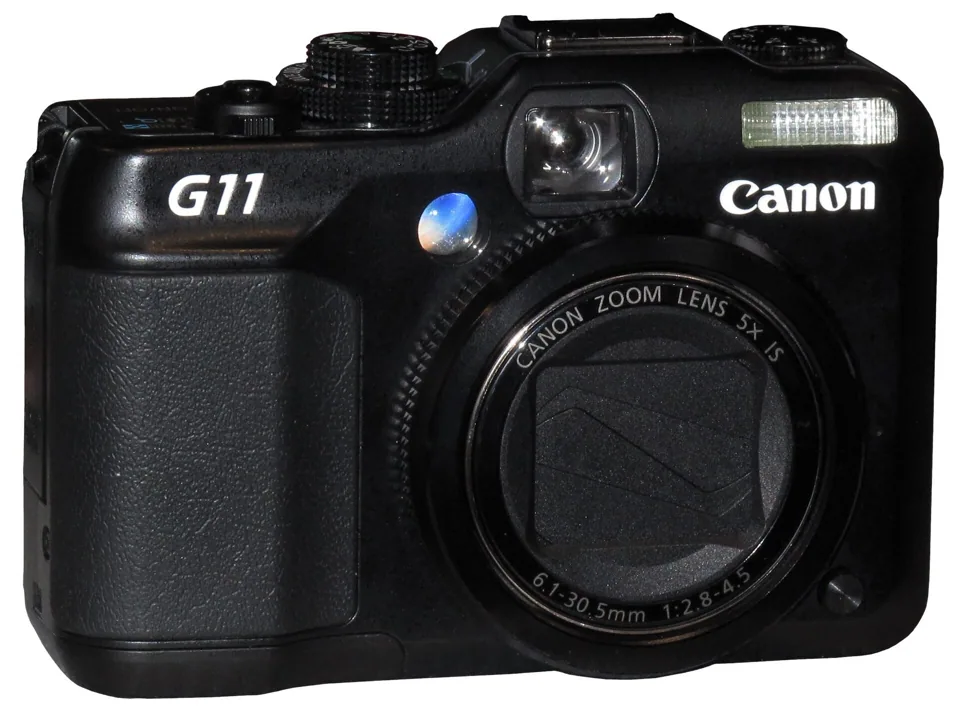
In 2009 Canon cut the G series from 14.7 to 10 megapixels, put a tilting, swivelling screen back on the back, and left the metal dials alone. Reviewers loved the handling, disagreed about the noise, and noticed that the video was still VGA.
- Launched
- October 2009
- Sensor
- 10 MP CCD
- Lens
- 28–140 mm, 5×
- Card
- SDHC, SD, MultiMediaCard
- Battery
- NB-7L
Canon PowerShot G11 specs: sensor, lens, battery, memory card and cable
The Canon PowerShot G11 is a 10 MP CCD compact camera with a 28–140 mm (35 mm equivalent) 5× zoom lens, launched in October 2009 at $499. It runs on the NB-7L battery. Sources
- Sensor
- CCD, 1/1.7", 10 MP source
- Lens
- 28–140 mm equivalent, 5× zoom source
- Memory card
- SDHC, SD, MultiMediaCard source
- Battery
- NB-7L source
- USB / A/V cable
- IFC-400PCU, AVC-DC400 Confirmed · all Canon cables
Meet the camera
The G11 looks like the G10, but DPReview pointed out that the rear panel is now plastic, with the same surface finish as before, and the camera weighs just 5 grams more than its predecessor despite the folding screen.1 Canon's figure for the body alone is about 355 grams, at 112.1 by 76.2 by 48.3 millimetres; Cameralabs gave 402 grams including the battery.54 PhotographyBLOG's advice was the usual one for this family: it is no shirt-pocket camera, but a deep winter coat will do.3
Canon announced it in London on 19 August 2009 and recommended $499, €589 and £569.2 PhotographyBLOG, reviewing it in October, printed $499.99 and £569 as well, but €659 for the euro price, so the sources disagree there.3 Ubergizmo expected it in October at $499, and Canon's museum gives October 2009 as the marketing month.65 DPReview's spec table, in a review dated 16 December 2009, listed a street price of $440 in the United States and £390 in Britain.1
Why this one was interesting
Fewer pixels, on purpose
Canon's pitch was a "Dual Anti-Noise System": a high-sensitivity sensor and DIGIC 4, claimed to improve noise by up to two stops over the G10.2 DPReview called the pixel cut possibly a first for the company and explained the logic: the larger photosites of a less dense chip collect more light in the same exposure.1 Cameralabs noted that the sensor matches the old G7 in size and resolution, that Canon insisted it was a new chip, and that the same sensor sits in the S90.4
The screen returns
The 2.8-inch panel is smaller than the G10's 3 inches but keeps the 461,000 dots and now tilts and swivels.14 Cameralabs said it is the first flip-out screen on a G-series camera since the G6 of 2004, and objected only that the hinge stops short of a full 180 degrees, which feels awkward when looking down on the image.4 PhotographyBLOG enjoyed the unusual angles and the option of folding the screen inward for protection.3
A camera that pays attention
Cameralabs reported that scene detection arrived in Auto, shared with the SX20 IS, recognising backlit subjects, night scenes and motion as well as faces, and calling it effective in practice. Blink detection is also new, but works only on faces the camera has already found.4 A Quick Shot mode switches to the viewfinder and continuous focus for fast reactions.4 New against the G10 is an HDMI port.1
The family above and below it is reviewed here: the PowerShot G9 before, and the S90, S95 and G7 X after.
What was lost
DPReview's list of removals is short and specific: Superfine JPEG compression, voice annotation and tethered remote capture.1 Cameralabs added that the cunning Auto ISO shift of the G10 appears to be gone.4 The video stung most. It still tops out at standard definition, with no optical zoom while recording; PhotographyBLOG called that a missed opportunity beside an HDMI socket with nothing high-definition to send down it, and Cameralabs thought it unforgivable for a premium compact in 2009, adding that Canon blamed a technical limitation.34
Speed fared no better. Cameralabs measured 50 frames in 46 seconds, about 1.1 per second, slower than the G10, and 0.9 in raw; Canon lists about 2.4 per second in Low Light mode.45 DPReview measured 1.1 per second as well, and found the 1.5-second black screen after each shot made the camera feel slower than it is.1
The dark: its weak point
This is where the reviews diverge. DPReview found the G11 had the lowest noise across its test group, but said it got there through strong noise reduction that blurred fine detail: above ISO 400 little remains, by ISO 800 subtle detail is gone, and by 3200 everything is a vague mess.1 Its measured sensitivities ran about a third of a stop below the labels, at ISO 3200 reading roughly ISO 2500.1 Cameralabs agreed that the G11 gained about a stop over the G10 above ISO 200, called 400 acceptable, and said that from 800 up the quality suffers at 100 per cent; at 3200 it was "too compromised" to be of much use.4 PhotographyBLOG saw it the other way: at ISO 3200, it said, noise was low enough to be comparable with ISO 800 on most rivals.3
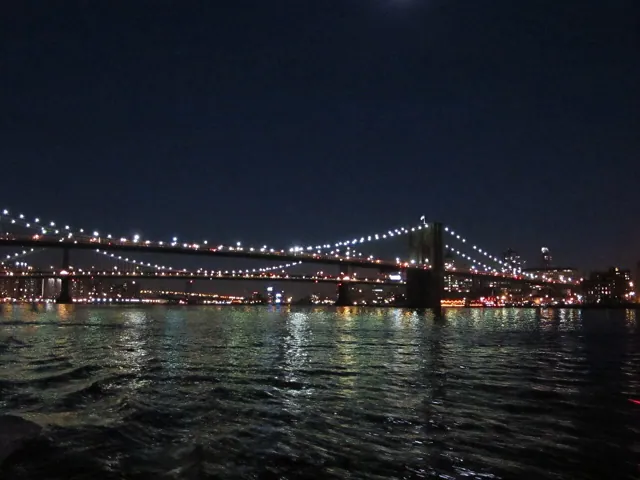

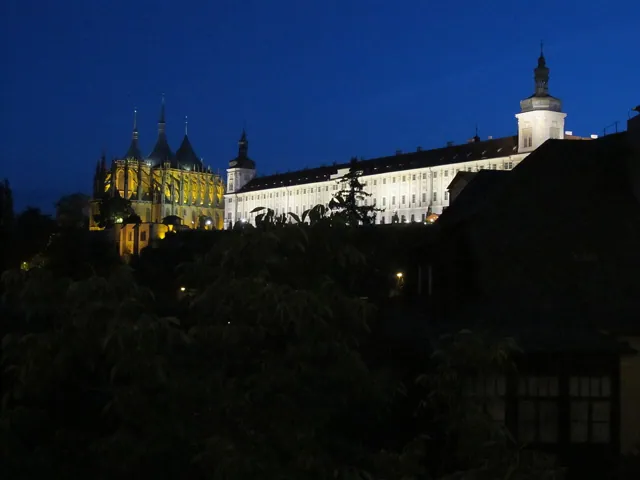
Real photographs taken with this camera. The sensitivity shown is recorded in each file's EXIF data. The two ISO 3200 waterfront files are 1824 by 1368 pixels, the 2.5 megapixel size Canon gives for Low Light mode; whether that mode was used is not recorded here.
The top of the range is the other disagreement. Low Light mode drops to 2.5 megapixels and goes to ISO 12,800; Cameralabs called it impressive for shooting without flash, with acceptable images when shrunk for email or the web, while PhotographyBLOG said detail was smeared into a watercolour effect.43 Set against the larger sensors of Olympus's E-P1 and Panasonic's GF1, Cameralabs found the G11 visibly poorer from ISO 800 upward.4
Like that look? See recent eBay sold listings for this camera ↗
On eBay right now
Live listings for this camera, supplied by eBay and updated automatically. We earn a commission if you buy through them.
The little wins
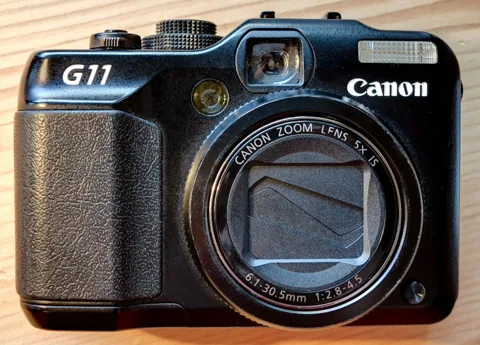 The front of the G11, showing the lens ring and grip. · Richard Huber · CC BY-SA 3.0 · Commons
The exposure dial
DPReview's favourite feature was the exposure-compensation dial on the top left, which it said sets the G11 apart from every other compact and speeds up shooting.1 Cameralabs found the two-tier mode and ISO dial easy to turn independently, even in gloves, and stiff enough to stay put in a pocket.4
A built-in ND filter
A three-stop neutral-density filter, switched on from the Function menu, lets you use long exposures or wide apertures in bright light without carrying a filter.4 PhotographyBLOG found it useful for preserving sky detail.3
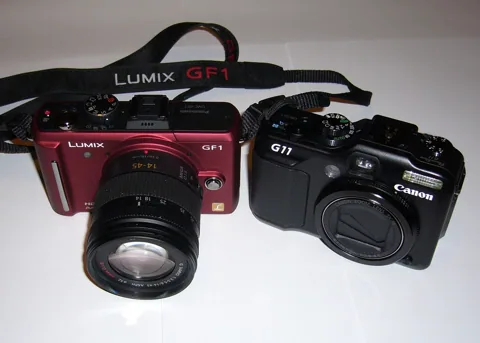 The G11 beside a Panasonic GF1, a camera reviewers compared it with. · Maurice Colyer · CC BY 2.0 · Commons
Macro to a centimetre
Canon and PhotographyBLOG give 1 centimetre at wide angle; DPReview noted soft frame edges and visible fringing at the closest distance, and that at that range the subject is hard to light.531
A stabiliser: three stops or four
Canon claimed four stops;3 DPReview measured about three, and almost four in continuous mode, with no blurred frames in continuous mode at or above 1/15 second at 140 millimetres,1 and Cameralabs got a nearly shake-free handheld frame at 1/8 second, which it also called four stops.4
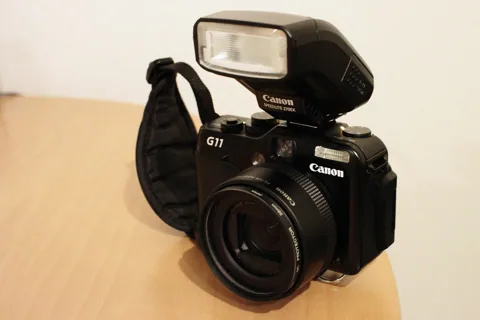 The G11 with a Speedlite fitted to its hot shoe. · MIKI Yoshihito · CC BY 2.0 · Commons
A real hot shoe
Speedlites such as the 270EX, 430EX II and 580EX II work with in-camera flash control like a Canon SLR, though Cameralabs found the small grip awkward with a big flash.4 A WP-DC34 housing takes the camera to 40 metres.42
How it drew the picture
DPReview called the G11's image quality among the best it had seen from a compact, and found low-ISO resolution a little below the G10's, but close enough that prints would need to be big to show it.1 Cameralabs reached a similar split: below ISO 200 the G10 resolves slightly more; above it the G11 wins.4 PhotographyBLOG found plenty of fine detail, natural colour, burnt-out skies at default settings and some barrel distortion at 28 millimetres; DPReview measured 1.3 per cent barrel distortion there, and chromatic aberration that it said can be visible in large prints, which PhotographyBLOG did not find troublesome.31 Cameralabs thought the default sharpening struck a good balance.4




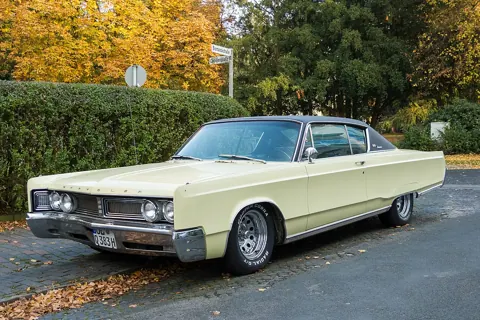

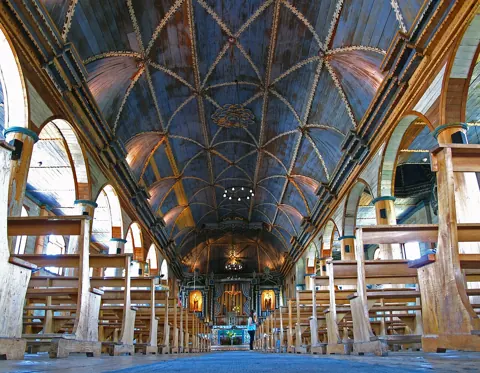



Photos taken with this camera, from Wikimedia Commons, credited under each picture.
Where it let you down
Handling complaints were about the edges of an otherwise liked design. DPReview disliked the manual-mode workflow, where the metering button doubles as the shutter-aperture toggle, and the battery door beside the tripod mount, which cannot be opened on a tripod.1 PhotographyBLOG disliked the unsupported thumb and the delete button where it rests, the manual that comes only on CD, and a shared card and battery compartment.3 The optical viewfinder shows about 77 per cent of the scene, small and inaccurate, but Cameralabs valued it for bright sun and for more than doubling battery life when the screen is off.54 DPReview timed half-press autofocus lag at 0.5 to 0.7 seconds at wide angle and 1.0 to 1.3 at telephoto, with 1.3 seconds to power up.1
The G11 also had rivals at both ends of the price list. Cameralabs said the S90 shares the G11's sensor and much of its control into a smaller body with a brighter f/2.0 lens, and "arguably" is the more compelling camera; the G11 still has the screen, hot shoe, viewfinder and longer zoom.4 Read our S90 review for that case.
What the reviewers said in 2009
| Outlet | Date | Verdict |
|---|---|---|
| PhotographyBLOG | 22 Oct 2009 | Design 4.5, features 4.5, ease of use 4, image quality 4.5, value 4 out of 5. Praised the solid build and the lens range; said it did not quite deserve "ultimate compact" given the new interchangeable-lens rivals, but that the G10 is the one to buy if resolution matters more.3 |
| Cameralabs | 16 Jun 2011 (page date) | 88 per cent: build 19, image quality 18, handling 16, specification 18, value 17, each out of 20, relative to 2009 compacts. Recommended if it fits the need, though most of its audience would be better served by Micro Four Thirds, the G10 or the S90.4 |
| DPReview | 16 Dec 2009 | Highly Recommended (just). Scores out of 10: build 9.0, ergonomics and handling 9.0, features 8.5, image quality 8.5, optics 9.0, performance 8.5, value 7.5. It found the GF1's sensor 5.6 times larger than the G11's.1 |
| CNET UK, as quoted by PhotographyBLOG | Undated | Excellent photograph quality and options, with the lower resolution paying off, but fat, heavy and expensive, with sluggish responses and an awkward main controller.3 |
The timeline
- 19 August 2009Canon announces the G11 in London, with $499, €589 and £569 recommended prices.2
- October 2009Marketing month per Canon's museum; Ubergizmo expected it in October.56
- 22 October 2009PhotographyBLOG publishes its review.3
- 16 December 2009DPReview publishes its review.1
- LaterCameralabs said the older G10 would stay on sale alongside it while stocks lasted.4
Should you buy one now?
Buy one if you want a weighty CCD compact with raw files, a hot shoe, a flip-out screen and real dials, and you can live with VGA video and one frame a second. It was listed at about $499;2 what it sells for now is a question for the sold listings, not for us. Before you bid, check these:
- The name. Canon sold it as the PowerShot G11 everywhere, so one search covers it.5
- The battery. It uses an NB-7L;5 a fresh one is on Amazon ↗.
- The card. It takes SD, SDHC and MMC cards;5 see our memory card guide.
- The screen. The hinge is the new part; swing it through its full travel and check the picture does not flicker.
- The back panel and dials. The rear panel is plastic;1 look for cracks around the hinge and dials that turn freely.
- The hot shoe. Check that it is intact if you plan to use a flash.
- The lens. Check that it extends and retracts cleanly.
If you are wondering why cameras like this are being hunted down again, we tell that story once, in Pictures that never left the card.
See recent sold prices on eBay ↗Shop on eBay ↗NB-7L battery ↗
Sources
- DPReview, Canon PowerShot G11 review by Richard Butler (16 Dec 2009; read in full, including conclusion and scores)
- DPReview news, Canon unveils PowerShot G11 high-end compact (19 Aug 2009), with Canon's London press release and recommended prices
- PhotographyBLOG, Canon PowerShot G11 review by Gavin Stoker (22 Oct 2009), including its review round-up
- Cameralabs, Canon PowerShot G11 review by Gordon Laing (pages dated 16 June 2011; text written as a 2009 launch review; all pages read)
- Canon Camera Museum, PowerShot G11 (marketed October 2009; specifications)
- Ubergizmo, Canon PowerShot G11 unveiled (Aug 2009: expected October at $499)
Camera photos by Rama (CC BY-SA 2.0 fr), Richard Huber (CC BY-SA 3.0), MIKI Yoshihito (CC BY 2.0) and Maurice Colyer (CC BY 2.0); other photographs are credited under each one, all via Wikimedia Commons. Links to eBay and Amazon are affiliate links.