Canon PowerShot G · on sale autumn 2007
The Canon PowerShot G9: the serious compact that gave raw back
Sold under the same name in the Americas, Europe and Japan.6
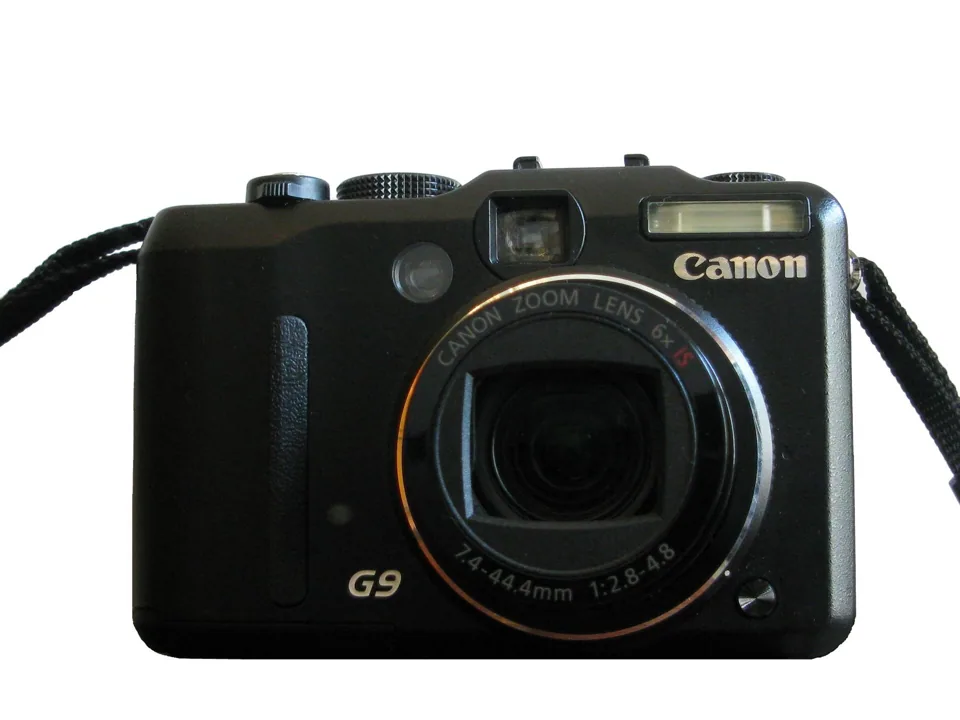
In 2007 Canon put raw shooting, a 3-inch screen and 12 megapixels into the metal-bodied G series, and, by Imaging Resource's count, listed it $100 below its predecessor. Reviewers praised the body and the controls, then argued over the noise.
- Launched
- September 2007
- Launch price
- $499.99 (US, estimated) · £429 / €629 inc. VAT (UK)5
- Sensor
- 12.1 MP CCD
- Lens
- 35–210 mm, 6×
- Card
- SDHC, SD, MultiMediaCard
- Battery
- NB-2LH
Canon PowerShot G9 specs: sensor, lens, battery, memory card and cable
The Canon PowerShot G9 came out in September 2007 at $499.99 as a 12.1 MP CCD compact with a 35–210 mm (35 mm equivalent) 6× zoom lens. It runs on the NB-2LH battery. Sources
- Sensor
- CCD, 1/1.7", 12.1 MP source
- Lens
- 35–210 mm equivalent, 6× zoom source
- Memory card
- SDHC, SD, MultiMediaCard source
- Battery
- NB-2LH source
- USB / A/V cable
- IFC-400PCU, AVC-DC300 Confirmed · all Canon cables
Meet the camera
Weight is the first fact about the G9. DPReview weighed it at about 370 grams with battery and card, nearly all metal beneath a plastic top plate,1 and Cameralabs, at 363 grams with the battery, said it wanted a coat pocket rather than a shirt pocket.3 Canon's own figure for the body alone is about 320 grams, at 106.4 by 71.9 by 42.5 millimetres.6
Canon announced it on 20 August 2007 at an estimated $499.99 in the United States and £429 (quoted as €629 including VAT) in the United Kingdom, with availability announced for October in the United States and September in Britain.5 Imaging Resource counted the price as $100 below the G7's launch price,4 and Cameralabs also called the launch price lower than its predecessor's;3 DPReview, whose spec sheet gave a street price of US$480, said the price had stayed about the same.1 Canon's museum lists the camera as marketed in September 2007.6
- Sensor
- 12.1 MP CCD, 1/1.7", DIGIC III6
- Lens
- 6x, 35–210 mm equiv., f/2.8–4.8, optical stabiliser6
- ISO
- 80 to 1600; 3200 only in a scene mode, at 2 MP3
- Flash
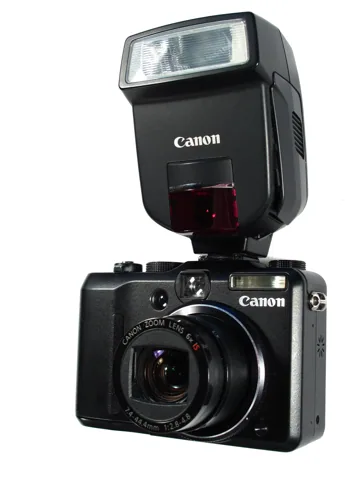
- Built-in flash and a hot shoe for Canon Speedlites3
- Card and battery
- SD, SDHC, MMC · NB-2LH, about 240 shots with the screen on (CIPA)6
- Launch price
- $499.99 (US, estimated) · £429 / €629 inc. VAT (UK)5
Why this one was interesting
Raw came back
The G7 had no raw mode, and the G9 restored it, with raw+JPEG as well.4 DPReview called the implementation genuinely usable, at about three seconds from shot to shot, and found that Canon's supplied converter reproduced the camera's own JPEGs while Adobe Camera Raw pulled out a little more detail and highlight headroom.1 PhotographyBLOG found single raw shots as snappy as JPEGs and continuous raw slow.2 Cameralabs added that the camera's restrained noise reduction leaves detail for later processing, which raw makes easier.3 The catch, in DPReview's list of cons, is that the best image quality needs raw and the supplied converter lacks sophistication.1
A hot shoe that talks to the flash
Cameralabs called the hot shoe a highlight, one that works much as it does on a Canon SLR. New since the G7 was in-camera control of a flash such as the 580EX II and support for the ST-E2 wireless transmitter; flash sync reaches 1/250 second.3 Cameralabs also admitted that the camera is awkward to hold with a 580EX II on top.3 Underwater, a WP-DC21 housing was rated to 40 metres.3
A bigger screen
The screen grew to 3.0 inches and about 230,000 dots, from 207,000 on the G7; DPReview found it bright with a wide viewing angle, and noted that it smudges easily.1 PhotographyBLOG called the 3-inch panel a great addition.2
If the G9 is bigger than you want to carry, Canon's later enthusiast compacts are reviewed here: the PowerShot S90, S95 and G7 X.
What was lost
The larger screen cost the viewfinder, which PhotographyBLOG said was smaller than the G7's, murky under indoor lighting, and showed about 80 per cent of the scene, with the lens intruding at the bottom left when zoomed wide.2 DPReview thought it all but unusable in most situations, and added that although it looks smaller than the G7's it is identical.1 Cameralabs, who also put its coverage at 80 per cent with no exposure information, still valued it for composing in direct sunlight and for saving battery.3
Continuous shooting also slowed against the G7. DPReview gave about 1.5 frames a second for the G9 and 2.0 for the older camera, and about 0.7 in raw.1 Battery life improved only a little, from 220 to about 240 shots.31
The dark: its weak point
All three reviewers found the sensor's limit, and they put it at different sensitivities. Cameralabs saw noise already at ISO 100 and said it began to hurt at 200, advising ISO 200 or lower.3 DPReview saw noise reduction smearing fine, low-contrast detail above ISO 100 (about ISO 125 in its list of cons), found ISO 200 to 400 usable for standard-sized prints, and put ISO 800 and 1600 in the emergency-use-only bracket.1 PhotographyBLOG saw noise readily above ISO 200.2 At the top, PhotographyBLOG's verdict was that ISO 800 and 1600 were virtually unusable.2
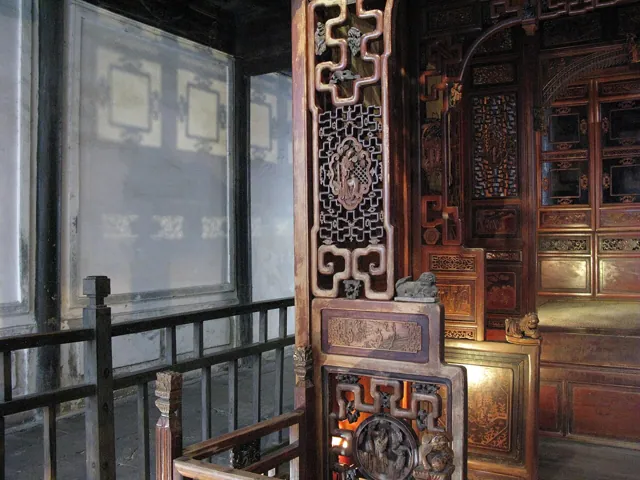
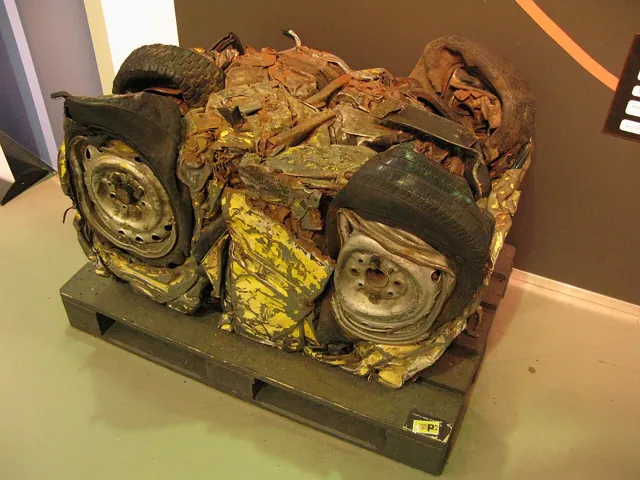
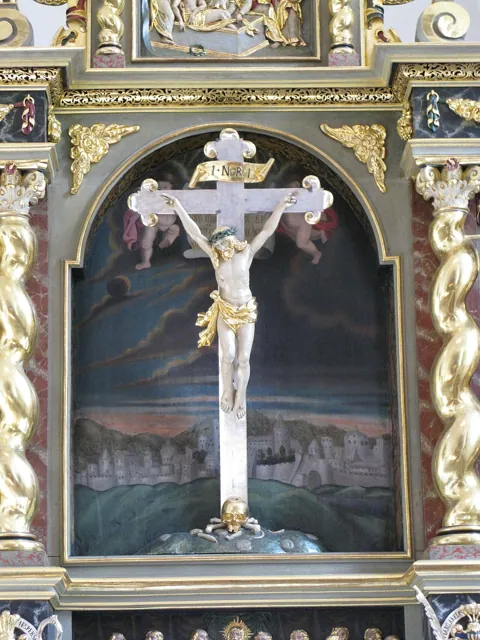
Real photographs taken with this camera. The sensitivity shown is recorded in each file's own EXIF data; none of these is a true night scene.
Like that look? See recent eBay sold listings for this camera ↗
On eBay right now
Live listings for this camera, supplied by eBay and updated automatically. We earn a commission if you buy through them.
The little wins
The stabiliser
The G7's lens system carried over, with three modes: continuous, shoot-only and panning.3 DPReview found about three stops of benefit in its own handheld test;1 Cameralabs, at 210 millimetres, got sharp handheld frames at 1/60 second where it needed 1/125 to 1/250 without, or one to two stops, against Canon's claim of up to three.3
Macro to a centimetre
DPReview lists focus down to 1 centimetre at wide angle and 50 centimetres at telephoto.1


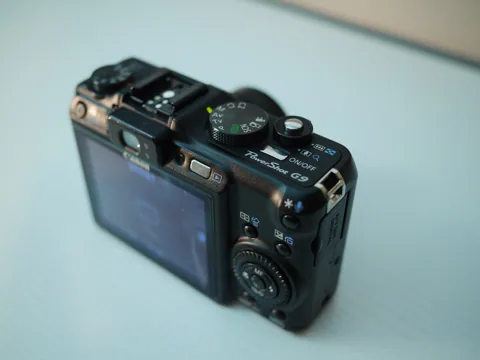 The G9 from above and behind, with the hot shoe, dials and screen. · bfishadow from Beijing, China · CC BY 2.0 · Commons

An ISO dial
A small dial on the top left selects 80 to 1600 plus Auto and Hi, which Cameralabs found a quick way to change sensitivity;3 PhotographyBLOG liked a shortcut that raises ISO against shake, though it does not work with flash.2
How it drew the picture
DPReview praised ISO 80 pictures outdoors, with respectable edge-to-edge sharpness across the zoom range, and measured 1950 by 1900 lines on its resolution chart, against 1775 by 1850 for the G7; it said the extra megapixels bought only a marginal gain.1 It saw purple fringing at wide angle in backlit scenes, highlight clipping in contrasty ones, and poor automatic white balance under incandescent and fluorescent light.1 PhotographyBLOG found out-of-camera files a little soft at the default setting, colours punchy and skin tones warm, and chromatic aberration handled well, with only slight fringing in high-contrast areas.2 DPReview measured low distortion, 1.3 per cent barrel at wide angle.1


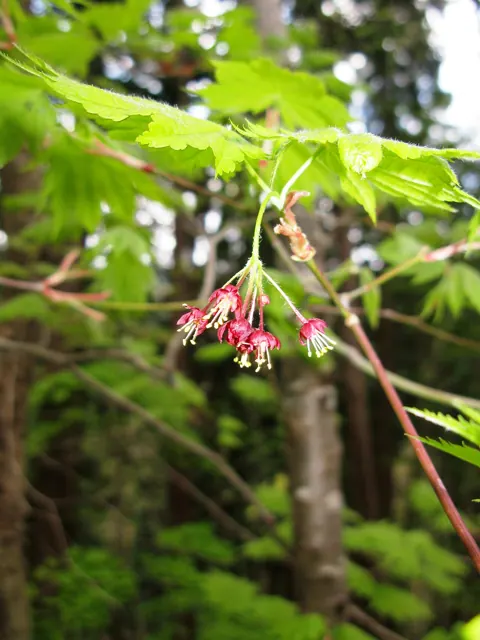





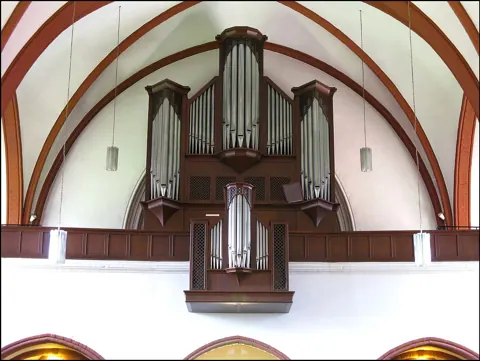









Photos taken with this camera, from Wikimedia Commons, credited under each picture.
Where it let you down
DPReview and Cameralabs both disliked that the card door on the underside cannot be opened while the camera sits on a tripod.13 Grip drew mixed comments: DPReview said the lack of a true grip makes single-handed operation difficult, while Cameralabs found it secure enough on its own, though the left hand can easily block the built-in flash.13 DPReview found autofocus only marginally quicker than the G7's, slow in low light and in macro, and measured a half-to-full-press shutter lag (with focus already locked) of about 0.05 seconds with the optical viewfinder and 0.12 with the screen.1 Cameralabs called power-up, autofocus and burst slow, and said the 35 mm wide end lacks true wide-angle coverage; in its comparison, Panasonic's Lumix DMC-LX2 starts at 28 mm but has no hot shoe and shows heavier noise.3
The G9 also shared its sensor and lens with Canon's PowerShot A650 IS, which both reviewers noted had a flip-out screen; DPReview put the saving at about $100 and said the G9 was nonetheless in a different league.13
What the reviewers said in 2007
| Outlet | Date | Verdict |
|---|---|---|
| PhotographyBLOG | 8 Oct 2007 | Design 4.5, features 5, ease of use 4, image quality 4.5, value 4.5 out of 5. A solid G7 upgrade and a backup for an entry-level SLR; noise at ISO 400 and above is the complaint.2 |
| DPReview | 27 Oct 2007 | Highly Recommended, but only just. Build 9.5, features 9.5, optics 8.5, handling 8, image quality 8, performance 8, value 7.5 out of 10: buyers pay partly for the styling and build.1 |
| Cameralabs | Page dated 23 Sep 2011 | Recommended, 87 per cent. A powerful pocketable compact; held back from Highly Recommended by slow performance and the missing wide angle.3 |
The timeline
- 20 August 2007Canon announces the G9 at $499.99, £429 and €629.54
- September 2007Due on sale in Britain, per the announcement; Canon's museum gives the same month as its marketing date.56
- 8 October 2007PhotographyBLOG publishes its review.2
- October 2007Due in US stores, per the announcement.5
- 27 October 2007DPReview publishes its review.1
Should you buy one now?
Buy one if you want a weighty, metal-bodied CCD compact with raw files, a hot shoe and real manual controls, and you can shoot at ISO 200 or below. It listed at $499.99;5 what it sells for now is a question for the sold listings, not for us. Before you bid, check these:
- The name. Canon sold it as the PowerShot G9 everywhere, so one search covers it.6
- The battery. It uses an NB-2LH;6 a fresh one is on Amazon ↗.
- The card. It takes SD, SDHC and MMC cards;6 see our memory card guide.
- The screen. DPReview noted it smudges; look for scratches and a clean, even image.1
- The card door and hot shoe. Open the door and check the shoe is intact if you plan to use a flash.
- The lens. Check that it extends and retracts cleanly.
If you are wondering why cameras like this are being hunted down again, we tell that story once, in Pictures that never left the card.
See recent sold prices on eBay ↗Shop on eBay ↗NB-2LH battery ↗
Sources
- DPReview, Canon PowerShot G9 review by Simon Joinson (27 Oct 2007)
- PhotographyBLOG, Canon PowerShot G9 review by Mark Goldstein (8 Oct 2007)
- Cameralabs, Canon PowerShot G9 review by Gordon Laing (page dated 23 Sep 2011; the camera was announced in August 2007)
- Imaging Resource, Canon PowerShot G9 announcement (20 Aug 2007: $499.99, availability October)
- PhotographyBLOG, Canon G9 announcement (20 Aug 2007: US and UK prices and availability)
- Canon Camera Museum, PowerShot G9 (marketed September 2007; specifications)
Camera photos by User:Saforrest (CC BY-SA 3.0), bfishadow (CC BY 2.0), Joadl (CC BY-SA 3.0) and ほしけん (Hosiken, CC BY 3.0); other photographs are credited under each one, all via Wikimedia Commons. Links to eBay and Amazon are affiliate links.