Sony Cyber-shot T · on sale November 2003
The Sony Cyber-shot DSC-T1: the prism-lens ultracompact that started the T series
We found no other regional name for it; Sony's Japanese release and the 2004 reviews all call it the DSC-T1.124
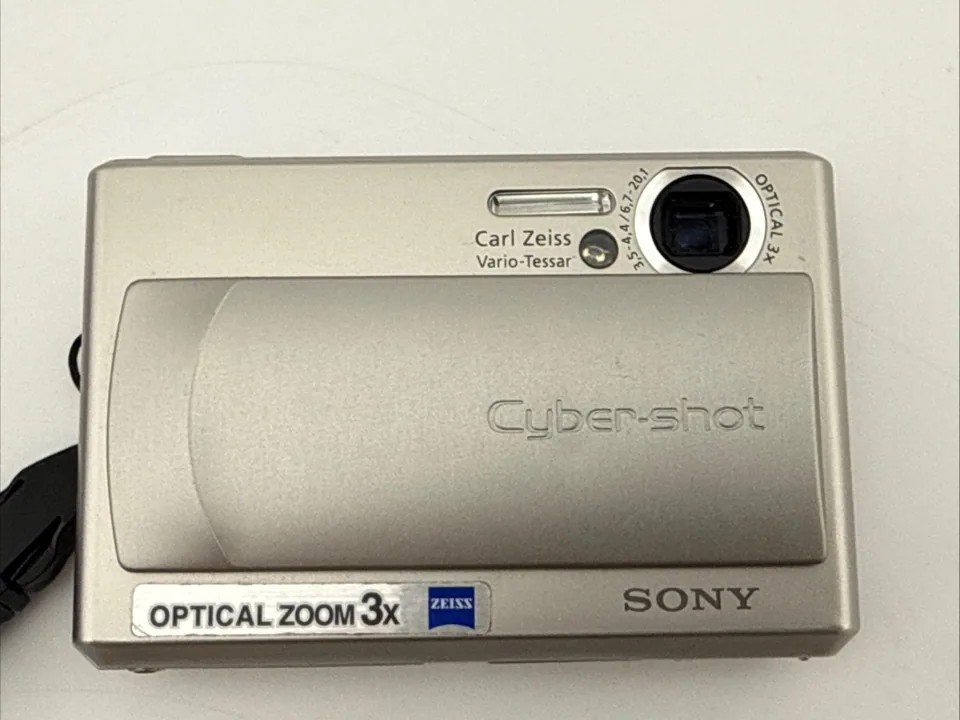
In late 2003 Sony put a 5-megapixel sensor and a 3x Zeiss zoom into a stainless-steel slab 21 millimetres thick, with the lens folded inside. Reviewers loved the speed and the screen, and then listed the flash, the memory cards and the missing viewfinder.
- Launched
- November 2003
- Sensor
- 5.1 MP CCD
- Lens
- 38–114 mm, 3×
- Card
- Memory Stick Duo, Memory Stick Pro Duo
- Battery
- NP-FT1
Sony Cyber-shot DSC-T1 specs: sensor, lens, battery, memory card and cable
The Sony Cyber-shot DSC-T1 came out in November 2003 at $549.95 as a 5.1 MP CCD compact with a 38–114 mm (35 mm equivalent) 3× zoom lens. It takes Memory Stick Duo and Memory Stick Pro Duo cards and runs on the NP-FT1 battery. Sources
- Sensor
- CCD, 1/2.4", 5.1 MP source
- Lens
- 38–114 mm equivalent, 3× zoom source
- Memory card
- Memory Stick Duo, Memory Stick Pro Duo source
- Battery
- NP-FT1 source
- USB / A/V cable
- See our Sony cable page
Meet the camera
Stack credit cards to about 0.8 inches and you have its size, said the Digital Camera Resource Page.4 Sony listed 91 by 60 by 21 millimetres, 17.3 millimetres at the thinnest, and about 155 grams for the body or 180 grams with battery, card and strap.1 Luminous Landscape gave 200 grams,5 so weights differ by source. Sony said the case was stainless steel,1 and Imaging Resource said its all-metal body gave a strong impression of ruggedness.2
The lens never leaves the body. Sony described an eight-group, eleven-element design with three aspherical elements and a prism that bends the light 90 degrees, so the zoom moves up and down inside the camera.1 A sliding cover over the front doubles as the power switch.2 Imaging Resource saw the idea as similar to Minolta's DiMAGE X series,2 and the Resource Page said Minolta had done it for a few years already; its 3-megapixel DiMAGE Xg was lighter but had a smaller screen.4
Sony put it on sale in Japan on 21 November 2003 at an open price, meaning no list price, and called it a new series of Cyber-shot.1 Photo Review's October 2003 announcement said it would be released in December at an RRP of $1099 (the page does not name the currency; it is an Australian site).6 In the United States Imaging Resource gave a suggested price at introduction of $549.95, and its data sheet gives availability from 31 January 2004;23 Luminous Landscape said it reached markets outside Japan early in the new year.5
Why this one was interesting
A pocket camera with no compromise on pixels
Imaging Resource called it a full-featured digital camera in a subcompact body, with ISO and colour adjustments, and said it gave up little against full-sized 5-megapixel models.2 Luminous Landscape wanted something small enough for a shirt pocket that could still make 8 by 10 inch prints, and found it; a 13 by 19 inch print could pass for a six-megapixel SLR's, the reviewer said.5
A screen you could read in sun
Sony's screen combined reflective and backlit layers, and Sony said its area was about three times that of a 1.5-inch monitor.1 Imaging Resource found that this transflective screen worked in full sunlight and ranked it among the best on any digicam it had seen, and Luminous Landscape also called it viewable in the brightest sun.25
Quick on the draw
Because nothing had to extend, Sony quoted a start-up of about 1.3 seconds, a shot-to-shot time of about a second and a shutter lag of about 0.24 seconds.1 Imaging Resource measured full-autofocus lag at 0.28 to 0.32 seconds and prefocused lag at 14 milliseconds,2 but its power-on to first shot took 1.6 seconds, and the Resource Page said it took just over two seconds to warm up, so the 1.3 seconds is Sony's own figure.24
Our DSC-T9 picks up the story two years later, and the T10 and T100 followed.
What was lost
The reviewers named several omissions. There was no optical viewfinder, which the Resource Page called a deal breaker for its reviewer,4 and no tripod mount.24 Imaging Resource said the camera has no standard connection terminals, with USB, DC-in and A/V-out jacks on the cradle in the box,2 and the Resource Page said separate adapter cables cost about $20 each.4 Luminous Landscape added that the screen does not swivel.5 For cables today, see our Sony cable guide.
The dark: its weak point
Imaging Resource found the flash underpowered and said usable pictures at ISO 400 needed at least about 11 lux, with Twilight mode coming out darker than it liked.2 The Resource Page quoted a flash range of 0.3 to 1.5 metres at wide angle and 0.5 to 1.5 metres at telephoto, called red-eye a serious problem, and said the screen was almost impossible to see in dim light.4 It did praise low-light autofocus, thanks to the assist lamp.4








Real photographs taken with this camera. The sensitivity shown is recorded in each file's own EXIF data; the camera's top setting was ISO 400.1
Like that look? See recent eBay sold listings for this camera ↗
On eBay right now
Live listings for this camera, supplied by eBay and updated automatically. We earn a commission if you buy through them.
The little wins
Prefocus lag
Imaging Resource called the 14-millisecond prefocused lag blazing and said Sony had a handle on autofocus speed.2
A real macro
Sony claimed focus down to 1 centimetre in a magnifying-glass mode that enlarges up to 3.3 times,1 and the Resource Page found it unlike anything it had seen.4
A battery that counts
Imaging Resource noted that the InfoLithium battery shows remaining minutes, a feature it called unique to Sony.2
How it drew the picture
Imaging Resource found good colour with a slight warm cast, resolution with strong detail to about 1,350 lines and extinction at 1,600 to 1,650 lines, and not quite the sharpness of the best full-sized 5-megapixel models.2 It also measured 0.8 percent barrel distortion at wide angle and 0.6 percent pincushion at telephoto.2 The Resource Page found colour and exposure good and purple fringing absent, but said noise gave pictures a fuzzy look it likened to video capture.4
The reviewers disagreed on noise and vignetting. Luminous Landscape tested with DxO Analyzer and was impressed by how low noise stayed at ISO 400, with ISO 100, 200 and 400 results not much different in its lab numbers, and measured moderately high vignetting of about three quarters of a stop;5 Imaging Resource said Sony's noise suppression flattered flat colour patches while leaving noise around edges and in detail.2 The Resource Page saw no dark corners in its pictures.4
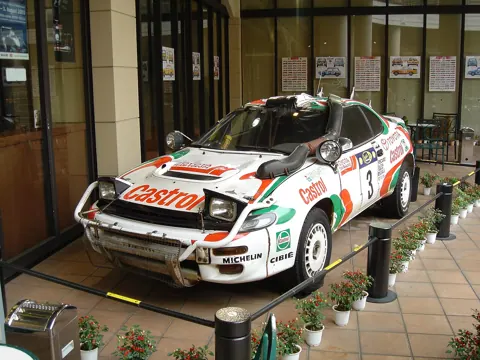















Photos taken with this camera, from Wikimedia Commons, credited under each picture.
Where it let you down
The Resource Page noted there was no TIFF or raw mode, and described the camera as having no manual controls, not even manual white balance, though its tungsten preset worked in the test.4 Luminous Landscape found only Program exposure and scene modes.5 Memory Stick Duo cards drew the most complaints: the Resource Page called the format a liability, said a 512 MB card cost $300, and said the 32 MB card in the box held only about 12 pictures at the best quality;4 Luminous Landscape said you would need at least 256 MB for a day's shooting at about $100.5 Luminous Landscape also found the battery can be inserted backwards and can fall out when the card door opens.5 Sony quoted about 170 shots,1 which the Resource Page called typical for cameras this small,4 and Imaging Resource measured a worst case of 81 minutes with the backlight on.2
What the reviewers said in 2004
| Outlet | Date | Verdict |
|---|---|---|
| Digital Camera Resource Page | First posted 24 Nov 2003; updated 12 Jun 2004 | No score. Very good quality for an ultracompact and stunning design, but expensive; flash weak, no manual controls, no viewfinder.4 |
| Luminous Landscape | Undated (price as of March 2004) | An admirable little camera with first-rate image quality; no aperture or shutter control; a permanent place in the reviewer's pocket.5 |
| Imaging Resource | Page headed 03/10/04 | A Dave's Pick: good colour, high resolution, fast response; limited low light, flash and battery life.2 |
| Photo Review | October 2003 (announcement) | Launch coverage only, not a review: its headline calls it the smallest 5-megapixel camera; RRP $1099.6 |
The timeline
- October 2003Sony announces the camera; Photo Review reports a December release in Australia.6
- 22 October 2003Sony Japan issues its press release.1
- 21 November 2003On sale in Japan.1
- 24 November 2003The Resource Page first posts its review.4
- 31 January 2004Imaging Resource's data sheet gives this availability date.3
- 12 June 2004The Resource Page's review is last updated; the page says it was completed with a production camera.4
Should you buy one now?
Buy one if you want a 2003 pocket camera that wakes quickly and draws cleanly in daylight, and you accept a weak flash and a proprietary card. It launched at $549.95 in the United States;2 what it sells for now is a question for the sold listings, not for us. Before you bid, check these:
- The name. It is the DSC-T1; we found no other name.1
- The cradle. The camera has no ports of its own, so check that the cradle and its cables are included.24
- The battery. It uses an NP-FT1;1 a fresh one is on Amazon ↗. Our T9 takes the same battery.
- The card. It takes Memory Stick Duo and PRO Duo cards, not SD;1 PRO Duo is needed for the 30 fps video.1 See our memory card guide.
- The lens door. Check that the sliding cover moves smoothly and the picture is clear.
- The finish. The Resource Page warned that metal cameras like this scratch easily.4
If you are wondering why cameras like this are being hunted down again, we tell that story once, in Pictures that never left the card.
See recent sold prices on eBay ↗Shop on eBay ↗NP-FT1 battery ↗
Sources
- Sony Marketing (Japan), press release for the Cyber-shot DSC-T1, 22 Oct 2003 (in Japanese; on sale 21 Nov 2003, open price)
- Imaging Resource, Sony Cyber-shot DSC-T1 review (page headed Review Date 03/10/04, probably 10 March 2004; suggested price at introduction $549.95)
- Imaging Resource, Sony Cyber-shot DSC-T1 data sheet (availability 31 Jan 2004, retail price $550)
- Digital Camera Resource Page, Sony Cyber-shot DSC-T1 review by Jeff Keller (first posted 24 Nov 2003, updated 12 Jun 2004; Wayback Machine copy of 31 Dec 2005)
- The Luminous Landscape, Sony DSC-T1 review by Michael Reichmann (undated; price given as of March 2004; Wayback Machine copy of 1 Jan 2006)
- Photo Review (Australia), Sony Announces World's Smallest 5-Megapixel Camera (text dated October 2003; RRP $1099 on an Australian site)
Photographs are credited under each one, all via Wikimedia Commons. Links to eBay and Amazon are affiliate links.