Sony Cyber-shot P · announced July 2004
The Sony Cyber-shot DSC-P150: the 2004 pocket camera that put 7.2 megapixels into a metal body an inch thick
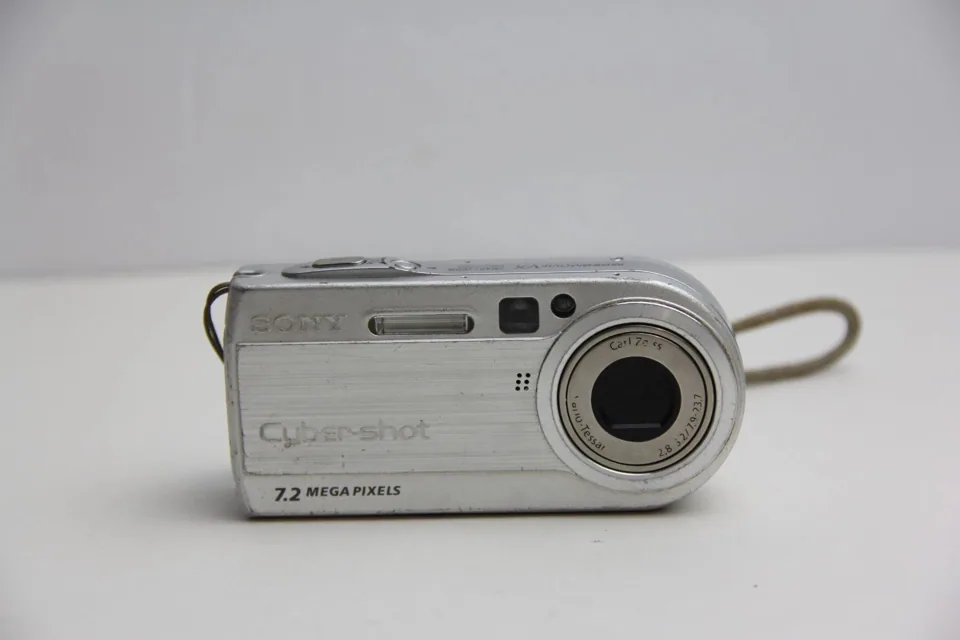
In July 2004 Sony called the P150 the first compact point-and-shoot with 7.2 megapixels, for under $500. Four full reviews praised how fast and solid it was, and split over how much noise, softness and flash it came with.
- Launched
- July 2004
- Sensor
- 7.2 MP CCD
- Lens
- 38–114 mm, 3×
- Card
- Memory Stick, Memory Stick PRO
- Battery
- NP-FR1
Sony Cyber-shot DSC-P150 specs: sensor, lens, battery, memory card and cable
Launched in July 2004, the Sony Cyber-shot DSC-P150 is a 7.2 MP CCD compact with a 38–114 mm (35 mm equivalent) 3× zoom lens. Inside: it takes Memory Stick and Memory Stick PRO cards and runs on the NP-FR1 battery. Sources
- Sensor
- CCD, 1/1.8", 7.2 MP source
- Lens
- 38–114 mm equivalent, 3× zoom source
- Memory card
- Memory Stick, Memory Stick PRO source
- Battery
- NP-FR1 source
- USB / A/V cable
- See our Sony cable page
Meet the camera
Sony announced the P150 on 20 July 2004, according to PhotographyBLOG's copy of the release (Sony's own page dates it 21 July). The release called it the world's first compact point-and-shoot with 7.2 megapixels, said it would be available in September for less than $500, and noted that 3072 x 2304 pixels was enough for a 300-dpi 8 by 10 inch print.56 Imaging Resource, reviewing it in October, gave the availability as August 2004 and the suggested price at introduction as $499,2 so our sources disagree on the month. This was not a new design. DPReview described it as the existing DSC-P100 with a brushed-metal front and a higher-resolution sensor,1 and Imaging Resource called it virtually identical to the P100 apart from that CCD.2 What interested Imaging Resource was the detail it kept: the reviewer said the P150 gave up very little sharpness to noise reduction, and found noise rose only a little over the P100.2
Why this one was interesting
Quick, with one exception
All four reviewers noticed the speed. DPReview timed 1.4 seconds from switching on to shooting, a half-press lag of about 0.3 seconds at wide angle and 0.5 at full zoom, and 1.55 seconds between shots with the flash off.1 Imaging Resource measured 0.31 to 0.54 seconds with full autofocus, 0.011 seconds when prefocused and 1.8 seconds per shot.2 The Digital Camera Resource Page's reviewer got 1.4 seconds to start, 0.3 to 0.5 seconds to focus and about 1.5 seconds between shots,4 and The Register's reviewer found it ready quickly with almost no lag.3 Continuous shooting was the exception. DPReview recorded 0.6 frames a second for five frames at the top setting and then about six seconds of waiting, about four on a faster card,1 and the Digital Camera Resource Page's reviewer saw the screen black out between frames.4 A separate Multi Burst mode took 16 small frames at a selectable 7.5, 15 or 30 a second, stored as a single picture.21
Metal, and what it did to the handling
Three reviewers praised the body. The Register called the brushed-metal build excellent,3 DPReview listed superb build quality1 and the Digital Camera Resource Page's reviewer called the camera almost entirely metal, apart from the plastic door over the battery and card slot, which they found flimsy. Imaging Resource called that door easy to open, and DPReview called it sturdy and spring-hinged, so the reviewers disagree about it.421 Grip was less settled. DPReview found it handled well, with a small thumb grip on the back and safe to shoot one-handed, but warned that the lens sits far from the right hand and shake was an ever-present risk, seen even at 1/200 second,1 while Imaging Resource found the camera felt secure with a middle finger wrapped round the front.2 Imaging Resource also reported that the mode dial moved easily enough to change modes in a pocket.2
A little control, and a lot of accessories
Imaging Resource thought a manual mode fairly unusual in a compact, and the P150 had one,2 but DPReview and the Digital Camera Resource Page both counted only two aperture choices at any focal length, no custom white balance, and focus distances set from a short list.14 It also took add-on gear. The Digital Camera Resource Page listed wide and telephoto conversion lenses, a slave flash and an underwater case, and thought it notable that so small a camera accepted them;4 Sony's release put the case's depth rating at 132 feet.5 See how the line developed after it in our DSC-P200 review, which replaced it six months later, or in the DSC-W55 and DSC-T9 reviews.
What was lost
The P150 lacked the image-cropping tool of the cheaper P100, the Digital Camera Resource Page noted, and it had no RAW or TIFF option.4 The 32 MB card in the box held nine photos at the best quality, which led that reviewer to say a bigger Memory Stick should be counted in the price.4 DPReview timed about 2.9 seconds to store each full-size picture.1 The weights do not agree either: DPReview gives 147 g with the battery, The Register 145 g including it, and Imaging Resource 182 g with battery and card (the Digital Camera Resource Page's table also lists 147 g, labelled empty).1324 The colour options also differ: Imaging Resource lists red, blue and silver, the Digital Camera Resource Page silver, blue or black.24
The dark: where noise showed
Here the reviewers disagreed in degree, not direction. Imaging Resource called the noise lower than it expected from a 7-megapixel compact, with little detail lost to noise reduction, found usable pictures down to its darkest test level of 0.67 lux, and said that although noise was high at ISO 400 its pattern was tight and light.2 DPReview found noise visible in shadow areas above ISO 200 (its pros-and-cons list says at 200 and 400), less intrusive than it expected.1 The Register's reviewer saw random red and blue pixels in low light and uniform areas but thought Sony had controlled them surprisingly well.3 The Digital Camera Resource Page's reviewer wanted less noise, found a night shot noisier than expected, with some detail lost, and said noise got a lot worse at ISO 400 than at 100 and 200, though a high-quality 5 by 7 inch print was probably still possible.4 Autofocus in the dark was a clear strength: with the focus-assist lamp on, Imaging Resource found it focused in total darkness.2 The flash was weaker. DPReview called it underpowered, with slight underexposure on most flash shots, though it throttled down well close up and its colour was almost perfect;1 The Register's reviewer found it fine as fill but short of power for bigger subjects;3 the Digital Camera Resource Page's reviewer saw no red-eye in the test shot.4







Real photographs taken with this camera. The sensitivity shown is recorded in each file's own EXIF data; the camera's top setting is ISO 400. These were not made under test conditions, and none is a very dark scene.
Like that look? See recent eBay sold listings for this camera ↗
On eBay right now
Live listings for this camera, supplied by eBay and updated automatically. We earn a commission if you buy through them.
The little wins
Macro
The Digital Camera Resource Page gives a closest focus of 6 cm at wide angle and 30 cm at full zoom.4 DPReview also says 6 cm at wide angle and measured a 61 x 46 mm field there, and about 101 x 75 mm at full zoom.1 Imaging Resource's text says the macro setting reaches 10 cm and its test measured the same 61 x 46 mm minimum area.2
How it drew the picture
Resolution tests used different yardsticks. DPReview read 1500 lines per picture height as absolute, with aliasing from about 1700;1 Imaging Resource found strong detail to 1550 lines vertically and 1600 horizontally.2 The same split appears in distortion: DPReview measured 1.8 percent barrel at wide angle, Imaging Resource 0.8 percent.12 Sharpness is the clearest disagreement. Imaging Resource called the lens's sharpness excellent and its resolution test showed very little detail lost to noise reduction, though it noted some corner softness in its close-up test, while DPReview saw a slight loss of sharpness at the corners and weak edges at f/2.8, calling the resolution results a little soft but clean,21 and The Register's reviewer thought default images slightly soft.3 Colour got better marks: Imaging Resource praised its colour and tonality, and The Register's reviewer thought colour and metering good.23 DPReview described dynamic range as strong, with a slightly conservative exposure.1 On print size, The Register said 7.2 megapixels allowed prints up to A3, which its reviewer thought overkill for the usual 10 by 15 cm.3
















Photos taken with this camera, from Wikimedia Commons, credited under each picture.
Where it let you down
DPReview's cons list ran to limited manual controls, no manual white balance, a flash it called underpowered, shadow noise at ISO 200 and 400, and focus problems with near subjects, including shots taken without a focus lock.1 The Register's reviewer found the multi-point autofocus sometimes picked the wrong part of the frame, and single-point autofocus fixed it.3 The Digital Camera Resource Page's reviewer added a screen that does not brighten in low light, a zoom rocker that felt wrong, and a zoom taking about two seconds from wide to tele.4 Memory Stick is the only card type: see our Memory Stick guide and the glossary.4
What the reviewers said in 2004
| Outlet | Date | Verdict |
|---|---|---|
| DPReview | 23 Sep 2004 | A fantastic pocket camera, with more detail than the 5-megapixel P100 and no large noise penalty; limits were manual control, flash and near focus.1 |
| Imaging Resource | 7 Oct 2004 | A Dave's Pick: one of the best subcompacts the reviewer had seen that year, with few trade-offs for its size.2 |
| The Register | 30 Nov 2004 | 80 percent: classy and fast, with some noise, fringing and softness not expected to show in normal prints.3 |
| Digital Camera Resource Page | 17 Dec 2004 | No score; a very good small camera for big prints if you accept limited manual controls and a little more noise than they liked.4 |
The timeline
- 20 July 2004Sony announces the P150 for under $500, due in September.56
- August 2004Imaging Resource's stated availability.2
- 23 September 2004DPReview's review, at $499 and GBP 330.1
- 7 October 2004Imaging Resource's review.2
- 30 November 2004The Register's review.3
- 17 December 2004The Digital Camera Resource Page posts its review.4
Should you buy one now?
Buy one if you want a quick, solid metal 2004 CCD compact that is happiest at ISO 100 or 200 in daylight. Its launch price was $499;12 what it sells for now is a question for the sold listings, not for us. We have not tested a unit. Before you bid, check these:
- The model. The P150 has a 1.8-inch screen;1 the later P200 is a different camera with its own review.
- The battery. It uses an NP-FR1;2 a fresh one is on Amazon ↗.
- The card. It takes Memory Stick or Memory Stick PRO.4
- The door. Check the battery and card compartment door, which one reviewer called flimsy and another sturdy.41
- The lens. Check that it extends and retracts cleanly.
If you are wondering why cameras like this are being hunted down again, we tell that story once, in Pictures that never left the card. A later, cheaper Sony of the same family is our DSC-W80 retrospective.
See recent sold prices on eBay ↗Shop on eBay ↗NP-FR1 battery ↗
Sources
- DPReview, Sony Cyber-shot DSC-P150 Review by Simon Joinson (23 Sep 2004)
- Imaging Resource, Sony Cyber-shot DSC-P150 review (7 Oct 2004; suggested price at introduction $499, availability August 2004)
- The Register (review by Doug Harman, credited to Pocket Lint), Sony Cyber-shot DSC P150 (30 Nov 2004; 80%, GBP 330)
- Digital Camera Resource Page, Sony Cyber-shot DSC-P150 review by Jeff Keller (posted 17 Dec 2004; read from an Internet Archive copy of 2016)
- Sony Electronics press release, Sony's New Cyber-Shot DSC-P150 (21 Jul 2004 on Sony's site; PhotographyBLOG's copy is dated 20 Jul)
- PhotographyBLOG, Sony Announces 7 Megapixel DSC-P150 (21 Jul 2004; reproduces the Sony release)
Photographs are credited under each one, all via Wikimedia Commons. Links to eBay and Amazon are affiliate links. All five review and release pages were re-read in full by a second reader before publication.