Sony Cyber-shot P · announced January 2005
The Sony Cyber-shot DSC-P200: the quick, well-built 2005 pocket compact with the Zeiss lens
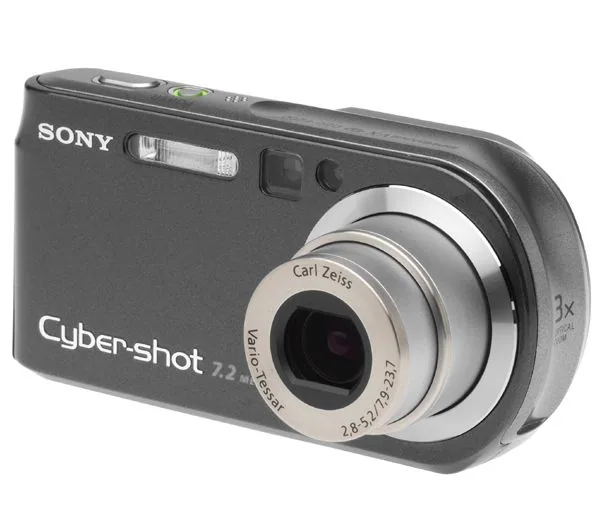

In January 2005 Sony put a 7.2-megapixel sensor and a Carl Zeiss zoom into a pocket camera for just under $400. Three full reviews liked how fast and solid it was, and differed on how much noise, and the noise reduction used to hide it, cost the pictures.
Sony Cyber-shot DSC-P200 specs: sensor, lens, battery, memory card and cable
Launched in February 2005 at $400, the Sony Cyber-shot DSC-P200 is a 7.2 MP CCD compact with a 38–114 mm (35 mm equivalent) 3× zoom lens. Inside: it takes Memory Stick and Memory Stick PRO cards and runs on the NP-FR1 battery. Sources
- Sensor
- CCD, 1/1.8", 7.2 MP source
- Lens
- 38–114 mm equivalent, 3× zoom source
- Memory card
- Memory Stick, Memory Stick PRO source
- Battery
- NP-FR1 source
- USB / A/V cable
- See our Sony cable page
Meet the camera
The P200 was announced at CES in Las Vegas on 5 January 2005, and Sony said it would ship the next month.3 It was a minor update. Imaging Resource described it as the successor to the P150 with a larger 2.0-inch screen in a slightly smaller body,2 and DPReview, which called the changes minimal, counted the redesign, the larger screen, an extra metering mode and custom white balance.1 The sensor and the 3x zoom did not change.3 What did change was the price: Imaging Resource reported that it would cost about $100 less than the P150 had at its own launch the previous September.3
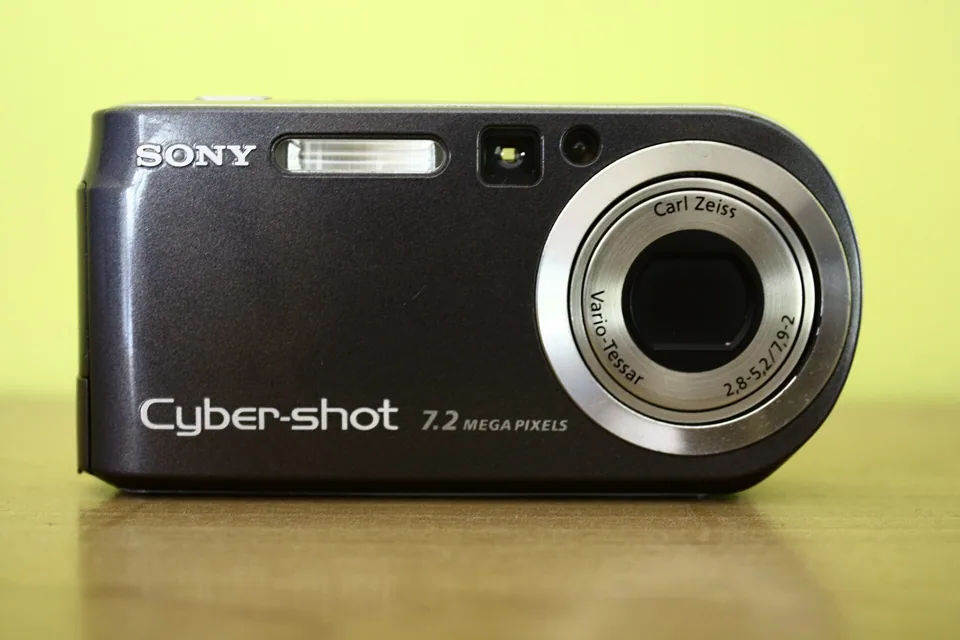

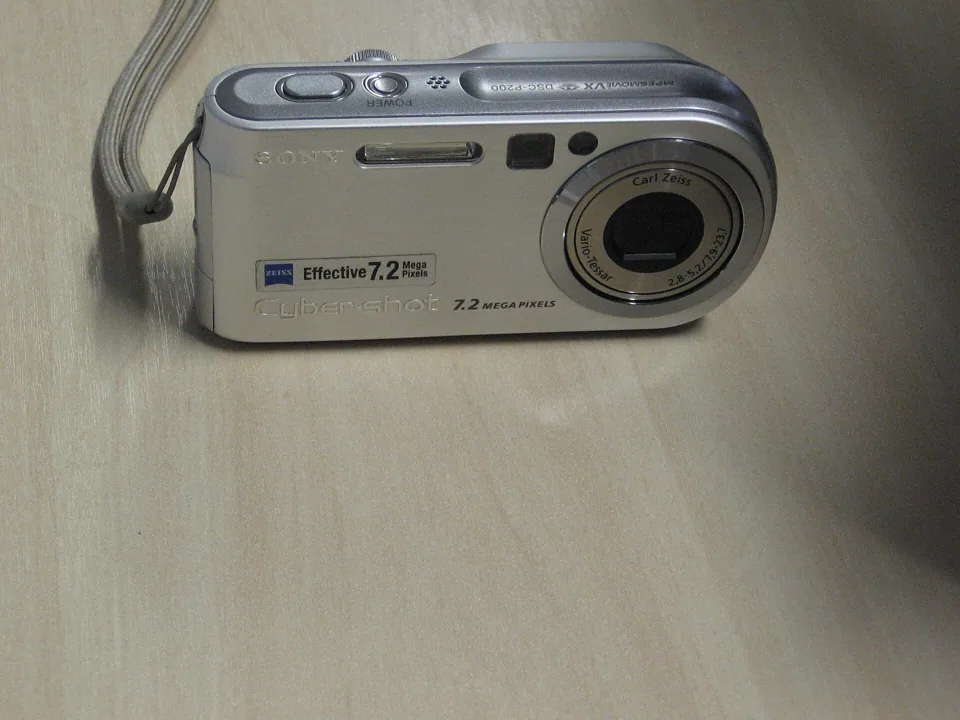

PhotographyBLOG, in its introduction, noted the aluminium body and the Carl Zeiss Vario-Tessar lens, and called the P200 one of the best-selling digital cameras around.4 We found no regional second name for it: our sources all call it the DSC-P200.
Why this one was interesting
Speed, and a lot of it
Speed was where the P200 shone. DPReview measured about 1.4 seconds from switching on to being ready, a half-press lag of roughly 0.3 seconds at wide angle, and 1.5 seconds between shots with the flash off.1 Imaging Resource recorded 0.013 seconds when prefocused, 0.30 to 0.55 seconds with full autofocus, and a 1.44 second cycle time.2 PhotographyBLOG found focusing very quick in good light, helped in the dark by the focus-assist lamp, and noted that the screen did not black out between shots.4 The weak spot was bursts. DPReview measured about one frame a second and five frames at full size before a pause of around six seconds, and called that not terrible but disappointing.1
A real exposure mode, with limits
Beginners had full auto and nine scene modes; more experienced users had a manual mode.4 The limits were obvious. DPReview noted only two aperture settings,1 and PhotographyBLOG missed shutter-priority and aperture-priority modes, adding that setting manual exposure with the arrow pad was not quick.4 The camera could also take conversion lenses through an adaptor, which the specification page lists for wide and tele attachments.5
The viewfinder and the screen
The P200 kept an optical viewfinder, which Imaging Resource found tight, showing about 80 to 84 percent of the frame, while the LCD was almost exactly accurate.2 DPReview listed the bright screen among its pros.1 If you want to see how Sony's compacts developed afterwards, we have written up the DSC-W55 and the DSC-T9, both from 2006.
What was lost
DPReview called it essentially a point-and-shoot, and listed the price of that: limited manual controls and a long-winded route to the advanced functions.1 PhotographyBLOG found the menus easier to live with. A row of icons along the bottom of the screen opened plain pop-up lists, and only a few options showed at a time. It did bury red-eye reduction in the setup menu, which it found inconvenient.4 The weight figures need a note. PhotographyBLOG lists 144 grams without battery and card and 180 "with accessories";5 Imaging Resource gives 180 grams with battery and card installed;2 DPReview's spec table lists 144 grams "inc batt" while its text says 180 grams fully loaded.1
The dark: where noise started
Here the three reviewers split. Imaging Resource found low light excellent, with usable pictures down to about 0.67 lux, and described noise as low but at the cost of some subtle detail.2 DPReview found noise acceptable at ISO 100 and 200 and a loss of detail at 400.1 PhotographyBLOG put its first sign of noise at ISO 200 and thought quality had fallen a long way by ISO 400, calling that setting "something of a last resort".4 The flash divides them too. DPReview called it underpowered, with occasional underexposure, but said it throttled down well at close range;1 PhotographyBLOG found it worked very well indoors at 1.5 metres, with only a little red-eye;4 Imaging Resource found it overexposed in close macro.2 The menu stops at ISO 400, so there is no higher setting to fall back on.1
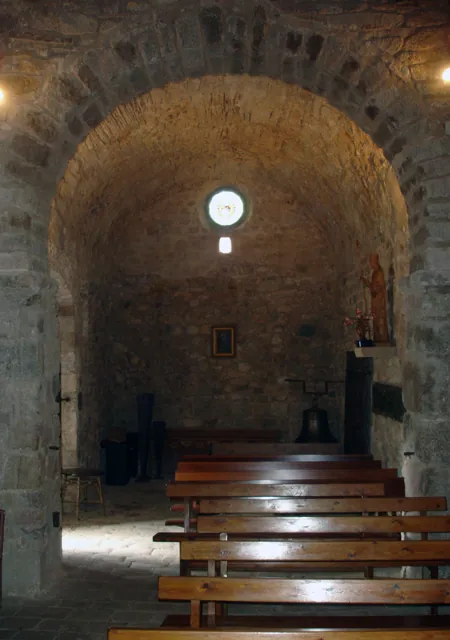





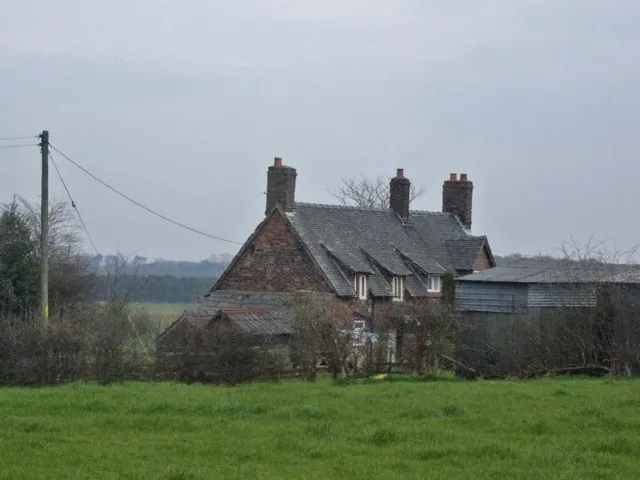

Real photographs taken with this camera. The sensitivity shown is recorded in each file's own EXIF data; they were not made under test conditions, and none is a very dark scene.
Like that look? See recent eBay sold listings for this camera ↗
On eBay right now
Live listings for this camera, supplied by eBay and updated automatically. We earn a commission if you buy through them.
The little wins
Battery life
The CIPA rating was 370 shots, which DPReview listed as good and PhotographyBLOG's own spec page repeats.15 Sony's launch release claimed about 310 shots; our sources do not explain the difference.3 Imaging Resource's test gave about 202 minutes of capture with the screen on.2
Build
DPReview's pros list includes superb build quality and a wide range of optional accessories.1
How it drew the picture
DPReview called the results excellent, with good resolution and dynamic range, and found them almost identical to the P150's; it also saw some edge softness at wide apertures and barrel distortion of about 1.8 percent at wide angle.1 Imaging Resource measured about 1,550 lines of strong detail, measured barrel distortion at the wide end at about 0.8 percent, and found colour vivid but natural, slightly warm, with more orange skin tones than the P150.2 PhotographyBLOG was less happy with the default settings: files were quite soft at Normal sharpening, which it suggested raising, and image quality overall was rated above average.4 Print size was a point of agreement. Imaging Resource called print quality excellent, with good-looking 13 by 19 inch prints, and PhotographyBLOG said the camera made strong A4 prints.24












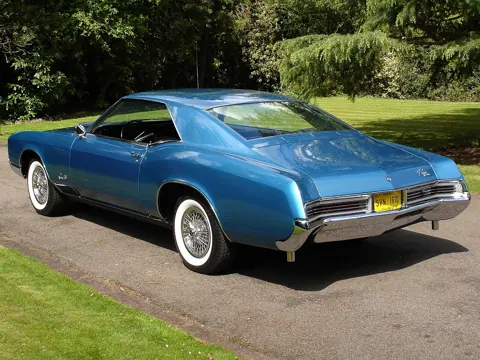



Photos taken with this camera, from Wikimedia Commons, credited under each picture.
Where it let you down
DPReview's cons list ran to a flash it called usable rather than outstanding, a body shape that could worsen camera shake at slow shutter speeds, and limited continuous shooting.1 PhotographyBLOG timed the zoom at about two seconds from wide to tele, slow for a 3x lens.4 The camera records only to Memory Stick or Memory Stick PRO, not SD; see our Memory Stick guide and the glossary.5
What the reviewers said in 2005
| Outlet | Date | Verdict |
|---|---|---|
| Imaging Resource | 16 Mar 2005 | A Dave's Pick: strong resolution, quick, good battery and low-light results; the trade is subtle detail lost to noise reduction.2 |
| DPReview | 12 Oct 2005 | Highly Recommended, with no numeric score; a minor upgrade on the P150, and good value at a street price of $370.1 |
| PhotographyBLOG | 24 Oct 2005 | 4 out of 5; a great pocket camera for people who mainly shoot outdoors or indoors with flash, not for those who often need fast ISO settings.4 |
DPReview said much of its text carried over from its P150 review.1 We could not read Trusted Reviews' page for this model, so we do not cover it.
The timeline
- 5 January 2005Sony announces the P200 at CES, for under $400.3
- February 2005Sony's stated shipping month; Imaging Resource lists availability as February 2005.23
- 16 March 2005Imaging Resource's review, with a suggested price of $399.2
- 12 October 2005DPReview's review, at a $370 street price.1
- 24 October 2005PhotographyBLOG's review.4
Should you buy one now?
Buy one if you want a quick, solid 2005 CCD compact that is happy outdoors and in flash-lit rooms and that you will leave at ISO 100 or 200. Its launch price was under $400;3 what it sells for now is a question for the sold listings, not for us. We have not tested a unit. Before you bid, check these:
- The model. The P200 has the 7.2-megapixel sensor and the 2.0-inch screen; the older P150 has a 1.8-inch one.3
- The battery. It uses an NP-FR1;5 a fresh one is on Amazon ↗.
- The card. It takes Memory Stick or Memory Stick PRO.5
- The screen. Look for scratches on the 2.0-inch LCD.
- The lens. Check that it extends and retracts cleanly.
If you are wondering why cameras like this are being hunted down again, we tell that story once, in Pictures that never left the card. A later, cheaper Sony of the same family is our DSC-W80 retrospective.
See recent sold prices on eBay ↗Shop on eBay ↗NP-FR1 battery ↗
Sources
- DPReview, Sony Cyber-shot DSC-P200 review by Simon Joinson (12 Oct 2005)
- Imaging Resource, Sony Cyber-shot DSC-P200 review (16 Mar 2005; MSRP $399, availability February 2005)
- Imaging Resource news, Sony introduces the 7.2-megapixel DSC-P200 (announced 5 Jan 2005 at CES)
- PhotographyBLOG, Sony Cyber-shot DSC-P200 review, Ease of Use, Image Quality and Conclusion pages (24 Oct 2005)
- PhotographyBLOG, Sony Cyber-shot DSC-P200 specifications page (24 Oct 2005)
Photographs are credited under each one, all via Wikimedia Commons. Links to eBay and Amazon are affiliate links.