Sony Cyber-shot F series · announced August 2003
The Sony Cyber-shot DSC-F828: the 8-megapixel bridge camera with a fourth colour
We found no other regional name for it; Sony's US release and the reviews we read all use DSC-F828.124
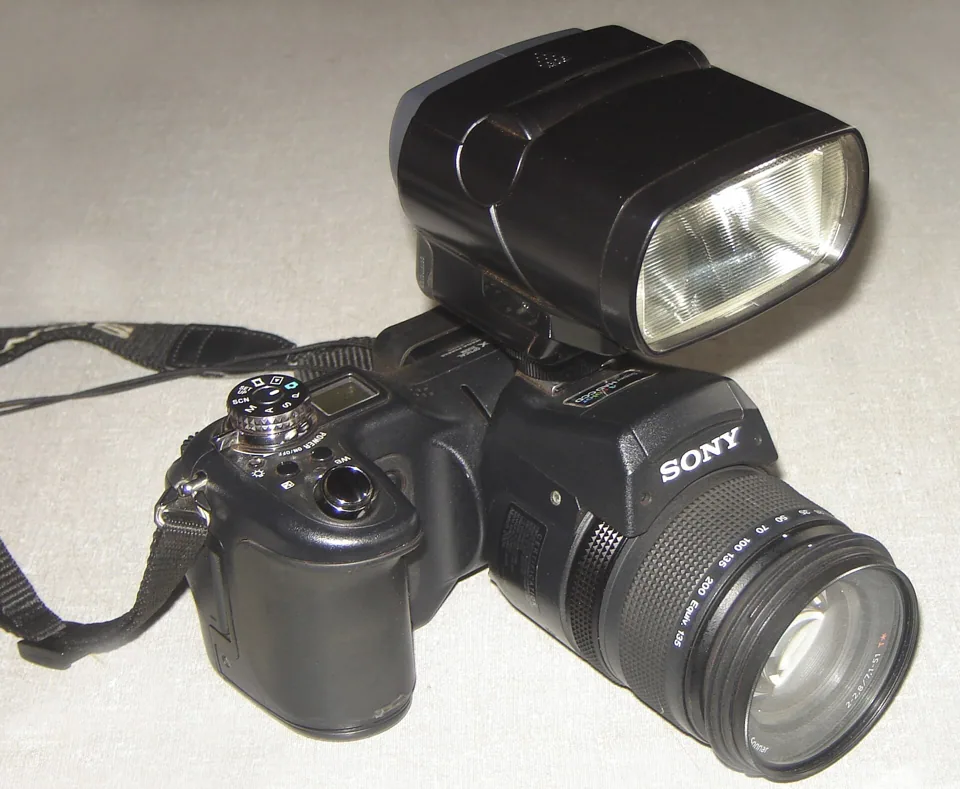

In 2003 Sony put an 8-megapixel sensor into a black magnesium body with a twisting lens barrel, and added an emerald pixel to the red, green and blue ones. Reviewers praised how fast it was, then spent pages on noise and colour fringes.
- Launched
- August 2003
- Sensor
- 8 MP CCD
- Lens
- 28–200 mm, 7×
- Card
- Memory Stick, Memory Stick Pro, CompactFlash
- Battery
- NP-FM50
Sony Cyber-shot DSC-F828 specs: sensor, lens, battery, memory card and cable
The Sony Cyber-shot DSC-F828 is an 8 MP CCD compact camera with a 28–200 mm (35 mm equivalent) 7× zoom lens, launched in August 2003 at about $1,200. It runs on the NP-FM50 battery. Sources
- Sensor
- CCD, 2/3", 8 MP source
- Lens
- 28–200 mm equivalent, 7× zoom source
- Memory card
- Memory Stick, Memory Stick Pro, CompactFlash source
- Battery
- NP-FM50 source
- USB / A/V cable
- See our Sony cable page
Meet the camera
It is a big camera: 134 by 91 by 157 millimetres, with the lens barrel doing most of the work.3 Weights differ by source and by what is counted: Photo Review listed 832 g without accessories on its review page and 906 g with battery and cards in its pricing news, Cameralabs 925 g with battery, Imaging Resource 978 g with batteries, and Steve's Digicams 955 g on its spec table.67839 Sony announced it on 15 August 2003 as the next F-series enthusiast model, in a black magnesium alloy body, and the first with its four-colour filter sensor and Real Imaging Processor.1 DPReview's timeline puts it fifth in a line that began with the F505 in 1999.4
The body twists: the lens barrel tilts about 70 degrees up and 30 degrees down against the grip, so you can frame at ground level or over a crowd.2 Sony's release quoted a suggested price of about $1,200 with mid-November availability, and said the older F717 would carry on at about $800.1 Imaging Resource's data sheet lists $1200 too, with an availability date of 1 October 2003;3 DPReview's table says $999 in the US and £799 in the UK,4 and retailer lists on archived Steve's Digicams and CNET pages showed Sony's own store at $999.95;95 CNET gave a release date of 15 December 2003.5 Photo Review's Australian pages show $2599 with a 256 MB card in September 2003 and an RRP of $1999 on the review page.76 We can only show you the disagreement. The lens range is a smaller one: Sony's release gave the zoom as 28 to 280 mm,1 Imaging Resource's introduction says 28 to 215 mm, and its data sheet and every other source we read say 28 to 200 mm, which we use.234695
Why this one was interesting
A fourth colour in the sensor
Instead of red, green, blue and a second green, the sensor's filter used red, green, blue and "emerald", a cyan-like colour; Sony said this moved colour closer to human vision, especially blues, blue-greens and reds.12 DPReview thought the result more pleasing than the F717's,4 and Imaging Resource saw the benefit in preserved detail in saturated red flowers and called the handling of saturated reds and yellows excellent.2 Cameralabs, writing two decades later, was not sure it saw any benefit in the writer's own pictures; the one effect noticed was a tint on raw files opened in a current version of Adobe Camera Raw, which they wondered might come from the filter.8
A zoom you turn by hand
The 28 to 200 mm lens had a ring around the barrel coupled directly to the lens, with focus handled by a second, electronic ring; the F717's electronic zoom was gone.24 Imaging Resource said it greatly preferred this to the F717's "fly by wire" zoom, and DPReview put the excellent mechanically linked zoom ring in its list of pluses.24
Speed, and a lens that could see in the dark
Imaging Resource called the autofocus system the fastest of any prosumer camera it had tested and the shutter release the fastest of any camera at any price range, measuring 9 milliseconds of prefocused lag.2 Sony said a new processor cut processing time by nearly 40 percent.1 Sony's infrared NightShot and NightFraming modes, with a hologram focus light, let it frame and focus in total darkness.12 It also added a CompactFlash slot beside Memory Stick, which Imaging Resource said removed a barrier for buyers with CF cards already.2
What was lost
The F828 was bulkier than the F717: Photo Review said it weighed about 250 g more,6 and Cameralabs said it was roughly 50 percent heavier.8 Imaging Resource found the grip big enough that the reviewer's wife and assistant both thought it awkward.2 Sony said the F717 would stay on sale at about $800.1 Cameralabs added that the F828 was the last Sony to carry the NightShot mode, and the last of its F series.8
The dark: its weak point
Noise and colour fringes decided the verdicts. Imaging Resource found more noise than the best 5-megapixel cameras, not objectionable at low ISO but objectionable by ISO 400, and with a large grain.2 DPReview noted the tiny 2.7-micron pixels, measured the F828 about a third of a stop less sensitive than the F717 at the same setting, and wrote that many observers had worried about the small pixel pitch but that the chromatic aberration was the surprise.4 Photo Review said stills showed noise above ISO 200.6 In the dark, Imaging Resource got clear, bright pictures down to about 0.67 lux with good colour at all five ISO settings, but more noise than top 5-megapixel cameras showed.2 CNET found images noticeably noisy at ISO 200 and above, but somewhat cleaner than those from most competing 8-megapixel viewfinder cameras, especially at ISO 400.5
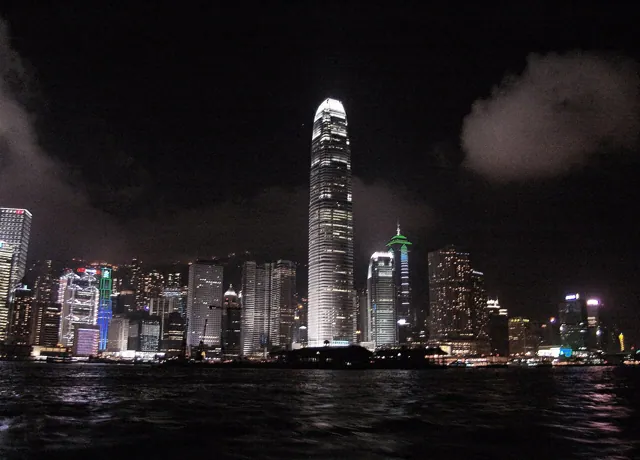



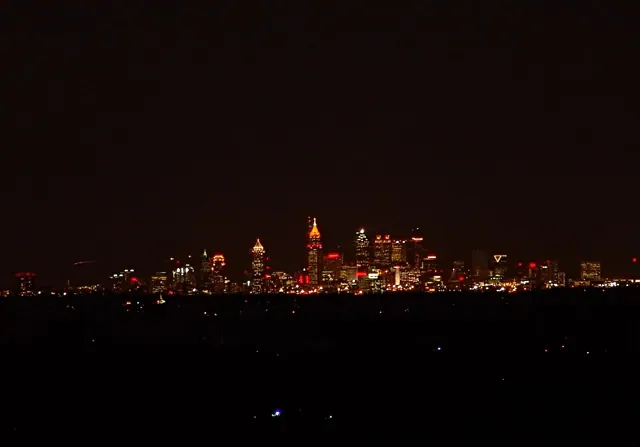

Real photographs taken with this camera. The sensitivity shown is recorded in each file's own EXIF data; we did not find ISO 800 files among the free photos we checked.
The fringing: Imaging Resource saw the "purple fringe" around bright objects but less than other reviewers did, and measured chromatic aberration of nine or ten pixels either side of the test lines.2 DPReview called it a huge pity, visible throughout the zoom range and worst at 28 mm and f/2.0.4 Photo Review listed strong fringing in backlit, contrasty scenes, and CNET called chromatic aberration the camera's Achilles' heel, while saying most of its pictures showed none that would catch the eye in an 8 by 10 print.65 DPReview also found one real picture in several hundred where a green turned cyan in an overexposed area; Imaging Resource saw the same effect only very slightly.42
Like that look? See recent eBay sold listings for this camera ↗
On eBay right now
Live listings for this camera, supplied by eBay and updated automatically. We earn a commission if you buy through them.
The little wins
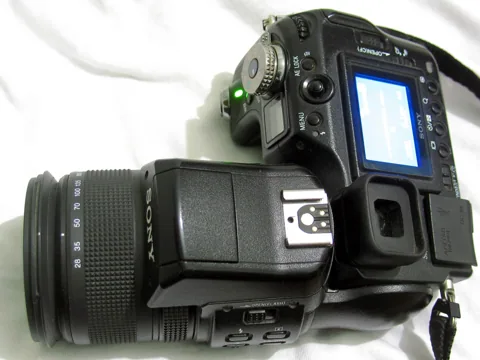 The F828 seen from above and behind, with its rear screen and viewfinder. · order_242 from Chile · CC BY-SA 2.0 · Commons

Immediate
Imaging Resource timed 1.5 seconds from power-on to first shot, a shutter lag of 0.25 seconds at wide angle with full autofocus (0.69 at full telephoto), and 0.009 seconds when prefocused.2 The shot-to-shot time was about 1.3 seconds.2
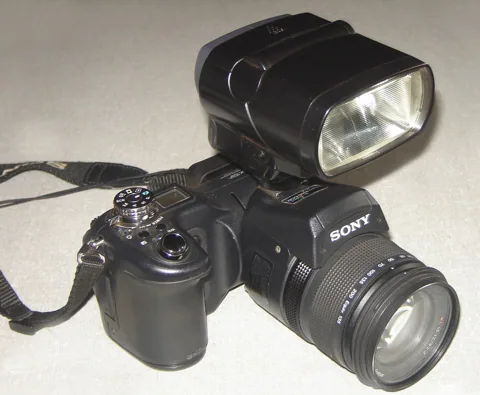 The F828 with its HVL-F32X flash. · Jose Reynaldo da Fonseca · CC BY 2.5 · Commons
Raw files, a first for the line
Imaging Resource said raw mode was new to the Sony line, and Steve's Digicams called it the first Cyber-shot with a raw mode and the first prosumer camera with an 8-megapixel imager.29 File sizes disagree: Cameralabs gave TIFF and raw as about 17 and 24 MB, while Imaging Resource's table has raw at 17.4 MB and TIFF at 24.0 MB.82
A tripod-friendly swivel
Imaging Resource liked the tilting barrel for studio and ground-level macro work, and praised Sony for keeping the card and battery compartments away from the tripod screw so you can change the battery while mounted.2
Video that kept up
Photo Review called its video outstanding and DPReview called the 640 by 480, 30 frames-per-second recording superb, though still not MPEG-4.64 Cameralabs noted that standard cards were limited to 16 fps, and that a Memory Stick PRO or Microdrive was needed for 30.8
Frame in the dark
Imaging Resource found framing and focusing possible in total darkness thanks to the hologram focus light and infrared night framing.2
How it drew the picture
Imaging Resource found 1,600 to 1,650 lines of strong detail on its resolution chart, with extinction at about 1,950 lines, the best of any prosumer digicam it had tested to that date.2 DPReview scored image quality 7.5 out of 10 and the lens and sensor combination 7, and said the picture quality was where the camera started to disappoint.4 Photo Review said the pictures were sharp and detailed, with accurate colours, but affected by noise and colour shifts and by sharpening artefacts along dark edges.6 Imaging Resource called its normal colour a tad oversaturated and found the Real colour mode natural looking.2
















Photos taken with this camera, from Wikimedia Commons, credited under each picture. They are all at ISO 64 according to their EXIF data, by several different photographers.
Where it let you down
Raw capture was slow: Imaging Resource timed 13.5 seconds per shot with a Memory Stick PRO and 15.3 with CompactFlash, with no buffer, and CNET listed very slow raw capture among its dislikes.25 Burst mode held seven pictures at about 2.65 frames a second, then paused.2 DPReview disliked a shutter-release lock that made you wait before pressing again, and noted no custom settings or Adobe RGB option; CNET listed the lack of custom settings and of Adobe RGB too.45 At closest macro distance the long lens barrel blocked the flash, Imaging Resource found, with softness in the corners and barrel distortion.2
What the reviewers said in 2003 and 2004
| Outlet | Date | Verdict |
|---|---|---|
| Imaging Resource | Posted 15 Aug 2003, updated 5 Feb 2004 | A technological tour de force held back by noise and fringing; a provisional Dave's Pick for resolution and sports use, but not for general enthusiast use.2 |
| DPReview | 10 Jan 2004 | Rated Recommended; the reviewer wrote that it "just scraped through" and was still on the edge of Above Average; sub-ratings from 7 to 9 out of 10.4 |
| CNET | 7 Jun 2004 | 7.8 out of 10, "Very good", on the archived review, which carries an editor's note that the rating was changed to reflect a new rating scale; an earlier archived summary page shows 7.9 "Good". A lot to offer enthusiasts who do not shoot much raw.5 |
| Photo Review | Undated | Strengths: accurate colours, a fast wide zoom, ring controls and video; weaknesses: no user memories, fringing, noise above ISO 200.6 |
| Cameralabs | 8 Apr 2024 | Despite more fringing and noise than the writer wanted, called it one of the best vintage digital cameras.8 |
We read the Imaging Resource, DPReview and CNET reviews in full (CNET from an Internet Archive copy). For Photo Review and Steve's Digicams we could read only a summary or first page, so those entries are thinner. Cameralabs, writing in 2024, notes that Canon launched the EOS 300D, which it calls the first sub-$1000 DSLR, the same year, and argues that affordable DSLRs doomed bridge cameras like this one.8
The timeline
- 15 August 2003Sony announces the DSC-F828 in the US; Imaging Resource first posts its review; the version we read was updated on 5 February 2004.12
- September 2003Photo Review, an Australian site, reports a price of $2599 with a 256 MB Memory Stick PRO card and mid-December sales.7
- 15 December 2003The release date shown on CNET's page.5
- 31 December 2003Steve's Digicams posts its full review.9
- 10 January 2004DPReview publishes its review.4
- 7 June 2004CNET's review date.5
Should you buy one now?
Buy one if you want a big, quick, manual-feeling camera with an eight-megapixel CCD and fast optics, you will shoot at low ISO in daylight, and you can live with fringing. Sony listed it at about $1,200;1 what it sells for now is a question for the sold listings, not for us. Cameralabs says another reason people look for it is that a magnet held near the accessory port can move its infrared-blocking filter, giving a full-spectrum camera (or, with a filter, an infrared one) without a permanent conversion; we have not tried it.8 Before you bid, check these:
- The name. Search the DSC-F828; we found no other regional name.12 See our W55 and T9 reviews for the small Cyber-shots Sony sold a few years later.
- The battery. It uses an NP-FM50;2 Cameralabs said original packs are unlikely to hold a charge today, and that a replacement is needed along with an original AC-L15 adapter to charge in the camera.8 A fresh pack is on Amazon ↗.
- The card. It takes Memory Stick and Memory Stick PRO, and CompactFlash Type I or II;1 Cameralabs used a Pro Duo card in an adapter.8 See our memory card guide.
- The lens. Check that the zoom ring turns smoothly and the glass is clean; the barrel should tilt and click back to centre.28
- The bundle. Sony packed a hood, AC adapter and in-camera charger, A/V and USB cables, strap and lens cap, but no card.129
If you are wondering why cameras like this are being hunted down again, we tell that story once, in Pictures that never left the card.
See recent sold prices on eBay ↗Shop on eBay ↗NP-FM50 battery ↗
Sources
- Sony Electronics press release, Eight Megapixels Just Part of the Picture With Sony's Latest High-End Digital Camera (San Diego, 15 Aug 2003)
- Imaging Resource, Sony Cyber-shot DSC-F828 review by Dave Etchells (first posted 15 Aug 2003, updated 5 Feb 2004), pages 1 to 12
- Imaging Resource, Sony DSC-F828 data sheet (retail price $1200, availability 1 Oct 2003)
- DPReview, Sony Cybershot DSC-F828 review by Phil Askey (published 10 Jan 2004)
- CNET Reviews, Sony Cyber Shot DSC-F828 review by Aimee Baldridge (review date 7 Jun 2004; read in full from an Internet Archive copy of 31 Dec 2006, which shows 7.8 Very good; an earlier archived copy of the summary page shows 7.9 Good and a retailer price list)
- Photo Review (Australia), Sony Cyber-shot DSC-F828 review summary page (undated; full text not on the page we could read)
- Photo Review (Australia), Pricing Announced for Sony DSC-F828 Camera (September 2003)
- Cameralabs, Sony Cyber-shot F828 retro review by Gordon Laing (8 April 2024, 21 years after launch)
- Steve's Digicams, Sony Cyber-shot DSC-F828 review, first page (full review posted 31 Dec 2003; Internet Archive copy; later pages not retrievable)
Camera photos by Jose Reynaldo da Fonseca (CC BY 2.5) and order_242 (CC BY-SA 2.0); other photographs are credited under each one, all via Wikimedia Commons. Links to eBay and Amazon are affiliate links.