Sony Cyber-shot P · announced February 2004
The Sony Cyber-shot DSC-P93: the 2004 five-megapixel compact that ran on AA batteries
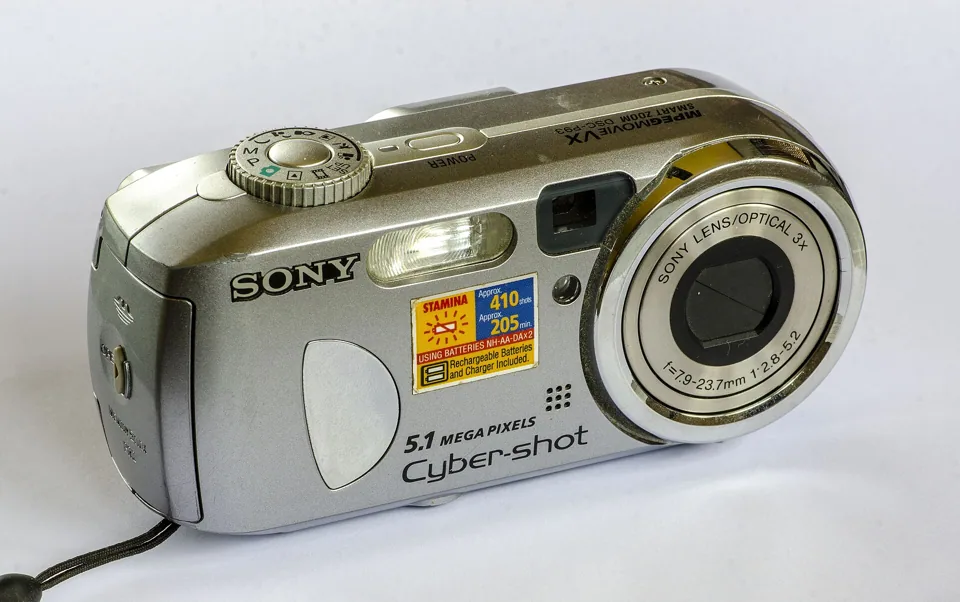

Sony’s middle P-series model of 2004 had a 5.1-megapixel sensor, a quick shutter and a removable lens ring, for about $350. Reviewers liked its speed and disagreed about its colour, its resolution and whether it fitted a pocket.
- Launched
- May 2004
- Sensor
- 5.1 MP CCD
- Lens
- 38–114 mm, 3×
- Card
- Memory Stick, Memory Stick PRO
- Battery
- AA
Sony Cyber-shot DSC-P93 specs: sensor, lens, battery, memory card and cable
The Sony Cyber-shot DSC-P93 is a 5.1 MP CCD compact camera with a 38–114 mm (35 mm equivalent) 3× zoom lens, launched in May 2004 at about $350. It takes Memory Stick and Memory Stick PRO cards and runs on AA batteries. Sources
- Sensor
- CCD, 1/1.8", 5.1 MP source
- Lens
- 38–114 mm equivalent, 3× zoom source
- Memory card
- Memory Stick, Memory Stick PRO source
- Battery
- AA source
- USB / A/V cable
- See our Sony cable page
Meet the camera
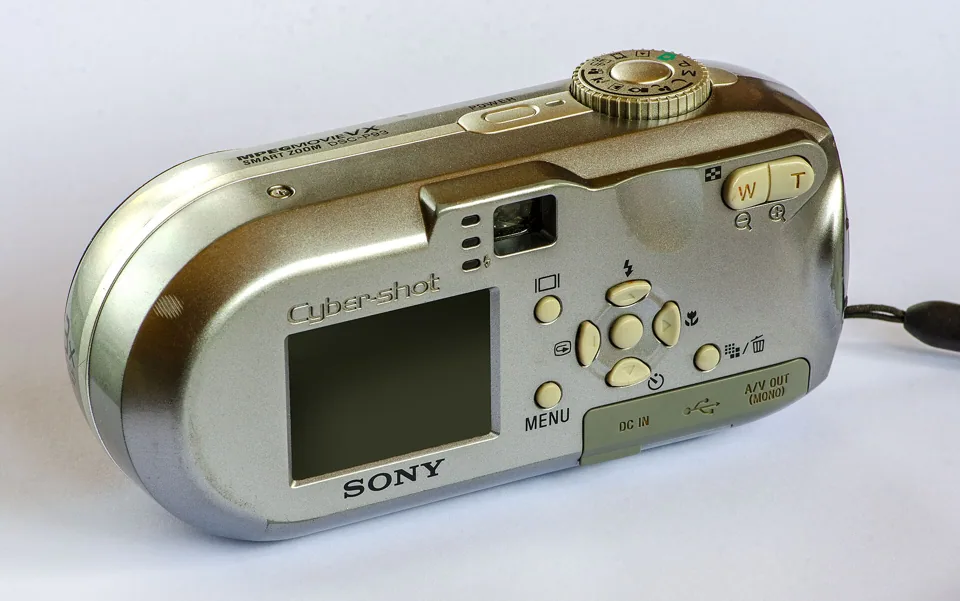
It is a long, rounded compact with the lens barrel at one end.9 Imaging Resource described a slender, elongated shape that suits a shirt pocket, with a built-in shutter-like lens cover and a lens that telescopes about three-quarters of an inch.2 Reviewed.com saw the same shape differently: it compared the body to a small electric razor and said the width makes carrying hard without a case.6 Steve’s Digicams called it small enough for a pocket or purse.5 Imaging Resource gave the size as 117 by 54 by 36 millimetres and 236 grams with batteries and card;2 Steve’s Digicams and Photo Review gave 175 grams, the latter explicitly without batteries and card, and Steve’s listed 236 with them.37 Sony’s own list, as Imaging Resource printed it, says 190 grams “without supplied accessories”, a different basis, so the bare-weight figures do not line up.1
Sony announced it on 11 February 2004 at the PMA show in Las Vegas, together with the P41, P73 and P100, and said all four would be available in May.1 Imaging Resource’s report put the P93 at $350 and the P73 at $300,1 and its review header gives $349 as the introductory price.2 Reviewed.com’s value section quotes $329.95.6 Our sources give the camera one name, DSC-P93, and we found no regional alias.
Why this one was interesting
Squeezed between two siblings
The P93 sat between the 4-megapixel P73 and the P100. Imaging Resource said it was virtually identical to the P73 apart from the sensor; in its tests the P93’s lens looked slightly better and its noise was slightly higher yet looked better to the eye, but it preferred the P73’s colour, because the P93 had a slight reddish cast.2 Steve’s Digicams told readers who did not need five megapixels to look at the P73, which it said cost about $50 less.5 Reviewed.com pointed the other way: for about $50 more it saw no reason not to buy the P100, which it measured at 4.17 megapixels of real resolution against the P93’s 3.1, and scored 8.51 for colour against 6.28.6 Imaging Resource’s report said the P100 adds a 2.5-inch screen, three more scene modes, a docking cradle and a rechargeable InfoLithium battery, in a body smaller and lighter than the P93.1 Photo Review noted the two share a sensor, but the P93 has a Sony-branded lens that focuses no closer than 10 cm in macro mode, where Sony’s release gave the P100 a Carl Zeiss lens.71
Quick for 2004
Sony credited a new Real Imaging Processor for fast start-up and shot-to-shot times.1 Imaging Resource said the shutter response placed it among the fastest consumer digicams at any price and called start-up quick enough, if not spectacular.2 The stopwatches differ by tester. Steve’s Digicams, using a 512 MB Memory Stick PRO, got a first picture in 2.5 seconds, a shutter lag of 0.1 seconds pre-focused and 0.4 with autofocus, and about 1.2 seconds between shots without flash.5 Reviewed.com timed 2.7 seconds to start up, 0.32 seconds of shutter lag and 1.5 seconds between shots.6 Photo Review averaged 0.35 seconds with focusing and 0.2 pre-focused.7 A CNET excerpt reproduced by PhotographyBlog put the burst rate at 1.4 frames a second, while Steve’s Digicams fitted nine Fine pictures into about 6.1 seconds, then needed 8 seconds to clear the buffer.85
A manual mode with two apertures
Imaging Resource called the P93 a scaled-down version of Sony’s W1, with a manual mode that gives shutter speeds from 30 seconds to 1/1000 but only two aperture choices, f/2.8 and f/5.6, and no shutter or aperture priority.2 Photo Review listed the two apertures as a weakness.7 Steve’s Digicams still found six scene modes plus program and manual exposure enough to suit both beginners and intermediate shooters.5
What was lost
Against the P100, the P93 gave up the larger screen, three scene modes, the cradle and the InfoLithium battery, according to Imaging Resource’s report.1 It has no custom white balance: Steve’s Digicams noted that only presets are available,5 and Reviewed.com said it was baffled that Sony had not added one.6 The optical viewfinder is small and has no dioptre adjustment.246 Video at 640 × 480 and 30 frames a second needs a Memory Stick PRO card,23 and Reviewed.com said settings cannot be changed while recording.6 Photo Review also faulted the memory card supplied as inadequate.7
The sources do not agree on the card in the box. Sony’s press release said the P41, P73 and P93 came with a 16 MB Memory Stick; Sony’s specification list for the P93 says 32 MB, and Imaging Resource’s own review prints both numbers.12 Reviewed.com says 32 MB; Steve’s Digicams prints 32 MB in its text and in one line of its specification page, and 16 MB in the accessories line of the same page.643
The dark: reviewers split
Imaging Resource called the low-light performance surprisingly good: usable, colourful pictures down to its limit of about 1/16 of a foot-candle, with very low noise at ISO 100 and only moderately high noise at ISO 400.2 It could focus in complete darkness on nearby subjects with the autofocus lamp, and Steve’s Digicams called low-light autofocus exceptional.25 Reviewed.com disagreed on noise: it called ISO 100 competent and 200 adequate, but said ISO 400 was fraught with noise, and that anyone who wants more than outdoor and flash shooting may be let down.6 Photo Review said noise was generally low in its low-light shots.7
The flash is another split. Steve’s Digicams found indoor portraits well exposed with natural skin tones, red eye effectively eliminated and close-up flash shots excellent, because the camera throttles the flash down; it also noted the range is limited, about 11.5 feet in its words.5 Imaging Resource found the flash too far to the side for even lighting at the closest macro distance.2 White balance indoors is the third: Imaging Resource and Photo Review both said household incandescent light gave trouble,27 and Reviewed.com saw rosy, brown or bluish casts,6 while Steve’s Digicams said the auto setting was effective.5
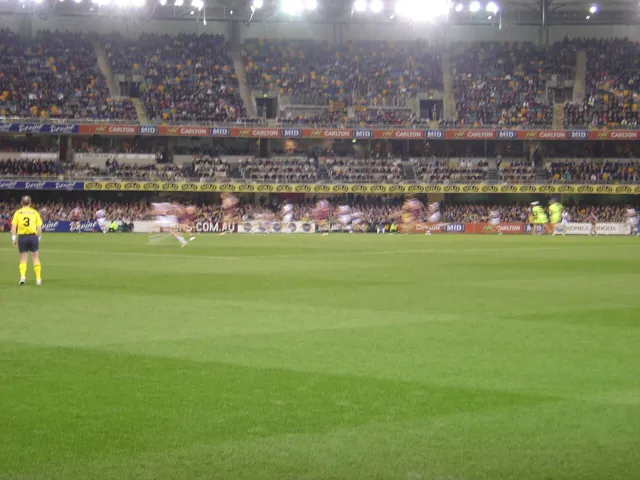







Real photographs taken with this camera. The sensitivity shown is recorded in each file’s own EXIF data (the camera stops at ISO 400); the files were not made under test conditions.
Like that look? See recent eBay sold listings for this camera ↗
On eBay right now
Live listings for this camera, supplied by eBay and updated automatically. We earn a commission if you buy through them.
The little wins
Smart Zoom
It crops the middle of the sensor without interpolating: 3.8x total at 3 megapixels, 6.1x at 1 megapixel, 12x at VGA.5 Imaging Resource called this the most reasonable approach to digital zoom;2 Reviewed.com was lukewarm, noting that it goes only one step beyond the optical zoom.6
Light for the autofocus
Imaging Resource said the lamp let the camera focus in total darkness on nearby subjects, and that without it the camera still focused routinely down to about an eighth of a foot-candle.2
How it drew the picture
Imaging Resource’s chart showed strong detail to about 1,300 lines vertically and 1,350 horizontally, but said strong noise suppression flattened subtle detail such as hair.2 Photo Review said the anti-noise processing smothered the finest detail.7 Reviewed.com’s chart test produced images worth about 3.1 megapixels, 61 per cent of the pixels, which it called not stellar.6 Colour divides the reviewers too. Imaging Resource found good hue and saturation, with natural skin tones outdoors;2 Steve’s Digicams called its outdoor shots richly saturated, with very little fringing and moderate barrel distortion at wide angle;5 Reviewed.com measured a mean saturation of 97.34 per cent, one of the few cameras it had tested below 100, with under-saturated blues and greens;6 and Photo Review found its pictures less contrasty and less saturated than the P100’s, and warmer.7 For prints, Steve’s Digicams said 11 by 14 inches would please,5 against Imaging Resource’s summary of sharp 8 by 10s.2

















Photos taken with this camera, from Wikimedia Commons, credited under each picture. We used only files whose EXIF model reads DSC-P93; some Commons files carry DSC-P93A, a suffix we found no source to explain, and we left them out.
Where it let you down
Reviewed.com was the hardest on handling: it called the viewfinder nearly impossible to use, found the zoom buttons small enough to press by mistake and the hinge of the port cover flimsy, and said the autofocus gave softer pictures than rivals, so it shot some scenes more than once.6 Imaging Resource measured the optical finder at about 82 per cent of the frame, while the screen was close to 100.2 Steve’s Digicams’ complaint was the small icons and exposure text on the screen, and that the screen image does not brighten when the flash is used.5
Battery life is where the numbers disagree most. Sony’s label says 410 shots,9 and Steve’s Digicams, using the supplied 2100 mAh NiMH cells, got about 250 pictures with heavy screen use.5 The CNET excerpt reported almost 1,000 shots on 1,850 mAh cells.8 Imaging Resource could not run its power test, because of the camera’s non-standard power connector.2
What the reviewers said
| Outlet | Date | Verdict |
|---|---|---|
| Steve’s Digicams | 23 Jun 2004 | A 2004 upgrade of the P92 with a better autofocus system, conversion-lens support and a $50 lower launch price; good image quality and impressive speed, and a family camera. Choose the P73 if you do not need the resolution.35 |
| Imaging Resource | Header reads 07/09/03, which predates the camera’s announcement; we do not use it | A Dave’s Pick: a good all-round camera for an affordable price with fast shutter response and surprisingly good low light; held back by aggressive noise reduction.2 |
| Reviewed.com | 2 Sep 2004 (page metadata) | A bit bulky and cumbersome, but a strong candidate for point-and-shoot buyers; weak colour accuracy and resolution, and the P100 is worth the extra $50. Value scored 7.0 at $329.95.6 |
| Photo Review | Undated | Listed high functionality for the price, a small well-built body and fast response as strengths, and limited macro, two apertures, a poor supplied card and weak incandescent white balance as weaknesses.7 |
PhotographyBlog’s news item shows CNET also reviewed it, in a piece reported on 10 February 2005;8 we read only the excerpt, so we do not cover CNET’s overall verdict. We found no full DPReview or Cameralabs review.
The timeline
- 11 February 2004Sony announces the P41, P73, P93 and P100 at PMA 2004, promising May availability.1
- May 2004The month Sony’s release said all four would ship, at about $350 for the P93.1
- 23 June 2004Steve’s Digicams posts its review.3
- 2 September 2004The date in Reviewed.com’s page metadata for its review.6
- 10 February 2005PhotographyBlog reports CNET’s review.8
Should you buy one now?
Buy one if you want a fast, plain 2004 CCD compact that runs on AA cells, takes conversion lenses and rewards good daylight, and you can accept a tiny viewfinder, a missing custom white balance and a verdict on colour that depends on whom you ask. It launched at about $350;1 what it sells for now is a question for the sold listings, not for us. Before you bid, check these:
- The model. The P93 has 5.1 megapixels and a 1.5-inch screen; the P73 is virtually identical apart from a 4.1-megapixel sensor (Imaging Resource also gives the P73’s screen half the P93’s pixels),2 and the P100 has a 2.5-inch screen and an InfoLithium battery.1
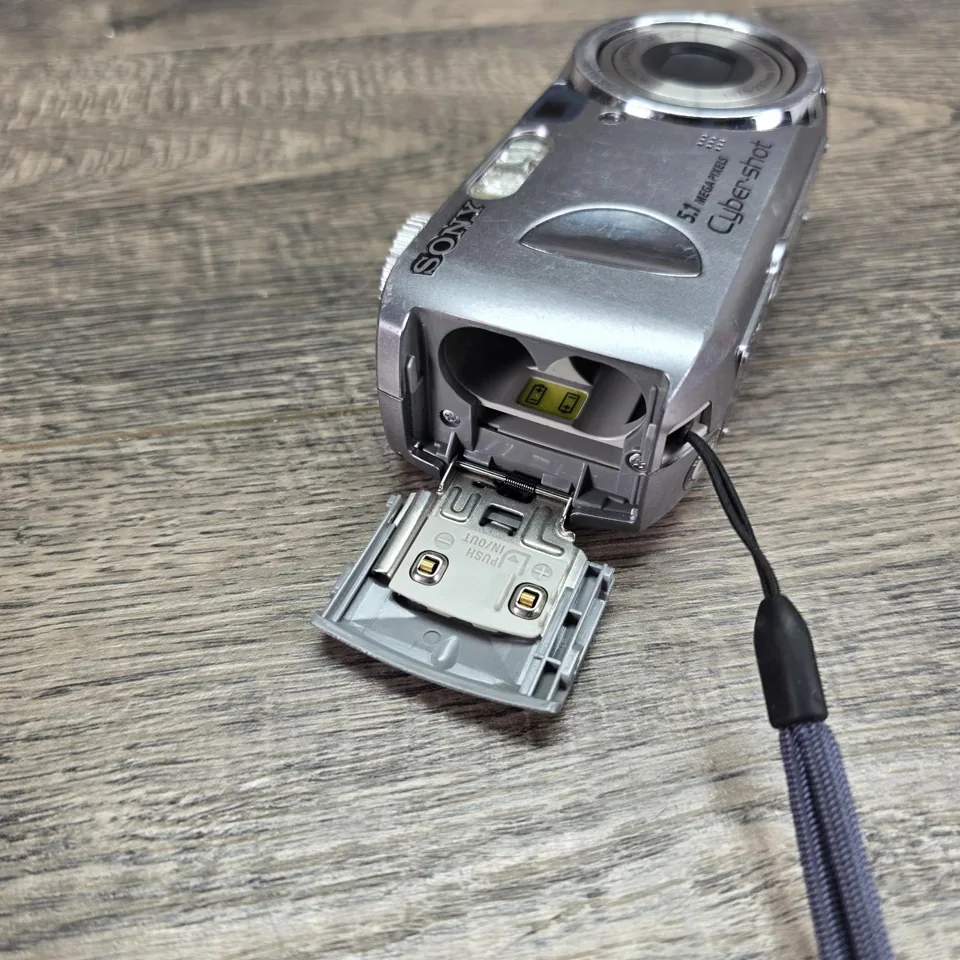
- The batteries. It takes two AA cells; Imaging Resource urged high-capacity NiMH over alkaline,2 and Steve’s Digicams’ unit shipped with 2100 mAh cells.5 A fresh pair is on Amazon ↗; see also our guide to CCD digicams that run on AA batteries.
- The card. It takes Memory Stick or Memory Stick PRO; Sony’s list says tested up to 1 GB and that it does not support the Access Control security function.1 30 fps video needs PRO.2 See our memory card guide.
- The lens and ring. Make sure the lens cover opens and the lens extends and retracts cleanly,2 and check the chrome ring around it, which comes off to fit the optional VAD-PEB conversion-lens adapter.4
- The doors. Reviewed.com thought the hinge of the cover over the USB, video and power sockets flimsy; check it and the battery door on the right side.6
The previous year’s AA-powered P-series camera is in our DSC-P72 retrospective. If you are wondering why cameras like this are being hunted down again, we tell that story once, in Pictures that never left the card.
See recent sold prices on eBay ↗Shop on eBay ↗NiMH AA batteries ↗
Sources
- Imaging Resource, “Sony announces four P-series digicams” by Mike Tomkins (12 Feb 2004); reproduces Sony USA’s press release dated 11 Feb 2004 and Sony’s specification list for the P41, P73, P93 and P100
- Imaging Resource, Sony Cybershot DSC-P93 review (the page’s header reads “07/09/03” and “Availability May, 2004”; we do not rely on the header date)
- Steve’s Digicams, Sony Cyber-Shot DSC-P93 review, introduction and specifications (posted 23 June 2004; archived copy of 1 Oct 2004)
- Steve’s Digicams, Sony DSC-P93 review, “Features & Controls” page (archived copy of 15 Sep 2004)
- Steve’s Digicams, Sony DSC-P93 review, “Steve’s Conclusion” page (archived copy of 31 Dec 2004)
- Reviewed.com, Sony Cyber-shot DSC-P93 digital camera review (credited on the page to James Murray; the page’s own metadata dates it 2 Sep 2004)
- Photo Review (Australia), Sony Cyber-shot DSC-P93 (no date printed; the page’s metadata says 17 Feb 2012, which we do not treat as the review date; a short review of about 250 words)
- PhotographyBlog, “Sony DSC-P93 Review at CNET” (news item, 10 Feb 2005, quoting one paragraph of CNET’s review; we read only that excerpt)
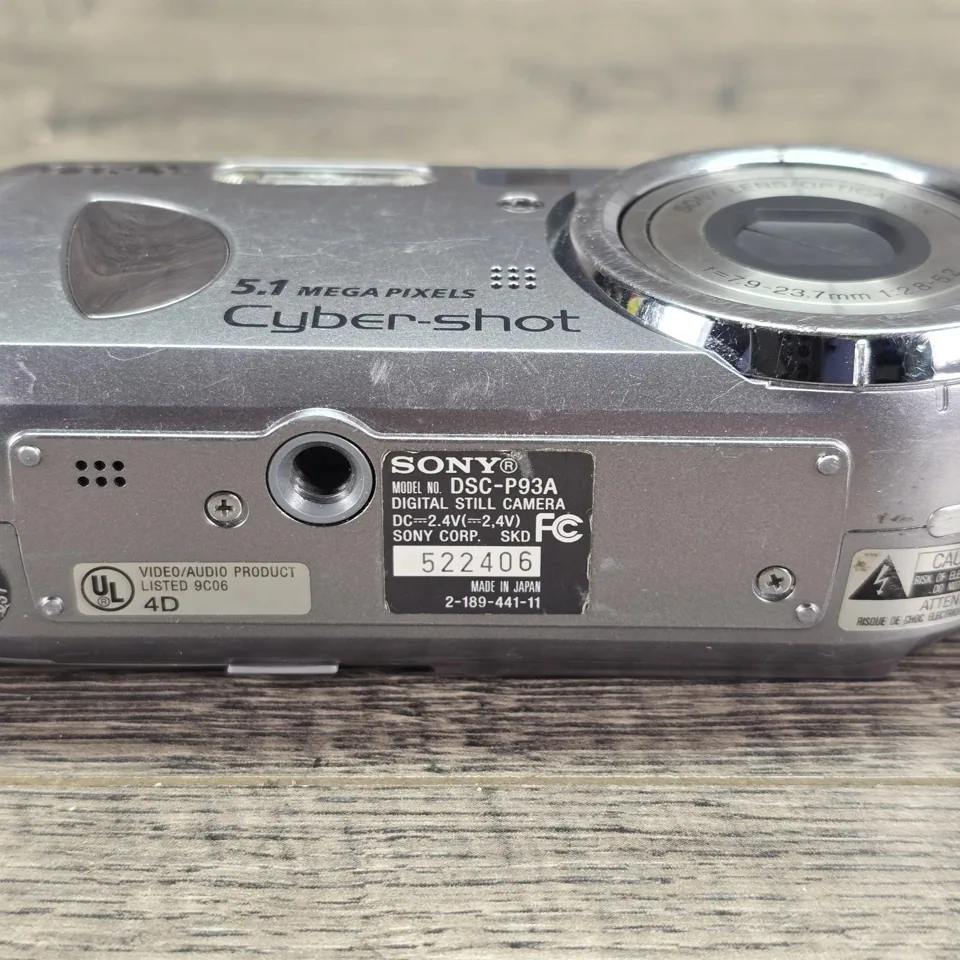
- Wikimedia Commons, “Cámara Sony Cyber-shot frontal.jpg” (front photo of a DSC-P93 by Amfeli, CC BY 4.0; the label on the camera is readable)
Photographs are credited under each one, all via Wikimedia Commons. Links to eBay and Amazon are affiliate links.