Panasonic Lumix TZ / ZS · on sale March 2016
The Panasonic Lumix DMC-ZS100 (TZ100): a one-inch sensor and a ten-times zoom in a coat pocket
Sold in Europe as the Lumix DMC-TZ100.
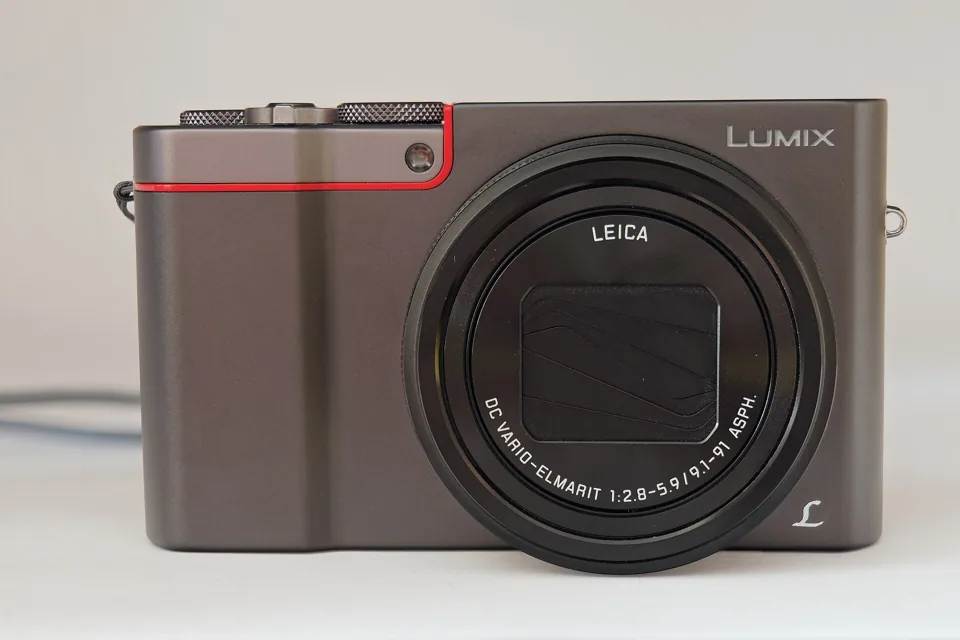
Panasonic's 2016 travel zoom swapped the tiny sensor of every ZS before it for a 20-megapixel, one-inch-type one, and kept a viewfinder and a 25–250 mm lens. Reviewers loved the pictures and the focus, then aimed many of their complaints at the viewfinder and the slick body.
- Launched
- March 2016
- Launch price
- $699.99 · £549.991
- Sensor
- 20.1 MP CMOS
- Lens
- 25–250 mm, 10×
- Card
- SDHC, SDXC
- Battery
- DMW-BLG10
Panasonic Lumix DMC-ZS100 specs: sensor, lens, battery, memory card and cable
The Panasonic Lumix DMC-ZS100 (also sold as the Lumix DMC-TZ100) is a 20.1 MP CMOS compact camera with a 25–250 mm (35 mm equivalent) 10× zoom lens, launched in March 2016 at $699.99. It takes SDHC and SDXC cards and runs on the DMW-BLG10 battery. Sources
- Sensor
- CMOS, 1", 20.1 MP source
- Lens
- 25–250 mm equivalent, 10× zoom source
- Memory card
- SDHC, SDXC source
- Battery
- DMW-BLG10 source
- Also sold as
- Lumix DMC-TZ100
- USB / A/V cable
- See our Panasonic cable page
Meet the camera
The ZS100's pitch is its sensor: a 1-inch-type chip and a 10x zoom in a small body. Imaging Resource called it the first ZS-series camera built around a 1-inch-type sensor.2 The sensor has 20.1 effective megapixels; in front of it sits a Leica-branded 10x lens covering 25 to 250 millimetres in 35 mm terms, with an aperture of f/2.8 at the wide end and f/5.9 at the long end.13 The body measures about 110.5 by 64.5 by 44.3 millimetres and weighs roughly 310 grams with battery and card.1 Sources disagree on the sensor's dimensions: Imaging Resource lists 13.2 by 8.8 mm,3 while New Atlas gave 12.8 by 9.6 mm; we show the former, and neither source is Panasonic.4
New Atlas covered the announcement on 7 January 2016, alongside the cheaper TZ80 / ZS60, and gave the price as $700 and the on-sale date as March.4 Imaging Resource lists availability as 03/2016 and a US price of just under $700.3 PhotographyBLOG gave the exact launch prices as £549.99 and $699.99,1 and DPReview's review gives an MSRP of $699.5 DPReview says the DMC-ZS100 is the DMC-TZ100 outside North America, and PhotographyBLOG, a UK site, reviewed it as the TZ100.51
- ISO
- 125 to 12800, extended 80 to 256001
- Viewfinder and screen
- 0.2-inch EVF with about 1.17 million dots; 3.0-inch, 1.04 million dots, touch, fixed1
- Video
- 4K at 24 or 30 fps, Full HD up to 60 fps (Imaging Resource, New Atlas); PhotographyBLOG's spec sheet lists 4K at 25p and 24p and Full HD at 50p241
- Card and battery
- SDHC/SDXC (a U3 card for 4K) · DMW-BLG10, 300 shots on the screen, 260 with the EVF312
- Size
- 110.5 × 64.5 × 44.3 mm, about 310 g1
- Launch price
- $699.99 · £549.991
Why this one was interesting
A big sensor with a real zoom
PhotographyBLOG reported Panasonic's own claim that this was the first compact with a one-inch sensor and a notable 10x zoom, agreed in its conclusion that rivals from Sony, Canon and Nikon had none of this zoom, and saw no like-for-like competition;1 we have not checked that claim against every rival, and New Atlas, covering the announcement, framed the camera more modestly as the latest compact with a 1-inch-type sensor, set against Sony's RX100 IV and Canon's G7 X.4 PhotographyBLOG listed Canon's G9 X and Sony's RX100 IV among its rivals.1 Our Canon G7 X review covers another one-inch compact of the period.
Focus that did not wait
The ZS100 focuses by depth from defocus, a system PhotographyBLOG found close to instant in bright light and only slightly slower in dim light.1 Imaging Resource measured a full autofocus lag of 0.102 seconds at wide angle and 0.106 at telephoto, against 0.026 seconds when pre-focused, and found it still able to focus in light below minus 2 EV.2
A viewfinder at all
Our ZS3 review notes no viewfinder at all. The ZS100 has a tiny one that switches on when you raise it to your eye.1 PhotographyBLOG found it small but useful in bright sunlight.1 Neocamera's pre-production unit had an eye sensor that handled the switch between viewfinder and screen well, though they found the viewfinder too low in resolution to confirm focus.6 For the earlier, simpler cameras in the line, see the Lumix DMC-ZS3 and DMC-ZS7; for the enthusiast alternative from the same maker, the Lumix DMC-LX7.
What was lost
The long end was the compromise: Imaging Resource's cons list includes a lens that is not very sharp at longer focal lengths, soft corners, a slow f/5.9 maximum aperture at telephoto, a small viewfinder, a slippery body, no hot shoe, a fixed screen and a small, weak flash.2 The same review found corners soft at the wide end when the lens is fully open, and the 250 mm end soft even at the centre.2 Amateur Photographer, looking back in 2025, found it sharp up to about 100 millimetres and noticeably softer beyond.7
The dark: its weak point
Reviewers graded it on a curve for its size, and said where the curve ended. PhotographyBLOG shot eight sensitivities from ISO 125 to 12800 and found detail stayed sharp at ISO 800 and 1600, with smoothing growing more visible at smaller print sizes; very dark, high-ISO pictures, it said, were a little less than perfect, which it thought normal for one-inch compacts.1 Imaging Resource saw a drop in quality at ISO 400, more blur and luminance noise at 800, a crystalline look at 3200 and heavy noise from 6400 up; its prints were good at 20 by 30 inches up to ISO 200, 8 by 10 at ISO 1600 and 4 by 6 at ISO 6400.2 In the field, the same team found ISO 800 JPEGs good but over-sharpened in camera, and raw files noisier.2 In 2025 Amateur Photographer found detail loss from noise and noise reduction detectable as low as ISO 400, was happy shooting up to ISO 1600, and called ISO 6400 about as high as you would want to go.7
Want to see how it handled a real scene? See recent eBay sold listings for this camera ↗
On eBay right now
Live listings for this camera, supplied by eBay and updated automatically. We earn a commission if you buy through them.
The little wins
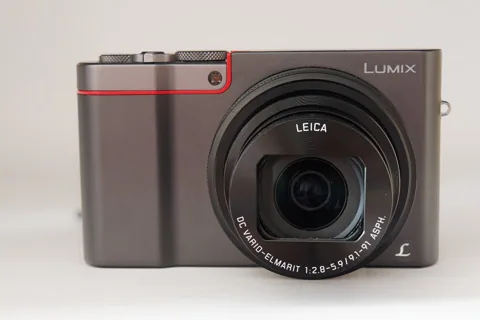 The lens extended: the ring sits around the barrel. · Alexxx1979 · CC BY-SA 4.0 · Commons
A lens ring and a lot of buttons
A control ring around the lens, a mode dial, a control dial and four function buttons sit alongside five customisable touchscreen buttons, which PhotographyBLOG called a pleasing number of buttons and dials.1 Neocamera, with its pre-production unit, also liked how far dials and touch functions can be customised, but found the ring has no click-stops and can turn by accident.6
Two kinds of burst
Imaging Resource measured about 9.9 frames a second in JPEG, and a Super High Speed mode that reaches 50 frames a second at five megapixels.2
4K Photo and Post Focus
The camera pulls eight-megapixel stills out of 4K video, and Post Focus records a burst at different focus points; PhotographyBLOG thought it suited static subjects, macro in particular, and said shallow depth of field works better than on the TZ80 because of the larger sensor.12 Neocamera noted that Post Focus outputs eight megapixels with a crop of about 1.48x.6
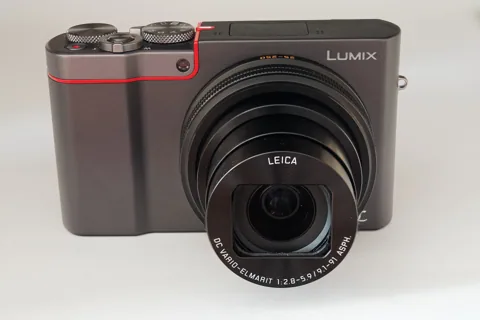


How it drew the picture
PhotographyBLOG scored image quality 4.5 out of 5: JPEGs warm and vibrant without looking unrealistic, excellent detail at A4 and smaller, chromatic aberration handled well with only slight purple fringing, and files a little soft at the default sharpening setting.1 Imaging Resource measured detail out to about 2,500–2,600 lines, but rated JPEG dynamic range poor for its class, with highlights clipping in harsh sun, and colour slightly below average; it reported barrel distortion of about 0.3 percent in JPEG and about 3.7 percent in uncorrected raw at the wide end.2 DPReview's scores were 7.6 for JPEG quality, 8.0 for raw and 7.8 for low light.5 Amateur Photographer's lab tests, on raw files, found at least 3,400 lines per picture height at low ISO and a measured dynamic range of 12.4 EV at ISO 100.7


















Photos taken with this camera, from Wikimedia Commons, credited under each picture. The first two, underground shops in Chur and an Amavita shop at Zurich airport, were shot at ISO 800 according to their EXIF data.
Where it let you down
The body is slippery: PhotographyBLOG found no textured grip and recommended the strap, and Imaging Resource found the smooth finish slippery and some rear buttons small and recessed.12 The screen is fixed, which PhotographyBLOG thought a pity but guessed would have raised the price.1 When PhotographyBLOG reviewed it, raw files could not yet be opened in Adobe Camera Raw, and it pointed to the SILKYPIX software available from Panasonic's website.1 The automatic white balance leaned slightly warm under some artificial light for PhotographyBLOG,1 but Imaging Resource found it a touch cool under incandescent bulbs.2 Imaging Resource found the macro flash coverage uneven, with the lens shadowing the bottom of the frame, and a flash recycle time of 2.8 seconds.2 Neocamera's list of nuisances also included a touchscreen that is easily brushed, shifting the focus point, though its unit was pre-production and the first click of a dial was sometimes ignored.6
What the reviewers said
| Outlet | Date | Verdict |
|---|---|---|
| PhotographyBLOG | 25 Feb 2016 | 4.5 out of 5. In many respects the perfect compact camera for travelling photographers, with the fixed screen, small viewfinder and missing grip as the problems it picked.1 |
| Imaging Resource | Feb–Jun 2016 | 4 out of 5 and a Dave's Pick: a very compelling compact travel zoom in the conclusion, while its field-test summary called it "solid, albeit unspectacular".2 |
| DPReview | 4 Apr 2016 | 82 percent and its top award; a top-notch travel zoom with a mediocre viewfinder (from its summary and conclusion; we did not read the body of the review).5 |
| Amateur Photographer | 3 Jun 2025 | Four and a half stars on the page badge; the best pocket travel camera money can buy right now, with a small viewfinder and a fixed screen as cons.7 |
The timeline
- 7 January 2016New Atlas reports the announcement, at $700 and due in March.4
- 25 February 2016PhotographyBLOG publishes its review.1
- March 2016On sale, per Imaging Resource's table.3
- 4 April 2016DPReview's review lists an 82 percent score.5
- 24 June 2016Imaging Resource posts its conclusion.2
- June 2025Amateur Photographer publishes a long look at it, nine years on.7
Should you buy one now?
Buy one if you want a small camera with a one-inch sensor, a 25–250 mm zoom and 4K video, and can live with a small viewfinder, a fixed screen and a soft long end. It launched at $699.99;1 what it sells for now is a question for the sold listings, not for us. Before you bid, check these:
- The name. It is the DMC-ZS100 in the US and the DMC-TZ100 in Europe, so search both.52
- The battery. It uses a DMW-BLG10;3 a fresh one is on Amazon ↗.
- The card. It takes SDHC and SDXC cards, and Imaging Resource recommends at least 32 GB at UHS Speed Class 3 for 4K;3 see our memory card guide.
- The lens ring. Neocamera found it has no click-stops and can turn by accident, so check that it moves smoothly and that the lens extends and retracts cleanly.6
- The grip. The finish is slippery, so a strap helps.12
If you are wondering why cameras like this are being hunted down again, we tell that story once, in Pictures that never left the card.
See recent sold prices on eBay ↗Shop on eBay ↗DMW-BLG10 battery ↗
Sources
- PhotographyBLOG, Panasonic Lumix DMC-TZ100 review by Amy Davies (25 Feb 2016): price, specifications, handling, image quality
- Imaging Resource, Panasonic ZS100 review by Mike Tomkins, Jeremy Gray, Zig Weidelich and Dave Pardue (First Shots 24 Feb 2016, performance tests 20 Apr, Field Test 20 May, conclusion 24 Jun 2016)
- Imaging Resource, Panasonic ZS100 basic specifications (availability 03/2016, DMW-BLG10, SDHC/SDXC; price in the summary text)
- New Atlas, Panasonic ZS100 / TZ100 announcement by Simon Crisp (7 Jan 2016)
- DPReview, Panasonic Lumix DMC-ZS100/TZ100 review (4 Apr 2016; scores, expert summary, conclusion, MSRP and regional name only; the body of the written review was not read)
- Neocamera, Panasonic ZS100 review, usability page only (21 Apr 2016; pre-production unit; no author named)
- Amateur Photographer, Panasonic Lumix DMC-TZ100 review by Andy Westlake (3 Jun 2025, updated 16 Jun 2025): a nine-years-later look with lab figures
Camera photos by Alexxx1979 (CC BY-SA 4.0); other photographs are credited under each one, all via Wikimedia Commons. Panasonic's own pages were not read: launch facts come from the press and from Imaging Resource's table. Links to eBay and Amazon are affiliate links.