Panasonic Lumix FX · on sale spring 2008
The Panasonic Lumix DMC-FX35: the slim compact that gave Panasonic its first 25 mm lens
Sold in Asia, Australia and New Zealand as the Lumix DMC-FX36; the two are otherwise identical.31
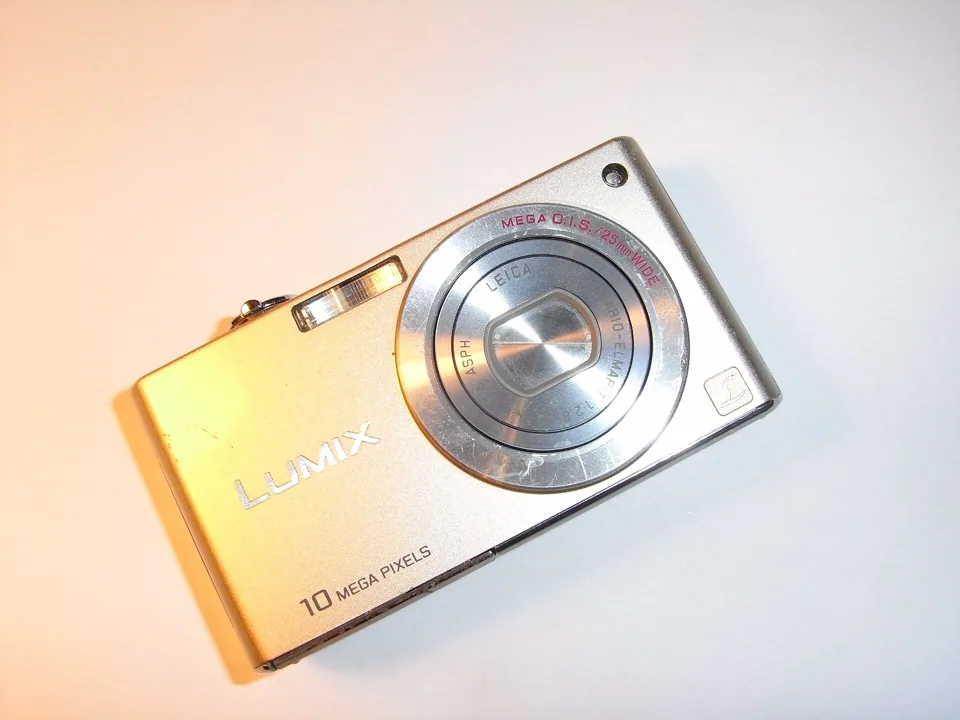

In January 2008 Panasonic took its slim FX-series compact, widened the lens from 28 to 25 millimetres, added a 10-megapixel sensor and 720p video, and priced it at $349.95. Reviewers loved the lens and the build, then spent their test charts arguing about noise.
- Launched
- January 2008
- Sensor
- 10.1 MP CCD
- Lens
- 25–100 mm, 4×
- Card
- SD, SDHC, MMC
- Battery
- DMW-BCE10E
Panasonic Lumix DMC-FX35 specs: sensor, lens, battery, memory card and cable
Launched in January 2008 at $349.95, the Panasonic Lumix DMC-FX35 is a 10.1 MP CCD compact with a 25–100 mm (35 mm equivalent) 4× zoom lens. Inside: it takes SD, SDHC and MMC cards and runs on the DMW-BCE10E battery. Sources
- Sensor
- CCD, 1/2.33", 10.1 MP source
- Lens
- 25–100 mm equivalent, 4× zoom source
- Memory card
- SD, SDHC, MMC. Largest, in the maker's words: SD 8 MB-2 GB; SDHC 4, 8 and 16 GB (32 GB not listed). Maker-stated source · card guide · all cards
- Battery
- DMW-BCE10E source
- USB / A/V cable
- See our Panasonic cable page
What is the biggest SD card the Panasonic Lumix DMC-FX35 takes?
The Panasonic Lumix DMC-FX35 takes SD, SDHC, MMC. The maker's words on size: SD 8 MB-2 GB; SDHC 4, 8 and 16 GB (32 GB not listed). A 64 GB card is SDXC, which this row does not name. Maker-stated source
More: SD, SDHC and SDXC guide · lookup table · the full memory card guide
Meet the camera
It is a slim, all-metal pocket camera. Trusted Reviews measured it at 94.7 by 51.9 by 22.0 millimetres and 146 grams with battery and card (125 grams without),5 and Cameralabs said the body was unchanged from its predecessor, the FX33, with a cross-hatched Lumix logo for grip and raised dots on the back as a thumb rest.3 Imaging Resource cited the metal tripod socket as part of its solid build.4 The headline was the lens: a Leica-branded 4x zoom covering 25 to 100 millimetres, where the FX33 began at 28.31
Panasonic announced it on 29 January 2008 in Las Vegas, quoting a suggested price of $349.95 for March in silver, black and blue.12 Trusted Reviews put the UK list price at nearly £300 while noting that shops were selling it for around £170 by the time of its review.5
Why this one was interesting
Three millimetres that changed the frame
Trusted Reviews worked out the horizontal angle of view as about 71.5 degrees, against 65.5 for a 28 mm lens and 54.4 for 35 mm, and said it meant fitting half a room into the frame.5 Panasonic called it its first-ever 25 mm ultra-wide lens,1 and the zoom grew from 3.6x to 4x by extending the wide end while the telephoto end stayed at 100 mm.3 The price of that choice is a short reach: 100 millimetres, which Trusted Reviews noted is less than most 3x zoom compacts.5
An auto mode that thinks
Panasonic's Intelligent Auto picked the scene, metering and ISO for you.5 Cameralabs called the Intelligent Auto mode very good, but found the Intelligent Exposure feature had little effect in its tests.3 Face detection tracked up to 15 faces and worked even on near-profile subjects.3
HD video, of a sort
The FX33 had no high-definition video; the FX35 shot 1280 by 720.31 Cameralabs found the footage noisy and the sound weak, better than the older standard-definition modes but no substitute for a camcorder.3 An optional cable carried the picture to a high-definition TV.31
The cheaper FX33 and the 10x TZ5 were its closest relatives; of the TZ5, Cameralabs noted the same sensor, a bigger and sharper 3-inch screen and a longer zoom, against the FX35's smaller body and about 20 percent lower price.3 A year later the line grew a longer lens in our Lumix DMC-ZS3 review; the enthusiast compact of the same period is our Lumix DMC-LX3.
What was lost
The mode dial shrank from eight settings to five (Intelligent Auto, Normal, Scene, Movie and Clipboard), with a small slider switch on the back to change between shooting and playback.35 Cameralabs found almost no control over shutter and aperture: two apertures, and no manual exposure.3 Imaging Resource found the menus cluttered and hard to navigate, and Cameralabs reported that RAW is not supported.43
The dark: its weak point
All three full reviews listed noise among the weak points but disagreed about where it started. Cameralabs saw noise and processing artefacts in shadows and flat colour at ISO 100, more softening at 200, a significant drop at 400 and 800, and called ISO 1600 an emergency setting; its advice was to shoot at ISO 100 and 200 at most, and it judged the FX35 arguably slightly worse than the FX33 at higher sensitivities.3 Imaging Resource saw visible noise even at ISO 100, colour starting to degrade around 800, and mottled shadow detail; its print guide called ISO 400 usable at 8 by 10 inches and 800 better for 5 by 7.4 Trusted Reviews was kinder: ISO 200 had no real noise problems, ISO 400 was where noise reduction began erasing detail, and 800 and 1600 got progressively worse.5 The same reviewer's verdict nevertheless called the low-light performance exceptionally good, and its autofocus worked well in dim light, with an assist lamp that could focus in total darkness at about three metres.5
We could not find a free photo from this camera with a high ISO recorded in its file, so this page shows no low-light strip.
Want to judge the noise yourself? See recent eBay sold listings for this camera ↗
On eBay right now
Live listings for this camera, supplied by eBay and updated automatically. We earn a commission if you buy through them.
The little wins
Close focus
Cameralabs listed macro focusing from 5 centimetres, and its 5 cm test shot gave decent results.3
Quick to shoot
Trusted Reviews timed start-up at about 2.5 seconds and a shot every 1.7 seconds in single mode; Imaging Resource called prefocused shutter lag fast.54
A pocketable tool
Imaging Resource's pros list: compact and well built, a wide 25 mm lens, good colour accuracy, 16:9 shooting and 720p video.4
How it drew the picture
Cameralabs measured about 2,050 lines per picture height horizontally and 2,100 vertically on its resolution chart, slightly above the FX33's 1,950 and 2,000, and said the extra two megapixels were hard to see in real life: against a 6-megapixel Fujifilm F30 (see our F30 review) the FX35 showed little extra detail, and was softer in the extreme top-left corner.3 Imaging Resource also found corner sharpness poor at both ends of the zoom, while Trusted Reviews said the corners blurred only a little at wide angle;45 the reviewers disagreed. Trusted Reviews saw highlights tend to over-expose, leaving burned-out spots in contrasty scenes, while Imaging Resource noted high contrast outdoors.54 A DigiCamReview review quoted by PhotographyBLOG found excellent colour and very low purple fringing, with red-eye in group photos.6


















Photos taken with this camera, from Wikimedia Commons, credited under each picture. Most are daylight scenes from a handful of uploaders, so this is a thin sample.
Where it let you down
Imaging Resource listed a weak flash, slow autofocus and poor low-light results among the cons, a view Trusted Reviews did not share about autofocus, which it found fast and reliable.45 Zoom could not be used during video,3 and Imaging Resource found an Eye-Fi card too slow for HD video, so a faster card was needed.4 Panasonic claimed 290 shots per charge, which Cameralabs found optimistic, though Imaging Resource still listed battery life as a strength.134 Cameralabs' high-speed burst dropped to 2 megapixels, and its standard burst captured only three frames at fine quality.3
What the reviewers said in 2008
| Outlet | Date | Verdict |
|---|---|---|
| Cameralabs | 18 Mar 2008 | 86 percent, Highly Recommended: a slim, light, well-built compact with unusually wide coverage; noise above ISO 200 and little manual control hold it back.3 |
| Imaging Resource | 13 Jun 2008 | Not a bad little camera, but not a Dave's Pick: image quality and menus were the main complaints.4 |
| Trusted Reviews | Undated page | One of the best feature-packed luxury compacts with a wide zoom and stabiliser; cons listed were high-ISO noise and slightly over-exposed shots.5 |
| PhotographyBLOG | 27 Jul 2008 | Roundup only: it quotes DigiCamReview's very good image quality and higher-than-average noise, good at ISO 400 or below.6 |
Cameralabs compared it with the Canon PowerShot SD870 IS (see our SD870 IS review): similar price, 8 megapixels, a 28–105 mm lens and a 3-inch screen, and better at high ISO, against the Panasonic's HD video and smarter auto modes.3
The timeline
- 29 January 2008Panasonic announces the FX35 in Las Vegas, at $349.95.1
- 30 January 2008TechCrunch relays the announcement.2
- 18 March 2008Cameralabs publishes its review.3
- 13 June 2008Imaging Resource publishes its review.4
- 27 July 2008PhotographyBLOG publishes its roundup.6
- 11 December 2008PhotographyBLOG reviews the FX37, which adds a 5x zoom, new scene modes, AF tracking and better battery life.7
Should you buy one now?
Buy one if you want a metal pocket camera with a real wide angle for daylight snapshots and can live with noisy shadows and no manual control. It launched at $349.95;1 what it sells for now is a question for the sold listings, not for us. Before you bid, check these:
- The name. Search the DMC-FX35, and also the FX36, its Asian name.3 The FX37 that followed has a 5x zoom and is a different camera.7
- The battery. Cameralabs names it as a 1,000 mAh DMW-BCE10E;3 a fresh one is on Amazon ↗.
- The card. It takes SD, SDHC and MultiMediaCard media;1 see our memory card guide.
- The screen and glass. Look for scratches on the 2.5-inch screen and the lens.
- The lens. Check that it extends and retracts cleanly.
If you are wondering why cameras like this are being hunted down again, we tell that story once, in Pictures that never left the card.
See recent sold prices on eBay ↗Shop on eBay ↗Battery ↗
Sources
- Imaging Resource, Panasonic announces the Lumix DMC-FX35 by Mike Tomkins (29 Jan 2008) with press release and spec table
- TechCrunch, Panasonic's Lumix FX35: Classy 25mm wide-angle shots, by John Biggs (30 Jan 2008)
- Cameralabs, Panasonic Lumix DMC-FX35 / FX36 review by Gordon Laing (18 Mar 2008, nine pages)
- Imaging Resource, Panasonic Lumix DMC-FX35 review by Mike Pasini (13 Jun 2008)
- Trusted Reviews, Panasonic Lumix DMC-FX35 review (undated page, written in 2008)
- PhotographyBLOG, Panasonic Lumix DMC-FX35 (27 Jul 2008): a short roundup of a DigiCamReview review, not a full review
- PhotographyBLOG, Panasonic Lumix DMC-FX37 review by Mark Goldstein and Gavin Stoker (11 Dec 2008), the successor
Photographs are credited under each one, all via Wikimedia Commons. Links to eBay and Amazon are affiliate links.