Panasonic Lumix TZ / ZS · on sale spring 2010
The Panasonic Lumix DMC-ZS7 (TZ10): the pocket zoom that added GPS and manual control
Sold in Europe as the Lumix DMC-TZ10.
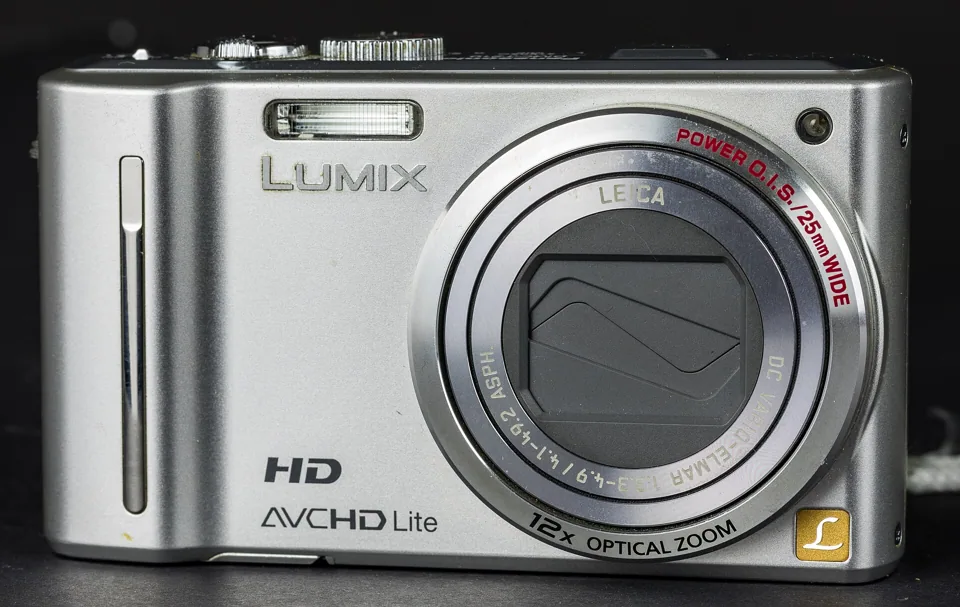
In 2010 Panasonic took its 25–300 mm pocket zoom, gave it a built-in GPS receiver and aperture and shutter priority, and listed it at about $400. Reviewers loved the video and the control, and split over the pictures and the price.
- Launched
- March 2010
- Sensor
- 12.1 MP CCD
- Lens
- 25–300 mm, 12×
- Card
- SD, SDHC, SDXC
- Battery
- DMW-BCG10
Panasonic Lumix DMC-ZS7 specs: sensor, lens, battery, memory card and cable
The Panasonic Lumix DMC-ZS7 (also sold as the Lumix DMC-TZ10) came out in March 2010 at $400 as a 12.1 MP CCD compact with a 25–300 mm (35 mm equivalent) 12× zoom lens. It takes SD, SDHC and SDXC cards and runs on the DMW-BCG10 battery. Sources
- Sensor
- CCD, 1/2.33", 12.1 MP source
- Lens
- 25–300 mm equivalent, 12× zoom source
- Memory card
- SD, SDHC, SDXC source
- Battery
- DMW-BCG10 source
- Also sold as
- Lumix DMC-TZ10
- USB / A/V cable
- See our Panasonic cable page
Meet the camera
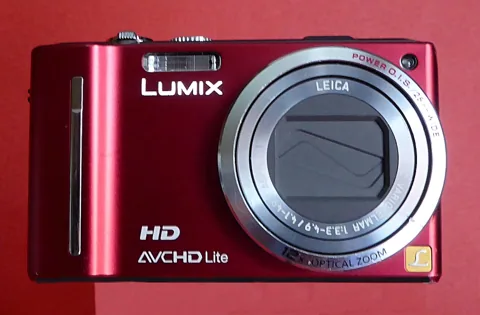
It is a metal-bodied pocket camera of 103 by 60 by 33 millimetres, which Imaging Resource lists at 217 grams and Cameralabs at 218 grams with battery and card.25 Its 12x zoom carries Leica branding and runs from 25 to 300 millimetres on a 35 mm camera.12 PhotographyBLOG listed silver, black, red and blue bodies,1 and Imaging Resource called it Panasonic's first camera with a built-in GPS receiver.2
It had two names: Panasonic sold it as the Lumix DMC-ZS7 in the United States and the DMC-TZ10 in Europe.215 Cameralabs said it was announced in January 2010,5 and Imaging Resource lists availability in March 2010 at an MSRP of $400.2 PhotographyBLOG gave £399 and $399, slightly more than the TZ7 / ZS3 at its launch;1 Expert Reviews tested it at £270 in May,3 and Photo Review in Australia listed a recommended price of A$699.4
Why this one was interesting
A travel zoom that knew where it was
PhotographyBLOG explained that the camera writes latitude, longitude and local time into each picture's data and carries a landmark database of more than half a million places.1 Cameralabs added that it shows place names, where the rival Sony HX5 showed coordinates only.5 Imaging Resource noted that no heading or altitude is given,2 and that Panasonic estimated an hour of GPS use costs about as much battery as ten shots.2
Manual control, for the first time in the series
Cameralabs called the manual exposure modes a first for the TZ series,5 and PhotographyBLOG called the added A, S and M modes by far the biggest reason to upgrade, and noted a custom position that stores up to three set-ups and two scene-mode slots.1 Imaging Resource's list of likes included the full set of exposure modes, customisable scene modes and a custom position on the dial.2 Cameralabs warned that a blurred portrait background is hard to get even with the aperture wide open.5
More pixels, same lens
Resolution rose, Cameralabs said the lens, body and screen were carried over from the TZ7 / ZS3, with an effective resolution of 12.1 megapixels, two more than that camera.5 Our Lumix DMC-ZS3 review covers that earlier camera; the enthusiast alternative in the same range was the Lumix DMC-LX5.
What was lost
PhotographyBLOG found the E.Zoom button and Dual Play gone, and its cons list named a slow zoom, slow burst and a higher launch price than the TZ7.1 Cameralabs said the unlimited burst mode had been dropped.5 Photo Review found the burst limited to three frames at full resolution.4 Expert Reviews was blunter about the economics: it recommended the cheaper TZ8 over the TZ10, and rated Samsung's WB650 above both, saying it matched the features, beat the image quality and cost less.3
The dark: its weak point
Four reviewers described the noise and agreed on the shape. PhotographyBLOG found ISO 100 and 200 noise free, ISO 400 good, and visible noise with softer detail by ISO 800, and advised keeping the maximum at 800.1 Photo Review called noise negligible at ISO 80 to 200, visible from 400 and quite obvious at 800, and thought high-ISO results better than the TZ7's.4 Imaging Resource judged ISO 800 good at 8 by 10 inches and ISO 1600 soft up close but good at 5 by 7 and smaller.2 Expert Reviews was the harshest: it saw aggressive noise reduction throughout, and said the central 12-megapixel crop of a 14-megapixel sensor gives the noise of the larger count without the extra detail.3




Real photographs taken with this camera (sold in Europe as the TZ10). The sensitivity shown is recorded in each file's own EXIF data.
Like that look? See recent eBay sold listings for this camera ↗
On eBay right now
Live listings for this camera, supplied by eBay and updated automatically. We earn a commission if you buy through them.
The little wins
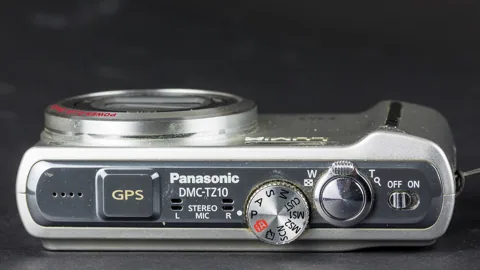 The top plate, with the GPS panel at left. · Raimond Spekking · CC BY-SA 4.0 · Commons
The stabiliser
Cameralabs said Panasonic's Power O.I.S. claims to be nearly twice as effective as the older Mega O.I.S., and its testers got sharp handheld shots at 1/20 second or slightly slower, where they needed 1/320 without stabilisation, which it put at about four stops.5 PhotographyBLOG found a noticeable gain in sharpness at slow shutter speeds.1
Video, with a hand from the lens motors
Expert Reviews called video the highlight, with silent lens motors, responsive autofocus and a high-quality soundtrack, and found that AVCHD clips were smaller and cleaner than Motion JPEG.3
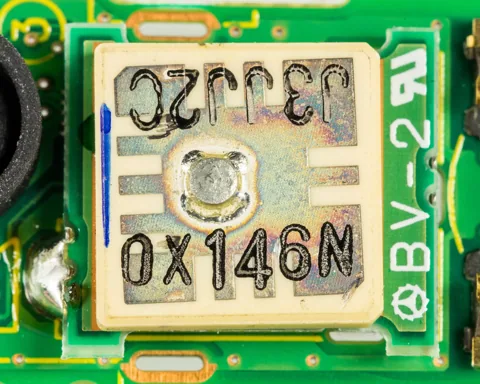 A teardown photo of the camera's GPS antenna board. · Raimond Spekking · CC BY-SA 4.0 · Commons
Place names in the picture data
Cameralabs said the place names come from a database of over half a million landmarks that cannot be upgraded, so newer landmarks are missing, and that with regular use a fix took no more than about ten seconds.5


How it drew the picture
PhotographyBLOG scored image quality 4 out of 5, called out-of-camera files soft at the default sharpening, and said it dealt very well with chromatic aberration.1 Imaging Resource saw moderate chromatic aberration at both ends of the zoom, some soft corners at wide angle, often blown highlights and under-saturated yellows, but good prints up to 16 by 20 inches at ISO 80 and 100.2 Photo Review thought resolution marginally below expectations, with edge softening.4 Expert Reviews missed definition in skin and grass even in bright light, and said digital zoom from 12x to 16x fell short of Panasonic's claims.3















Photos taken with this camera, from Wikimedia Commons, credited under each picture.
Where it let you down
There are no raw files and no viewfinder.14 Imaging Resource found the flash weak, with power that cannot be adjusted, and the menus sprawling.2 Photo Review found automatic white balance not fully accurate under incandescent or fluorescent light, and the stereo microphones short on separation.4
Reviewers disagreed on the details. PhotographyBLOG said the mode dial had been moved and was now more secure,1 while Cameralabs noted the dial had moved to the left of the shutter button and worried instead that the play and record switch is easy to leave on play and so miss a shot.5 Cameralabs found video autofocus hunting reduced against the TZ7,51 while Photo Review found video autofocus and zoom speeds just as slow.4
The GPS verdict
This is where the sources part ways most. Expert Reviews said it took 45 minutes to calculate a position and then failed to update for the following 15,3 and called the GPS slow to lock on. PhotographyBLOG found it worked well in central London, though it can keep an old position underground.1 Cameralabs said it would typically find its location in no more than ten seconds, or 20 at a push.5 The cost was the battery: PhotographyBLOG listed about 175 shots with GPS on against 300 with it off,1 while Cameralabs found a charge lasted a couple of days of regular shooting with GPS on.5
What the reviewers said in 2010
| Outlet | Date | Verdict |
|---|---|---|
| PhotographyBLOG | 10 Mar 2010 | 4.5 out of 5 and Highly Recommended (design 4.5, features 5, ease of use 4.5, image quality 4, value 4): versatile and well built, with soft files and a high launch price.1 |
| Imaging Resource | 12 Mar 2010 | 4.0 out of 5 and a Dave's Pick: the user report says it does exactly what it is told; against the Sony HX5V the reviewer would not pick a winner.2 |
| Expert Reviews | 24 May 2010 | Excellent video, disappointing photo quality for the price; buy the TZ8 or the Samsung WB650 instead.3 |
| Photo Review | Undated | 8.5 out of 10 overall and an Editor's Choice: a lightweight zoom for travellers who want advanced controls and 720p video; not for those needing raw or fast full-resolution bursts.4 |
| Cameralabs | Page dated 7 Jun 2011 | Long zoom in a pocket body with effective stabilisation, manual modes and GPS place names; the GPS drains the battery and the play and record switch is easy to leave on play. (We read the opening pages of this review, not its final verdict page.)5 |
The timeline
- January 2010Announced, according to Cameralabs.5
- 10 March 2010PhotographyBLOG publishes its review.1
- 12 March 2010Imaging Resource publishes its review; availability listed as March 2010 at $400.2
- 24 May 2010Expert Reviews publishes its review.3
Should you buy one now?
Buy one if you want a pocketable CCD zoom with a real wide angle, manual modes and decent HD video, and you can treat GPS as a bonus. It launched at about $400;2 what it sells for now is a question for the sold listings, not for us. Before you bid, check these:
- The name. It is the DMC-ZS7 in the US and the DMC-TZ10 in Europe, so search both.215
- The battery. It uses a DMW-BCG10E, which Imaging Resource said carries ID-Security to block counterfeit or third-party packs,2 so look for a genuine Panasonic battery ↗. Expect about 175 shots with GPS on.1
- The card. It takes SD, SDHC and SDXC cards;2 see our memory card guide.
- The mode dial and switch. PhotographyBLOG found the dial firmer than on the TZ7 and Cameralabs disliked the play and record switch, so check that both click properly.15
- The GPS. Switch it on in the menu4 and see whether it finds satellites; the info screen shows the lock.2
- The lens. Check that it extends and retracts cleanly.
If you are wondering why cameras like this are being hunted down again, we tell that story once, in Pictures that never left the card.
See recent sold prices on eBay ↗Shop on eBay ↗DMW-BCG10 battery ↗
Sources
- PhotographyBLOG, Panasonic Lumix DMC-TZ10 review by Mark Goldstein (10 Mar 2010)
- Imaging Resource, Panasonic DMC-ZS7 review by Mike Pasini and Zig Weidelich (12 Mar 2010; MSRP $400, specification table)
- Expert Reviews, Panasonic Lumix DMC-TZ10 review by Ben Pitt (24 May 2010)
- Photo Review (Australia), Panasonic Lumix DMC-TZ10 review (undated page)
- Cameralabs, Panasonic Lumix DMC-TZ10 / ZS7 review by Gordon Laing (page dated 7 Jun 2011)
Camera photos by Raimond Spekking (CC BY-SA 4.0) and Pierre André Leclercq (CC0); other photographs are credited under each one, all via Wikimedia Commons. Links to eBay and Amazon are affiliate links.