Panasonic Lumix FS · announced January 2009
The Panasonic Lumix DMC-FS25: the $250 slim compact with a 29 mm Leica lens
We found no other regional name for it: PhotographyBLOG's announcement uses DMC-FS25 for both the US and the UK.2
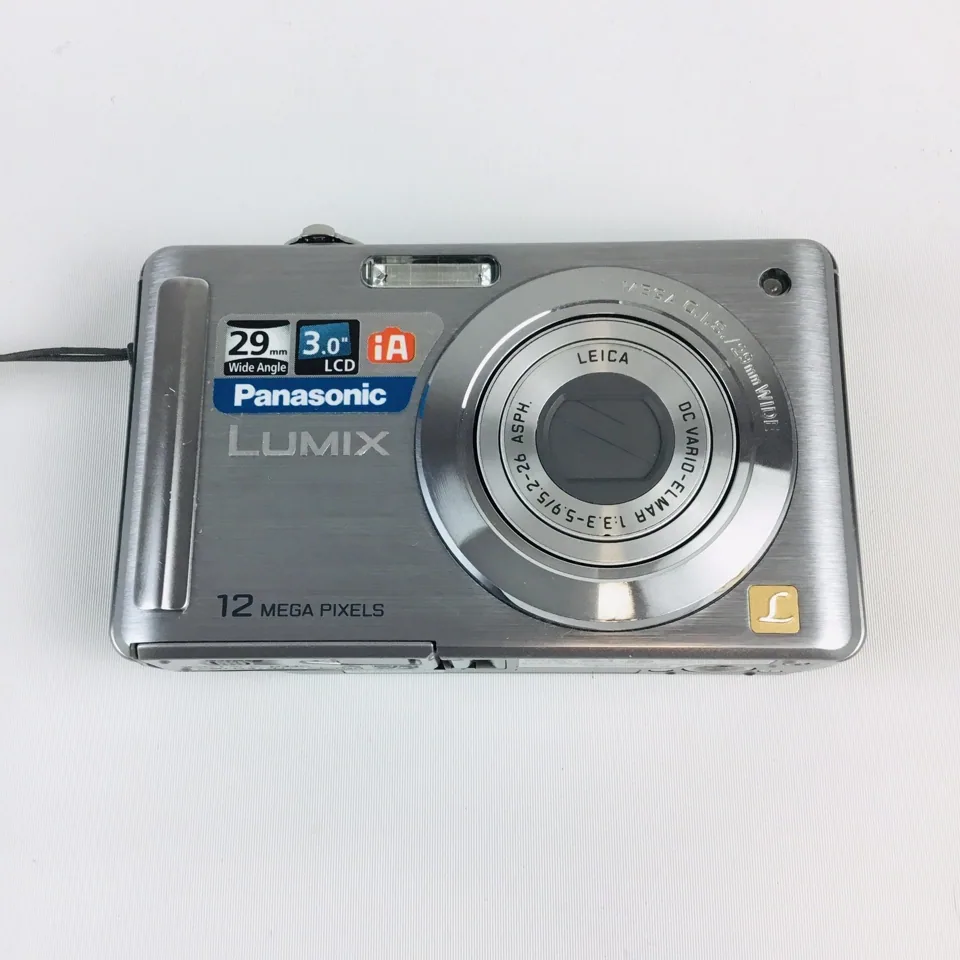
In January 2009 Panasonic put a 12-megapixel sensor, a wider 5x zoom and a 3-inch screen into the top model of its budget FS line. Reviewers called it easy and good value, and then disagreed about its burst speed, its colour and its screen.
- Launched
- January 2009
- Sensor
- 12.1 MP CCD
- Lens
- 29–145 mm, 5×
- Card
- SD, SDHC, MultiMediaCard
- Battery
- DMW-BCF10E
Panasonic Lumix DMC-FS25 specs: sensor, lens, battery, memory card and cable
The Panasonic Lumix DMC-FS25 came out in January 2009 at $249.95 as a 12.1 MP CCD compact with a 29–145 mm (35 mm equivalent) 5× zoom lens. It runs on the DMW-BCF10E battery. Sources
- Sensor
- CCD, 1/2.33", 12.1 MP source
- Lens
- 29–145 mm equivalent, 5× zoom source
- Memory card
- SD, SDHC, MultiMediaCard source
- Battery
- DMW-BCF10E source
- USB / A/V cable
- See our Panasonic cable page
Meet the camera
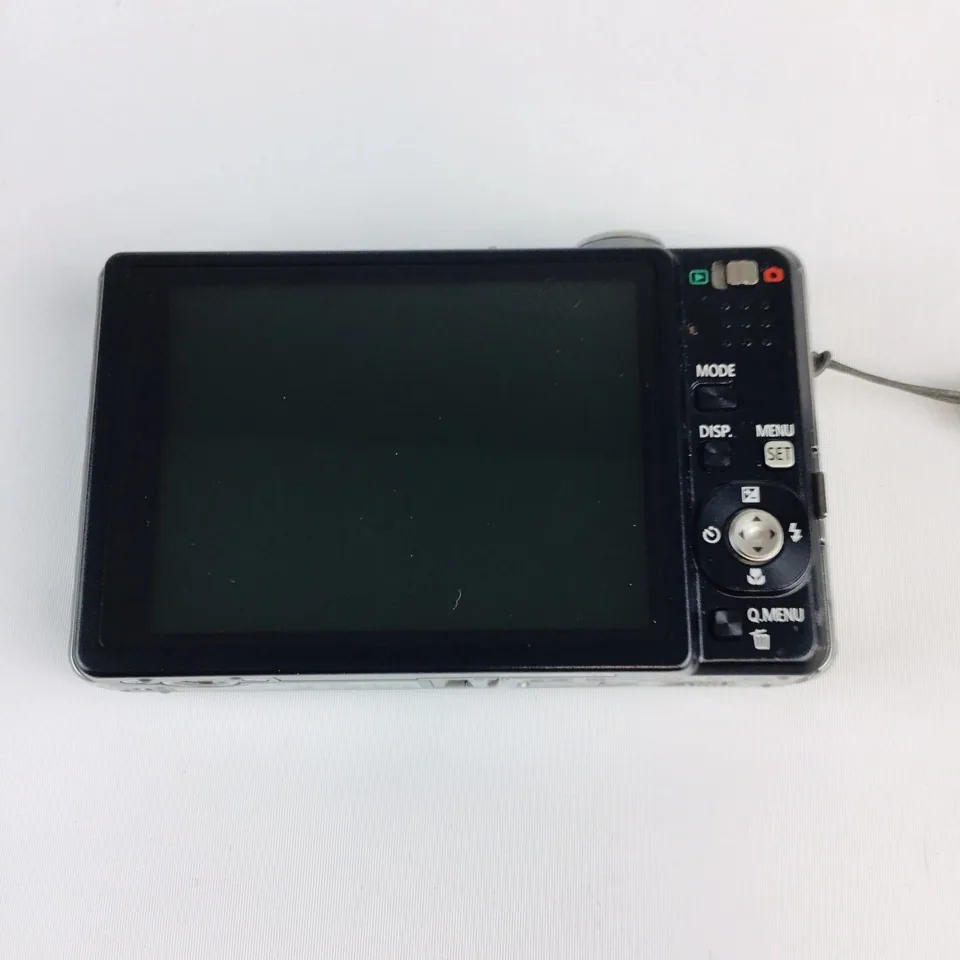
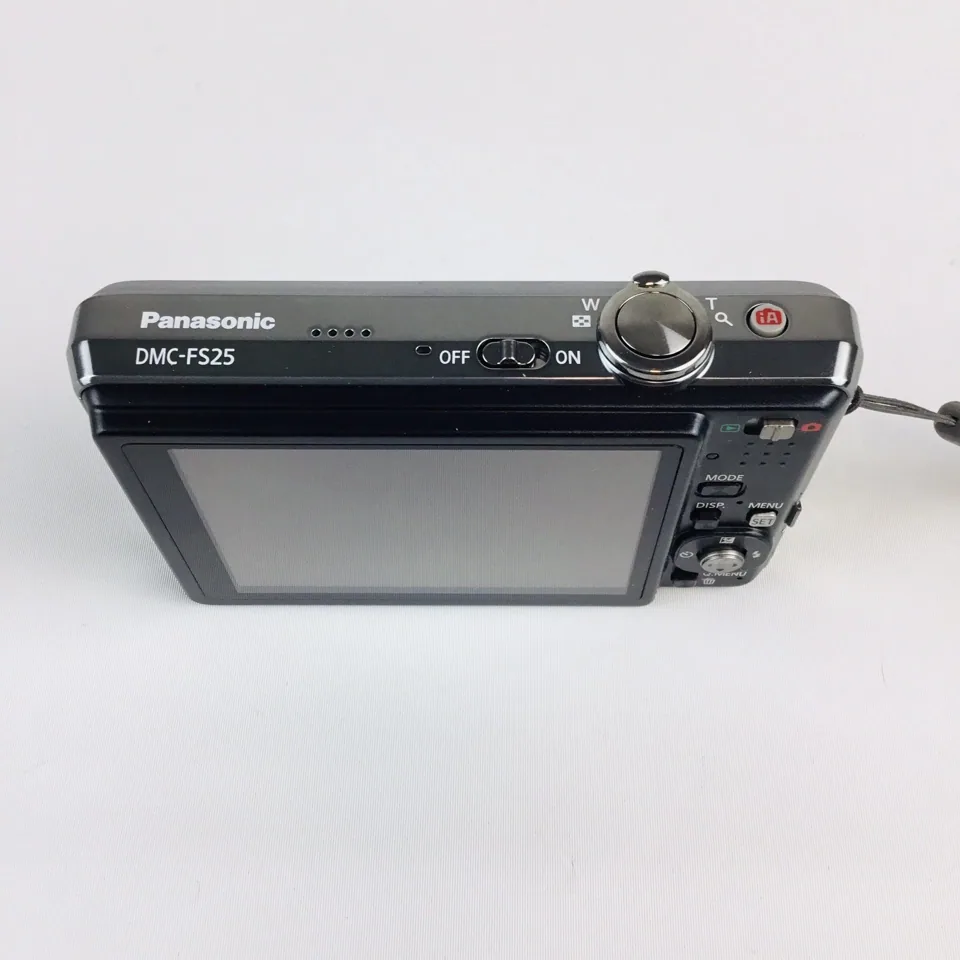
It is a slim pocket camera, 97 by 58 by 22 millimetres and about 148 grams with battery and card, with a brushed silver finish on the front and a 3-inch screen.345 Panasonic announced it on 27 January 2009 as the top-of-the-line model in its FS series, at a suggested US price of $249.95 for April.1 In the UK it was due from April at £219, in black or silver, while the US range added gold.2 Cameralabs described it as sitting at the top of the FS range and meant to be more affordable than the FX range, replacing the FS20 with a new sensor and a wider zoom in a smaller body.5
Imaging Resource said the FS25 is nearly identical to the cheaper FS15, mainly differing in a bigger screen, slightly different styling and a joystick the FS15 lacks, and tested image quality with the FS15, which it says tests identically.4 Everything we say about the FS25's pictures therefore comes partly from a sibling.
- Video
- 848 × 480 at 30 fps, Motion JPEG3
Why this one was interesting
A 29 mm start in a budget slab
PhotographyBLOG praised the 5x zoom starting at 29 mm, as a real advantage, noting that compacts of this size from other makers typically have a 3x zoom starting at 35 mm or higher.3 Imaging Resource, in its FS15-based lab tests, measured wide-angle distortion at about 0.2 percent and under 0.1 percent at the long end.4 Cameralabs found it wider than the Canon PowerShot A2100 IS, which had the longer zoom.5
Intelligent Auto, now with tracking
The iA button switched on a mode that picks one of five scenes and the ISO, and now added Intelligent Exposure, which increases exposure only in the underexposed areas, and AF tracking that keeps a moving subject in focus.32 PhotographyBLOG said it worked very well in practice,3 and Cameralabs found the tracking good outdoors.5 Imaging Resource called it a good choice for novices who want automatic shooting.4
A bigger screen and a bigger sensor
Imaging Resource noted the screen is larger than the FS15's,4 and the sensor went to 12.1 megapixels.1 PhotographyBLOG did not like what the extra pixels cost, as the next section shows.3
Cameralabs placed the FS25 below the pricier FX range,5 such as our Lumix DMC-FX35; for a longer zoom see the Lumix DMC-ZS3, and for an enthusiast compact the Lumix DMC-LX3.
What was lost
Burst shooting was the price of the extra pixels: PhotographyBLOG measured 1.8 frames a second for three pictures and called it the main drawback of the move to 12-megapixel images.3 Cameralabs, by contrast, found continuous shooting faster than on the Canon A2100 IS or the Sony W270/W290.5 PhotographyBLOG also found the joystick no longer opens the menu, with a separate Menu/Set button instead, and said the battery and card compartment felt flimsier than on the FS20, and disliked the poorly positioned tripod mount.3 Cameralabs agreed on the flimsy battery cover and the poorly placed, off-centre tripod mount.55
The dark: its weak point
Noise was the main complaint, with reviewers agreeing broadly and differing on how early it began. PhotographyBLOG said noise was readily visible above ISO 200, obvious at ISO 400 and progressively worse at 800, and called ISO 1600 completely unusable; its conclusion advises against ISO 800 and 1600 unless there is no alternative.3 Imaging Resource, testing the FS15, saw blurring from about ISO 200 and a painted look at 800 and 1600, though its prints held up: ISO 80 and 100 at 13 by 19 inches, ISO 800 at 8 by 10 and ISO 1600 only at 4 by 6 to 5 by 7.4 Cameralabs, comparing it with the Canon A2100 IS and the Sony W270/W290, found noise very well controlled at ISO 80 to 200, acceptable at 400 and 800 and very grainy at 1600, with the Canon's pictures slightly more detailed and the Panasonic's less grainy.5






Real photographs taken with this camera. The sensitivity shown is what each file's own EXIF data records. ISO 1000 is not one of the fixed steps in PhotographyBLOG's specification list (80, 100, 200, 400, 800, 1600),3 and PhotographyBLOG reported that Auto ISO never chose a speed above 400.3 The two do not agree, and we cannot say why: we do not know how the photographers set the camera, so treat the ISO labels as what the files record, not as a test result.
Like that look? See recent eBay sold listings for this camera ↗
On eBay right now
Live listings for this camera, supplied by eBay and updated automatically. We earn a commission if you buy through them.
The little wins
The stabiliser
Imaging Resource listed the optical stabiliser among its pros, saying it works very well, PhotographyBLOG called it excellent and tested it with a handheld quarter-second exposure at 29 mm, and Cameralabs estimated two to three stops of benefit at full zoom.435
A screen for sunlight
Cameralabs listed the screen, whose brightness changes with ambient light and which has a High Angle setting for viewing overhead, among the camera's good points.5
Macro
Cameralabs found macro sharp down to 3 centimetres.5 PhotographyBLOG's own review gives both 3 and 5 centimetres, so check the number before relying on it.3
Faces
Cameralabs said face detection tracks up to 15 faces and holds them even at near-profile angles, working best up close and in good light.5
How it drew the picture
PhotographyBLOG scored image quality 4 out of 5: out-of-camera files were soft and needed sharpening, and colour a little washed out at the default Standard setting, though chromatic aberration was handled excellently.3 Imaging Resource, on the FS15, found colour less saturated than many consumers may prefer but a little more true to life, with softness in some corners and with auto white balance handling tungsten light poorly.4 Cameralabs disagreed on colour, finding excellent saturation and good central detail with softness towards the edges, and judged it sharper, with finer detail, better contrast and colour saturation, than the Sony W270/W290.5

















Photos taken with this camera, from Wikimedia Commons, credited under each picture. The Commons category holds about 236 photos from a limited set of uploaders, so this is a thin sample.
Where it let you down
Speed. Imaging Resource measured shutter lag with full autofocus at 0.90 seconds at wide angle and 1.18 at telephoto, and a single-shot cycle of about 3.25 seconds, though a prefocused shot took 0.125 seconds and a Hi-Speed Burst mode was fast.4 Panasonic's launch material claimed a shutter release lag as short as 0.006 seconds,12 a best-case claim whose test conditions the coverage we read does not give, so it should not be read against the measured 0.90 seconds. PhotographyBLOG called the operational speed average, with about 2 seconds to start and 4 to zoom across the range.3 Imaging Resource and Cameralabs found the rear controls and their labels small, and PhotographyBLOG said the combination of joystick and Menu/Set button takes a while to get used to and called the joystick a little unresponsive, while Imaging Resource said the joystick translates small movements into easy menu navigation.435 Imaging Resource also found framing hard to see on the screen in strong sunlight, though Cameralabs counted the brightness-adjusting screen among its good points.45 PhotographyBLOG disliked the f/5.9 aperture at full zoom and the lack of a viewfinder, and found the Photo Frame mode cut pictures to 2 megapixels.3 Cameralabs added poor face detection in low light, a playback switch it found inconvenient, no manual focus, and video capped at 848 by 480 without zoom while recording.5
What the reviewers said in 2009
| Outlet | Date | Verdict |
|---|---|---|
| PhotographyBLOG | 10 Feb 2009 | Design 4, features 4.5, ease of use 4.5, image quality 4, value 4.5 out of 5: a strong, affordable camera almost anyone can use.3 |
| Imaging Resource | 30 Jul 2009 | 4.0 out of 5 and a Dave's Pick: a good point-and-shoot for novices; slow shot-to-shot timing the main drawback.4 |
| Cameralabs | 1 Oct 2009 | 80 percent and Recommended (build 16, image quality 16, handling 17, specification 15, value 16 out of 20): stylish and fun to use, with great pictures in most situations and some flaws.5 |
Cameralabs compared it with the Sony DSC-W270/W290 (a similar size; better styling, colour, detail and low-light results on the Panasonic, 720p video and arguably better menus on the Sony) and the Canon PowerShot A2100 IS (longer telephoto reach, clearer control labels and about 400 shots per charge from its two NiMH AA batteries against the Panasonic's 330, wider coverage on the Panasonic).5
The timeline
- 27 January 2009Panasonic announces the FS25 at $249.95 and £219.12
- 10 February 2009PhotographyBLOG publishes its review.3
- April 2009Planned on-sale month in the US and UK.12
- 30 July 2009Imaging Resource publishes its review.4
- 1 October 2009Cameralabs publishes its review.5
Should you buy one now?
Buy one if you want a pocketable CCD compact with a real wide angle that picks settings for you and you can live with sluggish shot-to-shot speed and noisy high ISO. It launched at $249.95;1 what it sells for now is a question for the sold listings, not for us. Before you bid, check these:
- The name. Search the Lumix DMC-FS25, and do not confuse it with the near-identical FS15 or the older FS20.45
- The battery. It uses a DMW-BCF10E;4 a fresh one is on Amazon ↗.
- The card. It takes SD, SDHC and MMC cards;3 see our memory card guide.
- The battery door and tripod thread. Two reviewers called the door flimsy.35
- The lens. Check that it extends and retracts cleanly and the screen is free of scratches.
If you are wondering why cameras like this are being hunted down again, we tell that story once, in Pictures that never left the card.
See recent sold prices on eBay ↗Shop on eBay ↗Battery ↗
Sources
- Imaging Resource, Panasonic DMC-FS25 announcement by Mike Tomkins (27 Jan 2009: $249.95, April availability)
- PhotographyBLOG, Panasonic DMC-FS25 announcement (27 Jan 2009: US $249.95, UK £219, colours)
- PhotographyBLOG, Panasonic Lumix DMC-FS25 review by Mark Goldstein (10 Feb 2009; pages 1, 2, 5 and 6)
- Imaging Resource, Panasonic DMC-FS25 review by Stephanie Boozer (30 Jul 2009; image quality tested with the FS15)
- Cameralabs, Panasonic Lumix DMC-FS25 review by Gordon Laing (1 Oct 2009; pages 1, 2, 3 and 5)
Photographs are credited under each one, all via Wikimedia Commons. Links to eBay and Amazon are affiliate links.