Panasonic Lumix LX series · announced July 2012
The Panasonic Lumix DMC-LX7: an f/1.4 lens in a coat pocket, and a ring to work it
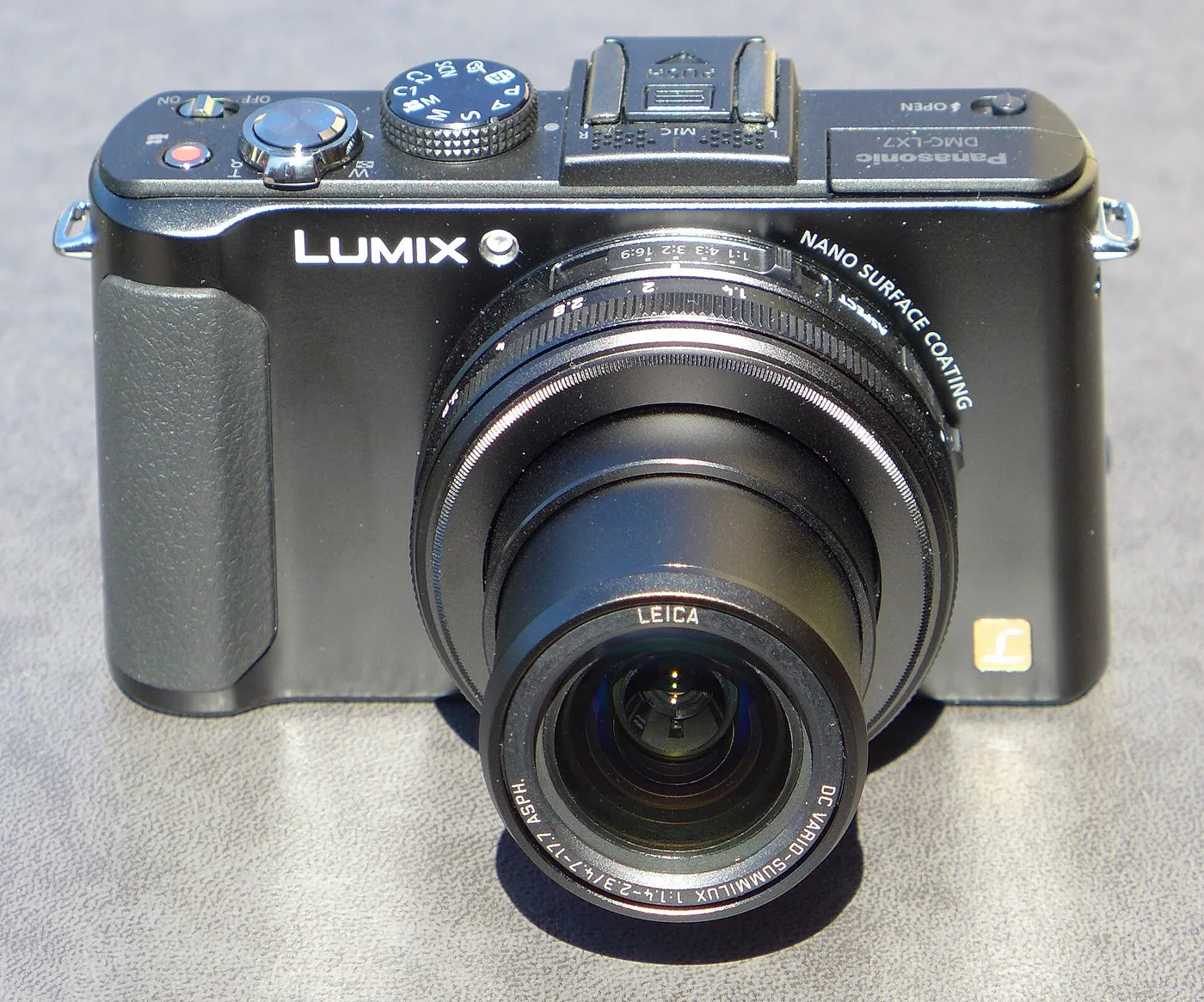
In 2012 Panasonic gave the LX series a lens DPReview called the fastest you will find in a compact, plus a physical aperture ring and a three-stop ND filter. Reviewers loved the controls and the lens, then argued about the noise and the flash.
- Launched
- August 2012
- Launch price
- US $499.95 · UK £449.994
- Sensor
- 10.1 MP CMOS
- Lens
- 24–90 mm, 3.8×
- Card
- SD, SDHC, SDXC
- Battery
- DMW-BCJ13
Panasonic Lumix DMC-LX7 specs: sensor, lens, battery, memory card and cable
The Panasonic Lumix DMC-LX7 came out in August 2012 at US $499.95 as a 10.1 MP CMOS compact with a 24–90 mm (35 mm equivalent) 3.8× zoom lens. It takes SD, SDHC and SDXC cards and runs on the DMW-BCJ13 battery. Sources
- Sensor
- CMOS, 1/1.7", 10.1 MP source
- Lens
- 24–90 mm equivalent, 3.8× zoom source
- Memory card
- SD, SDHC, SDXC source
- Battery
- DMW-BCJ13 source
- USB / A/V cable
- See our Panasonic cable page
Meet the camera
It is a compact metal-bodied camera with a rubber handgrip, a mode dial and a hot shoe on top, and a lens barrel with a ring around it.36 The lens sticks out about 20 millimetres when switched off, and Expert Reviews still fitted the camera into a jeans pocket.6 PhotographyBLOG put the weight at about 298 grams with battery and card, or about 269 grams without them.4
Panasonic announced it on 18 July 2012. The US price was about $500 and shipping was expected at the end of August;1 the UK price was £449 with sales from September.2 PhotographyBLOG's review lists the launch price as £449.99 or $499.95, the same dollar figure the LX5 had launched at (see our LX5 retrospective).4 Imaging Resource lists the MSRP as $499.99 rather than $499.95.5 By the time Expert Reviews tested it, UK shops were asking £399.6
Why this one was interesting
The LX5 had made Panasonic's enthusiast compact a known quantity; PhotographyBLOG called the LX7 a rather modest update to a proven design, and in the same breath said it was no longer king of its class because Sony's RX100 produced better images from an even smaller camera.3 Cameralabs was more upbeat: a bright zoom can still make a smaller-sensor compact worth choosing over bigger-sensor rivals, and the reviewer had no hesitation in recommending it.7 Expert Reviews went further: the Fujifilm X10 had been its favourite premium compact, and it concluded the LX7 surpasses it.6
f/1.4, and what it buys
The lens is a Leica-branded 24–90 mm equivalent zoom, f/1.4 at the wide end and f/2.3 at the long end, built from 11 elements in 10 groups with five aspherical elements and one ED element.13 Expert Reviews worked out what that means in practice: about twice the light of the f/2 lenses on rival compacts and nearly seven times that of the f/3.5 kit zoom on interchangeable-lens compact system cameras.6 Cameralabs compared it with named rivals: roughly two-thirds of a stop brighter than the RX100 at wide angle, about a stop over Canon's S110, and about two stops over the G1 X.7 At 90 mm the lens closes down to f/2.5 on PhotographyBLOG's account, though its own specification table lists f/2.3 at the long end.3
A ring for the aperture
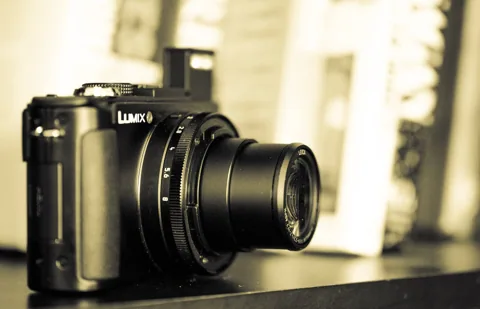
A control ring around the barrel sets the aperture directly, with a rear dial for shutter speed;8106 Expert Reviews called manual exposure control extremely fluid.6 Cameralabs found the ring clicks in third-of-a-stop steps; DPReview noted it runs from f/1.4 to f/8 and cannot be reassigned to another job.78 It works only in aperture-priority and manual modes, and it is capped at whatever the lens can manage at the current zoom, so a marked f/1.4 is unavailable once you zoom in; Cameralabs and Neocamera made the same point about values that are ignored.8710
Less battery, more screen
Battery life fell from the LX5's 400 shots to 330 on the CIPA test. Cameralabs assumed the new screen, which doubled from 460,000 to 920,000 dots, was responsible for much of the drop, and pointed out that the RX100 is rated at the same 330.7 DPReview still called the figure tied for best in its class.8
The dark, with a fast lens
Panasonic claimed a signal-to-noise ratio 1.5 dB better than the LX5's from the new sensor.1 The lens matters more when the light goes, because it lets the camera hold a lower ISO. Expert Reviews showed this with a test at 1/200 s against two interchangeable-lens cameras: despite its much smaller sensor, the LX7 came top for detail clarity because its wide aperture let it use a much lower ISO.6 The sensor itself is a small one, and the reviewers drew the line in slightly different places. PhotographyBLOG found pictures clean to ISO 1600, comparing that with ISO 800 on lesser compacts, with noise noticeable at 3200 and 6400.3 DPReview was stricter: clean through ISO 400 in low light and ISO 1600 in good light, ISO 6400 weak and ISO 12800 not recommended.8 Expert Reviews found ISO 1600 acceptable and, with raw files in a pre-release Lightroom 4.2, stretched that to 3200; it also saw slight noise in dark, smooth areas even at ISO 80, but praised the gentle noise reduction for keeping detail.6 Digital Photography School saw noise from ISO 3200 on.9




Real photographs taken with this camera. The sensitivity shown is read from each file's own EXIF data. We found no free LX7 photo at ISO 3200 or higher in our search, so these show indoor shooting at ISO 1000 to 1600, not the top of the range.
Like that look? See what LX7s have recently sold for on eBay ↗
On eBay right now
Live listings for this camera, supplied by eBay and updated automatically. We earn a commission if you buy through them.
The little wins
Next to the lens and ring, the other additions look small, but reviewers kept coming back to them.
A level gauge, time-lapse and filters
Digital Photography School listed an on-screen level gauge, a time-lapse mode and 16 Creative Control filters.9 PhotographyBLOG found the time-lapse capped at 60 shots with a one-minute minimum interval.3


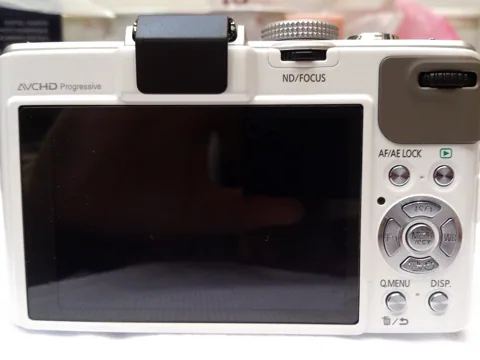 The rear, with the ND/FOCUS lever beside the thumb rest. · Kenming Wang · CC BY-SA 2.0 · Commons

A built-in ND filter
A three-stop neutral density filter, switched on from the rear, cuts the light by a factor of eight, useful for slow shutter effects.6 Panasonic lists an internal ND filter among the controls.1 Panasonic's own examples were ski scenes and flowing water.2 Expert Reviews noted that pushing the focus lever engages it;6 Cameralabs said the same rocker also moves manual focus.7
Aspect ratios on a switch
A switch on the lens barrel changes the shape of the picture from 1:1 to 16:9, and Expert Reviews said the sensor was designed for several ratios.96
Video with manual exposure
Full HD at 60p (50p in PAL regions) in AVCHD, or 30p in MP4, with a high-speed 720p mode at 120 fps (100 fps in PAL regions).1536 Expert Reviews rated video quality outstanding, with stereo sound and a quiet zoom, and said aperture and shutter speed can be changed while recording.6 Cameralabs found no external microphone socket.7
How it drew the picture
PhotographyBLOG found bright-light results sharp with minimal chromatic aberration, though the default sharpening looked a little soft, and described a night shot as excellent.3 DPReview praised JPEG and raw output, with saturated colour and mostly accurate exposure, and found raw files offered extra dynamic range but only a modest gain in detail.8 Expert Reviews called the detail startlingly sharp for 10 megapixels, with moiré and pixelated diagonal lines that raw processing in Lightroom fixed.6 Digital Photography School rated the quality excellent, especially at larger apertures.9 Against the larger-sensor competition, Cameralabs found the LX7's autofocus faster and more reliable than the RX100's.7
















Photos taken with this camera, from Wikimedia Commons, credited under each picture. The ninth, below, is a dusk scene.

Where it let you down
The flash is where the reviewers split. DPReview reported a lot of red-eye in its tests, worse than the LX5's, with no way to fix it in playback;8 PhotographyBLOG said the pop-up flash worked well indoors without red-eye.3 We have not shot with one, so we cannot say why they differ.
The other complaints agree more. There is no built-in viewfinder, and Expert Reviews priced the optional shoe-mounted electronic viewfinder at about £200;6 there is no touchscreen, no GPS or Wi-Fi.6 DPReview found the zoom slow, timing about 2.8 seconds from wide to tele; PhotographyBLOG timed it at just over three seconds.83 DPReview found the rear dial cheap-feeling, and DPReview and Neocamera both called the battery and card door flimsy.810 Cameralabs called the menus unwieldy and the redesigned quick menu a step backward.7 Digital Photography School complained that the silver-on-silver rear button labels are hard to read, and that video to the internal memory is limited to VGA.9
What the reviewers said
| Outlet | Date | Verdict |
|---|---|---|
| PhotographyBLOG | 13 Aug 2012 | 4.5 stars and Highly Recommended; a modest update that lost the class lead to the RX100, with value for money its weakest score (3.5).3 |
| Expert Reviews | 4 Sep 2012 | Best Buy; surpasses the Fujifilm X10, its previous favourite premium compact; outstanding video and fluid controls, and it came out on top against interchangeable-lens cameras at the price.6 |
| Neocamera | 26 Sep 2012 | Usability section only: solid, well-detented front dial, sharp screen; modal exposure compensation and a flimsy door.10 |
| Cameralabs | 9 Oct 2012 | Highly Recommended; the bright lens is the main reason; shorter battery life and awkward menus count against it.7 |
| DPReview | 15 Oct 2012 | Overall score 75%; praised for low-light and manual control; its lowest category scores were flash (4.5/10) and value (6.5/10), and red-eye and the slow zoom are listed as cons.8 |
| Digital Photography School | 17 Feb 2013 | Excellent quality; a small, powerful camera best as a companion to a DSLR, not ideal as a travel camera because of the limited zoom.9 |
The timeline
- 18 July 2012Panasonic announces the LX7; PhotographyBLOG reports £449 for September.12
- 13 August 2012PhotographyBLOG publishes its review.3
- 4 September 2012Expert Reviews publishes its review, at £399.6
- 26 September 2012Neocamera's usability section is dated.10
- 9 October 2012Cameralabs publishes.7
- 15 October 2012DPReview publishes Jeff Keller's review.8
- 17 February 2013Digital Photography School publishes.9
Should you buy one now?
Buy one if you want a pocket camera that takes manual control seriously, with a lens that gathers about twice the light of the f/2 zooms on rival compacts.6 Skip it if you shoot a lot of flash portraits or want a long zoom. It launched at $499.95;4 what it sells for now is a question for eBay's sold listings, not for us. We have not tested a unit. Our coverage rests on six reviews, one of them partial and one written months after launch. Before you bid, check these:
- The lens. It extends when switched on; check that it runs out and in smoothly. PhotographyBLOG found no automatic cover and got fingerprints on the glass when pocketing it, and Cameralabs said the camera beeps and asks you to remove the lens cap before it will start.37
- The aperture ring. It should click in third-of-a-stop steps; test it in aperture-priority mode.7
- The battery and card door. Two reviewers called it flimsy, so check that it closes and latches.810
- The battery. It is rated at 330 shots when new (PhotographyBLOG's review text says about 300),43 so an old one will be worse. The code is DMW-BCJ13, from Adorama's launch accessory list and DPReview.18 A replacement is on Amazon ↗.
- The flash. Fire it once; reviewers disagreed about red-eye.83
- The card. It takes SD, SDHC and SDXC and has about 70 MB built in.4
If you are wondering why cameras like this are being hunted down again, we tell that story once, in Pictures that never left the card. For the cameras this one followed, see our LX5 and LX3 retrospectives.
See recent sold prices on eBay ↗Shop on eBay ↗LX7 battery ↗
Sources
- Adorama Learning Center, Panasonic LX7 pre-order article with Panasonic's press release dated 18 Jul 2012 (price, lens construction, speed, video, accessories)
- PhotographyBLOG, Panasonic Lumix LX7 announcement by Zoltan Arva-Toth (18 Jul 2012; UK price and ISO range)
- PhotographyBLOG, Panasonic Lumix DMC-LX7 review by Mark Goldstein (13 Aug 2012)
- PhotographyBLOG, Panasonic Lumix DMC-LX7 specifications page (battery, card, weight, size, launch price, ISO)
- Imaging Resource, Panasonic LX7 specifications (sensor, internal memory, CIPA rating, MSRP, video modes)
- Expert Reviews, Panasonic Lumix DMC-LX7 review by Ben Pitt (4 Sep 2012)
- Cameralabs, Panasonic Lumix LX7 review by Ken McMahon (9 Oct 2012; main page only, the separate image-quality pages were not read)
- DPReview, Panasonic Lumix DMC-LX7 review by Jeff Keller (15 Oct 2012; first published at DCResource)
- Digital Photography School, Panasonic Lumix DMC-LX7 review by Barrie Smith (17 Feb 2013)
- Neocamera, Panasonic Lumix DMC-LX7 review, usability and ergonomics section (26 Sep 2012; author not stated; other sections not read)
Camera photos by Dnalor 01, Kenming Wang and Sharada Prasad CS as credited; other photographs are credited under each one, all via Wikimedia Commons. Links to eBay and Amazon are affiliate links.