Canon PowerShot G · on sale October 2014 · a retrospective
The Canon PowerShot G7 X: Canon's pocket camera with a one-inch sensor
Sold under the same name in the Americas, Europe and Japan. Not the Mark II or Mark III.
In 2014 Canon fitted a 1-inch, 20-megapixel sensor and an f/1.8 lens into a body that fits a coat pocket, and priced it at US$699.99. Reviewers loved the pictures and then argued about the focus, the battery and the missing viewfinder.
Release date and launch price: launched October 2014; launch price US$699.99 · £579 · €5992.
Quick answers
- Sensor
- CMOS, 1.0-type (13.2 x 8.8 mm), 20.2 MP source
- Lens
- 24–100 mm equivalent, 4.2× zoom source
- Memory card
- SD, SDHC, SDXC source
- Battery
- NB-13L source
- USB / A/V cable
- IFC-400PCU, AVC-DC400ST Confirmed · all Canon cables
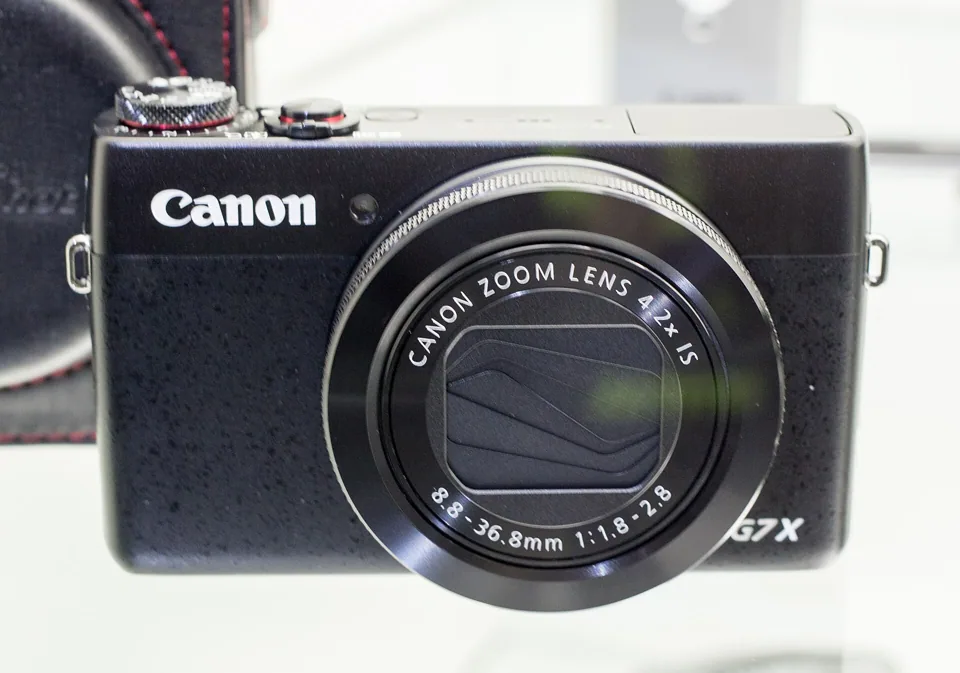
Meet the camera
It is a metal-bodied compact that measures 103.0 by 60.4 by 40.4 millimetres and weighs about 304 grams with battery and card.1 DPReview called it essentially a larger and sturdier PowerShot S120, with a matte black finish and no grip, and found the rear dial and four-way controller the one part that felt cheap.5 PhotographyBLOG, by contrast, called the metal body solid, with well-damped controls, and said it fits a coat pocket more easily than a trouser pocket.4
Canon's museum lists it as marketed in October 2014, with the same name in all three regions.1 Canon announced it on 15 September 2014 at £579, €599 and US$699.99, for availability in October.2 DPReview called the price hefty, though a little below the larger G1 X Mark II's.5 Photo Review gave a recommended price of AU$949 and US$699, and saw a US$649.99 kit with a case and strap.6
Why this one was interesting
A big sensor in a small body
TechRadar framed the camera against Canon's own G1 X Mark II, whose sensor is nearly as large as an SLR's but whose body stretches the idea of a compact. The G7 X, it said, used a 1-inch sensor big enough for great pictures and small enough for a truly pocketable design.3 DPReview named the Sony RX100 III, and arguably its predecessor, as the G7 X's direct competitor, and after testing said the G7 X uses the same 20.2-megapixel back-illuminated sensor as the RX100 III; that is DPReview's finding, not a Canon statement.5
A lens that stays bright
Canon lists the lens as f/1.8 to f/11 at the wide end and f/2.8 to f/11 at the long end.1 DPReview pointed out that this gathers more light across the range than the RX100 III's 24–70 mm lens and reaches further.5 TechRadar noted that f/1.8 is only available at the widest setting.3
Where it sat in Canon's family
PhotographyBLOG called it the best balance of portability and features in the PowerShot line so far, and said it trails the G1 X Mark II at high ISO while offering most of its features in a smaller body.4 TechRadar said the S120 and G16 fell short on sensor size next to it.3 For earlier S-series pocket cameras, see our PowerShot S95 and PowerShot S100; for a different kind of pocket zoom, see our ELPH 360 HS.
What was lost
There was no viewfinder, which all four reviewers noted; PhotographyBLOG, DPReview and Photo Review add that none can be fitted.4536 PhotographyBLOG also missed a filter thread, a front control dial and GPS.4 The screen tilts up 180 degrees for selfies but not down.45
In the dark
Noise handling was a strength, with caveats. PhotographyBLOG called ISO 125 to 800 clean, ISO 1600 slightly noisy, ISO 3200 and 6400 more obviously noisy but usable, and ISO 12800 best avoided.4 Photo Review found resolution held up well to about ISO 1600 and declined gradually after that, with the top two settings visibly softer, flatter and less saturated.6 DPReview found raw files nearly identical to the RX100 III's at high ISO, while the camera's JPEG noise reduction was gentler, so JPEGs kept more noise.5 The flash popped up and gave good indoor exposure with no red-eye, though PhotographyBLOG saw vignetting at 24 mm; DPReview noted it cannot be tilted for bounce.45




Two photographs taken with this camera: a dim interior and a railway bridge by a river. The high-ISO photos on Commons were almost all of identifiable people, so we did not use them.
On eBay right now
Live listings for this camera, supplied by eBay and updated automatically. We earn a commission if you buy through them.
The little wins
The control ring and dials
DPReview liked having easy access to exposure compensation from the top-plate dial, though it found the dial hard to reach and difficult to turn.5 TechRadar praised the lens ring's friction and click, and said the ring and touchscreen made changing settings quick.3
Night and stabiliser
PhotographyBLOG called night shooting excellent, with exposures up to 30 seconds and a Bulb mode, and found the stabiliser very effective when hand-holding in low light.4
How it drew the picture
DPReview found image quality in line with what a 1-inch sensor should give, with vivid colour and good sharpness in the centre of the frame, but soft corners at wide angle and a soft image at full telephoto until stopped down to about f/4.5 PhotographyBLOG scored image quality 4.5 out of 5 and found JPEGs a little soft at default sharpening, with chromatic aberration well handled.4 Photo Review found JPEGs slightly soft and warm-biased, with colours slightly oversaturated, and found diffraction softening from about f/4.5.6














Photos taken with this camera, from Wikimedia Commons, credited under each picture.
Where it let you down
Battery life was a complaint in DPReview and PhotographyBLOG; Photo Review quoted the same CIPA rating. It is 210 shots, 310 in Eco mode, against 320 for the RX100 III.546 PhotographyBLOG advised carrying a spare.4 Reviewers disagreed on focus. DPReview found it disappointing and inconsistent, with the focus-failure warning appearing more often than expected, even in good light;5 PhotographyBLOG put the delay at around 0.15 seconds and called the autofocus fast for a compact;4 Photo Review found it acceptably fast and accurate in most light, with some hunting in very dim scenes, and about 0.5 seconds of lag that fell below 0.1 prefocused.6 DPReview also noted slow raw shooting, a laggy interface and weak manual focus, and said the card slot cannot be opened while the camera is on a tripod.5 Photo Review found video autofocus slow and remote shooting from the phone limited.6
What the reviewers said
| Outlet | Date | Verdict |
|---|---|---|
| TechRadar | 2014 | A strong competitor to the Sony RX100 II, with excellent image quality and quick settings changes; no viewfinder, tilt-only screen.3 |
| PhotographyBLOG | 21 Oct 2014 | 4.5 out of 5, Highly Recommended. An excellent enthusiast pocket camera; the RX100 III's viewfinder gave it the edge.4 |
| DPReview | 11 Nov 2014 | Silver award, 77%. Excellent photo quality and a fast lens with a longer zoom than rivals; held back by poor battery life, inconsistent focus and other gaps.5 |
| Photo Review | Undated | 8.5 out of 10. Difficult to find much that was really exciting, and the missing viewfinder would deter many buyers.6 |
The family and the revival
Canon followed it with the G7 X Mark II in April 2016 and the Mark III in August 2019.89 KEH's July 2026 guide to digicams to buy lists the original's family as a bonus pick, not a Y2K camera but a modern compact favourite that is easier to live with than early-2000s models, with newer batteries, SD support and faster performance.7 It names the G7X series, not a particular generation, so we cannot say how much of that demand is for the 2014 original. For why people want cameras like this, we tell the story once, in Pictures that never left the card.
The timeline
- 15 September 2014Canon announces the camera at £579 / €599 / US$699.99.2
- October 2014Canon's museum lists it as marketed.1
- 21 October 2014PhotographyBLOG publishes its review.4
- 11 November 2014DPReview publishes its review.5
- April 2016The Mark II appears.8
- 16 July 2026KEH's buying guide names the G7X series.7
Should you buy one now?
Buy one if you want a pocketable large-sensor camera with a bright lens and real controls, and can live with a weak battery and no viewfinder. It launched at US$699.99;2 what it sells for now is a question for the sold listings, not for us. Before you bid, check these:
- The generation. The original is plain G7 X; the Mark II and Mark III are different, later cameras.89
- The battery. It uses an NB-13L, rated at 210 shots;5 a fresh one is on Amazon ↗, and a spare is worth having.4
- The card. It takes SD, SDHC and SDXC cards;4 see our memory card guide.
- The lens. The lens retracts behind a cover when the camera is off, so check that it extends and retracts cleanly.6
- The screen. Test the touchscreen and the 180-degree tilt.4
- The charger. DPReview says the charger takes about 150 minutes to charge the NB-13L, so ask whether a charger is included.5
See recent sold prices on eBay ↗Shop on eBay ↗NB-13L battery ↗
Sources
- Canon Camera Museum: PowerShot G7 X (marketed October 2014; sensor, lens, size, weight)
- PhotographyBLOG, Canon PowerShot G7 X announcement by Mark Goldstein (15 Sep 2014; prices, availability)
- TechRadar, Canon PowerShot G7 X review by Angela Nicholson (2014; the page does not show the day)
- PhotographyBLOG, Canon PowerShot G7 X review by Mark Goldstein (21 Oct 2014)
- DPReview, Canon PowerShot G7 X review by Jeff Keller and Richard Butler (11 Nov 2014)
- Photo Review (Australia), Canon PowerShot G7X review (undated page; written about nine months after the announcement)
- KEH Camera, “Top Y2K digicams and point-and-shoots to buy in 2026” by Terez Turner (16 Jul 2026)
- Canon Camera Museum: PowerShot G7 X Mark II (marketed April 2016)
- Canon Camera Museum: PowerShot G7 X Mark III (marketed August 2019)
Camera photo by GodeNehler (CC BY-SA 4.0); sample photographs are credited under each one, all via Wikimedia Commons. Links to eBay and Amazon are affiliate links.