Panasonic Lumix LX · announced July 2005
The Panasonic Lumix DMC-LX1: the compact that outgrew its own screen
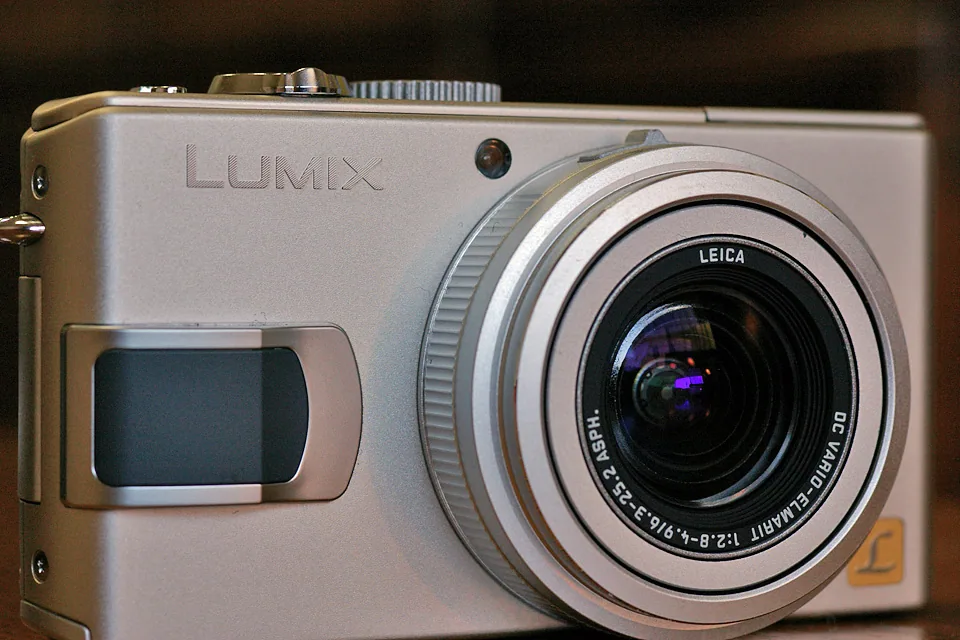
In 2005 Panasonic built a CCD in the shape of a widescreen television and put it behind a 28 mm Leica-branded lens, but kept a squarer screen on the back. Reviewers loved how it handled, then marked it down for noise.
- Launched
- July 2005
- Sensor
- 8.4 MP CCD
- Lens
- 28–112 mm, 4×
- Card
- SD, MultiMediaCard
- Battery
- proprietary Li-ion
Panasonic Lumix DMC-LX1 specs: sensor, lens, battery, memory card and cable
Launched in July 2005, the Panasonic Lumix DMC-LX1 is an 8.4 MP CCD compact with a 28–112 mm (35 mm equivalent) 4× zoom lens. Inside: it uses SD and MultiMediaCard and runs on the proprietary Li-ion battery. Sources
- Sensor
- CCD, 1/1.65", 8.4 MP source
- Lens
- 28–112 mm equivalent, 4× zoom source
- Memory card
- SD, MultiMediaCard source
- Battery
- proprietary Li-ion source
- USB / A/V cable
- See our Panasonic cable page
Meet the camera
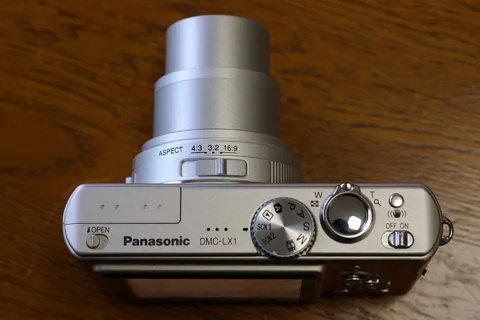
The LX1 is a small metal box that looks like a rangefinder: a lens barrel that stays partly out when the camera is off, a pop-up flash, no viewfinder, and two sliders on the barrel that choose the focus mode and the shape of the picture.346 DPReview compared the look to the rangefinders of the 1950s and called the build fantastic; PhotographyBLOG measured the true depth, lens included, at just over 45 mm, a tight squeeze for a pocket.34
Panasonic announced it on 20 July 2005. Its own claim was the first 16:9 CCD in a digital still camera, dated to 7 July 2005 in the press release's footnote; DPReview and PhotographyBLOG repeated it.134 The sensor is wider than a normal compact's but about as tall, so the 8.4 effective megapixels exist only at 16:9. Switch to 3:2 and you get about 7 megapixels, and 4:3 about 6, with the field of view cropped at the sides.463
Sources disagree on several numbers. Price: Reviewed.com's launch story said $699.95 for September 2005; Imaging Resource listed a suggested price of $599 at introduction; PhotographyBLOG's announcement, which prints the Panasonic Europe press release below it, gave GBP 449.99 for the UK in August (the figure sits in PhotographyBLOG's own opening text, not in the release). DPReview listed street prices of $570 and GBP 400.2613 Battery: PhotographyBLOG's spec table says 7.2 V and 730 mAh; DPReview and the Imaging Resource data sheet say 3.7 V and 1150 mAh.437 Fastest shutter: PhotographyBLOG's feature page says 1/4000 second, but its own spec table, DPReview and Imaging Resource say 1/2000.436
Why this one was interesting
A sensor wider than the screen
Imaging Resource put the idea in television terms: leave the camera on 4:3 and it is like buying a widescreen set to watch old videotape.6 DPReview put it plainly: at 16:9 you get a wider view than at 4:3 or 3:2, and the 28 mm in the specifications becomes 34 mm in 4:3.3 A switch on top of the barrel changes the shape, which DPReview said makes you much more likely to experiment than a menu would.3 Digital-Lifestyles enjoyed the cinema-like sweep so much that pictures from other cameras looked cramped by comparison.5
The oddity is the screen. It is 4:3, so a 16:9 or 3:2 picture is shown with black bars, as Imaging Resource, DPReview and PhotographyBLOG all noted, and PhotographyBLOG called the lack of a matching screen a missed opportunity.634 Our LX2 review picks up the story with the screen that finally matched.
Manual control with a thumb
The LX1 had more external controls than any Lumix compact before it, DPReview said, and a joystick that replaced the exposure button used on models such as the FZ5.3 Imaging Resource set aperture and shutter speed with a nudge while watching a live histogram; PhotographyBLOG hoped other makers would take note.64 Holding it down opens a quick menu for ISO, white balance, size and quality, which DPReview called a big improvement on the older menus.3
Hands that shake
Panasonic's Mega O.I.S. had two modes: one steadies the picture continuously and the other only at the moment of exposure.1 Imaging Resource noted that other makers reserved optical stabilisation for their long-zoom models, and PhotographyBLOG said it set the camera apart from its competitors; its handheld test at 112 mm, f/8 and ISO 80 gave a much sharper frame with the stabiliser on.64 DPReview got handheld shots at the wide end down to around 1/15 second in the second mode, if you were fairly steady.3
The Leica twin
In September 2005 PhotographyBLOG, citing Photoworkshop.com, reported that Leica's D-Lux 2 appeared to be a rebranded LX1, with a different accessories package and an adapter for a spotting scope.8 Reviewed.com later listed the same sensor, lens and screen on both, and said the D-Lux 2 lacks the black grip band on the front of the LX1.9 We have found no source that compares their pictures, and every sample photograph on this page is from a file whose EXIF model is the Panasonic DMC-LX1.
What was lost
The camera asked for compromises. The wide-angle end exists only at 16:9; in 4:3 it starts at 34 mm.3 The lens is a 4x zoom, which Imaging Resource listed as a minus because many rivals offered more, and ISO stops at 400.64 There is no viewfinder, and DPReview regretted that an external flash cannot be added.3 PhotographyBLOG's raw mode took more than 10 seconds to write a file, and the camera locked up while it did; DPReview timed 3.4 seconds with a fast Panasonic card and said a slower no-name card made the burst stall after six or seven frames.43
The dark: its weak point
Everyone saw the noise; they disagreed about where it began. PhotographyBLOG saw almost none at ISO 80 and 100, quite a lot at 200 and said 400 was virtually unusable.4 Imaging Resource found noticeable noise even at the lowest setting, and said ISO 400 prints were fine at 4 by 6 inches, marginally acceptable at 5 by 7, and objectionable at 8 by 10.6 Digital-Lifestyles said there was more noise than in many rivals at ISO 80 and 100, and said you would be reaching for noise-reduction software at ISO 200.5 DPReview measured it: the LX1 was noisier than the 7-megapixel Canon SD550 at every setting. It called the result unforgivable for a camera aimed at serious photographers, a Ferrari that tops out at 55 mph, though it said low-ISO shots processed from raw could still look excellent.3 PhotographyBLOG's 30-second night exposure was noisy and short of detail even at ISO 80 and f/8.4




Real photographs taken with this camera. The sensitivity shown is recorded in each file's own EXIF data.
Like that look? See recent eBay sold listings for this camera ↗
On eBay right now
Live listings for this camera, supplied by eBay and updated automatically. We earn a commission if you buy through them.
The little wins


The joystick
All four reviewers praised it. DPReview said it encouraged more creative shooting; Digital-Lifestyles called the LX1 the best-handling compact it had met.3564
The lens
Imaging Resource measured 0.6 percent barrel distortion at the wide end and very low chromatic aberration; DPReview said edge-to-edge sharpness was good and that fringing was hard to find. Their resolution charts gave 1,300 and 1,550 lines horizontally, so the figures cannot be compared line for line.63
Low-light focus
Imaging Resource found it focused unaided down to about 1/8 foot-candle and, with the assist lamp, in the darkest light of its test. It also said the sensor captured bright pictures in very dim light, on a tripod.6
How it drew the picture
At base ISO the LX1 resolved plenty. DPReview said it matched the best 7-megapixel compacts, with very clean results free of moiré, and called the Leica-badged lens sharp.3 Imaging Resource called 13 by 19 inch prints very usable, though it also saw some noise even at ISO 80.6 PhotographyBLOG called it average and said files were soft at the default setting, advising the Hard sharpening option or a pass in software.4 DPReview, by contrast, thought the default settings a little over-sharpened and contrasty.3
Colour also split opinion. DPReview said white balance and colour were accurate in good light and a touch over-vivid; Imaging Resource found reds and blues oversaturated, with skies that looked almost unnatural.36


















Photos taken with this camera, from Wikimedia Commons, credited under each picture. The first four are 16:9.
Where it let you down
The flash is the plainest weakness: DPReview called it underpowered, with a stated range of 4.1 m at the wide end and 2.3 m at the long end, and Imaging Resource found it dim at the long end and barely able to light its target at 14 feet.36 DPReview also saw clipped highlights or blocked shadows in contrasty scenes, mostly at 28 mm.3 The supplied raw converter drew the sharpest criticism: DPReview thought it spectacularly useless and recommended Adobe Camera Raw instead, and PhotographyBLOG called the software poor.34
Start-up was timed three ways: around 1 second by PhotographyBLOG, 2.9 seconds from switch-on to first shot by DPReview and 3.5 by Imaging Resource, whose shutter lag was 0.48 second with full autofocus and 0.019 second prefocused.436 The tests and cards differ, so treat the figures as approximate.
The little things varied too. PhotographyBLOG's review unit had a very loose lens cap and a scratched, dusty screen cover, which it put down to a unit that other journalists had used; DPReview said the cap stayed firmly on, and Digital-Lifestyles listed the clip-on lens cover as a minus.435 DPReview's aspect switch began to stick after a couple of months.3 On battery life, Imaging Resource called it very good, though it could not run its own power test and relied on Panasonic's 240-shot figure, while Digital-Lifestyles called it average; DPReview got around 190 shots in a day against the 240 quoted, and PhotographyBLOG over 200.6534 The box card was 32 MB, which PhotographyBLOG said holds 7 top-quality pictures.4
What the reviewers said in 2005 and 2006
| Outlet | Date | Verdict |
|---|---|---|
| DPReview | 30 Sep 2005 | Could not decide between its Above Average and Recommended awards. Loved the controls, build and lens; found the noise at ISO 80 unforgivable and called the camera quite expensive.3 |
| PhotographyBLOG | 6 Dec 2005 | 4 stars out of 5 overall. Almost the perfect compact, undone by noise; it told readers to wait for the LX2.4 |
| Digital-Lifestyles | 19 Jan 2006 | 86 percent, "a flawed gem": best handling it had seen, spoiled by noise above ISO 100.5 |
| Imaging Resource | 26 Apr 2006 | A Dave's Pick and a strong value; noise called its Achilles' heel.6 |
The timeline
- 20 July 2005Panasonic announces the LX1; UK sales planned for August, US for September.12
- 23 September 2005PhotographyBLOG reports the Leica D-Lux 2 as an apparent rebranded LX1.8
- 30 September 2005DPReview publishes its review.3
- 6 December 2005PhotographyBLOG's review is dated.4
- 19 January 2006Digital-Lifestyles publishes its review.5
- 26 April 2006Imaging Resource's review is dated.6
Should you buy one now?
Buy one if you want to shoot wide at low ISO, in daylight or on a tripod, and you like a camera with a dial and a joystick. If you will mostly shoot indoors without a tripod, expect noise: all four reviewers flagged it. It launched at a price the sources cannot agree on;261 what it sells for now is a question for the sold listings, not for us. The line continued with the LX2, LX3, LX5 and LX7. Before you bid, check these:
- The pictures. Ask for a sample at ISO 100 and ISO 200 and decide whether you can live with it.
- The lens cap and the screen. A loose cap and a scratched screen cover were found on a review unit;4 ask for photos of both.
- The switches. Slide the aspect and focus switches through every position; one review unit's aspect switch started to stick.3
- The battery. Ask how many shots a charge gives you; reviewers got 190 to over 200 against the 240 quoted.34 No source we read names the battery code.
- The card. Reviewers list SD and MultiMediaCard;43 none of the sources says it accepts SDHC cards, so test with the card you plan to use. See our memory card guide.
If you are wondering why cameras like this are being hunted down again, we tell that story once, in Pictures that never left the card. Terms like CCD and O.I.S. are explained in our glossary.
See recent sold prices on eBay ↗Shop on eBay ↗SD cards ↗
Sources
- PhotographyBLOG, Panasonic DMC-LX1 Announced, by Mark Goldstein, with the Panasonic Europe press release (20 Jul 2005; the UK price of GBP 449.99 for August is in the announcement text above the press release)
- Reviewed.com, Panasonic Announces First Digital Camera With 16:9 CCD, by KJ Kabza (20 Jul 2005; US $699.95, September)
- DPReview, Panasonic Lumix DMC-LX1 Review, by Simon Joinson (30 Sep 2005; all text pages read in an Internet Archive copy, because dpreview.com blocked our fetch)
- PhotographyBLOG, Panasonic Lumix DMC-LX1 Review, by Mark Goldstein (6 Dec 2005; pages 1 to 3, 5, 6 and 8)
- Digital-Lifestyles, Lumix LX1 By Panasonic Review, A Flawed Gem (86%), by Mike Slocombe (19 Jan 2006)
- Imaging Resource, Panasonic Lumix DMC-LX1 review, by Mike Pasini (review date 26 Apr 2006; suggested price at introduction $599)
- Imaging Resource, Panasonic Lumix DMC-LX1 data sheet (CCD size, battery form factor; the price fields are blank)
- PhotographyBLOG, Leica D-Lux 2 Announced (23 Sep 2005)
- Reviewed.com, 8 Megapixel Leica D-Lux 2 in Australia, by KJ Kabza (4 Oct 2005; no official Leica release at the time)
Camera photos by Makoto SATSUKAWA (CC BY-SA 2.0, via Flickr and Wikimedia Commons); other photographs are credited under each one, all via Wikimedia Commons. Links to eBay and Amazon are affiliate links.