Panasonic Lumix LX · announced July 2006
The Panasonic Lumix DMC-LX2: a widescreen sensor, and now a widescreen screen
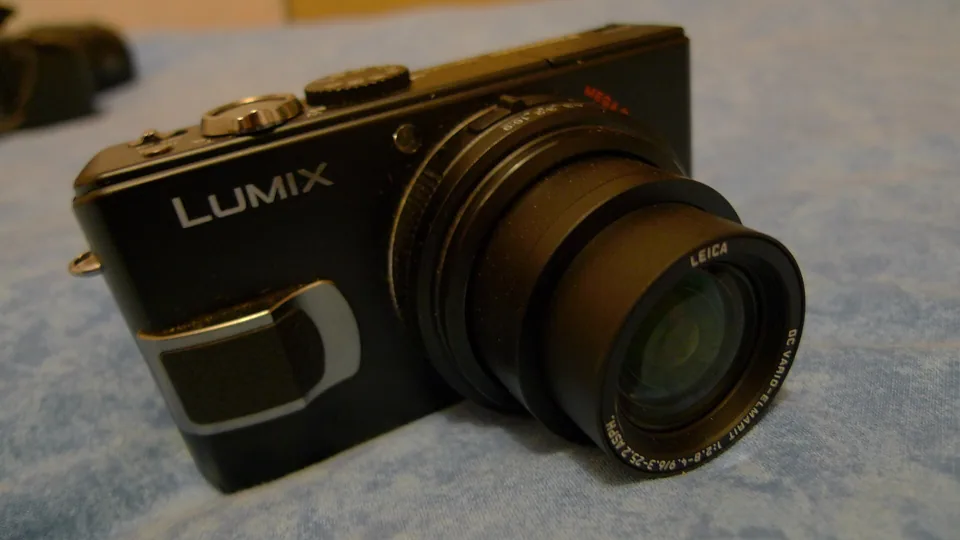
In 2006 Panasonic cut a 10-megapixel CCD in the proportions of a widescreen television, put a Leica-branded 28 mm lens in front of it and finally gave it a screen of the same shape. Reviewers liked the controls and the wide frame, then quarrelled about the noise.
Panasonic Lumix DMC-LX2 specs: sensor, lens, battery, memory card and cable
The Panasonic Lumix DMC-LX2 is a 10.2 MP CCD compact camera with a 28–112 mm (35 mm equivalent) 4× zoom lens, launched in July 2006. It runs on the CGA-S005A battery. Sources
- Sensor
- CCD, 1/1.65", 10.2 MP source
- Lens
- 28–112 mm equivalent, 4× zoom source
- Memory card
- SD, SDHC, MultiMediaCard source
- Battery
- CGA-S005A source
- USB / A/V cable
- See our Panasonic cable page
Meet the camera
The LX2 looks like a small rangefinder: a boxy body, a lens barrel that sticks out when the camera is on and, on top of that barrel, a slider that picks the shape of the picture. Imaging Resource called its styling almost identical to the LX1's and said the black version stayed truer to the classic look.4 DPReview said the build and finish were fantastic and that it was a pleasure to hold; PhotographyBLOG called the body all metal, DPReview metal and plastic.35 PhotographyBLOG pointed out something the spec sheet hid: the listed depth of 26.3 mm leaves out the lens, and the real depth is nearer 45 mm, which makes it a tight fit for a pocket.51
Panasonic announced it on 19 July 2006 as the successor to the LX1, with sales planned for September at about $500.12 The sensor is the point of the camera. DPReview explained that it is about as tall as an ordinary 7-megapixel chip but much wider, so shooting at 16:9 uses all of it, while the 3:2 and 4:3 settings crop the sides and shrink the picture to 8.5 and 7.5 megapixels.345 A switch on the lens barrel changes the shape, and a second one on the left of the barrel moves between autofocus, macro and manual focus.3
Sources disagree on one number: Reviewed.com's launch story put the sensor at 1/1.8 inch, while Imaging Resource's table and DPReview's specifications say 1/1.65 inch, which is the figure we use. It also gave the price as $499, where Panasonic's release (reproduced by Imaging Resource) says $499.95.2431
Why this one was interesting
A screen the shape of the picture
The LX1 had a 16:9 sensor behind a 4:3 screen, so widescreen pictures appeared with black bars. The LX2's 2.8-inch screen is 16:9 and shows the whole frame; Imaging Resource called it the biggest improvement over the predecessor, and DPReview said the shape made sense for the sensor.43 The pixel count did not rise: it is still 207,000 dots, which PhotographyBLOG and DPReview both noted.53 DPReview grumbled that Panasonic had stretched the menus to fit rather than redrawing them.3
More pixels, a new engine
The new chip raised the 16:9 size from 8.4 to 10 megapixels, and the Venus Engine III processor replaced the Venus Engine II.43 The LX1's ISO range had run only from 80 to 400, Reviewed.com noted; the LX2 offers 100 to 1600, with 3200 in a scene mode.24 A new Intelligent ISO Control picks sensitivity from subject movement, though Imaging Resource saw no dramatic benefit from it.4
Wide, bright and in your hand
The lens was carried over from the LX1: 28 mm at the wide end and f/2.8, narrowing to f/4.9 at the long end.13 Reviewed.com's launch story and Imaging Resource both treated the wide lens, wide sensor and wide screen together as the selling idea; Imaging Resource, repeating Panasonic's own phrase, called it "triple-wide".241 Our later Lumix DMC-LX3 is where this line went next; PhotographyBLOG, in its LX2 verdict, said it would wait for it.5
What was lost
PhotographyBLOG called the LX2 a step backwards in places: the fastest shutter speed dropped from 1/4000 to 1/2000 second, and continuous shooting slowed.5 DPReview put the burst rate at 2 frames per second against the LX1's 3 (PhotographyBLOG quoted 3 frames per second for up to three frames in its fastest mode), and listed the dropped TIFF format and a new control layout that was "a little more prone" to stray thumb presses.3 PhotographyBLOG found the rear controls cramped, but called the trade worth it for the larger screen.5
The dark: its weak point
The reviews turned on noise. DPReview's complaint was not noise itself but what the processor did about it: it described heavy noise reduction at anything above ISO 100, a "watercolor" look even at ISO 200, and advised turning the reduction down or shooting raw.3 Its own graphs showed luminance noise lower than rivals', which it read as a sign of the smoothing, not of a cleaner sensor.3 PhotographyBLOG saw almost no noise at ISO 100, some at 200, blurred detail at 400 and worse at 800, and said to avoid 1600.5 Imaging Resource was more forgiving and called ISO 800 about as far as it would push the camera: ISO 400 prints looked distinctly soft at 8 by 10 inches and ISO 800 would not go beyond 5 by 7.4
The ISO 3200 mode is a different trick. DPReview said it bins pixels to give a very low-resolution result for very small prints;3 PhotographyBLOG quoted Panasonic as calling it good enough for a 4 by 6 inch print.5 At night PhotographyBLOG found a 30-second exposure noisy and short of detail even at the lowest ISO.5




Real photographs taken with this camera. The sensitivity shown is recorded in each file's own EXIF data.
Like that look? See recent eBay sold listings for this camera ↗
On eBay right now
Live listings for this camera, supplied by eBay and updated automatically. We earn a commission if you buy through them.
The little wins
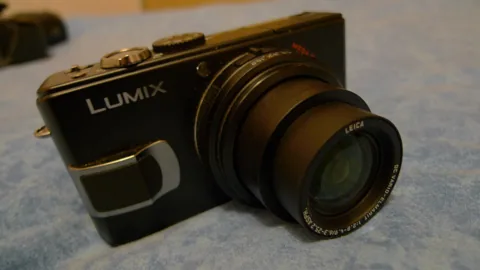 The LX2 in black. · Nicolas Vigier · CC0 · Commons
The widescreen frame
DPReview said 16:9 gave a field of view the 4:3 and 3:2 settings lose, and that the switch made you try the different shapes more often than a menu would. Imaging Resource suggested it for landscapes, group shots and real-estate work.34
Raw, done properly
DPReview said the LX1's raw software had been all but useless, and that the bundled SILKYPIX fixed it, with a small resolution advantage over the JPEGs.3 Imaging Resource noted the TIFF option had gone.4
Lens quality
DPReview measured 1.1 percent barrel distortion at the wide end in 4:3 and next to none at the long end, found macro distortion well below many similar cameras, and said edge-to-edge performance was good.3


How it drew the picture
At ISO 100 the camera was strong. DPReview said the output was excellent and on a par with the best 7- and 8-megapixel compacts; its resolution chart gave 1550 lines horizontally and 1650 vertically, a little above the LX1 and close to the Canon PowerShot S80 and Ricoh GR Digital.3 Imaging Resource called the sensor's detail very good and noted little purple fringing.4 PhotographyBLOG scored image quality 3.5 out of 5, said files were a touch soft at default sharpening, and saw purple fringing only in high-contrast scenes.5
On colour they split. DPReview found it pleasingly natural and white balance reliable in good light;3 Imaging Resource found reds and blues pushed too saturated.4


















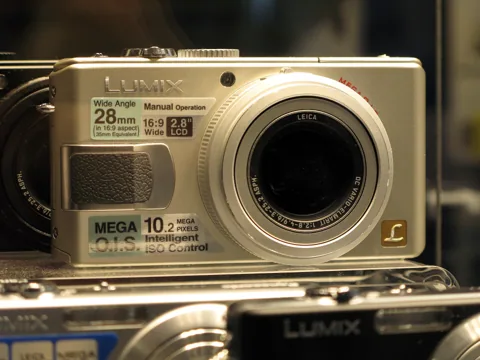
Photos taken with this camera, from Wikimedia Commons, credited under each picture.
Where it let you down
The flash was weak: DPReview called it underpowered and said it reached only about 6 feet at ISO 100.3 Imaging Resource found weak dynamic range outside soft light, and DPReview saw clipped highlights or shadows in very contrasty scenes.43 DPReview also had occasional overexposure at the wide end and a warm cast indoors at night unless you set white balance by hand.3 Video came in 848 by 480 at 30 frames, or a 720p mode at only 15 frames per second that Imaging Resource called herky-jerky; DPReview could not zoom while filming.43 Memory was thin too: 13 MB built in, and a 32 MB card that DPReview's specification lists as supplied while Imaging Resource said no card was included (Imaging Resource's storage section also says 16 MB built in, against 13 MB elsewhere in its review). USB stayed at the old full-speed standard.341
Speed depends on who measured it. Imaging Resource found full-autofocus shutter lag of 0.60 second at wide angle and about 0.02 second prefocused;4 DPReview put a full press at wide angle at roughly 0.75 second and 0.11 second once primed, and 2.9 seconds from switching on to being able to take the first shot against Imaging Resource's 1.7 plus 0.7.34 The tests, cards and definitions differ, so treat both sets as approximate. Reviewers also disagreed on battery drain: Imaging Resource said the always-on stabiliser mode cost significant battery life, while PhotographyBLOG, which got over 275 shots from one charge, said leaving stabilisation on did not hurt.45
What the reviewers said in 2006
| Outlet | Date | Verdict |
|---|---|---|
| DPReview | 10 Oct 2006 | Recommended with reservations. Image quality 7.5 out of 10, build 9, others 8. A good camera, not a great one: excellent at ISO 100, undone above it by noise reduction.3 |
| PhotographyBLOG | Page prints 10 Oct 2005 (an error) | Design 4, features 4, ease of use 4.5, image quality 3.5, value 3 out of 5. Noise makes it a premium-priced camera without premium results; wait for the LX3.5 |
| Imaging Resource | 28 Oct 2006 | 4.0 out of 5 and a Dave's Pick: a refinement of the LX1 that suits enthusiasts, with noise and weak dynamic range as the faults.4 |
The timeline
- 19 July 2006Panasonic announces the LX2 for September at about $500.12
- September 2006Planned availability.14
- 10 October 2006DPReview publishes its review.3
- 28 October 2006Imaging Resource's review is dated.4
Should you buy one now?
Buy one if you want to shoot wide, often, at low ISO and in decent light, and you like a camera with dials. DPReview's advice still holds: if you will not use the 16:9 mode there is little reason to choose it.3 It launched at about $500;1 what it sells for now is a question for the sold listings, not for us. Our LX3, LX5 and LX7 reviews follow the line. Before you bid, check these:
- The pictures. Ask for a sample at ISO 100 and 200, and be ready to turn noise reduction down or shoot raw.3
- The screen. It sits slightly raised on the back; PhotographyBLOG saw scratches on a well-used LX1 review unit with the same raised screen, so look at the glass.5
- The battery. It ships with a CGA-S005A;4 a fresh one is on Amazon ↗.
- The card. It takes SD, SDHC and MMC cards;3 see our memory card guide.
- The switches. Slide the aspect and focus switches through every position, and check that the lens extends and retracts cleanly.
If you are wondering why cameras like this are being hunted down again, we tell that story once, in Pictures that never left the card.
See recent sold prices on eBay ↗Shop on eBay ↗CGA-S005A battery ↗
Sources
- Imaging Resource, Panasonic announcement of the DMC-LX2 by Mike Tomkins (19 Jul 2006; planned price $499.95, September 2006)
- Reviewed.com, Panasonic Presents Widescreen-Optimized Lumix LX2 by Emily Raymond (19 Jul 2006)
- DPReview, Panasonic Lumix DMC-LX2 review by Simon Joinson (10 Oct 2006)
- Imaging Resource, Panasonic DMC-LX2 review by Dan Havlik and Shawn Barnett (review date 28 Oct 2006; MSRP $500, availability 09/2006)
- PhotographyBLOG, Panasonic Lumix DMC-LX2 review (pages 2, 3 and 7; the page prints a review date of 10 October 2005, which cannot be right for a camera announced in July 2006)
Camera photos by Nicolas Vigier (CC0) and Rama (CC BY-SA 2.0 fr); other photographs are credited under each one, all via Wikimedia Commons. Links to eBay and Amazon are affiliate links.