Panasonic Lumix FX · announced July 2004
The Panasonic Lumix DMC-FX7: the 2004 pocket camera that fitted a stabiliser into a Leica lens
Sold as the Lumix DMC-FX7; not to be confused with the 2006 DMC-FX07, a different 7.2-megapixel camera.18
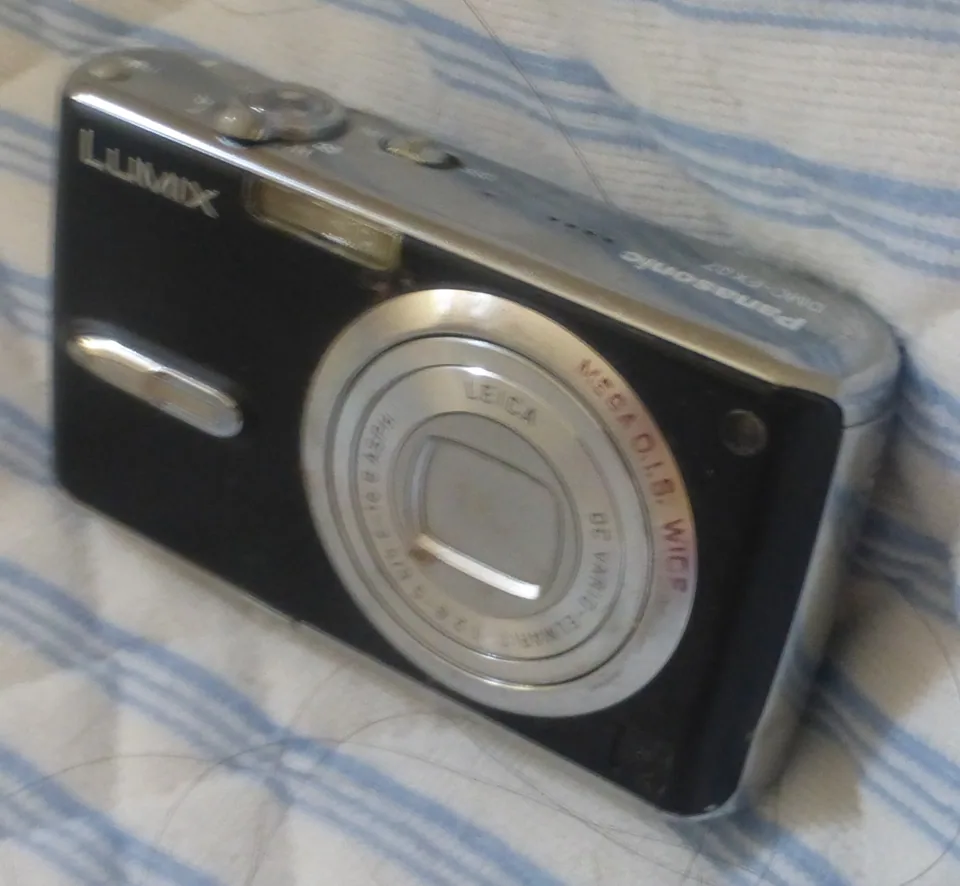

In July 2004 Panasonic fitted a stabilised 35 to 105 millimetre Leica zoom and a 2.5-inch screen into a 153-gram metal body and priced it at $499.95. Reviewers liked the pictures and the stabiliser, but the battery figures in the sources are hard to reconcile.
- Launched
- July 2004
- Launch price
- $499.95 (US suggested retail)1
- Sensor
- 5 MP CCD
- Lens
- 35–105 mm, 3×
- Card
- SD, MultiMediaCard
- Battery
- CGA-S004A
Panasonic Lumix DMC-FX7 specs: sensor, lens, battery, memory card and cable
The Panasonic Lumix DMC-FX7 came out in July 2004 at $499.95 as a 5 MP CCD compact with a 35–105 mm (35 mm equivalent) 3× zoom lens. It uses SD and MultiMediaCard and runs on the CGA-S004A battery. Sources
- Sensor
- CCD, 1/2.5", 5 MP source
- Lens
- 35–105 mm equivalent, 3× zoom source
- Memory card
- SD, MultiMediaCard source
- Battery
- CGA-S004A source
- USB / A/V cable
- See our Panasonic cable page
Meet the camera
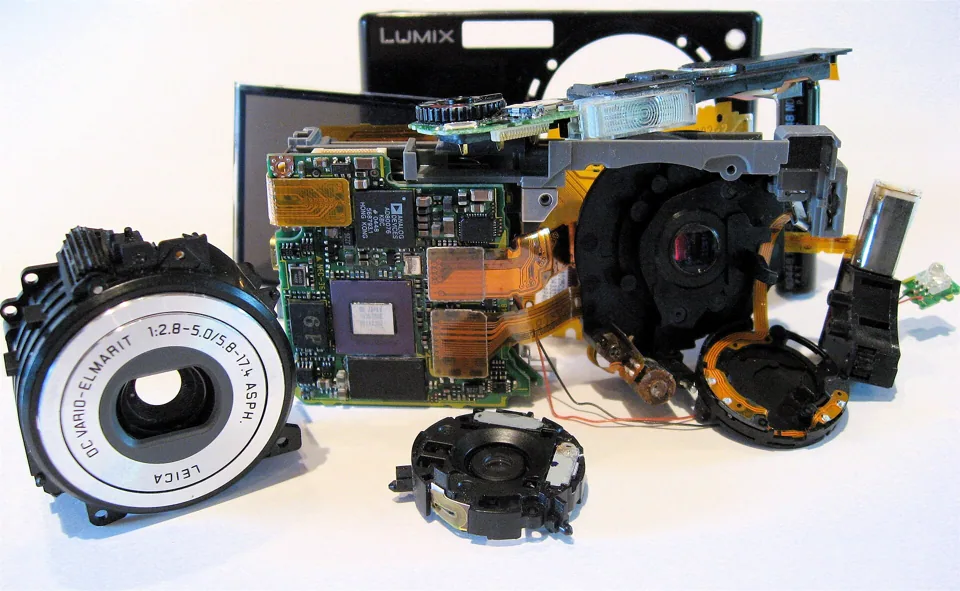
It is a metal pocket camera with a chrome band wrapping the rounded sides and top plate.3 DPReview gave its body volume as 112 cubic centimetres against 172 for the FX5 it replaced, and its weight as 153 grams with the battery;3 Panasonic's manual gives 94.1 by 50.0 by 24.2 millimetres and 135 grams without card and battery.2 A 2.5-inch screen with 114,000 pixels covers about two thirds of the back, which left no room for an optical viewfinder.34 The lens is a 3x Leica DC Vario-Elmarit, seven elements including three aspherical ones, that DPReview said retracts almost flush into the body and extends by about 18 millimetres when switched on.13
Panasonic USA's press release, dated 21 July 2004, gave a suggested retail price of $499.95, shipping to US retailers in August, in black or silver. It called the FX7 the first compact digital camera to combine an optical image stabiliser with a screen of this size, which is Panasonic's own claim; we did not check it.1 DPReview's spec box listed a US street price of $440 and a UK price of £300.3
Why this one was interesting
A stabiliser in a camera this small
Fitting an optical stabiliser inside a lens this compact struck DPReview as remarkable, and the stabiliser got its own button, a first for Panasonic.3 There are two modes: Mode 1 runs all the time and steadies the preview, Mode 2 acts only when the shutter is pressed.34 DPReview found Mode 2 usually better, good for handheld shots at the wide end down to about 1/6 second if you are steady-handed, though it found the difference between the two modes less pronounced and less predictable than on Panasonic's FZ3 and FZ20, and it advised taking a few frames once shutter speeds fall below about 1/15 second.3 CNET said the stabiliser let you shoot two or more settings slower, for example 1/8 second where you could manage 1/30 without it, and that it adds a little shutter lag.4 DCResource, quoted by PhotographyBLOG, put the gain at three to four stops.7 The three estimates differ, and each depends on how steady the photographer's hands are.
A screen that took over the back
DPReview called the screen bright, clear and nearly lag-free, though 114,000 pixels stretched over 2.5 inches looked pixelated, and said direct sunlight can make it hard to read.3 CNET found it easier to use in medium to bright light than in dim light because it does not gain up, and workable outdoors except in direct sun.4 Holding the DISPLAY button for a second brightens it further, at the cost of battery.3
Quick for 2004, with one catch
DPReview said the Venus II processor made the camera feel very responsive: 1.4 seconds from off to ready to shoot, about 0.7 seconds of full-press lag at the wide end and 1.66 seconds from shot to shot with the flash off.3 CNET measured 0.6 seconds of shutter lag under high contrast and 0.9 under low contrast, 2.4 seconds between shots without flash, and nearly 5 seconds for the camera to wake up;4 DPReview's own off-to-first-shot time was about 4.3 seconds, a different measure from its 1.4 seconds and nearer CNET's figure; CNET does not say how it timed the wake-up.3 Photo Review averaged 1.0 seconds of capture lag, or 0.3 seconds with the focus pre-set.5 Burst was the catch, covered below.
Imaging Resource's launch coverage compared the FX7 with the Sony DSC-T1, which it said was almost exactly the same size;1 see our Sony T1 review. Our Lumix DMC-FX35 review covers a later model in the same FX line.
What was lost
DPReview said the huge screen came at the expense of an optical viewfinder.3 The mode dial has six positions (record, simple, play, macro, scene and movie), DPReview warned that anyone wanting control over shutter speed and aperture would be disappointed,3 and CNET said enthusiasts would miss the almost complete lack of manual controls: apart from exposure compensation there are no manual exposure adjustments, though it lists an autobracketing option.4 Video is 320 by 240 pixels, at 10 or 30 frames per second, with sound.3 CNET named the low-resolution movie mode among its cons.4
The dark: its weak point
The camera stops at ISO 400, and the reviewers agree that ISO 400 is where it struggles, but not on how clean the lower settings are. DPReview found ISO 80 and 100 very similar, luminance noise rising noticeably at ISO 200, and heavy noise reduction at ISO 400 that could not hide a grainy look or some colour noise in pale green and blue areas; it still said that noise was no worse than most competitors and advised avoiding ISO 400 unless you must.3 CNET reported a little noise even at ISO 100, more at 400, and JPEG artefacts at high magnification.4 Photo Review said ISO 400 shots were noisy.5
Low light brought other complaints. DPReview listed some focus problems in dim scenes, and very orange automatic white balance indoors at night unless you set it by hand;3 CNET listed poor screen visibility in low light.4 The flash is the other weak spot, and the sources give different reach figures: DPReview's spec table lists 0.3 to 4.0 metres and its test found roughly 1 to 13 feet with auto ISO, CNET found about 13 feet at wide angle at ISO 400 and 7.2 feet at telephoto, and Photo Review about 2 metres.345 DPReview called the flash colour and exposure reliable but red-eye common, with a pre-flash that delays the shot by just under a second;3 CNET said red-eye reduction did not fully remove red pupils.4








The camera's top sensitivity is ISO 400, so these four photos from Wikimedia Commons are dim scenes whose files record ISO 200 to 400.
Want to judge the noise yourself? See recent eBay sold listings for this camera ↗
On eBay right now
Live listings for this camera, supplied by eBay and updated automatically. We earn a commission if you buy through them.
The little wins
A live histogram
DPReview called a live histogram unusual on a camera of this type, and Photo Review counted four display options, including the histogram, among its strengths.35
White balance fine-tune
DPReview liked a slider that shifts the presets or a manual reading toward red or blue, and its three auto white balance tests (outdoor, fluorescent, incandescent) each came within 0.6 percent.3
Simple mode
CNET described a heart-icon mode that locks the centre focus point, sets white balance and ISO to auto, keeps the stabiliser on and cuts the menu to four items, with picture sizes called Enlarge, 4x6 and E-mail.4
How it drew the picture
On DPReview's resolution chart the FX7 resolved 1,450 lines per picture height horizontally and 1,400 vertically before detail was lost, against 1,250 and 1,200 for the Pentax Optio S5i, 1,300 and 1,250 for the Casio EX-Z55, and 1,400 and 1,350 for the Nikon Coolpix 5200 (see our Coolpix 5200 review); DPReview marked moire as visible in the Pentax and Casio results and said the FX7 looked slightly soft because of lower in-camera sharpening, though it had plenty of resolution.3 Against the Pentax, which DPReview said uses an identical CCD, the FX7 showed more edge detail but a little more noise: a standard deviation of 1.85 against 1.77 at ISO 80, and 4.1 against 3.6 at ISO 400.3
The reviewers did not describe the colour the same way. DPReview called exposure, sharpness, colour and focus excellent, with occasional mild colour casts in bright outdoor light and blown highlights in contrasty scenes, helped by a rather high default contrast.3 CNET said images were sharp and well exposed in shadows and highlights, but colour was accurate and a bit muted, with harsh greens in grass and foliage and slightly yellow skin.4 PCMag, in an excerpt we could read only through PhotographyBLOG, said it expected more of the FX7 and that it lacks the speed and image quality to be the magazine's top choice.6


















Photos taken with this camera, from Wikimedia Commons, credited under each picture. The pool holds about 1,900 files, many of them station and food snapshots from a few uploaders, so we chose nine from different photographers; the last was shot at ISO 400.
Where it let you down
The battery is where the sources are hardest to reconcile. Panasonic's manual rates the 710 mAh pack at about 120 pictures by the CIPA standard, which assumes a flash shot every other picture and the screen on.2 DPReview called battery life low, said that 120-shot rating was optimistic, and advised budgeting for a second battery because the lack of a viewfinder forces you to use the screen.3 CNET got 533 shots from a single charge in its own test, half of them with the flash, including zooming, playback and stabiliser use.4 These are not the same measure: Panasonic's figure is a CIPA rating with a fixed routine (a shot every 30 seconds, full flash every other shot, screen on), while CNET does not say how it ran its test or whether it followed CIPA, so the two numbers cannot be compared directly and we cannot tell which is closer to what a used camera will do.
Burst shooting was a smaller disappointment. DPReview could not get near the quoted 3 frames per second and measured 1.5 frames per second for 4 frames at fine quality; CNET took 3 full-size shots in 1.7 seconds in low-speed burst, and Photo Review saw shots 0.8 seconds apart.345 The body itself caused trouble: DPReview found it easy to change the flash mode by accident with a thumb, said handshake is more of an issue than on a larger camera, and found a slower no-brand card made the camera struggle after 6 or 7 shots in its unlimited burst mode.3 Photo Review listed small controls and mode dial among its weaknesses.5
What the reviewers said in 2004 and 2005
| Outlet | Date | Verdict |
|---|---|---|
| DCResource | 2 Nov 2004 (via PhotographyBLOG) | Excerpt only: praised the stabiliser for letting you use much slower shutter speeds.7 |
| DPReview | Dec 2004 (gallery posted 9 Dec) | Calls it “the perfect pocket camera as long as you don't expect miracles”; praise for screen, speed and white balance, complaints about battery life, blown highlights and camera shake.3 |
| PCMag | 23 Dec 2004 (via PhotographyBLOG) | Excerpt only: a beautiful, feature-packed camera that lacks the speed and image quality to be the top choice.6 |
| CNET | 8 Jun 2005 | 7.2 out of 10, “Very good”: optical stabilisation, solid image quality, versatile burst and a large screen against no manual settings, low-resolution movies and a poor screen in low light.4 |
| Photo Review | Undated | Short write-up, no score: Leica lens, large screen and stabiliser as strengths; no viewfinder and small controls as weaknesses.5 |
Our coverage is thinner than for some cameras here: two full reviews (DPReview and CNET), one short write-up and two excerpts. Panasonic's own specifications come from its US operating instructions, read in a copy hosted by the Polish site cyfrowe.pl rather than on Panasonic's own pages.
The timeline
- 21 July 2004Panasonic USA issues its press release for the FX7 at $499.95, shipping in August; Imaging Resource posted the news the evening before.1
- 2 November 2004PhotographyBLOG relays DCResource's review.7
- 9 December 2004DPReview posts the sample gallery of its review (dated December 2004), which says the camera was announced at the end of July alongside the FX2.3
- 23 December 2004PhotographyBLOG relays PCMag's review.6
- 8 June 2005CNET reviews it and lists a release date of 1 September 2004, against Panasonic's August shipping target.41
- 30 September 2006The DMC-FX07, a different camera with 7.2 megapixels and a 3.6x zoom, becomes available.8
Should you buy one now?
Buy one if you want a 2004 pocket camera with a real stabiliser and nice daylight pictures, and can live with 320 by 240 video and a battery whose life the sources rate very differently. It launched at $499.95;1 what it sells for now is a question for the sold listings, not for us. Before you bid, check these:
- The name. Search the DMC-FX7. The DMC-FX07 of 2006 is a 7.2-megapixel camera with a different zoom,8 and the four-megapixel DMC-FX2, announced alongside it in Europe, has a 2.0-inch screen.1
- The battery. Panasonic's manual names the CGA-S004A (3.7 V, 710 mAh), supplied with a DE-991B charger, and tells owners to use genuine batteries only.2 A fresh one is on Amazon ↗. Budget for a spare, as DPReview advised.3
- The card. It takes SD cards and, optionally, MultiMediaCards; the manual says a MultiMediaCard is slower and that burst performance is quoted for SD only.2 The manual's card capacity tables and accessory list stop at 1 GB and it states no maximum, so we cannot say what the largest working card is; see our memory card guide. DPReview tested with a 512 MB card and found a slower no-brand card struggled in long bursts.3
- The cables. The manual lists an AV cable (K1HA08CD0002) and a USB cable (K1HA08CD0001) in the box, both plugging into a dedicated 8-pin jack, with USB 2.0 full speed.2 We did not test either cable.
- The doors and ports. DPReview called the combined battery and card door a slightly flimsy hinged cover, one of the few plastic parts, and described a rubber cover over the combined AV/USB connector and the DC-IN connector.3
- The lens and stabiliser. Check that the lens extends and retracts cleanly, and that the stabiliser button settles the live picture in Mode 1.3
- The screen. Look for scratches on the 2.5-inch panel.
If you are wondering why cameras like this are being hunted down again, we tell that story once, in Pictures that never left the card.
See recent sold prices on eBay ↗Shop on eBay ↗Battery ↗
Sources
- Imaging Resource, Panasonic announces DMC-FX7 digicam by Mike Tomkins (20 Jul 2004), with Panasonic USA's press release dated 21 Jul 2004
- Panasonic, Operating Instructions, Digital Camera Model No. DMC-FX7PP (VQT0M16), US edition; copy hosted by cyfrowe.pl
- DPReview, Panasonic Lumix DMC-FX7 Review by Simon Joinson (dated December 2004; its sample gallery is posted 9 Dec 2004)
- CNET, Panasonic Lumix DMC-FX7 editors' review by David D. Busch (reviewed 8 Jun 2005); read in an Internet Archive copy of the page captured 4 Jan 2007
- Photo Review (Australia), Panasonic Lumix DMC-FX7 (undated, a short write-up with strengths and weaknesses)
- PhotographyBLOG, PCMagazine Reviews Panasonic DMC-FX7 Ultra Zoom by Mark Goldstein (23 Dec 2004): an excerpt from PCMag's review, which we could not open
- PhotographyBLOG, DCResource Reviews Panasonic DMC-FX7 Ultra Zoom by Mark Goldstein (2 Nov 2004): an excerpt from DCResource's review, which we could not open
- Imaging Resource, Panasonic DMC-FX07 review page and specifications (7.2 MP, available 30 Sep 2006)
Photographs are credited under each one, all via Wikimedia Commons. Links to eBay and Amazon are affiliate links.