Nikon Coolpix · announced April 2001
The Nikon Coolpix 775: a pocket Coolpix with a Transfer button, and a lens that split the reviewers
We found no other regional name for it. Nikon's specification sheet gives the model number as E775, which is also the name written into its picture files.12
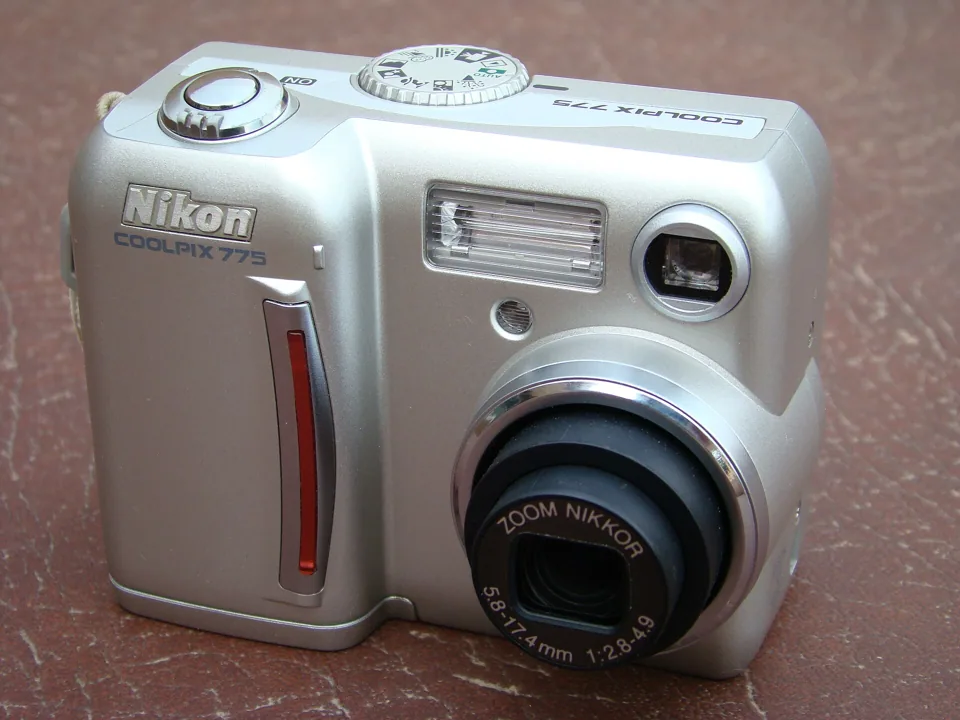
In April 2001 Nikon shrank the Coolpix into a 6.5-ounce camera with a grip, a 3x zoom and a button that started uploads to the desktop or the web. The reviews praised the handling and split over whether the pictures were good enough.
- Launched
- April 2001
- Launch price
- $449.95 (US list price)1
- Sensor
- 2.14 MP CCD
- Lens
- 38–115 mm, 3×
- Card
- CompactFlash Type I
- Battery
- EN-EL1, 2CR5
Nikon Coolpix 775 specs: sensor, lens, battery, memory card and cable
The Nikon Coolpix 775 came out in April 2001 at $449.95 as a 2.14 MP CCD compact with a 38–115 mm (35 mm equivalent) 3× zoom lens. It takes CompactFlash Type I cards and runs on EN-EL1 or 2CR5 batteries. Sources
- Sensor
- CCD, 1/2.7", 2.14 MP source
- Lens
- 38–115 mm equivalent, 3× zoom source
- Memory card
- CompactFlash Type I source
- Battery
- EN-EL1, 2CR5 source
- USB / A/V cable
- UC-E2, EG-775 Confirmed · all Nikon cables
Meet the camera
It is a mostly plastic box of 87 by 67 by 44 millimetres including a grip down one side, with red piping on the grip that DPReview called a Nikon signature; Imaging Resource also noted aluminium trim on the top panel and lens barrel.124 DPReview called it the first ultra-compact Coolpix, aimed at first-time and size-conscious buyers.2
The lens is a 3x Zoom-Nikkor of 38 to 115 millimetres in 35 mm terms, opening from f/2.8 to f/4.9; DPReview noted that it extends only about half an inch, with an automatic cover that closes as it retracts, new to Coolpix.312 Nikon's US list price was $449.95, with shops due to stock it from July 2001; DPReview put the street price near $450.12
- Sensor
- 2.14 MP total CCD, 1/2.7" (effective pixels: 1.92 MP in DPReview's table, 2.01 MP at the Digital Camera Resource Page)123
- Screen
- 1.5" TFT, about 110,000 pixels (112,000 in Imaging Resource's highlights); optical viewfinder, 82% coverage, no dioptre control1243
- Video
- 320 × 240 QuickTime, no sound; 15 seconds (DPReview, Digital Camera Resource Page, Imaging Resource's menus page) or 40 seconds (Nikon's release, Imaging Resource's highlights)2341
- Card and battery
- CompactFlash Type I (8 MB card in the box) · EN-EL1 lithium-ion pack and charger in the box; a 2CR5 cell also fits23
- Launch price
- $449.95 (US list price)1
Why this one was interesting
Nikon's claim: the lightest 3x zoom
Nikon's release called it the lightest 3x-zoom digital camera in the world.1 Imaging Resource's announcement story put numbers on that: Canon's PowerShot S300 weighed about 30 percent more, though the 775 was about 42 percent larger by volume.1 For the family it came from, see the Coolpix 880 and Coolpix 950 reviews on this site; the Coolpix 995 was announced the same day.1
A Transfer button
Nikon called the 775 the first digital camera with a one-touch button to send pictures to the desktop or the web, which was its own claim.1 Every picture was flagged for transfer by default, and you could un-flag it in playback; with the USB cable connected, the button started a NikonView 4 transfer and, if you ticked Web, queued pictures for Nikon's NikonNet sharing site.2 DPReview moved 22 pictures totalling 13.1 megabytes in 35.3 seconds.2
Scene modes, and what was lost
The mode dial held seven scene modes, from party and indoor to sunset, plus Auto, playback and movie.21 There was no manual control of aperture, shutter speed or focus, though the Digital Camera Resource Page noted that rivals in its price band mostly had none either.3 Next to the 995 and the 950, the 775 also gave up some things. You could not discard a picture right after taking it, which the 995 allowed.23 There was no TIFF mode, which the Sony DSC-P50 and Olympus D-510Z had.3 The camera took no external flash and had no autofocus lamp.32 Movie mode, by the reviews' account, was limited to 15 seconds without sound, with no change of macro or white balance.234
The dark
The 775 had no sensitivity setting to raise: DPReview's table lists Auto, ISO 100 to 200, and Nikon's sheet ISO 100.12 DPReview measured autofocus working down to 2.8 EV (17.4 lux) with no assist lamp, called that respectable, and found its flash, rated to 3 metres at wide angle, left shots very slightly dark but accurate in colour.2 Imaging Resource got usable pictures down to about half a foot-candle, with moderate noise, though it found the flash somewhat dim.4 The Digital Camera Resource Page found less to like: its night shot at Disney's California Adventure was not good, and a tripod shot of the Bay Bridge was “noise city”.3


The two pictures above are dim scenes we picked from the Commons category; their files record ISO 200 and ISO 300. DPReview's table lists Auto at 100 to 200 and Nikon's sheet ISO 100 with automatic gain, so the 300 sits outside both lists, and we do not know why.12
Like that look? See recent eBay sold listings for this camera ↗
On eBay right now
Live listings for this camera, supplied by eBay and updated automatically. We earn a commission if you buy through them.
The little wins
A grip on a pocket camera
DPReview thought the grip made it the most comfortable of the ultra-compacts it had met.2 The Digital Camera Resource Page found one-handed use no problem.3
Metering that landed
DPReview said the 256-segment matrix metering, inherited from the bigger Coolpix cameras, almost impeccably picked the right exposure.2
How it drew the picture
The reviews parted here. DPReview found pictures well metered, balanced and clean, with strong, accurate colour apart from blues that came out slightly weak or shifted towards turquoise, but soft; its Auto sharpening chose gentler levels than other cameras did.2 On its chart the 775 resolved 750 lines per picture height horizontally and vertically, against 820 and 800 for the IXUS 300 and 750 on both for the older Coolpix 950; DPReview called that a disappointment and blamed the lens.2 It measured about 1.5 percent barrel distortion at wide angle. Its verdict: Above Average, with 8 out of 10 for image quality and 7 for lens and sensor together.2
Imaging Resource, whose review began as a July first look and was finished with test results by November, was warmer: accurate colour, strong detail out to at least 750 lines, and a slight softness it thought most buyers would not see even in an 8 by 10 print. It measured 0.97 percent barrel distortion, against DPReview's 1.5, and called chromatic aberration very low.4 The Digital Camera Resource Page called the picture quality merely average among its rivals, with jagged edges and purple fringing standing out, and advised skipping the camera for the competition.37 DPReview saw a vertical “stepping” that may be the same defect; neither review said so.23

















Photos taken with this camera, from Wikimedia Commons, credited under each picture. The Commons category for it holds 2,498 files, every one with the camera model E775 in its data; we chose nine with no recognisable people.
Where it let you down
Start-up was slow by DPReview's count: 5.7 seconds to be ready to shoot, 2.6 of them before the lens starts to move.2 Imaging Resource timed 6.8 seconds to a first shot and called that about average for telescoping lenses, and the Digital Camera Resource Page said a bit over 4 seconds.43 Autofocus lag ran 0.8 to 2.0 seconds at DPReview and 0.81 to 0.88 at Imaging Resource, which judged the camera fairly fast overall.24 Shot to shot took 2.3 to 3.3 seconds across the three, and Imaging Resource's buffer held five full-size pictures before the rate fell to one every 5 to 8 seconds.234
The battery divided the reviewers. DPReview gave the EN-EL1 and its charger a pro, measuring 250 shots in its test against 155 for the IXUS 300.2 The Digital Camera Resource Page grumbled that most buyers would do better with AA cells, since a spare pack stayed expensive.3 Imaging Resource warned that the power jack needs a higher voltage than common nickel-metal-hydride external packs supply.4 The tripod socket sat too close to the battery door to change cells on a tripod,24 and the Digital Camera Resource Page called the body cheap-feeling and easy to scratch, where DPReview said it did not feel cheap or fragile.32
What the reviewers said in 2001
| Outlet | Date | Verdict |
|---|---|---|
| Imaging Resource | First posted 23 Jul 2001 | Began as an extended first look at a prototype whose colour and image quality were not final, praising the camera on function alone. The finished review calls it a strong entry with good colour and a slight softness most buyers would not see.64 |
| DPReview | 2 Aug 2001 | Above Average. Pleased by size and handling, found the features simple but adequate, and let down by a lens that resolved less than rivals in its comparisons.25 |
| Steve's Digicams | Aug 2001 | Positive, from the one passage Imaging Resource quoted; we could not read the review itself.5 |
| Digital Camera Resource Page | 30 Aug 2001 | Average: decent pictures but jaggies, a basic feature set and a proprietary battery. Skip it for the competition.37 |
Should you buy one now?
Buy one if you want a pocketable 2001 CCD camera that is quick to understand and sits well in the hand, and can live with soft edges, a slow start and basic controls. It listed at $449.95;1 what it sells for now is a question for the sold listings, not for us. Before you bid, check these:
- The name. Search the Coolpix 775; pictures from it carry E775 in their data.12
- The battery. It uses the Nikon EN-EL1 pack (750 mAh) or a 2CR5 lithium cell; DPReview listed the MH-51 charger for the US and MH-50 elsewhere.2 A pack is on Amazon ↗.
- The card. It takes CompactFlash Type I only, so no Microdrive.23 DPReview's unit refused a Lexar 12x 320 MB card with “THIS CARD CAN NOT BE USED” while 128 to 512 MB cards from Delkin, SanDisk and Kingston worked.2 See our CompactFlash guide and cards on Amazon ↗.
- The settings. Flash, focus, white balance, exposure compensation and sharpening reset each time you switch on; DPReview found that annoying.2
If you are wondering why cameras like this are being hunted down again, we tell that story once, in Pictures that never left the card. The later Coolpix 2500 has its own review here.
See recent sold prices on eBay ↗Shop on eBay ↗EN-EL1 battery ↗
Sources
- Nikon Inc., press release “Nikon Coolpix 775 is the first digital camera with One-Touch to the Web” (Melville, NY, 25 April 2001), with Nikon's specification sheet, as printed in full by Imaging Resource news (25 Apr 2001)
- DPReview, Nikon Coolpix 775 review (published 2 Aug 2001; all 17 pages read: introduction, specifications, body, controls, displays, menus, timings, features, NikonView 4, image quality, three comparisons, conclusion). A pre-production unit was used for the product shots and menus; the image tests and timings used a production unit
- Digital Camera Resource Page, Nikon Coolpix 775 review (posted 30 Aug 2001, updated 26 Oct 2001; Internet Archive copy of April 2014)
- Imaging Resource, Nikon CoolPix 775 review (first posted 23 Jul 2001 as an extended first look; completed with test results by 19 Nov 2001: the Internet Archive snapshot of 1 Aug 2001 says the results will follow a production model, that of 19 Nov 2001 has them; the August version calls the camera “a real winner” on function alone). All 12 pages read: page 1 on the live site, pages 2 to 12 from Internet Archive copies
- Imaging Resource news: “DPReview, Steve's Digicams examine Coolpix 775!” (5 Aug 2001; quotes both reviews' conclusions)
- Imaging Resource news: “Nikon Coolpix 775 reviewed!” (24 Jul 2001)
- Imaging Resource news: “DCRP examines Coolpix 775!” (1 Sep 2001; quotes the Digital Camera Resource Page's conclusion)
Photographs are credited under each one, all via Wikimedia Commons. Links to eBay and Amazon are affiliate links.