Nikon Coolpix · announced April 2001
The Nikon Coolpix 995: the swivel Coolpix that grew a pop-up flash and a 4x zoom
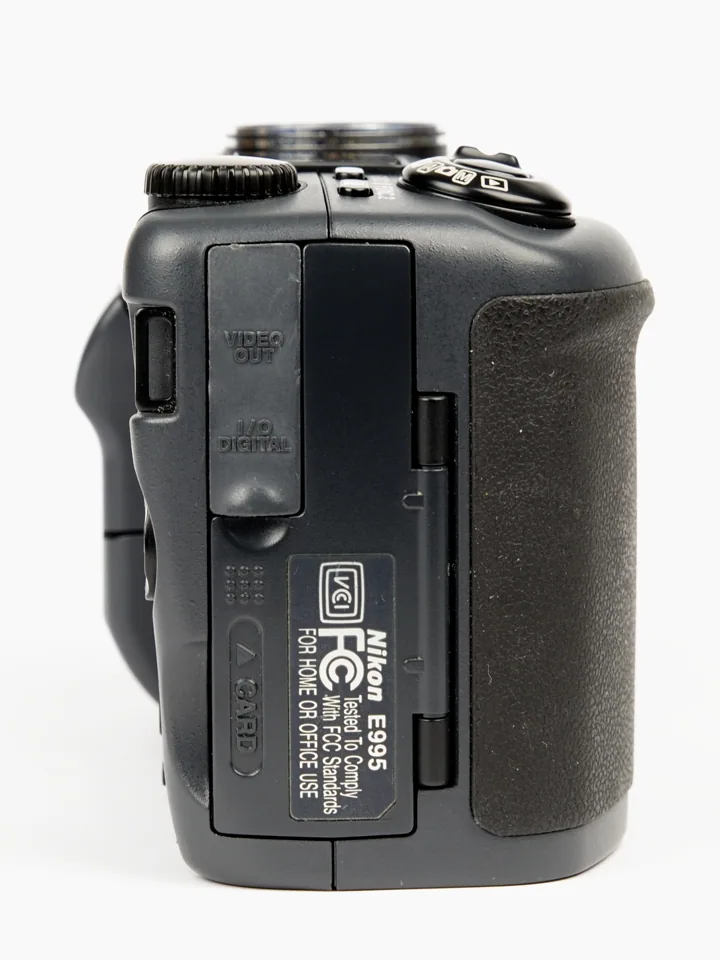

In 2001 Nikon gave its split-body 3-megapixel camera a longer lens, a flash that lifts away from the lens and a lithium-ion battery, for about $900. Reviewers praised the pictures and the macro, then marked it down for the battery, the lens distortion and the low-light focus.
- Launched
- April 2001
- Sensor
- 3.14 MP CCD
- Lens
- 38–152 mm, 4×
- Card
- CompactFlash Type I, CompactFlash Type II
- Battery
- EN-EL1
Nikon Coolpix 995 specs: sensor, lens, battery, memory card and cable
The Nikon Coolpix 995 came out in April 2001 as a 3.14 MP CCD compact with a 38–152 mm (35 mm equivalent) 4× zoom lens. It takes CompactFlash Type I and CompactFlash Type II cards and runs on the EN-EL1 battery. Sources
- Sensor
- CCD, 1/1.8", 3.14 MP source
- Lens
- 38–152 mm equivalent, 4× zoom source
- Memory card
- CompactFlash Type I, CompactFlash Type II source
- Battery
- EN-EL1 source
- USB / A/V cable
- UC-E1 Confirmed · all Nikon cables
Meet the camera
DPReview said Nikon announced the 995 on 25 April 2001, as the latest Coolpix in a line that began with the 900 in 1998, and described it as aimed as an evolution rather than a revolution, building on the 990.1 Imaging Resource put it in similar terms: Nikon updating the hugely successful 990, adding a pop-up flash and Type II CompactFlash support.2 The body is the one the family is known for, two halves on a swivel: lens, flash and sensor on one, grip, screen and controls on the other. Imaging Resource said the grip half is magnesium and the lens side appears to be high-impact polycarbonate.2 DPReview called the plastic lens section probably one of the most contentious details of the new camera, while listing the build as solid despite the plastic.1
Price depends on who you ask. DPReview's spec table listed a street price of US$900,1 the Digital Camera Resource Page $899,3 and The Register, reviewing it in August 2001, gave a UK price of £660.4 None of these is a launch price from Nikon, so we call it about $900, not a confirmed MSRP. Sources also disagree on the weight: 390 g in two reviews (the Digital Camera Resource Page says empty),34 but 410 g without the battery and 454 g with it in DPReview's table.1
Why this one was interesting
It answered the complaints about the 990
The Digital Camera Resource Page's Jeff Keller had picked Olympus's C-3030Z over the 990 in an earlier head-to-head and received angry letters from Coolpix fans. The main complaints were red-eye, a weak movie mode and fewer manual controls. Of the 995, the review says most of those were resolved, the flash most of all.3 Imaging Resource noted that Nikon had clearly listened to owners, and that the new camera brought many of the features owners had requested.2
Four times the zoom, and a lens that still takes add-ons
The zoom grew from 3x to 4x.1 The Digital Camera Resource Page liked having a 4x lens when everyone else offered 3x, and noted that the lens is threaded for wide-angle converters and filters.3 DPReview gave the thread as 28 mm and said it accepts the existing Nikon add-on lenses.1 DPReview described the lens as slower than the 990's: f/2.6 to f/5.1 against f/2.6 to f/4.0.1
More control than anything near its price
Keller wrote that it has more manual controls than any other consumer-priced camera then available, with program, shutter-priority, aperture-priority and full manual modes behind a switch to M-REC, and a simple A-REC mode for point-and-shoot.3 DPReview's verdict called it the most flexible and feature-rich digital camera available at the time, and rated its features 10 out of 10.1 DPReview did not expect owners of the 990 to upgrade, or to need to.1
The swivel idea ran on in a much smaller body in our Coolpix 2500 retrospective, and began with the 2-megapixel Coolpix 950.
What it gave up
The big change, and the argument that followed, was power. The 990 used four AA cells; the 995 switched to a lithium-ion EN-EL1 and bundled a charger.13 Keller disliked the proprietary battery and set its 650 mAh rating against the four 1600 mAh NiMH cells that fit the 990.3 Nikon pointed out afterward that non-rechargeable 2CR5 batteries can be bought in many places, which Keller conceded while noting they cost more than AAs.3 DPReview's own test found the 995 with the EN-EL1 lasted about 2 hours 30 minutes or 255 shots, matching a 990 with NiMH AAs, which it called an excellent performance.1 The Register welcomed the lithium-ion pack as giving longer life and, thanks to the charger, less cost.4
Two smaller shifts: the 16 MB card in the box held about ten Fine JPEGs at full resolution, which Keller called skimpy;3 and Microdrive support was a muddle, with the official word being no, though Keller reported a 1 GB drive working for another reviewer.3 Imaging Resource called its own information on the point severely conflicting.2
The dark: its weak point
Low light was the place the camera struggled, and two reviewers said why. DPReview called low-light autofocus poor, wrote that it was a shame Nikon had not added an assist lamp, and listed the missing lamp among its cons.1 Keller also named the missing AF-assist lamp as the thing he would add.3 DPReview reported low-light focus reaching 2.2 EV, roughly 11.5 lux.1
Noise was manageable at the low settings. DPReview described ISO 100 as very low in noise, ISO 200 as usable with very slight chroma speckling, ISO 400 as relatively low and manageable, and ISO 800 as something for extreme circumstances; it also found ISO 200 cleaner than on the 990.1 A noise reduction setting for long exposures, which DPReview said works only above one second,1 had mixed results in the Digital Camera Resource Page's night test: no visible difference in the foggy night shot, but less noise in other situations, and it doubles the time to write the file.3 We found no free photo from this camera shot at ISO 400 or higher on Wikimedia Commons, so this page has no low-light strip.
The flash is a different story. DPReview said the pop-up flash does seem to alleviate red-eye, and rated the flash as less powerful than the 990's, with a quoted range of 7 m (22 ft) against the 990's 9 m (its own spec table elsewhere gives 10.7 m, its intro table 10 m),1 and a skin-tone test shot was clearly underexposed.1 Keller, for his part, expected red-eye to be substantially reduced with the flash raised, without describing a test of it.3
Like what you read? See recent eBay sold listings for this camera ↗
On eBay right now
Live listings for this camera, supplied by eBay and updated automatically. We earn a commission if you buy through them.
The little wins
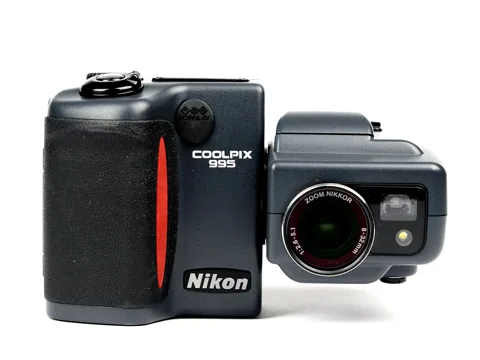 The Coolpix 995 with its flash raised. · François de Dijon · CC BY-SA 4.0 · Commons

Close focus
Macro focus runs down to 2 cm. DPReview measured the minimum frame coverage at 19 mm, identical to the 990, and listed the closest macros of any other digital camera among its pros,1 and Keller called it the camera for macro shots.3
White balance bracketing
Switched on in the menu, the camera takes three frames: the white balance you chose, a reddish one and a bluish one. Keller had not seen the feature on any other camera.3 Imaging Resource called it very useful for critical shots.2
Best Shot Selector
Keller described a mode that takes up to ten frames and keeps the sharpest, recommended for macro and low-light shots.3
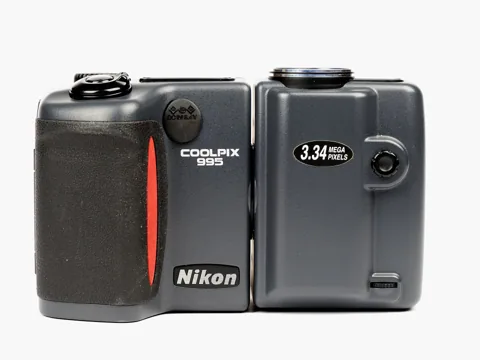 The back of the Coolpix 995, with the screen and the buttons beneath it. · François de Dijon · CC BY-SA 4.0 · Commons

Pause and delete as you shoot
The new Quick Review button shows a thumbnail of the shot just taken, and a second press makes it full-screen. Keller liked that you can pause and delete there, a feature he called less common by 2001.3 Imaging Resource also listed it among the good additions.2
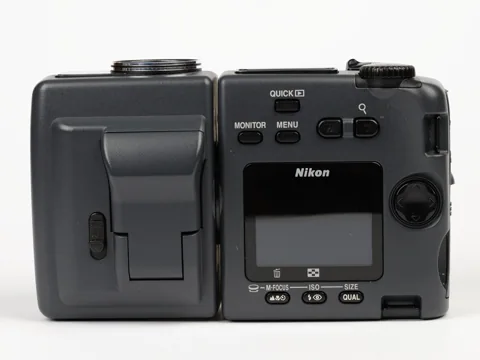 The Coolpix 995 from above, with the lens half turned. · François de Dijon · CC BY-SA 4.0 · Commons

A swivel lock
A lock on the underside stops the lens half turning past 90 degrees each way, so a heavy converter does not drag it round.3 DPReview listed the swivel lock among its pros, and Imaging Resource, which described it as preventing drooping with heavy auxiliary lenses, called it a very nice addition.12
How it drew the picture
DPReview's resolution chart readings matched the 990's: about 900 lines per picture height absolute and 1300 to 1400 extinction. The review added that moiré was more visible and the corners softer than on the 990.1 It described images as sharp and detailed, well balanced, with good dynamic range for a consumer camera, and colour better than on the 990, though blues ran slightly weak and it suggested the in-camera +1 saturation setting.1 The Register wrote that the high-resolution shots were brilliantly detailed and vividly coloured, and Keller called the photo quality nothing short of excellent.43


















Photos taken with this camera (its EXIF name is E995), from Wikimedia Commons, credited under each picture.
Where it let you down
DPReview's cons list included lens distortion that is quite apparent, chromatic aberration at the 990's level, corners that can look unsharp, and a slow lens against some competitors; it measured barrel distortion of 1.5 percent at wide angle and pincushion of 0.8 percent at the long end.1 The same list named a screen that needs an anti-reflective coating, worries over the strength of the CompactFlash compartment catch, and no RAW option; elsewhere in the review DPReview said it kept accidentally knocking the four-way pad onto the wrong AF spot.1 Keller added that the screen is hard to use in bright outdoor light, as all of them were then, and that self-timer mode forces macro focus.3
It was also not quick by modern habit. DPReview measured 5.6 seconds from switching on to the first shot and 2.6 seconds between shots, with shutter lag under 0.1 seconds, and about 0.8 to 1.7 seconds of autofocus lag.1 Keller said start-up takes about five seconds in A-REC mode and that an uncompressed TIFF takes roughly 35 seconds to write.3 Movies were 320 by 240 at 15 frames per second, up to 40 seconds, with no sound.3 The Register's one concern was a loud lens motor.4
What the reviewers said in 2001
| Outlet | Date | Verdict |
|---|---|---|
| Imaging Resource | 25 Apr 2001 | Highlights page: an updated 990 with a pop-up flash and Type II slot; the intro said it should be hugely popular if past success was a guide.2 |
| DPReview | 8 May 2001 (updated Jul 2001) | Highly Recommended. Ratings out of 10: construction 8.5, features 10, image quality 8.5, lens/CCD 8, ease of use 8, value 8.1 |
| Digital Camera Resource Page | 2 Aug 2001 (updated 26 Oct 2001) | Excellent quality, amazing macro and manual controls; disliked the proprietary battery and weak movie mode; a great choice.3 |
| The Register (PC Advisor) | 13 Aug 2001 | Not on its recommended list because of the price, but a great choice for experienced photographers.4 |
| Cameralabs (retrospective) | 14 Oct 2022 | Listed the 990 and 995 with the 950 as the most sought-after early Coolpix models; found the thicker lens section began to lose the charm.5 |
The timeline
- 25 April 2001Nikon announces the 995, per DPReview; Imaging Resource posts its first page the same day.12
- 8 May 2001DPReview publishes its review.1
- July 2001DPReview updates it with results from a production unit on firmware 1.6.1
- 2 August 2001The Digital Camera Resource Page's review appears.3
- 13 August 2001The Register runs PC Advisor's review.4
- 26 October 2001Last update to the Digital Camera Resource Page review.3
Should you buy one now?
Buy one if you want a close-focusing, hands-on 3-megapixel camera with a famously unusual body, and you will shoot mostly in daylight. It listed at about $900 in 2001 (sources, above);13 what it sells for now is a question for the sold listings, not for us. We have not tested a unit. Before you bid, check these:
- The swivel and the lock. The lens half should turn smoothly and stop at the lock position; DPReview listed the swivel lock among its pros and Imaging Resource called it a very nice addition.12
- The card door. DPReview worried about the strength of the CompactFlash latch;1 check that the door closes and stays shut.
- The card. It takes CompactFlash Type I or II, and Nikon did not officially support Microdrives;13 see our CompactFlash guide and cards on Amazon ↗.
- The battery. It uses the EN-EL1, which came with a charger in the box;13 DPReview also lists 2CR5 lithium cells as a power option.1 EN-EL1 batteries on Amazon ↗
- The screen. DPReview said the screen is the 990's and wanted an anti-reflective coating on it, so check it for scratches and glare damage.1
- The flash. Raise it and lower it by hand to confirm the pop-up mechanism moves freely.
If you are wondering why cameras like this are being hunted down again, we tell that story once, in Pictures that never left the card.
See recent sold prices on eBay ↗Shop on eBay ↗EN-EL1 battery ↗
Sources
- DPReview, Nikon Coolpix 995 review by Phil Askey (8 May 2001, updated July 2001 with a production unit on firmware 1.6; specifications, timings, battery life, image quality, conclusion)
- Imaging Resource, Nikon CoolPix 995 review, intro and highlights (first posted 25 Apr 2001)
- Digital Camera Resource Page, Nikon Coolpix 995 review by Jeff Keller (2 Aug 2001, last updated 26 Oct 2001; Internet Archive copy)
- The Register (PC Advisor), Nikon Coolpix 995 review (13 Aug 2001; UK price £660)
- Cameralabs, “Nikon Coolpix 950 retro review” by Gordon Laing (14 Oct 2022), the passages on the 990 and 995
Camera photos by François de Dijon (CC BY-SA 4.0) and Hiyotada (CC BY-SA 3.0); other photographs are credited under each one, all via Wikimedia Commons. Links to eBay and Amazon are affiliate links.