Nikon Coolpix · announced May 2002
The Nikon Coolpix 5700: the 35 to 280 mm Coolpix that could shoot in light it could not focus in
We found no other regional name; Nikon's release lists the type as “E5700”, the model string in the sample photos' EXIF data.1
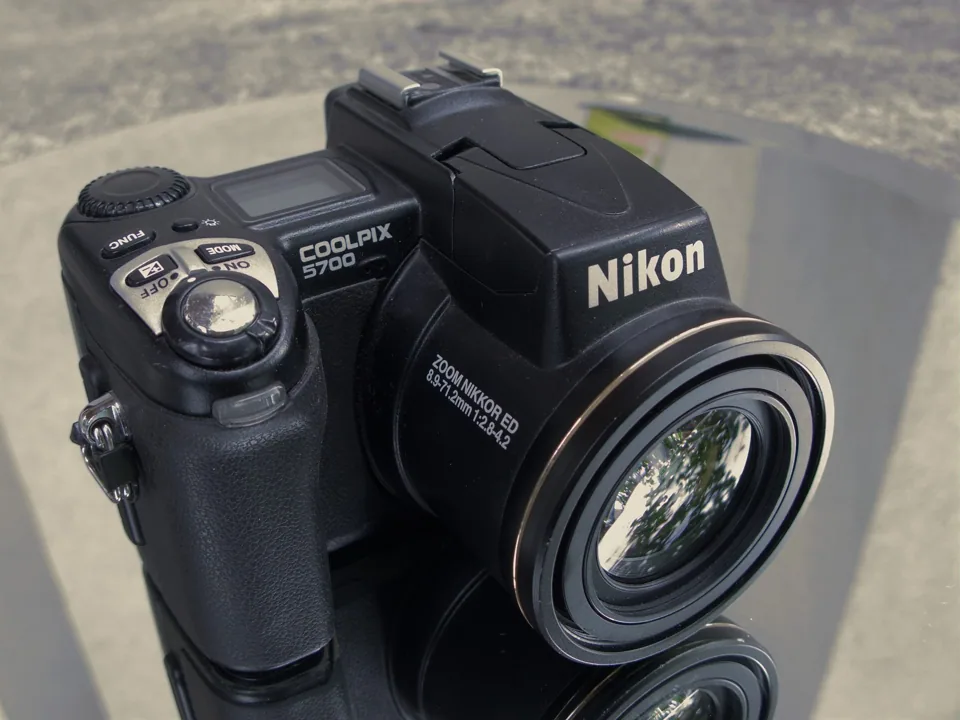

In May 2002 Nikon followed the Coolpix 5000 with a 5.0-megapixel camera whose 8x zoom ran from 35 to 280 mm and whose price, in the reviews that gave one, was about $1,200. All three reviewers praised its macro mode and its pictures; all three noted the missing autofocus lamp, and two found its autofocus struggled in dim light.
- Launched
- May 2002
- Sensor
- 5 MP CCD
- Lens
- 35–280 mm, 8×
- Card
- CompactFlash Type I, CompactFlash Type II
- Battery
- EN-EL1
Nikon Coolpix 5700 specs: sensor, lens, battery, memory card and cable
The Nikon Coolpix 5700 came out in May 2002 as a 5 MP CCD compact with a 35–280 mm (35 mm equivalent) 8× zoom lens. It takes CompactFlash Type I and CompactFlash Type II cards and runs on the EN-EL1 battery. Sources
- Sensor
- CCD, 2/3", 5 MP source
- Lens
- 35–280 mm equivalent, 8× zoom source
- Memory card
- CompactFlash Type I, CompactFlash Type II source
- Battery
- EN-EL1 source
- USB / A/V cable
- UC-E1 Confirmed · all Nikon cables
Meet the camera
The grip comes first. DPReview ranked it among the nicest of any prosumer camera, deep enough for the longest fingers and coated in soft rubber,3 and Imaging Resource found the deep recess between grip and lens barrel gave a firm hold.4 Nikon calls the body magnesium alloy;1 Imaging Resource called it a mixture of metal and plastic, the DCRP a sturdy alloy body apart from a few plastic parts, and DPReview's table lists metal.463 Nikon gives about 480 grams without battery; Imaging Resource agrees and adds 62 grams for the battery, while DPReview lists 512 grams with the battery fitted (our arithmetic: 480 plus 62 would be 542).143
Nikon announced it on 29 May 2002 as the partner of the Coolpix 5000 at the top of the line, and its release gave no price.1 Imaging Resource's news item that day said pricing had not been announced and that shipping would start in July 2002.2 We found no price from Nikon. The figures come from the reviews: the DCRP said $1,199 in July 2002, DPReview's table of August 2002 gives a US street price of $1,200 and £1,000 in the UK, and the header of Imaging Resource's review prints an MSRP of $1200, the same figure as its data sheet, which carries a 2007 update date.6345 Treat about $1,200 as approximate.
- Sensor
- 5.0 MP effective CCD, 2/3" (5.24 MP total); DPReview lists a cyan-yellow-green-magenta filter array13
- Lens
- 8x Zoom-Nikkor, 8.9 to 71.2 mm, 35 to 280 mm equiv., f/2.8 to 4.2; 14 elements in 10 groups, two ED elements1
- Screens
- 1.5" 110,000-dot vari-angle monitor; 180,000-dot electronic viewfinder, 0.44" by DPReview's figure13; Imaging Resource's review text says a 1.8" monitor, its data sheet 1.5"45
- Shutter
- 1/4000 to 8 s, with 1/4000 only when the aperture is within 1 1/3 steps of the widest; Bulb up to 5 minutes1
- Card and battery
- CompactFlash Type I or II, 512 MB and 1 GB Microdrives; EN-EL1 Li-ion, about 90 minutes with the monitor on by Nikon's figure1
Why this one was interesting
A longer zoom than the rivals the reviewers named
DPReview tabulated the rivals: the Minolta DiMAGE 7i started at 28 mm and reached 200, the Sony DSC-F707 ran 38 to 190 mm and the Olympus E-20 35 to 140.3 The DCRP said all of them came up short of the Nikon's reach, called the lens superb, and noted that the Sony's faster f/2.0 to 2.4 lens collects more light.6 DPReview found the lens better than expected and sharp even at full telephoto; it measured 1.3 per cent barrel distortion at 35 mm and 0.4 per cent pincushion at 280 mm, where Imaging Resource measured 0.9 and 0.2.34
An electronic viewfinder, because it had to be
Imaging Resource called an electronic finder a necessary evil: past roughly 4x zoom, an optical one that tracks the lens costs too much.4 Both Imaging Resource's announcement and DPReview called it a first for Nikon.23 DPReview said it appeared to be the same 0.44-inch, 180,000-pixel panel as in Fujifilm's FinePix S602Z and called it one of the best the reviewer had used;3 the DCRP found it sharp and smooth in following the subject.6
The Coolpix 5000, reworked
The DCRP recalled that the 5000 had arrived with a thud and said many, the reviewer included, saw the 5700 as what the 5000 should have been.6 DPReview listed what changed: a 1.5-inch screen in place of 1.8, no soft buttons below it, a pop-up flash in place of a fixed one, RAW, and a lens that went from 28 to 85 mm to 35 to 280 mm.3 It also found purple fringing greatly reduced, and the DCRP noted the flash sensor no longer sat under the fingers.36 Against rivals, the DCRP called it a very close call with the DiMAGE 7i, an easy win over the E-20 and another close one with the F707, whose laser focusing and picture quality made the choice hard.6 Nikon's 2003 Coolpix 5400, the 5000's direct successor, has its own page here.8
What was lost
DPReview listed the loss of the 5000's popular 28 mm wide end among its cons and expected some users to miss it.3 It and the DCRP also noted the lack of a manual focus ring, and DPReview added that manual focus no longer shows a distance, only a bar between macro and infinity, which Imaging Resource disliked too.364 The DCRP found the screen too small for the price.6 An external flash on the hot shoe loses power zoom and autofocus assist, which all three reviewers noted, and DPReview and the DCRP also named red-eye reduction and a record-review histogram.364
The dark: where it needed more light than it let on
The reviewers measured the focus floor differently. Imaging Resource's informal test focused on sharp, high-contrast targets at 1/4 foot-candle, about 2.6 lux, and said to expect reliable focus at about twice that; its test summary put the limit at 1/2 foot-candle, 5.5 lux.4 DPReview's chart test gave 8.7 lux at 35 mm and 20 lux at 280 mm, where focus took almost five seconds and locked half the time, and rated low-light focusing below average.3 Both pinned it on the missing assist lamp; Imaging Resource's own data sheet lists a lamp, which its review text contradicts.435
Exposure held up better than focus. Imaging Resource said the camera could capture bright, well-exposed pictures in light much darker than it could focus in, rated its long-exposure noise excellent, and could frame through the viewfinder down to 1/8 foot-candle, about 1.3 lux, though the viewfinder took 6 to 10 seconds to brighten after a higher ISO was selected.4 The DCRP called the noise-reduction setting a must: without it a night shot filled with hot pixels.6 The sources do not agree on when that setting acts: 1/4 s in DPReview's table and Imaging Resource, 1/15 s on DPReview's night-test page, 1/30 s for the DCRP.346 ISO 800 showed in red as a warning, and DPReview thought it useful only in extreme situations.43
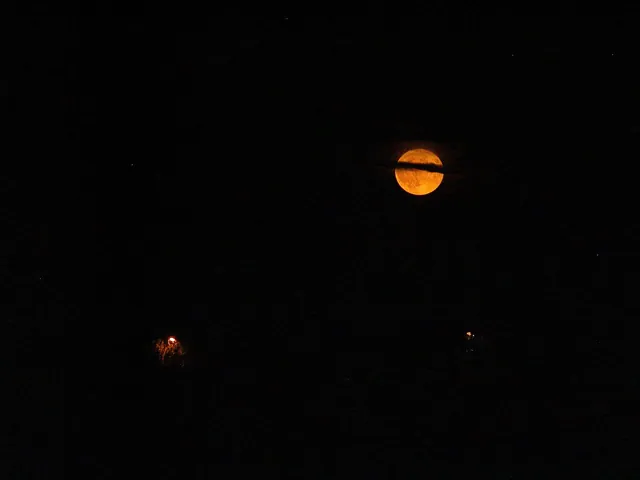

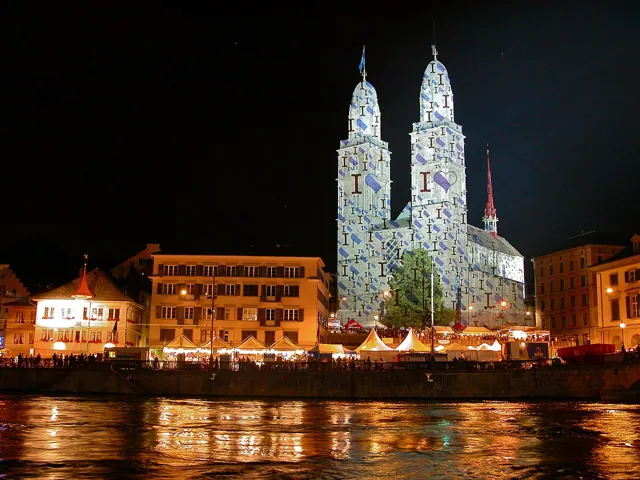





Real photographs taken with this camera. The sensitivity and exposure shown are recorded in each file's own EXIF data. Of the 9,632 files in the Commons category with this camera's EXIF model, 8,702 record ISO 100 and 115 record ISO 800, so dark scenes are thinly documented.7
Like that look? See recent eBay sold listings for this camera ↗
On eBay right now
Live listings for this camera, supplied by eBay and updated automatically. We earn a commission if you buy through them.
The little wins
How it drew the picture
Imaging Resource found colour natural and accurate, called it filmlike, and noted strong yellows came out slightly undersaturated and harsh noon sun produced contrast that cost highlight detail.4 DPReview said picture quality probably came second only to the F707, called its metering unbeatable at this level and measured about 1,350 lines of detail horizontally and 1,200 vertically, the same as the 5000; Imaging Resource saw strong detail to roughly 1,300.34 On highlights the reviewers split: DPReview said they clip early with a harsh edge, and suggested the Nikon's cyan-yellow-green-magenta filter might explain stray magenta and yellow artifacts, while the DCRP said it saw none of the blown-out highlights that had marred the 5000.36
The nine photographs below run from 8.9 mm (35 mm equivalent) to 71.2 mm (280 mm); the focal length is each file's EXIF value. Commons holds 9,645 files in this camera's category, and we read the metadata of every one: 9,632 carry the Nikon E5700 model string, from 970 uploaders, of whom the five largest supplied 4,932 files (51 per cent), 3,545 of them from a single bot, GeographBot.7 The pool therefore reflects a few large upload batches more than the camera's range.


















Photos taken with this camera, from Wikimedia Commons, credited under each picture.
Where it let you down
Handling drew a run of complaints. DPReview found the command dial ignores its first click, and called the strap eyelet on the grip a pressure point on the palm.3 The DCRP found the power switch easy to bump and the four small buttons on the lens barrel too.6 Imaging Resource said none of the advanced features appear until a user setting is chosen over Auto, which would stump new owners.4 DPReview added that its production firmware appeared to have a bug that could corrupt settings, metering mode especially, between the three user sets.3
Speed depends on whom you ask. Start-up to a first shot ran 5.0 seconds for DPReview and 5.4 for Imaging Resource, while the DCRP said under 3.346 Writing a RAW file took 21 to 24 seconds for DPReview, longer than a TIFF; Imaging Resource saw 17 to 62 seconds depending on the card; the DCRP said it locked the camera for about 6.346
DPReview called battery life not bad but not the best. Nikon said about 90 minutes with the monitor on; DPReview's own test gave 2 hours 8 minutes and 215 shots, and Imaging Resource estimated 86 to 92 minutes in capture mode, with the monitor or the viewfinder on.134 DPReview and Imaging Resource advised a spare, the DCRP listed the proprietary battery's cost and short life among its dislikes, and it called the 16 MB card in the box far too small.346
What the reviewers said
| Outlet | Date | Verdict |
|---|---|---|
| DCRP (Jeff Keller) | 25 Jul 2002, updated 15 Oct 2002 | Wholeheartedly recommended, a great choice for lots of resolution and a big lens; held back by a small screen, badly placed controls, no manual focus ring and a costly battery. No score.6 |
| DPReview (Phil Askey) | 23 Aug 2002 | Highly Recommended: construction 9, features 9, image quality 8.5, lens and sensor 8.5, ease of use 8, value 8 (out of 10).3 |
| Imaging Resource (no byline) | Page prints “first posted” 29 May 2002; the text mixes preview notes and production-sample tests, so the review date is uncertain | Called the 5700 very deserving of its place atop Nikon's consumer line, and liked its filmlike colour; disliked the viewfinder it needed, the lack of an assist lamp and contrasty midday results. No score found.4 |
The timeline
- 29 May 2002Nikon announces the 5700 in Tokyo; Imaging Resource reports it, with no price and a July ship date.12
- 25 July 2002The DCRP posts its review, quoting $1,199.6
- 23 August 2002DPReview publishes its review and calls it Highly Recommended.3
- 15 October 2002The DCRP updates its review.6
Should you buy one now?
Buy one if you want a robust CCD camera with a 35 to 280 mm lens, a screen that swivels, full manual control and RAW, and you will work in good light and carry spare batteries. Skip it if you need quick focus in dim rooms or a pocketable body: Imaging Resource called it too big for a shirt pocket.34 Nikon's release gave no price; the reviews put it at about $1,200;163 what it sells for now is a question for the sold listings. Before you bid, check these:
- The name. The Coolpix 5000 looks similar from the back; the 5700 is the one with the 8x lens, the electronic viewfinder and a pop-up flash, where the 5000 had an optical finder and a fixed flash.3
- The battery. It takes the EN-EL1, which DPReview listed at 7.4 V and 650 mAh, and a 2CR5 lithium cell as an alternative.31 You can search Amazon ↗ for a replacement pack; our Coolpix 995 page lists the same battery.8
- The card. It takes CompactFlash Type I or II and, Nikon says, 512 MB and 1 GB Microdrives;1 Imaging Resource warned the 170 and 340 MB Microdrives might not start the camera.4 See our CompactFlash guide.
- The cable. Nikon's accessory list names a UC-E1 USB cable, and the interface is USB 1.1;1 see our Nikon cable pages.
- Doors and hinges. The DCRP called the card door flimsy but tight, and DPReview warned that the spring-loaded card eject button can stay out and block the door;63 check that the screen swivels smoothly and that the lens extends and retracts cleanly.
If you are wondering why cameras like this are being hunted down again, we tell that story once, in Pictures that never left the card; for the vocabulary, see our glossary.
See recent sold prices on eBay ↗Shop on eBay ↗EN-EL1 battery ↗
Sources
- Nikon Corporation (Tokyo), COOLPIX 5700 news release and specification table, 29 May 2002 (archived copy of nikon.com)
- Imaging Resource, “Nikon announces new 8x zoom digicam!” by Mike Tomkins (29 May 2002)
- DPReview, Nikon Coolpix 5700 review by Phil Askey (published 23 Aug 2002; all 22 pages read through archived copies of 2020 and 2026, the 22 gallery images not examined)
- Imaging Resource, Nikon CoolPix 5700 review, print-friendly version (no byline; the page prints “Review First Posted: 5/29/2002” and an MSRP of $1200, and mixes pre-production notes with production-sample tests)
- Imaging Resource, Nikon CoolPix 5700 data sheet (retail price $1200 as updated 2007-02-07)
- The Digital Camera Resource Page (DCRP), Nikon Coolpix 5700 review by Jeff Keller (posted 25 July 2002, last updated 15 October 2002; archived copy of 1 January 2005)
- Wikimedia Commons, Category: Taken with Nikon Coolpix 5700 (9,645 files when we read every file's metadata on 28 Oct 2026)
- Digicam Atlas, our own Nikon Coolpix 5400 and Coolpix 995 retrospectives (their data files cite the reviews listed there)
Sample photographs and the low-light pictures are credited under each one, all via Wikimedia Commons. Links to eBay and Amazon are affiliate links.