Nikon Coolpix · announced August 2000
The Nikon Coolpix 880: a 990 without the swivel, and a battery problem
We found no other regional name for it; DPReview's and Imaging Resource's reviews use the Coolpix 880 name, and the camera's own file data calls it E880.12
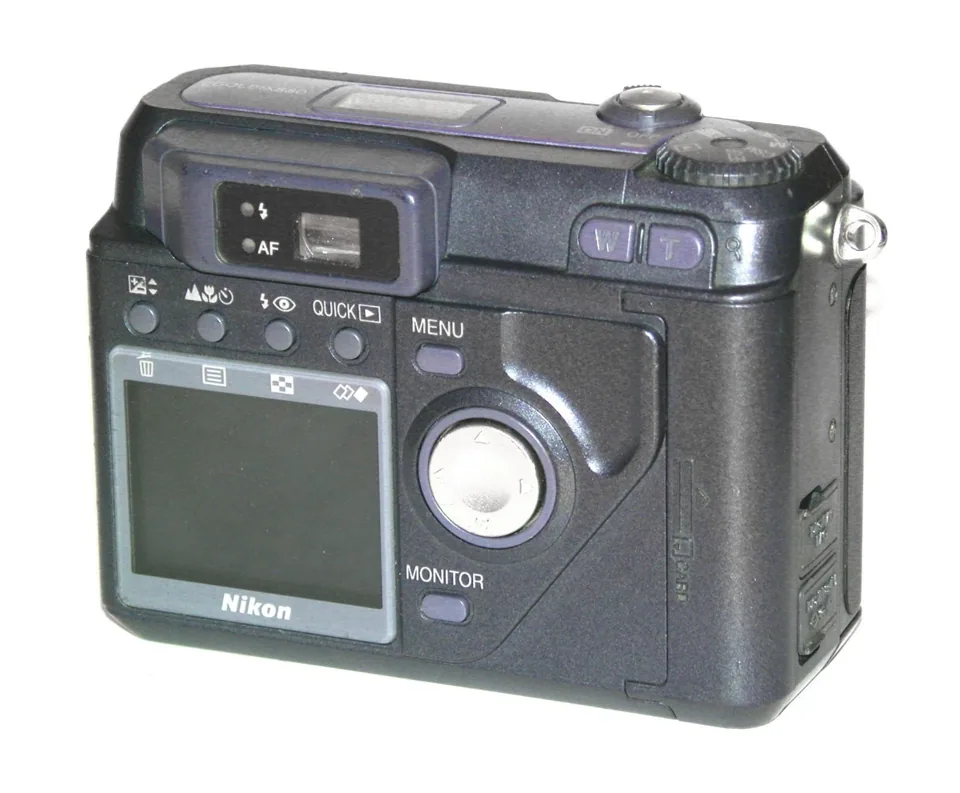
In August 2000 Nikon put the Coolpix 990's sensor into a one-piece body with a lens that folds away, added eleven scene modes and priced it at $799. Three reviewers loved the pictures and the controls, then objected to a battery that was not rechargeable.
- Launched
- August 2000
- Sensor
- 3.14 MP CCD
- Lens
- 38–95 mm, 2.5×
- Card
- CompactFlash Type I
- Battery
- EN-EL1, 2CR5
Nikon Coolpix 880 specs: sensor, lens, battery, memory card and cable
The Nikon Coolpix 880 is a 3.14 MP CCD compact camera with a 38–95 mm (35 mm equivalent) 2.5× zoom lens, launched in August 2000 at $799. It takes CompactFlash Type I cards and runs on EN-EL1 or 2CR5 batteries. Sources
- Sensor
- CCD, 1/1.8", 3.14 MP source
- Lens
- 38–95 mm equivalent, 2.5× zoom source
- Memory card
- CompactFlash Type I source
- Battery
- EN-EL1, 2CR5 source
- USB / A/V cable
- UC-E1, SC-EW3, SC-EM3, EG-900 Confirmed · all Nikon cables
Meet the camera
It is a plastic-bodied compact of about 100 by 75 by 53 millimetres, with a grip that houses the battery.134 DPReview called it palm-sized and almost identical in size and design to the Olympus C-3030Z;1 Imaging Resource said it should fit most shirt pockets.2 The weights disagree: DPReview listed 320 grams with battery, Imaging Resource's data sheet 400 grams with batteries, and the Digital Camera Resource Page 9.7 ounces, about 275 grams, empty. Nikon's manual gives 275 grams without the battery, matching the last figure, and the Japanese report's spec list 270 grams.13467 The colours were silver, or black with blue buttons.1
The lens is a 2.5x Zoom-Nikkor of 8 to 20 millimetres, which is 38 to 95 millimetres on a 35 mm camera, opening from f/2.8 to f/4.2.21 A Japanese report of Nikon's announcement, dated 29 August, called the retracting lens mount a first for the series.7 Nikon's US list price was $799; DPReview put the street price near $750, against $950 for the 990, and the Digital Camera Resource Page said under $700.134 DPReview's table adds £699 in the UK and FF 7,480 in France, both with battery and charger, and DM 1,799 in Germany for the body alone; Nikon Japan's price was ¥88,000, on sale from 23 September.17 DPReview wrote that the camera was not yet available and pre-orders were being taken.1
Why this one was interesting
A 990 in a smaller shell
DPReview's heading for its first page was "Baby 990?" and its answer was yes: the same imager, and image quality that came very close to the 990's in its comparisons.1 Imaging Resource said the 880 had more in common with the 990 than with the Coolpix 800 whose number it followed.2 The Digital Camera Resource Page called it almost a twin and put the price gap at about $200.4 Two swivel-bodied Coolpix cameras from the same family have their own reviews on this site: the Coolpix 950 and the Coolpix 995.
Scene modes, under Nikon's own name
Nikon's term was "Assisted Creative Photography": a menu of eleven presets, aimed at people who want better pictures without learning exposure.2 Imaging Resource found the idea unusual among digicams;2 the Digital Camera Resource Page said Casio had done it first and still did it better, and tried only Night Landscape, which it said worked.4 DPReview first doubted the concept and found it grew on them, and thought the modes also apply their own colour and contrast looks. The manual rates several scenes for camera-shake risk, with fireworks at three stars and a tripod advised.1
Small things that were new
The lens retracts, and the cap that covers it comes with a string, which DPReview greeted with "At last, a sensible lens cap!"1 The Digital Camera Resource Page added that the screen reminds you to remove it.4 A Quick Review button puts a quarter-size thumbnail of the last shot over the live view, and a second press fills the screen; the camera stays ready to shoot, and DPReview noted that pressing it twice is also the quickest route to a histogram.1
What was lost
DPReview's list reads like a bill of materials. The 990's magnesium-alloy case became high-impact plastic, and the split body with twisting lens and imager became a fixed one.1 The zoom stopped at 95 millimetres where the 990 reached 115, and the 990's long run of aperture steps shrank to two choices at each end of the zoom.1 The 880 had no seven-blade aperture diaphragm, no external-flash sync connector, a flash rated to about 4 metres against about 9, a flash sync speed that DPReview thought had dropped to 1/60 second from 1/120, no 3:2 picture size, and no buttons on the body for image size and quality.1 In exchange it weighed 320 grams against the 990's 450.1 DPReview added that the buffer was very slightly smaller and burst shooting a little behind the 990's, though far ahead of the competition.1
The dark: its weak point
Imaging Resource tested low light at measured light levels and rated the camera "very good", adding that six months earlier it would have said "amazing". At ISO 100 it got dim but usable pictures at 1/8 foot-candle (about 1.3 lux), good ones at 1/4 and clean bright ones at 1/2. At ISO 400 it got a usable but very noisy picture at 1/16 foot-candle, and a surprisingly good one at 1/4, with little noise.2 The test's own yardstick was that average street lighting is about 1 foot-candle, so ordinary city night scenes were within reach.2 DPReview's own ISO samples showed noise rising but still manageable across the three steps, with colour saturation falling as the sensitivity rose;1 it still listed low-light and long-exposure noise, and red-channel noise, among the cons.1
In DPReview's test shot the night landscape scene mode chose ISO 400 and, with white balance locked to Auto, could not correct for yellow street lamps; in Manual mode, ISO 100, eight seconds and Incandescent balance gave the best result.1 DPReview had earlier found that CCD noise falls as the camera cools, and repeated a long exposure after 20 minutes outdoors to show it.1

Like that look? See recent eBay sold listings for this camera ↗
On eBay right now
Live listings for this camera, supplied by eBay and updated automatically. We earn a commission if you buy through them.
The little wins
White balance you could tune
Every preset could be fine-tuned warmer or cooler, and Imaging Resource called the resulting control unprecedented.2 DPReview crowned the 990 and 880 the kings of white balance, but found Auto struggled a little under incandescent and fluorescent light.1
Best Shot Selector
Hold the shutter and the camera takes up to ten frames, then keeps the sharpest. DPReview's example set a hand-held 1/9-second shot against the same shot with the selector on, and concluded that it works;1 Imaging Resource named it a favourite Nikon feature and warned that it does not suit moving subjects.2
Focus confirmation
A sharpening mask on the screen makes whatever is in focus stand out, and DPReview found it extremely useful, especially for manual focus.1
How it drew the picture
DPReview's verdict was that the 880 had the best overall image quality of any three-megapixel compact in its size class, a group it named as Canon's PowerShot S20, Sony's DSC-S70, Fujifilm's FinePix 4700Z and Olympus's C-3030Z. It praised exposures and a colour balance that erred towards neutrality, not saturation.1 Its chart gave 900 lines per picture height before aliasing and 1,300 to 1,400 beyond; the Sony reached 1,050, the Olympus 900.1 Imaging Resource saw 750 to 800 lines and detail out to 1,000, with virtually no colour aliasing, and one complaint, a weak rendering of bright yellows.2 DPReview measured barrel distortion of 1.2 percent at wide angle and pincushion of 0.7 percent at the long end, found no purple fringing in more than a thousand real-life shots, yet got fringing on its deliberately overexposed test.1 The Digital Camera Resource Page called the quality exceptional, though one hillside shot could have been sharper.4




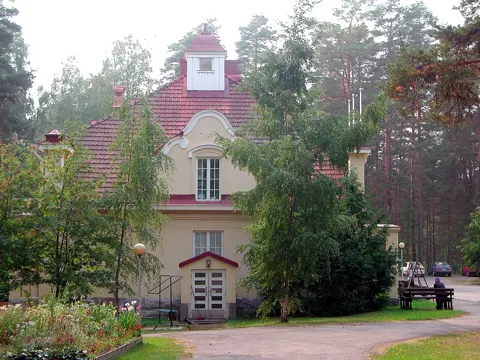











Photos taken with this camera, from Wikimedia Commons, credited under each picture. Only 109 free photos sit in this camera's Commons category, and many are reduced in size, so this is a thin sample.
Where it let you down
The battery came first. The 2CR5 lasted, DPReview said, about two days of solid use, and Imaging Resource put a replacement at $10 to $20.12 Nikon's EN-EL1 rechargeable and its charger were extra: DPReview estimated about $39 and $59, the Digital Camera Resource Page $45 and $65, and Imaging Resource saw a $99.90 kit, calling it mandatory.142 Imaging Resource also warned that a lithium-ion camera needs a higher voltage on its power jack, so common nickel-metal-hydride external packs would not run it.2
Speed was a matter of whom you asked. DPReview timed 6.2 seconds from off to ready, 2.7 of them lens extension, and a shutter lag of 0.1 second; Imaging Resource got 5.22 seconds and a lag of 0.74 with autofocus, 0.23 with manual focus.12 Shot to shot, Imaging Resource measured 1.7 seconds at full size, DPReview two fine-quality shots before a ten-second wait, and the Digital Camera Resource Page about four seconds.214 Other complaints: only two apertures, a noisy lens, no support for CompactFlash Type II, a tripod socket so near the battery door that you cannot change cells on a tripod, an optical viewfinder with no dioptre control, a screen with no anti-reflective coating, and uncompressed TIFF files of 9.3 megabytes that took 44 seconds to write.124 The reviewers also differed on connections: DPReview and Imaging Resource listed a serial option, the Digital Camera Resource Page said USB only.124 Nikon's manual sides with the first two: a UC-E1 USB cable came in the box, and SC-EW3 and SC-EM3 serial cables for PC and Mac were optional.6 Movies were silent.24
What the reviewers said in 2000
| Outlet | Date | Verdict |
|---|---|---|
| Imaging Resource | 26 Aug 2000 | Highly recommended: excellent for its three-megapixel class and a good fit for both enthusiasts and beginners, minus the "optional" $100 battery and charger.2 |
| DPReview | 28 Aug 2000 | Recommended. Construction 8.5, features 10, image quality 9, lens and CCD 8, ease of use 9, value 9.5, out of 10; half a point lost for the missing rechargeable.1 |
| Digital Camera Resource Page | 1 Oct 2000 | No score. For anyone who wants every manual control without a flagship price; closest rival the Olympus C-3000Z.4 |
The timeline
- 26 August 2000Imaging Resource posts its review.2
- 28 August 2000DPReview's review is dated, and says pre-orders are open.1
- 29 August 2000A Japanese report lists ¥88,000 and a 23 September sale date.7
- 30 August 2000Lexar and Altamira issue US press releases for the bundled card and software.5
- 23 September 2000On sale in Japan.7
- 1 October 2000The Digital Camera Resource Page posts its review.4
Dates are as printed on each page; the first two reviews carry dates earlier than the US press releases.
Should you buy one now?
Buy one if you want a pocketable CCD camera with manual exposure, fine white-balance control and a respected macro mode, and can live with a slow start-up and a small flash. It launched at $799;13 what it sells for now is a question for the sold listings, not for us. Before you bid, check these:
- The name. Search the Coolpix 880; its pictures carry E880 in their data.14
- The battery. It runs on a 2CR5 lithium cell or Nikon's EN-EL1; the EH-21 adapter is also its charger.1 A rechargeable pack is on Amazon ↗.
- The card. It takes CompactFlash Type I only.14 See our CompactFlash guide and cards on Amazon ↗.
- The lens. It extends and retracts; listen for roughness, since DPReview called the focusing and lens extension very noisy.1
- Converters. Wide, tele and fisheye adapters need a step-down tube.12
If you are wondering why cameras like this are being hunted down again, we tell that story once, in Pictures that never left the card.
See recent sold prices on eBay ↗Shop on eBay ↗EN-EL1 battery ↗
Sources
- DPReview, Nikon Coolpix 880 review by Phil Askey (published 28 Aug 2000 per DPReview's own page data; the text, dated only "August 2000", was read in 17 pages from an Internet Archive copy: specifications, body, operation, timings, features, image quality, conclusion)
- Imaging Resource, Nikon CoolPix 880 review (first posted 26 Aug 2000; all 12 pages)
- Imaging Resource, Nikon CoolPix 880 data sheet (retail price $799, 3.14 MP, 1/1.8 inch, USB 1.1 and serial)
- Digital Camera Resource Page, Nikon Coolpix 880 review by Jeff Keller (posted 1 Oct 2000; Internet Archive copy)
- DPReview, “Seybold: In the box with the Coolpix 880” (30 Aug 2000; Altamira and Lexar press releases)
- Nikon, COOLPIX 880 Guide to Digital Photography (the camera manual, PDF; connections, battery and specifications chapters)
- AV Watch / Phile-web, “Nikon's 3.34-megapixel compact digital camera COOLPIX 880, ¥88,000” (29 Aug 2000, in Japanese)
Photographs are credited under each one, all via Wikimedia Commons. Links to eBay and Amazon are affiliate links.