Nikon Coolpix · announced February 2003
The Nikon Coolpix 2100: the cheaper twin that drew framing outlines on its screen
We found no other regional name for it: Nikon's manual calls it COOLPIX 2100 and types it “E2100”, the model name written into its photos' EXIF data.112 Its near twin is the 3.2-megapixel Coolpix 3100.
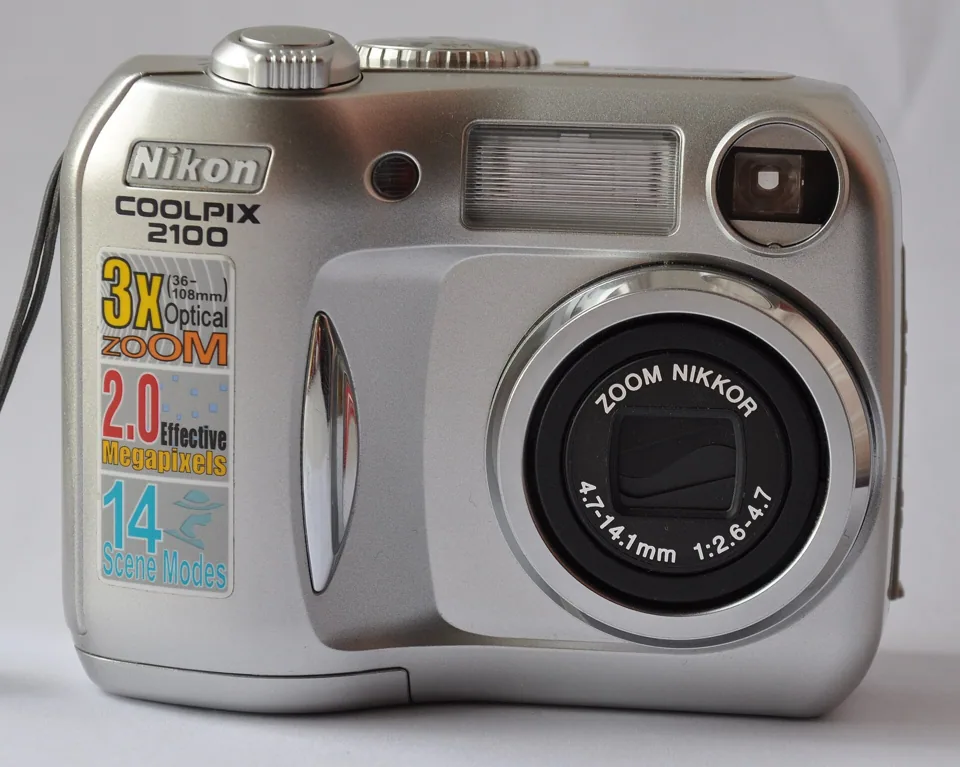

In February 2003 Nikon priced a 2-megapixel, 3x-zoom compact at $249.95 and gave it four dial modes that drew framing outlines on the screen. Reviewers liked its colour, marked down its flash, and could not agree on whether it would fit a pocket.
- Launched
- February 2003
- Launch price
- $249.95 US list2
- Sensor
- 2 MP CCD
- Lens
- 36–108 mm, 3×
- Card
- CompactFlash Type I
- Battery
- 2x AA, CRV3
Nikon Coolpix 2100 specs: sensor, lens, battery, memory card and cable
The Nikon Coolpix 2100 came out in February 2003 at $249.95 as a 2 MP CCD compact with a 36–108 mm (35 mm equivalent) 3× zoom lens. It takes CompactFlash Type I cards and runs on 2x AA or CRV3 batteries. Sources
Meet the camera
Nikon lists it at 87.5 by 65 by 38 millimetres and 150 grams without battery or card.1 Imaging Resource called it one of the tiniest digicams the reviewer had seen and said it slips into a shirt pocket; CNET, on the same camera, found the silver plastic chassis somewhat bulky and its curvy shape hard to get into a trouser pocket.49
Nikon Inc. announced it on 18 February 2003 alongside the 3.2-megapixel Coolpix 3100 and the swivel-bodied Coolpix SQ, at a US list price of $249.95, available nationwide in March; its release called the 2100 and 3100 the first Nikons with Scene Assist.2 Imaging Resource's data sheet gives 31 March 2003 as the date available, at $249.00 retail.8 On 2 October 2003 Nikon cut the price to $199.3
The spec card below follows Nikon's manual. Where Nikon, the reviewers and the retail paperwork part ways, the table further down shows who said what.1
- Sensor
- 2.0 MP CCD, 1/3.2" (2.11 MP total)1
- Lens
- 3x Zoom-Nikkor, 36–108 mm equiv. (4.7–14.1 mm), f/2.6–4.7; 4x digital zoom1
- Sensitivity
- About ISO 50 with automatic gain of two to four times; the camera picks the value and does not show it14
- Screen
- 1.5", 75,000 dots, about 97% coverage, plus a small optical viewfinder (about 82%)1
- Card and power
- CompactFlash Type I, 16 MB card in the US box · one CRV3 lithium pack or two AA cells of listed types12
- Size
- 87.5 × 65 × 38 mm, 150 g without battery and card1
- Launch price
- $249.95 US list2
Why this one was interesting
A camera that drew the shot for you
The mode dial carried four Framing Assist positions: portrait, landscape, sports and night portrait. Pick a sub-mode and bold yellow outlines appeared on the screen for you to line the subject up with: one figure centred or to either side, a close-up, a couple, a figure shot with the camera held upright, or in landscape mode a mountain outline and a grid. Imaging Resource called the result a nearly foolproof way to take good pictures.4 Nikon's release said the overlay also set focus and exposure for the chosen framing, and quoted its marketing vice-president saying it helps beginners with common problems such as out-of-focus subjects.2
An entry-level camera with a full feature list
CNET called it a worthy successor to the Coolpix 2000 with an ideal point-and-shoot feature set.9 Pocket-lint saw a good starter at the very entry level, dearer than similar Olympus, Kodak and Sony cameras but smaller, and it said a charger came in the box, although Nikon's own release lists a rechargeable battery and Quick Charger kit as a separate purchase.102 A column by a freelance writer and public-relations consultant on a Chattanooga news site went further and called it the best entry-level model for a new digital camera user.11 Imaging Resource listed the Canon A60, Fuji A203, Olympus 520 (marked as being phased out) and Sony P52 as its two-megapixel, 3x-zoom rivals.4 For the model one step up, see our Coolpix 3100 review; Imaging Resource said the CCD is the only significant difference.4
What was left out
No mode lets you choose aperture or shutter speed; the dial's “Manual” position only opens more menu options such as white balance, sharpening and Best Shot Selector.4 CNET also noted the lack of manual exposure.9 Video had no sound and was short.4910 The optical viewfinder shows only about 82 percent of the frame.14
The dark: the noise and the flash
Imaging Resource's night test produced clear, bright, usable pictures down to a quarter of a foot-candle (2.7 lux), with moderate noise and a slightly warm colour balance; the target was still visible, though dim, at 0.67 lux. The best exposures in its table ran one to two seconds at f/2.6 and ISO 400.7 CNET said you will see noise in dim light and dense shadows, as with most low-end cameras, yet found autofocus quick and accurate even in low light.9
Nikon rates the sensitivity at about ISO 50 with automatic gain. Imaging Resource never saw its test unit record below 100, and said the camera raised the value itself, to 400 in the night test and as high as 800 in Night Portrait Assist.147 Our own count, not a reviewer's: we read the EXIF data of 5,108 of the 5,153 files in the Commons category (we skipped 45 whose titles matched a keyword filter), and 5,097 are tagged E2100. Of the 5,083 that carry an ISO value, 3,548 are exactly ISO 100; the lowest is 100 and the highest 400, so the 800 does not show up in these files.12
The flash is the larger problem. Nikon rates it to 3.0 metres at wide angle and 1.7 at telephoto.1 Imaging Resource found flash pictures dim, called flash power the camera's one real Achilles' heel, saw its eight-foot target come out very dark and needed +1.3 EV of compensation for an indoor portrait; in macro the flash overexposed the shot.47 CNET found the red-eye-reduction flash only occasionally effective, and noted that the bundled NikonView software removes red-eye in one click.9







Real photographs taken with this camera. The sensitivity shown is recorded in each file's own EXIF data, and the same data flags the flash as fired in all four.
Like that look? See recent eBay sold listings for this camera ↗
On eBay right now
Live listings for this camera, supplied by eBay and updated automatically. We earn a commission if you buy through them.
The little wins
 A mushroom photographed up close with this camera. · Alok Mahendroo · CC BY-SA 3.0 · Commons

Close-ups
Focus down to 4 centimetres.1 Imaging Resource measured a minimum area of 55 by 41 millimetres, with high resolution and good detail in the coins and brooch it shot, though more softness in all four corners, and called Nikon's macro performance typically above average.4
Sixteen frames in one
Sport Composite shoots 16 images in two seconds and tiles them into one picture; a second multi-shot mode records at 15 frames a second for up to seven seconds, then picks 16 frames and arranges them in a single 1,600 × 1,200 image.4
Best Shot Selector
In the Manual position the shooting menu offers Best Shot Selector: hold the shutter button and the camera keeps the least blurry frame of the series. Imaging Resource named it one of its all-time favourite digicam features, because it lets you hand-hold long exposures.4
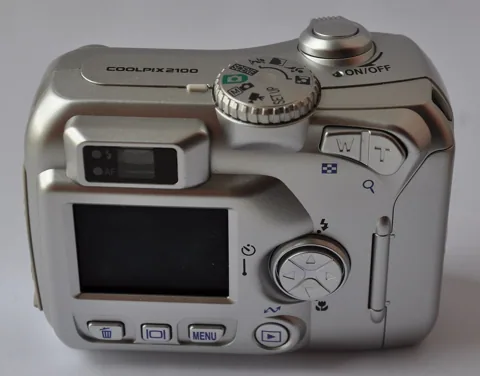 The top plate with mode dial, ON/OFF lever and shutter button, and the back of the camera. · Lokal_Profil · CC BY-SA 3.0 · Commons

Controls that explain themselves
CNET liked that most shooting features sit on the mode dial, with flash, macro and self-timer on the navigation pad and a zoom switch shaped for the thumb.9 Imaging Resource said it doubted you would need the manual for more than reference, and found the menus short.4
How it drew the picture
Imaging Resource's lab chart showed artefacts from about 500 lines per picture height, strong detail out to about 800 and extinction a little below 1,000, which it called average for 2.0 megapixels.47 It rated the colour excellent, skin tones particularly good and the hard-to-render blue flowers of its portrait only slightly dark, though the pure red, green and blue primaries ran a touch oversaturated. Corners were soft, the upper left most; barrel distortion measured 0.8 percent at wide angle and 0.2 at telephoto, and chromatic aberration about six pixels, which it called high. It marked down dynamic range after the bright house shot lost detail in the white trim.47
CNET said it produced some of the best images it had seen from a 2-megapixel model, with excellent white balance and colour and a broad dynamic range with very little noise; it called the sharpness above average but not the best in class, and saw slightly more purple fringing than it liked.9 Pocket-lint named skin tones the strength and found detail as expected for 2 megapixels.10 Nikon's release said it prints up to 8 by 10 inches; the Chattanooga columnist found 4 by 6 prints stunning, 5 by 7 good and 8 by 10 acceptable.211


















Photos taken with this camera, from Wikimedia Commons, credited under each picture.
Where it let you down
Pocket-lint disliked the power lever. You slide it briefly toward you and it springs back; the reviewer found it easily mistaken for the zoom control, so the camera switched off by accident, and wished the off position were on the mode dial.410 The optical finder showed about 82 percent of the frame at wide angle and about 78 at telephoto in Imaging Resource's measurement, and Pocket-lint saw parallax; the screen was closer to the truth at 96 to 97 percent.410
Imaging Resource clocked 4.1 seconds from power-on to the first shot, a bit slower than average. Shutter lag was 0.92 seconds with full autofocus and 0.069 prefocused; continuous mode ran at 1.6 frames a second for about seven full-size shots, and it did not seem to have any buffer memory. It noted that the unit used for the shutter-lag figure was a prototype that did not zoom, and a news item of 5 April 2003 says a production model was tested later.65 CNET found shot-to-shot time under three seconds in most cases and barely any lag when prefocused, but measured continuous shooting at 0.3 to 0.8 frames a second and up to three seconds to write one top-quality picture.9
On power, Nikon's manual lists two EN-MH1 rechargeable AA cells or one CRV3 lithium pack, with two ZR6 nickel-manganese or two FR6/L91 lithium AA cells as alternatives, and says alkaline batteries cannot be used. Its own test gives 220 minutes on a CRV3 and 120 on EN-MH1 cells.1 Imaging Resource projected 108 minutes with the screen on, on 1,600 mAh cells, and about four days with it off; CNET took more than 450 pictures on one CRV3.69
Where the sources disagree
We follow Nikon's manual unless a lab measurement is involved. Imaging Resource's pages also still carry sentences that evidently belong to other cameras: the Design section mentions a 3.2-megapixel CCD and the timing page calls the camera a Coolpix 3500 once, so we leave those sentences out.46
| Point | One account | Another |
|---|---|---|
| Lens | 36–108 mm: Nikon's manual and release, Imaging Resource's test-image page; f/2.6–4.7: Nikon's manual, and engraved on the lens in our photos127 | 38–114 mm: Imaging Resource's overview and data sheet; f/2.8–4.9: Pocket-lint4810 |
| Screen | 1.5 inch, 75,000 dots: Nikon's manual1 | 1.6 inch: Nikon's release, Imaging Resource's data sheet, Pocket-lint and the Chattanooga column; 80,000 pixels: Pocket-lint281011 |
| Weight | 150 g without battery and card: Nikon's manual and Imaging Resource's data sheet18 | 212 g with battery and card (Imaging Resource's Design section) and about 7 oz with a CRV3 and the 16 MB card (CNET): a different basis, not necessarily a conflict49 |
| Scene modes | 14: Nikon's release, CNET and the sticker on the camera in our photos; Imaging Resource counts 10 scenes plus 4 assist modes, which is 14 by our arithmetic294 | 16, plus four assist settings: the Chattanooga column11 |
| Video length | 15 s at 320 × 240 or 7 s at 640 × 480: Nikon's release and CNET; 15 s: Pocket-lint2910 | Set by free card space: Imaging Resource4 |
| In the box: power | A CRV3 lithium: Nikon's release, CNET, Pocket-lint2910 | Two alkaline AA cells: Imaging Resource, though Nikon's manual says alkaline cannot be used; a charger: Pocket-lint, while Nikon's release lists its charger kit as a separate purchase41102 |
| In the box: card | 16 MB: Nikon's release, Imaging Resource, CNET249 | 8 MB: Pocket-lint and the Chattanooga column, which found it stingy1011 |
What the reviewers said
| Outlet | Date | Verdict |
|---|---|---|
| Imaging Resource | 18 Feb 2003 (as printed) | Ends “Highly recommended!”: excellent colour and easy modes, but weak flash power, a tight viewfinder and resolution average for 2 megapixels.4 |
| CNET | 10 Jun 2003 | 7.6: great 2-megapixel pictures, solid performance and many presets; bulky, short silent videos and some purple fringing.9 |
| Chattanoogan.com column | 10 Aug 2003 | A freelance writer and PR consultant's (non-specialist) pick as best entry-level camera for a newcomer; liked the size and automatic mode, disliked the exposed lens cover during transfer and the small card. No score.11 |
| Pocket-lint | 16 Dec 2003 (as printed) | 4.0 out of 5, a good starter with good skin tones; dearer than its rivals, and the 3100 is the better buy if you can stretch.10 |
The timeline
- 18 February 2003Nikon Inc. announces the 2100, 3100 and SQ; the 2100 lists at $249.95.2
- 31 March 2003Date available in Imaging Resource's data sheet.8
- 5 April 2003Imaging Resource says it has tested a production model.5
- 10 June and 10 August 2003CNET and the Chattanooga column publish.911
- 2 October 2003Nikon cuts the price to $199.3
- 16 December 2003Pocket-lint's review carries this date.10
Should you buy one now?
Buy one if you want a very simple 2-megapixel CompactFlash camera that works as a point-and-shoot in daylight and you accept a weak flash; it launched at $249.95.2 What it sells for now is a question for the sold listings, not for us, and we have not tested a unit. Before you bid, check these:
- The model. The 3.2-megapixel Coolpix 3100 is a near twin.410 In our product photo the front panel and top plate read COOLPIX 2100, the front sticker reads 2.0 effective megapixels and the lens barrel is engraved 4.7–14.1 mm 1:2.6–4.7.
- The power. Use the cells in Nikon's list: EN-MH1 NiMH, ZR6, FR6/L91 or a CRV3; the manual says alkaline cells cannot be used, and the EH-61 adapter is the only adapter it allows.1 The sources differ on battery life, so test a charged set: AA batteries on Amazon ↗.
- The card. It takes CompactFlash Type I.1 Nikon's approved list tops out at 1 GB (SanDisk), apart from its own EC-CF line at all capacities, and says other makes are not guaranteed, and we have not tried a larger card. Imaging Resource advised at least 64 MB.14 See our CompactFlash guide and glossary.
- The cable. Nikon's manual names a UC-E6 USB cable and an EG-CP11 video cable;1 see our UC-E6 page.
- The lever and the doors. Check that the power lever springs back, that the connector cover, which stays attached to the camera, is intact, and that the hinged battery door latches; its tripod socket is plastic and sits beside the battery door.4
If you are wondering why cameras like this are being hunted down again, we tell that story once, in Pictures that never left the card. Another two-megapixel Nikon, from a year earlier and with a swivelling body, is our Coolpix 2500 review.
See recent sold prices on eBay ↗Shop on eBay ↗Rechargeable AA batteries ↗
Sources
- Nikon Corporation, COOLPIX 2100 user's manual (PDF, “Type E2100 digital camera”; specifications, approved cards, batteries, accessories)
- Imaging Resource, “Nikon's Coolpix SQ finally announced” by Mike Tomkins (18 Feb 2003), with the Nikon Inc. press release for the Coolpix 2100, 3100 and SQ
- Imaging Resource, “Nikon announces price cuts, rebates” by Mike Tomkins (3 Oct 2003), with Nikon Inc.'s release of 2 Oct 2003
- Imaging Resource, Nikon Coolpix 2100 Quick Review (review date printed as 02/18/03; no author printed on the page)
- Imaging Resource, news item on the Coolpix 2100 (5 Apr 2003): production model tested
- Imaging Resource, “Picky Details” for the Coolpix 2100 (timings, power)
- Imaging Resource, Coolpix 2100 test images and analysis
- Imaging Resource, Coolpix 2100 data sheet (date available 31 Mar 2003, retail $249.00)
- CNET, Nikon Coolpix 2100 review by Denny Atkin (10 Jun 2003; score 7.6)
- Pocket-lint, Nikon Coolpix 2100 by Stuart Miles (published date printed as 16 Dec 2003; score 4.0 out of 5)
- Chattanoogan.com, “Kent Callison's Technology Review: Nikon CoolPix 2100 Digital Camera” (10 Aug 2003), a column on a local news site, written by a freelance writer and public-relations consultant (the column's own author note; it gives no photography background)
- Wikimedia Commons, Category: Taken with Nikon Coolpix 2100 (EXIF of 5,108 of its 5,153 files read through the Commons API, 27 Oct 2026; 45 files skipped by a title keyword filter)
Camera photos by Lokal_Profil (CC BY-SA 3.0); other photographs are credited under each one, all via Wikimedia Commons. Links to eBay and Amazon are affiliate links.