Nikon Coolpix · announced May 2003
The Nikon Coolpix 5400: the 28 mm prosumer compact that went quiet while it saved
We found no other regional name; Nikon's Tokyo release lists the type as “E5400”, the model string in the sample photos' EXIF data.1
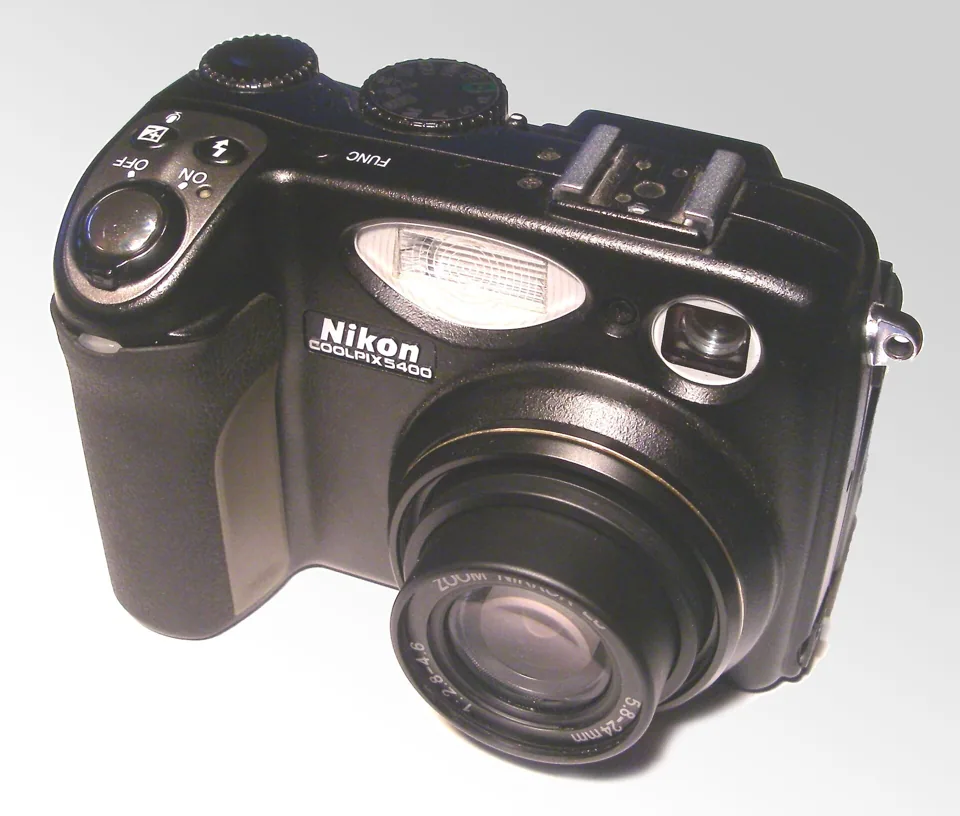

In May 2003 Nikon followed the Coolpix 5000 with a 5.1-megapixel camera whose 4x zoom still began at 28 mm, priced at $799.95. All three reviewers praised the lens and the macro mode; two of them also faulted it for stalling while it saved, for having no focus-assist lamp and for shipping without a RAW mode.
- Launched
- May 2003
- Launch price
- $799.95 US2
- Sensor
- 5.1 MP CCD
- Lens
- 28–116 mm, 4×
- Card
- CompactFlash Type I, CompactFlash Type II
- Battery
- EN-EL1
Nikon Coolpix 5400 specs: sensor, lens, battery, memory card and cable
Launched in May 2003 at $799.95, the Nikon Coolpix 5400 is a 5.1 MP CCD compact with a 28–116 mm (35 mm equivalent) 4× zoom lens. Inside: it takes CompactFlash Type I and CompactFlash Type II cards and runs on the EN-EL1 battery. Sources
- Sensor
- CCD, 1/1.8", 5.1 MP source
- Lens
- 28–116 mm equivalent, 4× zoom source
- Memory card
- CompactFlash Type I, CompactFlash Type II source
- Battery
- EN-EL1 source
- USB / A/V cable
- UC-E1, EG-E5000 Confirmed · all Nikon cables
Meet the camera
The first thing a 5400 hands you is its grip: deep, well shaped and wrapped in soft rubber, the best of the three 5-megapixel prosumer compacts DPReview set side by side that summer, with Canon's PowerShot G5 and Sony's DSC-V1.3 The body sat in the middle for size and weight. Nikon gives 108 by 73 by 69 millimetres and about 320 grams without battery and media;1 DPReview gives 380 grams with the battery in, and Imaging Resource the same with battery and card.34 The front is magnesium alloy and the back high-impact plastic, and DPReview judged the metal thicker than the G5's or the V1's.3 The DCRP found it very sturdy, apart from the plastic cover over the card slot.8
Nikon announced it on 28 May 2003 and placed it at the top of the Coolpix line,1 for sale that summer at a suggested $799.95.2 DPReview recorded a US street price of $799;3 Imaging Resource's data sheet agrees, and gives 31 August 2003 as the date available, though the header of its review prints an MSRP of $699, a figure we cannot reconcile.54
- Lens
- 4x Zoom-Nikkor, 5.8 to 24 mm, 28 to 116 mm equiv., f/2.8 to 4.61
- ISO
- 50, 100, 200, 400 and Auto1
- Screen
- 1.5", 134,000 dots, vari-angle, plus a zoom optical viewfinder1
- Shutter
- 1/4000 s to 8 s; Bulb or timed to 10 minutes in manual1
- Video
- 640 × 480 (Nikon notes vertical interpolation) at 15 fps for 70 s, or 320 × 240 at 15 fps for 180 s1
- Card and battery
- CompactFlash Type I or II, 16 MB card supplied · EN-EL1 Li-ion, about 110 minutes with the screen on by Nikon's figure1
- Launch price
- $799.95 US2
Why this one was interesting
A 28 mm start on a 4x zoom
Nikon's new lens ran 5.8 to 24 mm, with one extra-low-dispersion element and two aspherical ones among nine elements in eight groups.1 Imaging Resource called the wide end quite a bit wider than that of most prosumer digicams.4 The G5 started at 35 mm and the V1 at 34 mm, DPReview noted, though the Canon's lens was faster, f/2.0 to 3.0 against f/2.8 to 4.6.3 Distortion drew three readings at the wide end: one pixel of barrel distortion for Imaging Resource, which called it very low, 1.1 per cent for DPReview, which called that impressive at 28 mm, and “moderate” for the DCRP.438
A 5000 with the complaints answered
The 5400 was the Coolpix 5000's direct successor,3 and the reviewers who knew both kept score. DPReview said the 5000's habit of clipping highlights into harsh edges was gone and that purple fringing, a long Nikon weak spot, had almost vanished;3 the DCRP's Jeff Keller, no fan of the 5000, found exposure noticeably better.8 Some things went backwards: the screen shrank from 1.8 to 1.5 inches, though its dot count rose,8 and the small status display on top disappeared, which Imaging Resource missed.34
Three cameras, one summer, one price band
Three 5-megapixel 4x-zoom cameras arrived together at $799, $799 and $699, which DPReview called unusual and good for buyers.3 The G5 had the most detail and the sharpest lens, the V1 was faster, smaller and cheaper, and the Nikon had the least visible chromatic aberration; the $100 gap is why DPReview gave the 5400 only 8 out of 10 for value.3 Our page on the PowerShot G5, announced in June 2003, covers the rival.11
What was lost
There was no RAW mode. DPReview and the DCRP both reported that Nikon promised one by firmware update in early or spring 2004, as it had for the 5000 some months after that camera's release.38 DPReview thought shipping without it a mistake, and CNET, as excerpted by Photography Blog, wished for RAW too.39 There was no autofocus assist lamp, which Imaging Resource's announcement, DPReview and the DCRP each noted; the G5 and V1 had one.238 The DCRP also noted no live histogram in record mode, and DPReview listed the missing histogram on the post-shot review among its cons.83
The dark: its weak point
Imaging Resource and DPReview disagree about the dark. In Imaging Resource's low-light test the camera made clear, bright, usable pictures down to 1/16 foot-candle, about 0.67 lux, at all four ISO settings, with moderate noise at ISO 400 and only a few hot pixels in 60-second exposures.4 DPReview found the Night Landscape scene mode weak: it pushed sensitivity to ISO 200 and exposed for no more than two seconds, where manual mode allowed 8 seconds and the timed release one to ten minutes.3
Noise reduction cost detail. Imaging Resource said Nikon seemed to have raised it on every picture, not just long exposures, until some shadow detail was lost, and wondered whether a noisier sensor was the reason.4 DPReview saw more cyan colour noise as sensitivity rose.3 Focusing was the weaker half of the night story: DPReview's test found the camera unable to focus below about 65 lux at either end of the zoom, and the DCRP found low-light autofocus poor.38
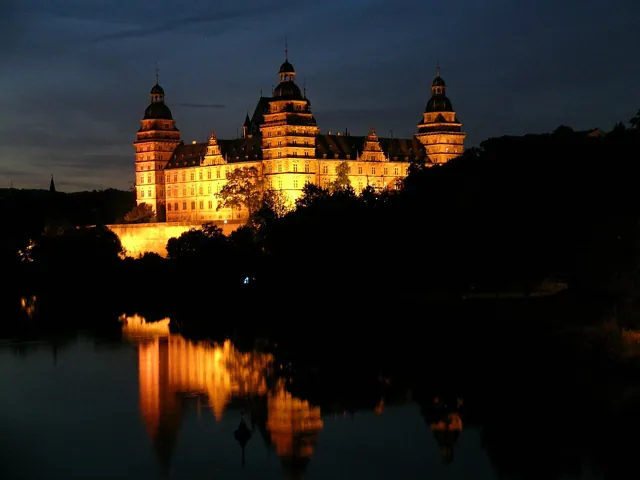

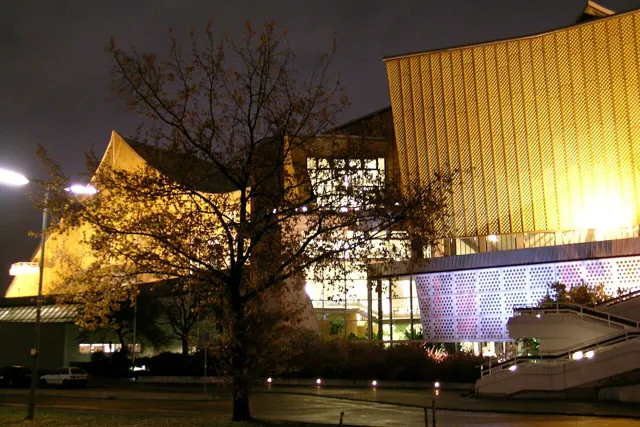



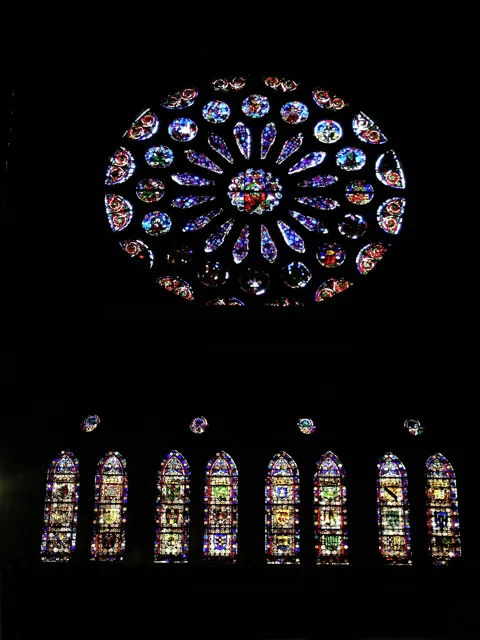

Real photographs taken with this camera. The sensitivity and exposure shown are recorded in each file's own EXIF data; the two ISO 400 frames are the camera's highest setting.
Like that look? See recent eBay sold listings for this camera ↗
On eBay right now
Live listings for this camera, supplied by eBay and updated automatically. We earn a commission if you buy through them.
The little wins
Best Shot Selector, and a new exposure version
Hold the shutter and the camera takes up to five frames and keeps the sharpest; Imaging Resource's tester routinely got sharp handheld shots at half a second this way.4 New here was AE-BSS, which Nikon described as picking the best-exposed of five frames by analysing tone, in highlight, shadow or histogram mode.1
How it drew the picture
Imaging Resource found colour pleasing and contrast a touch high; automatic white balance failed only under household incandescent light.4 On its resolution chart artifacts began near 800 lines per picture height, strong detail held to at least 1,200 and the patterns died out near 1,600; it also found details often soft in the left half of its pictures and wondered whether the sensor sat slightly cocked in its mount.4 DPReview measured about 1,400 lines horizontally and 1,250 vertically, saw some corner softness and judged pictures very slightly softer than other 5-megapixel cameras' without necessarily showing less detail.3 The DCRP called the photo quality excellent, with a soft look that in-camera sharpening or Photoshop would fix.8
The nine daylight photographs below run from the wide end of the zoom to near its long end; the focal length is each file's EXIF value, from 5.8 mm (28 mm equivalent) to 24 mm (116 mm). Commons held 4,201 files from this camera when we checked.10 We read the metadata of 4,077 (a title filter screened out the rest): 464 uploaders, five of whom supplied close to half, so the pool shows a few photographers' habits more than the camera's range.




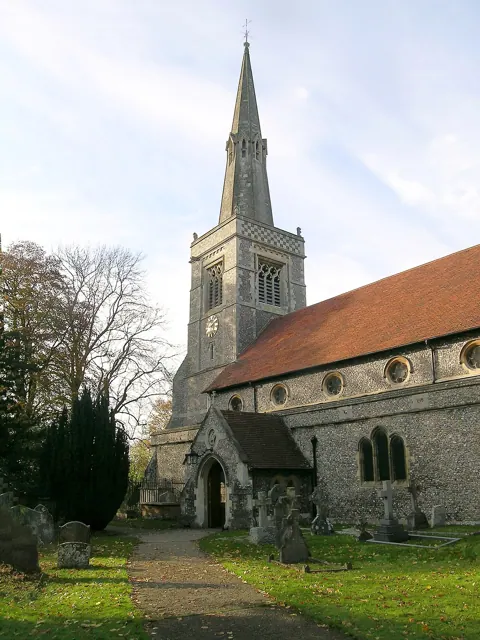













Photos taken with this camera, from Wikimedia Commons, credited under each picture.
Where it let you down
The save was the sore point. DPReview found that for the last two seconds or so of writing a JPEG the whole camera went deaf: no zoom, no menus, no settings, and ISO, image size and autofocus mode stayed locked while anything sat in the buffer; a press of the shutter in that window was remembered and acted on later.3 It timed 6.8 seconds to write a 2,400 KB Fine JPEG to a 256 MB card, about 352 KB per second, one of the slowest write speeds it had recently measured, and in Continuous Low a full flush took nearly three minutes after 17 frames.3 The DCRP reproduced it: 20 frames took about three minutes to reach a fast 512 MB card.8 Imaging Resource saw the same flush, 243 seconds after 29 frames, yet called the camera an excellent performer.4
The artificial shutter sound added a second trap. At the factory default it lengthened the pre-focused shutter lag: Imaging Resource measured 0.273 seconds with the sound on and 0.109 off, DPReview about 0.3 against 0.1, and both Imaging Resource and the DCRP credited DPReview's Phil Askey with spotting it.438 Autofocus was disputed: DPReview timed 0.9 to 1.2 seconds at wide angle and 1.0 to 2.0 at the long end, while Imaging Resource found it quicker at telephoto and on the fast side of average.34
The optical viewfinder drew three numbers: 77 per cent of the frame for DPReview, about 80 for the DCRP, and 92 at wide angle falling to 83 at telephoto for Imaging Resource, which put the screen at 97.384 On battery life Nikon said about 110 minutes with the screen on;1 DPReview's own test gave 3 hours 6 minutes and 315 shots, above average and about half an hour better than the 5000,3 and Imaging Resource a worst case of almost two hours.4
What the reviewers said
| Outlet | Date | Verdict |
|---|---|---|
| DCRP (Jeff Keller) | 25 Jun 2003, updated 15 Dec 2003 | A big step up from the 5000 and among the best full-featured 5-megapixel cameras, held back by the buffering and shutter-lag problems, slow menus, small screen and missing assist lamp and RAW. No score.8 |
| DPReview (Phil Askey) | 1 Jul 2003 | Recommended, a worthy successor to the 5000: construction 9, features 9, image quality 8, lens and sensor 8, ease of use 8, value 8; performance and the V1's price kept it from Highly Recommended.3 |
| Imaging Resource | 12 Jul 20037 | A Dave's Pick: exceptionally capable for enthusiasts and good for novices, despite contrasty images and over-aggressive noise reduction.46 |
| CNET (seen as an excerpt) | Excerpted 5 Dec 2003 | A clear improvement on the 5000 that should appeal mainly to enthusiasts; it wished for longer battery life and RAW.9 |
The timeline
- 28 May 2003Nikon announces the 5400 in Tokyo and the United States; the US price is $799.95.12
- 25 June 2003The DCRP posts its first review, later updated with a production camera.8
- 1 July 2003DPReview publishes its review.3
- 12 to 14 July 2003Photography Blog reports Imaging Resource's review on 12 July; Imaging Resource's own news item announcing the full review is dated 14 July.76
- Early or spring 2004The window Nikon gave reviewers for a RAW firmware update; we did not check whether it arrived.38
Should you buy one now?
Buy one if you want a robust CCD compact with a 28 mm wide end, a screen that turns to face the subject and timed exposures, and you will shoot patiently, mostly in good light. Skip it if you want a camera that answers the instant a burst ends. It launched at $799.95;2 what it sells for now is a question for the sold listings. Before you bid, check these:
- The name. The 5000 and 5700 have a similar form;2 as the photograph above shows, a 5400 has a Coolpix 5400 badge on the front and 5.8-24 mm on the lens barrel.
- The battery. It takes the EN-EL1, which DPReview listed at 680 mAh,3 and Nikon lists a 2CR5 lithium cell as an optional alternative.1 A fresh pack is on Amazon ↗; our Coolpix 995 page lists the same battery.11
- The card. It takes CompactFlash Type I or II and, Nikon says, 512 MB and 1 GB Microdrives,1 though the DCRP had had two Microdrives fail.8 See our CompactFlash guide.
- The cable. Nikon's accessory list names a UC-E1 USB cable, and DPReview lists USB 1.1;13 see our Nikon cable pages.
- The doors and hinge. The DCRP called the plastic card-slot door flimsy;8 check that it shuts, that the screen swivels smoothly and that the lens extends and retracts cleanly.
If you are wondering why cameras like this are being hunted down again, we tell that story once, in Pictures that never left the card; for the vocabulary, see our glossary. The DCRP also pointed readers to the Olympus C-5050 Zoom, which has its own page here.8
See recent sold prices on eBay ↗Shop on eBay ↗EN-EL1 battery ↗
Sources
- Nikon Corporation (Tokyo), Nikon COOLPIX 5400, news release and specification table, 28 May 2003 (archived copy of nikon.com)
- Imaging Resource, “Nikon announces Coolpix 5400 digital camera” by Mike Tomkins (28 May 2003), with the text of Nikon Inc.'s US press release
- DPReview, Nikon Coolpix 5400 review by Phil Askey (1 July 2003; all 18 sub-pages read)
- Imaging Resource, Nikon Coolpix 5400 review, print-friendly version (no byline; the header prints “Review First Posted: 07/12/2003” and an MSRP of $699)
- Imaging Resource, Nikon Coolpix 5400 data sheet (retail price $799.00, date available 2003-08-31)
- Imaging Resource news, “Full review posted for Nikon Coolpix 5400!” by Dave Etchells (Monday, 14 July 2003)
- Photography Blog, “Imaging Resource Review Nikon Coolpix 5400” by Mark Goldstein (12 July 2003)
- The Digital Camera Resource Page (DCRP), Nikon Coolpix 5400 review by Jeff Keller (posted 25 June 2003, last updated 15 December 2003; archived copy of 29 December 2004)
- Photography Blog, “CNET Reviews Nikon Coolpix 5400” by Mark Goldstein (5 December 2003): a short post quoting CNET's verdict; we could not read CNET's own page
- Wikimedia Commons, Category: Taken with Nikon Coolpix 5400 (4,201 files when we checked on 27 Oct 2026)
- Digicam Atlas, our own Canon PowerShot G5 and Nikon Coolpix 995 retrospectives (their data files cite the reviews listed there)
The camera photograph is by Devon Fyson (CC BY-SA 3.0), who notes on Commons that it was touched up in Photoshop; sample photographs are credited under each one, all via Wikimedia Commons. Links to eBay and Amazon are affiliate links.